

13 March 2026
Weekly Market View
Release of oil reserves is a good start
The global impact of the Middle East conflict continues to be felt through the oil market channel. Oil prices remain close to USD 100/bbl as the Strait of Hormuz remains virtually non-navigable.
We continue to see a 70% chance that the conflict will ease within 4-6 weeks. The release of strategic oil reserves by Developed Markets is a positive stop-gap measure as it should partly offset the lost supplies from the Middle East. Release of more reserves is likely needed to mitigate the economic and market impact of the conflict.
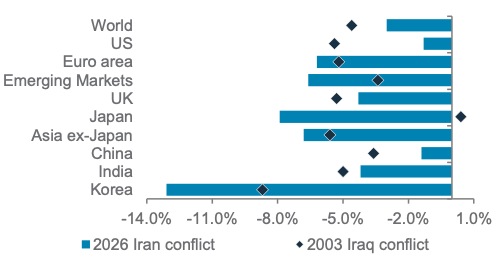
While we see elevated near-term risks, we remain constructive on equities over 6-12 months. Our preferred technology sector in the US and China has displayed defensive properties since the conflict escalated.
We would continue to add gold on dips given its role as a structural hedge against geopolitical risks and seek inflation protection through US inflation-linked bonds.
Hang Seng Tech index – expectations of strong revenue growth
Bullish US inflation-protected bonds – hedge against rising oil price-driven inflation
Bullish AUD and gold – benefit from higher commodity prices and elevated geopolitical risk
Charts of the week: Oil prices to ease in months?
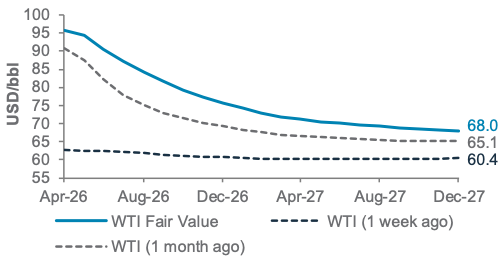
Markets are pricing less than USD 90/bbl oil by July; US and China equities have been more resilient in this conflict
US WTI crude futures price curve; today, last week, last month
First 10-day performance of equities in 2026 and 2003 conflicts
Source: Bloomberg, Standard Chartered
Editorial
Release of oil reserves is a good start
Strategy summary: The global impact of the Middle East conflict continues to be felt through the oil market channel. Oil prices remain close to USD 100/bbl as the Strait of Hormuz, through which almost a fifth of global oil and gas supplies pass, remains virtually non-navigable. We continue to see a 70% chance that the conflict will ease within 4-6 weeks. The release of strategic oil reserves by Developed Markets is a positive stop-gap measure as it should partly offset the lost supplies from the Middle East. Release of more reserves is likely needed to mitigate the economic and market impact of the conflict.
While we see elevated near-term risks, we remain constructive on equities over 6-12 months. Our preferred technology sector in the US and China has displayed defensive properties since the conflict escalated. We would continue to add gold on dips given its role as a structural hedge against geopolitical risks and seek inflation protection through US inflation-linked bonds.
Reserves release positive first step: This week’s decision by the International Energy Agency members (mostly Developed Market economies) to release a record 400 million barrels out of their estimated 1.2bn barrels of official oil stockpiles is a good first step to mitigate the impact on economies. There’s another 600mn of reserves held by the oil industry in these economies under government rules. The IEA release far exceeds the 182mn barrels released after the Ukraine conflict escalated in 2022. Nevertheless, the measures failed to calm oil markets, with oil prices staying above USD 90/bbl. Release of more reserves likely needed to bring down oil prices. The amount released so far is seen as insufficient, given the supply cutoff from the Gulf producers and that it takes weeks for the reserves released to reach markets. The 400mn barrels released equals roughly 3-4 weeks of the oil supplies from the Gulf economies which are being lost due to the Hormuz strait shutdown (the daily loss is estimated at 11-16mn barrels). Moreover, almost 10% of the global oil output of roughly 100mn barrels per day have been lost since the conflict
started as Gulf producers deepened production cuts as storage tanks fill up. Given this, the market remains very focused on how soon the Hormuz strait becomes navigable again.
We continue to see a 70% chance the conflict will last 4-6 weeks. This is based on the following assumptions: a) US President Trump does not want a prolonged conflict ahead of the mid-term elections in November and will use all means (military, insurance coverage, etc.) to restart shipping through the Hormuz strait; b) Iran’s military capabilities are reportedly severely depleted; and c) China does not want a prolonged conflict due to its dependence on Middle East oil. Given these factors, we expect the current geopolitical risk premium in oil prices to fade in the coming months. This view is also reflected in crude oil futures markets, which indicate oil prices dropping back to more manageable levels in a few months.
Risk of inflation impact lasting longer, delaying Fed rate cuts. Even if the conflict ends in 4-6 weeks, inflation is likely to rise in the coming months, especially in the US where inflation was elevated before the conflict started (February core inflation came in at 2.5% y/y). Given this, the Fed is likely to keep policy on hold next week and through H1. Thus, bond yields face upside pressure in the near term. Hence, we believe it would be prudent to wait for better levels to average into high quality US bonds. We prefer US inflation-protected bonds instead. We expect the Fed to cut rates eventually in H2, though, to support a weak job market (payrolls contracted again in February)
Remain positive on China, US tech sector: Global tech sector equities have displayed defensive properties over the past week, outperforming most asset classes over the past week, despite the global risk-off sentiment. We expect this pattern to continue, with solid Q4 2025 earnings reports expected from China’s tech sector leaders next week. China’s 15th Five-Year Plan signalled “AI Plus” and technological self-reliance as a key strategy. The Hang Seng technology index is our preferred route to gain exposure to the AI boom in China. We believe the index has significant valuation rerating potential.
— Rajat Bhattacharya
The weekly macro balance sheet
Our weekly net assessment: On balance, we see the past week’s data and policy as negative for risk assets in the near-term
(+) factors: China’s easing deflation and robust export growth
(-) factors: Falling US job creation; hawkish central banks; elevated geopolitical tensions

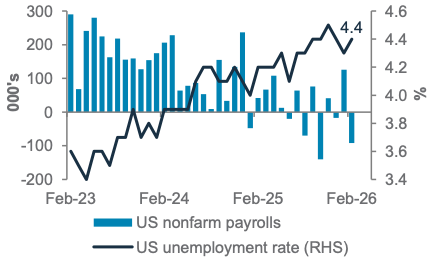
US non-farm payrolls fell 92,000 in February, defying expectations of growth and marking a significant labour market slowdown
US non-farm payrolls and unemployment rate
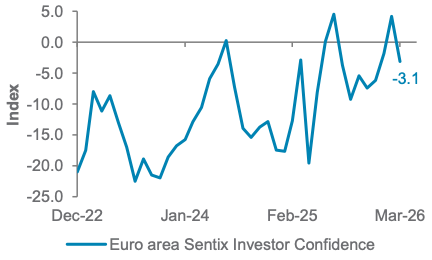
Euro area investor confidence fell in March, the first negative reading in five months and signalling a downturn in economic expectations
Euro area Sentix investor confidence
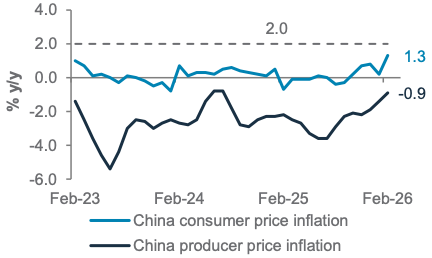
China’s consumer price inflation rose to the highest level in over three years in February along with easing producer deflation
China consumer and producer price inflation
Top client questions
What is your outlook for oil prices following the latest release of International Energy Agency (IEA) oil reserves?
Our view: We expect the current geopolitical premium in oil prices to fade gradually, as the IEA’s emergency oil reserve release and easing geopolitical tensions should allay supply-related fears.
Rationale: Crude oil prices once again approached USD 100/bbl after Iran’s new supreme leader Mojtaba Khamenei threatened a prolonged Strait of Hormuz closure. However, the IEA’s decision to release a record 400mn barrels of strategic oil reserves remains a positive step towards calming concerns regarding near-term oil supply disruptions.
We still see a 70% probability of the conflict ending within a few weeks. While the geopolitical risk premium is likely to remain elevated in the near term due to the Strait of Hormuz transit disruptions, it should eventually give way to the underlying supply overhang. With the futures curve currently in ‘backwardation’ – where near-term oil prices trade above longer-dated contracts – prices could face downward pressure over time.
We prefer holding US Treasury Inflation-protected Securities (TIPS) as a hedge against potential inflationary pressures stemming from the energy market volatility.
— Anthony Naab, CFA, Investment Strategist
The recent oil spike above key technical levels highlights the extent of the geopolitics-driven rally
WTI crude oil and technicals
With the US 10-year government bond yield rising, is there an opportunity to add? Or should investors wait?
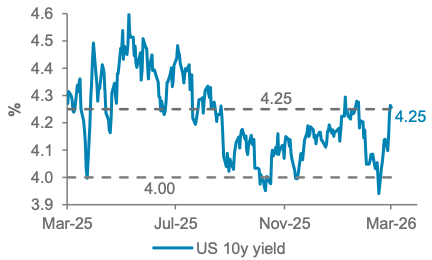
Our view: We believe investors will have an opportunity to add exposure when the US 10-year government bond yield is above 4.25% – above our expected three-month range (4-4.25%).
Rationale: The 10-year US government bond yield has climbed to above 4.25%, from below 4%, after oil prices spiked following the Middle East conflict-related disruptions. Our base case assumes the conflict will last a few weeks, sustaining oil price volatility and causing fluctuations in inflation expectations and bond yields in the near term.
February’s US non-farm payrolls disappointed (-92,000 jobs), with job creation remaining significantly slower since 2025. Despite higher inflation expectations, we anticipate the Fed will cut rates as the labour market weakens further. Investors should scale in if yields exceed 4.25%, provided the conflict does not escalate materially and prolong oil supply disruptions beyond our base case. US inflation-protected bonds remain a time-tested hedge against any upside inflation risks in the coming months.
— Ray Heung, Senior Investment Strategist
US 10-year government bond yield has reached the upper bound of our near-term range
US 10-year government bond yield and our expected three-month range
Top client questions (cont’d)
As oil prices pull back, are energy equities still a viable hedge against the risk of higher oil prices?
Our view: While higher oil prices might support the energy sector in the near term, the risk-reward around increasing exposure to energy sector equities has become less attractive.
Rationale: The energy sector still offers a near-term hedge against elevated oil prices. Upstream oil and gas producers are likely to outperform downstream refiners and petrochemical companies that cannot pass on higher input costs. However, our base-case scenario assumes the Middle East conflict will be relatively short-lived. If a ceasefire occurs and the Strait of Hormuz reopens over the next 4-6 weeks, we expect WTI oil prices to retreat towards USD 60/bbl, capping further upside for energy sector equities.
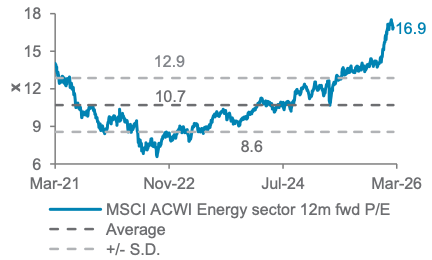
The MSCI ACWI Energy Index has significantly outperformed the global equity market year-to-date (+25.8% vs. -0.4%) and has reached overbought territory, with sector valuations now over 2 standard deviations above their five-year average. Our technical indicators point to a rising reversal risk for the US, Europe and China energy sectors following this rally. While the Strait of Hormuz is largely closed, global oil supply is not structurally scarce amid large production capacity and petroleum reserves globally. This raises the risk of a significant pullback in the oil prices and energy equities if geopolitical tensions de-escalate.
— Michelle Kam, CFA, Investment Strategist
Global energy sector equities are expensive after their recent rally
12-month forward P/E for MSCI ACWI Energy equities sector index
Major Chinese internet firms are reporting earnings next week. What are your expectations?
Our view: We expect major Chinese internet companies’ revenue growth to remain robust, supporting our positive outlook on the Hang Seng Technology Index (HSTECH).
Rationale: Major Chinese internet companies will announce their Q4 2025 results in the coming weeks. We expect their top-line growth to remain solid, underpinned by expanding cloud, AI, international e-commerce, etc. Profitability will be closely watched, given increasing AI investment and intense competition. For HSTECH, consensus estimates indicate revenue growth of 11%/13% and earnings growth of 4.3%/7.5% in 2025/2026, respectively.
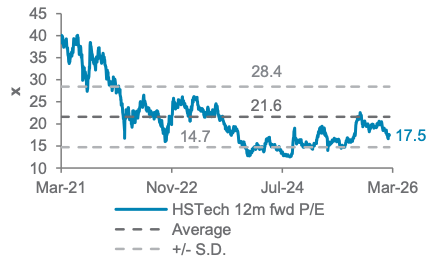
Policy support remains strong, with China’s 15th Five-year Plan emphasising ‘AI Plus’ and technological self-reliance. We expect the rising adoption of AI agents to boost demand for cloud services. Our preferred route for gaining exposure to China’s AI boom is HSTECH, which has significant valuation re-rating potential. Amid last week’s risk-off market sentiment, we saw outperformance by major US and Chinese tech companies. We expect this trend to continue, with reassuring earnings reports from major Chinese internet firms.
— Jason Wong, Equity Analyst
The Hang Seng tech index has significant re-rating potential, with upcoming earnings reports from China’s internet companies being a key catalyst
12-month forward P/E for Hang Seng Technology Index
Top client questions (cont’d)
Given the recent geopolitical events, is the USD’s rebound likely to persist? How can investors rebalance their foreign exchange (FX) exposure?
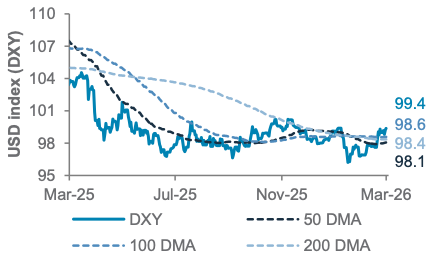
Our view: The USD Index (DXY) is expected to consolidate near the 100 resistance level. We see an opportunity for investors to diversify their FX exposure by adding Australian Dollar (AUD) and gold.
Rationale: We believe the sustainability of USD appreciation will depend on the persistence of geopolitical risks and the Fed’s monetary policy trajectory. If Middle East tensions remain elevated, the resulting oil price surge could add to inflation risks and prompt the Fed to signal fewer or delayed rate cuts. Therefore, we see the DXY consolidating near the 100 resistance level in the near term. A conflict resolution would likely weigh on the USD. Diversification remains essential for investors. It is prudent to increase allocations to currencies with robust fundamentals and a lower correlation with the DXY, such as the AUD (given the Reserve Bank of Australia’s [RBA’s] hawkish stance). AUD/USD continues to show positive momentum. Gold (XAU) also remains an attractive option. Although XAU/USD has experienced a slight retreat, further downside would require an exceptionally hawkish Fed, which is not our base case. Therefore, adding exposure on dips can serve as a natural hedge against heightened geopolitical and inflationary risks.
— Iris Yuen, Investment Strategist
The USD index is likely to rebound towards 100
DXY Index and technicals
Market performance summary*
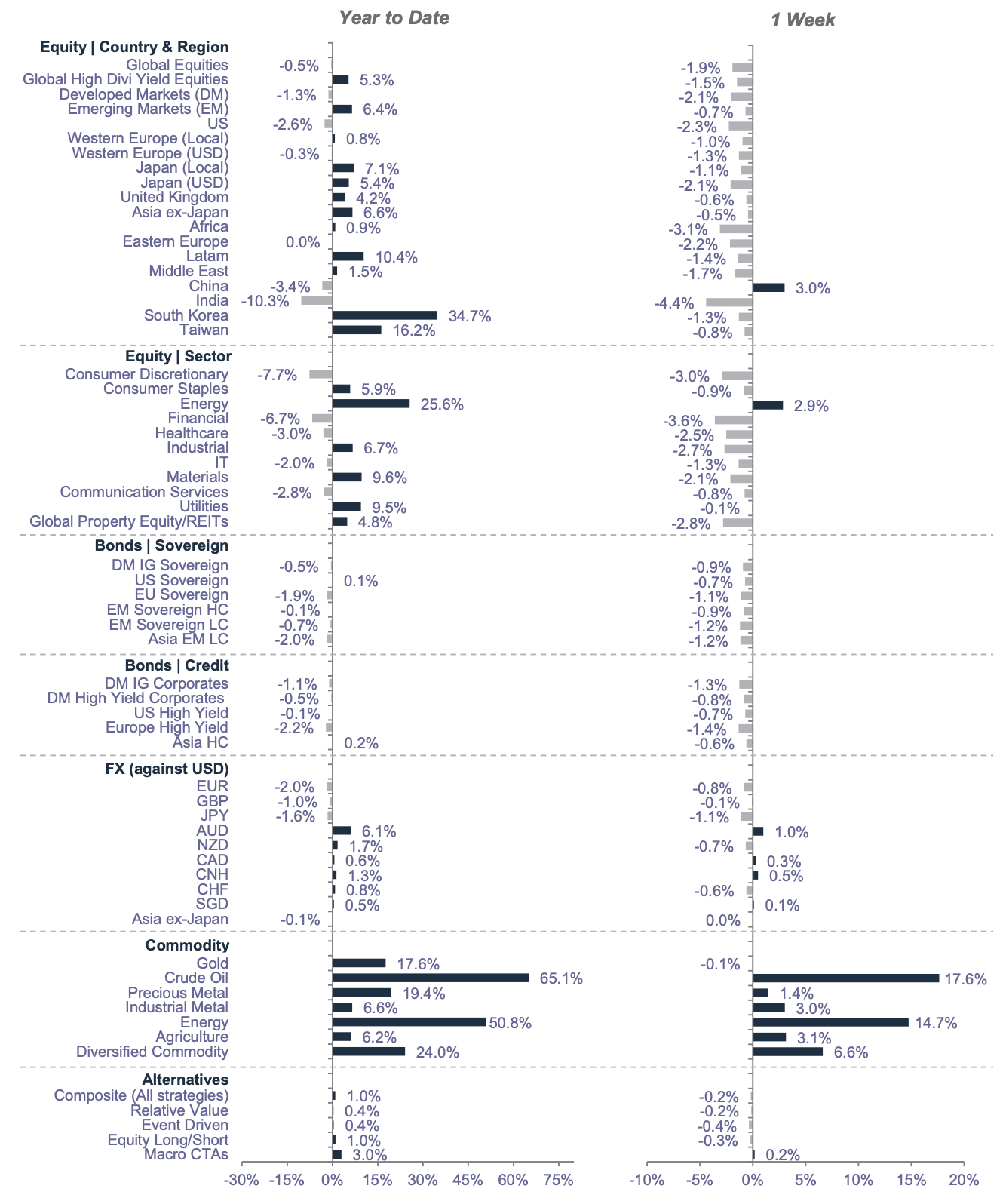
*Performance in USD terms unless otherwise stated, 2026 YTD performance from 31 December 2025 to 12 March 2026; 1-week period: 5 March 2026 to 12 March 2026
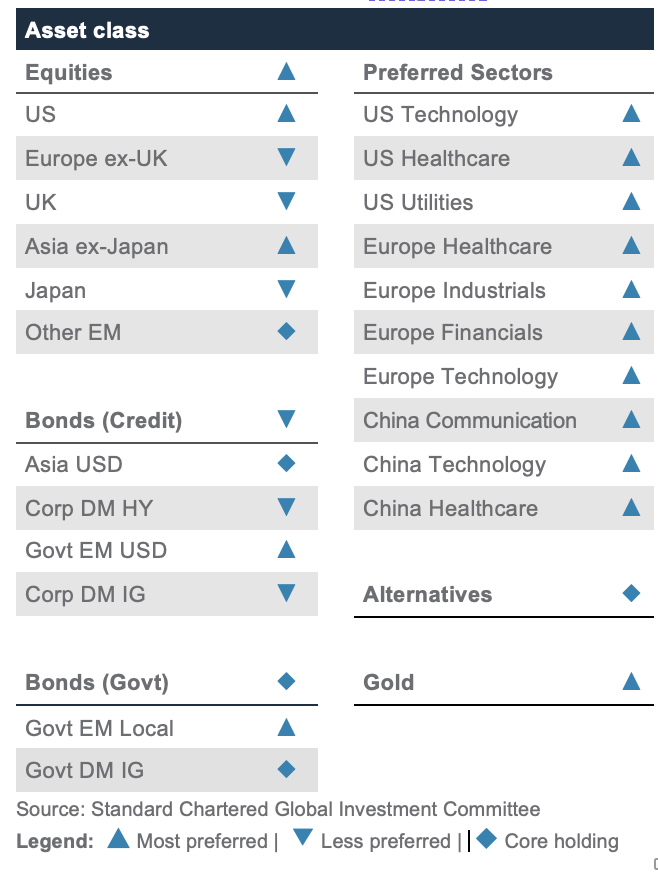
Our 12-month asset class views at a glance
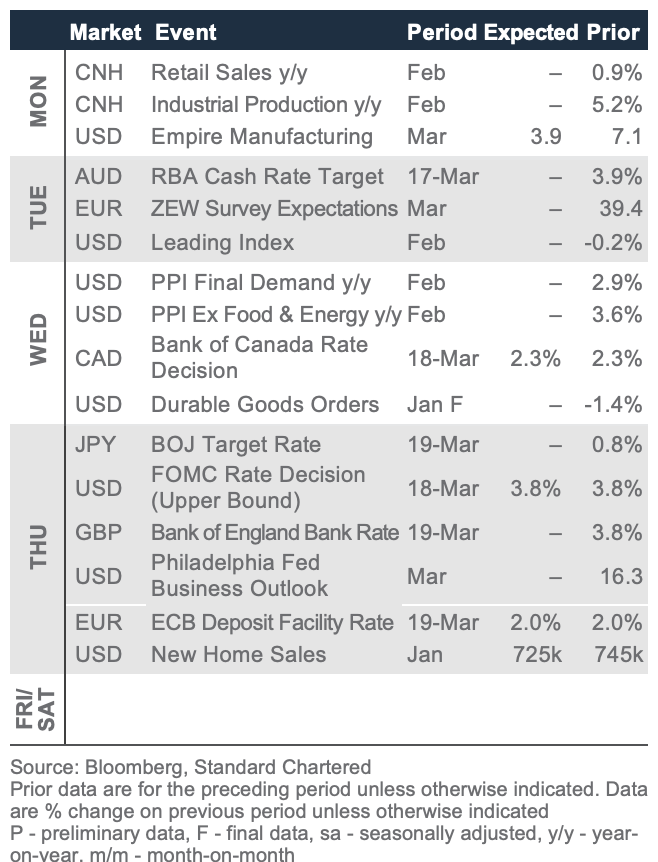
Economic and market calendar
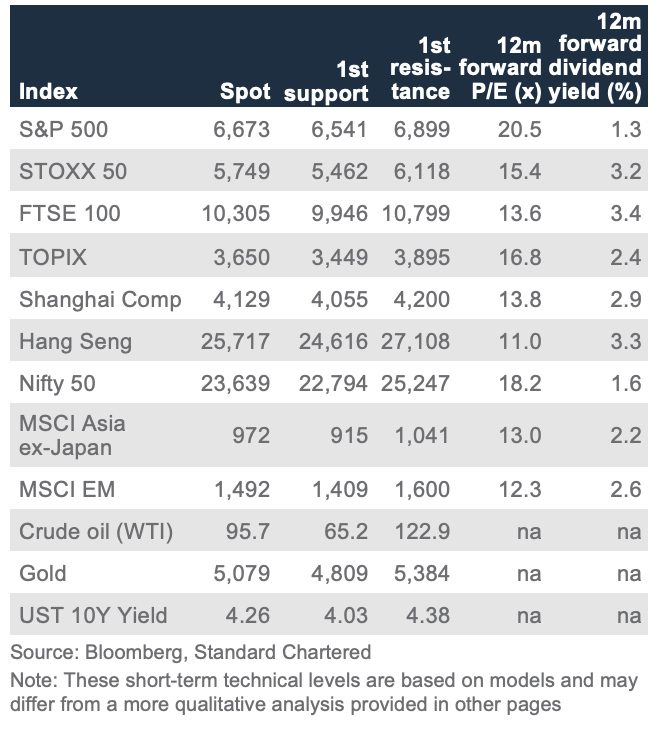
The S&P500 has next interim resistance at 6,899
Technical indicators for key markets as of 12 Mar close
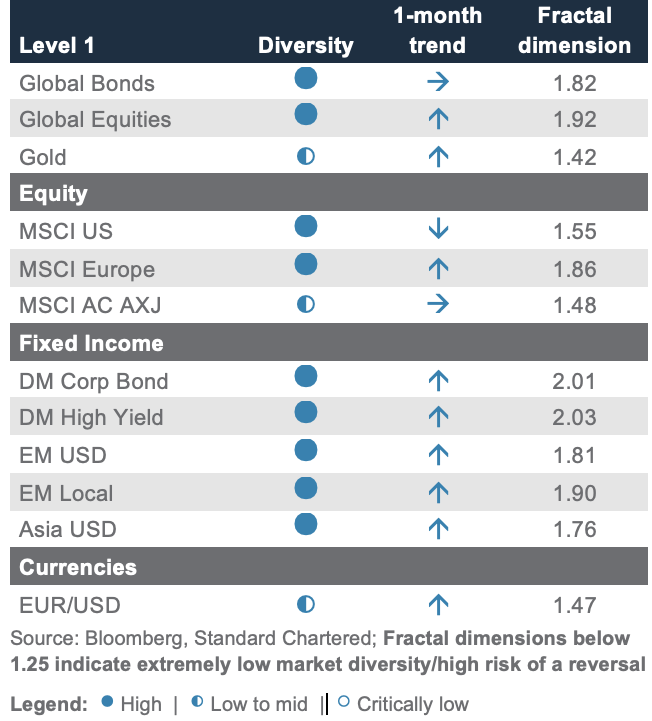
Investor diversity has normalised across asset classes
Our proprietary market diversity indicators as of 12 Mar close
Disclosure
This document is confidential and may also be privileged. If you are not the intended recipient, please destroy all copies and notify the sender immediately. This document is being distributed for general information only and is subject to the relevant disclaimers available at our Standard Chartered website under Regulatory disclosures. It is not and does not constitute research material, independent research, an offer, recommendation or solicitation to enter into any transaction or adopt any hedging, trading or investment strategy, in relation to any securities or other financial instruments. This document is for general evaluation only. It does not take into account the specific investment objectives, financial situation or particular needs of any particular person or class of persons and it has not been prepared for any particular person or class of persons. You should not rely on any contents of this document in making any investment decisions. Before making any investment, you should carefully read the relevant offering documents and seek independent legal, tax and regulatory advice. In particular, we recommend you to seek advice regarding the suitability of the investment product, taking into account your specific investment objectives, financial situation or particular needs, before you make a commitment to purchase the investment product. Opinions, projections and estimates are solely those of SC at the date of this document and subject to change without notice. Past performance is not indicative of future results and no representation or warranty is made regarding future performance. The value of investments, and the income from them, can go down as well as up, and you may not recover the amount of your original investment. You are not certain to make a profit and may lose money. Any forecast contained herein as to likely future movements in rates or prices or likely future events or occurrences constitutes an opinion only and is not indicative of actual future movements in rates or prices or actual future events or occurrences (as the case may be). This document must not be forwarded or otherwise made available to any other person without the express written consent of the Standard Chartered Group (as defined below). Standard Chartered Bank is incorporated in England with limited liability by Royal Charter 1853 Reference Number ZC18. The Principal Office of the Company is situated in England at 1 Basinghall Avenue, London, EC2V 5DD. Standard Chartered Bank is authorised by the Prudential Regulation Authority and regulated by the Financial Conduct Authority and Prudential Regulation Authority. Standard Chartered PLC, the ultimate parent company of Standard Chartered Bank, together with its subsidiaries and affiliates (including each branch or representative office), form the Standard Chartered Group. Standard Chartered Private Bank is the private banking division of Standard Chartered. Private banking activities may be carried out internationally by different legal entities and affiliates within the Standard Chartered Group (each an “SC Group Entity”) according to local regulatory requirements. Not all products and services are provided by all branches, subsidiaries and affiliates within the Standard Chartered Group. Some of the SC Group Entities only act as representatives of Standard Chartered Private Bank and may not be able to offer products and services or offer advice to clients.
Copyright © 2026, Accounting Research & Analytics, LLC d/b/a CFRA (and its affiliates, as applicable). Reproduction of content provided by CFRA in any form is prohibited except with the prior written permission of CFRA. CFRA content is not investment advice and a reference to or observation concerning a security or investment provided in the CFRA SERVICES is not a recommendation to buy, sell or hold such investment or security or make any other investment decisions. The CFRA content contains opinions of CFRA based upon publicly-available information that CFRA believes to be reliable and the opinions are subject to change without notice. This analysis has not been submitted to, nor received approval from, the United States Securities and Exchange Commission or any other regulatory body. While CFRA exercised due care in compiling this analysis, CFRA, ITS THIRD-PARTY SUPPLIERS, AND ALL RELATED ENTITIES SPECIFICALLY DISCLAIM ALL WARRANTIES, EXPRESS OR IMPLIED, INCLUDING, BUT NOT LIMITED TO, ANY WARRANTIES OF MERCHANTABILITY OR FITNESS FOR A PARTICULAR PURPOSE OR USE, to the full extent permitted by law, regarding the accuracy, completeness, or usefulness of this information and assumes no liability with respect to the consequences of relying on this information for investment or other purposes. No content provided by CFRA (including ratings, credit-related analyses and data, valuations, model, software or other application or output therefrom) or any part thereof may be modified, reverse engineered, reproduced or distributed in any form by any means, or stored in a database or retrieval system, without the prior written permission of CFRA, and such content shall not be used for any unlawful or unauthorized purposes. CFRA and any third-party providers, as well as their directors, officers, shareholders, employees or agents do not guarantee the accuracy, completeness, timeliness or availability of such content. In no event shall CFRA, its affiliates, or their third-party suppliers be liable for any direct, indirect, special, or consequential damages, costs, expenses, legal fees, or losses (including lost income or lost profit and opportunity costs) in connection with a subscriber’s, subscriber’s customer’s, or other’s use of CFRA’s content.
Market Abuse Regulation (MAR) Disclaimer
Banking activities may be carried out internationally by different branches, subsidiaries and affiliates within the Standard Chartered Group according to local regulatory requirements. Opinions may contain outright “buy”, “sell”, “hold” or other opinions. The time horizon of this opinion is dependent on prevailing market conditions and there is no planned frequency for updates to the opinion. This opinion is not independent of Standard Chartered Group’s trading strategies or positions. Standard Chartered Group and/or its affiliates or its respective officers, directors, employee benefit programmes or employees, including persons involved in the preparation or issuance of this document may at any time, to the extent permitted by applicable law and/or regulation, be long or short any securities or financial instruments referred to in this document or have material interest in any such securities or related investments. Therefore, it is possible, and you should assume, that Standard Chartered Group has a material interest in one or more of the financial instruments mentioned herein. Please refer to our Standard Chartered website under Regulatory disclosures for more detailed disclosures, including past opinions/ recommendations in the last 12 months and conflict of interests, as well as disclaimers. A covering strategist may have a financial interest in the debt or equity securities of this company/issuer. All covering strategist are licensed to provide investment recommendations under Monetary Authority of Singapore or Hong Kong Monetary Authority. This document must not be forwarded or otherwise made available to any other person without the express written consent of Standard Chartered Group.
Sustainable Investments
Any ESG data used or referred to has been provided by Morningstar, Sustainalytics, MSCI or Bloomberg. Refer to 1) Morningstar website under Sustainable Investing, 2) Sustainalytics website under ESG Risk Ratings, 3) MCSI website under ESG Business Involvement Screening Research and 4) Bloomberg green, social & sustainability bonds guide for more information. The ESG data is as at the date of publication based on data provided, is for informational purpose only and is not warranted to be complete, timely, accurate or suitable for a particular purpose, and it may be subject to change. Sustainable Investments (SI): This refers to funds that have been classified as ‘ESG Intentional Investments – Overall’ by Morningstar. SI funds have explicitly stated in their prospectus and regulatory filings that they either incorporate ESG factors into the investment process or have a thematic focus on the environment, gender diversity, low carbon, renewable energy, water or community development. For equity, it refers to shares/stocks issued by companies with Sustainalytics ESG Risk Rating of Low/Negligible. For bonds, it refers to debt instruments issued by issuers with Sustainalytics ESG Risk Rating of Low/Negligible, and/or those being certified green, social, sustainable bonds by Bloomberg. For structured products, it refers to products that are issued by any issuer who has a Sustainable Finance framework that aligns with Standard Chartered’s Green and Sustainable Product Framework, with underlying assets that are part of the Sustainable Investment universe or separately approved by Standard Chartered’s Sustainable Finance Governance Committee. Sustainalytics ESG risk ratings shown are factual and are not an indicator that the product is classified or marketed as “green”, “sustainable” or similar under any particular classification system or framework.
Country/Market Specific Disclosures
Bahrain: This document is being distributed in Bahrain by Standard Chartered Bank, Bahrain Branch, having its address at P.O. 29, Manama, Kingdom of Bahrain, is a branch of Standard Chartered Bank and is licensed by the Central Bank of Bahrain as a conventional retail bank. Botswana: This document is being distributed in Botswana by, and is attributable to, Standard Chartered Bank Botswana Limited which is a financial institution licensed under the Section 6 of the Banking Act CAP 46.04 and is listed in the Botswana Stock Exchange. Brunei Darussalam: This document is being distributed in Brunei Darussalam by, and is attributable to, Standard Chartered Bank (Brunei Branch) | Registration Number RFC/61 and Standard Chartered Securities (B) Sdn Bhd | Registration Number RC20001003. Standard Chartered Bank is incorporated in England with limited liability by Royal Charter 1853 Reference Number ZC18. Standard Chartered Securities (B) Sdn Bhd is a limited liability company registered with the Registry of Companies with Registration Number RC20001003 and licensed by Brunei Darussalam Central Bank as a Capital Markets Service License Holder with License Number BDCB/R/CMU/S3-CL and it is authorised to conduct Islamic investment business through an Islamic window. China Mainland: This document is being distributed in China by, and is attributable to, Standard Chartered Bank (China) Limited which is mainly regulated by National Financial Regulatory Administration (NFRA), State Administration of Foreign Exchange (SAFE), and People’s Bank of China (PBOC). Hong Kong: In Hong Kong, this document, except for any portion advising on or facilitating any decision on futures contracts trading, is distributed by Standard Chartered Bank (Hong Kong) Limited (“SCBHK”), a subsidiary of Standard Chartered PLC. SCBHK has its registered address at 32/F, Standard Chartered Bank Building, 4-4A Des Voeux Road Central, Hong Kong and is regulated by the Hong Kong Monetary Authority and registered with the Securities and Futures Commission (“SFC”) to carry on Type 1 (dealing in securities), Type 4 (advising on securities), Type 6 (advising on corporate finance) and Type 9 (asset management) regulated activity under the Securities and Futures Ordinance (Cap. 571) (“SFO”) (CE No. AJI614). The contents of this document have not been reviewed by any regulatory authority in Hong Kong and you are advised to exercise caution in relation to any offer set out herein. If you are in doubt about any of the contents of this document, you should obtain independent professional advice. Any product named herein may not be offered or sold in Hong Kong by means of any document at any time other than to “professional investors” as defined in the SFO and any rules made under that ordinance. In addition, this document may not be issued or possessed for the purposes of issue, whether in Hong Kong or elsewhere, and any interests may not be disposed of, to any person unless such person is outside Hong Kong or is a “professional investor” as defined in the SFO and any rules made under that ordinance, or as otherwise may be permitted by that ordinance. In Hong Kong, Standard Chartered Private Bank is the private banking division of SCBHK, a subsidiary of Standard Chartered PLC. Ghana: Standard Chartered Bank Ghana Limited accepts no liability and will not be liable for any loss or damage arising directly or indirectly (including special, incidental or consequential loss or damage) from your use of these documents. Past performance is not indicative of future results and no representation or warranty is made regarding future performance. You should seek advice from a financial adviser on the suitability of an investment for you, taking into account these factors before making a commitment to invest in an investment. To unsubscribe from receiving further updates, please send an email to feedback.ghana@sc.com. Please do not reply to this email. Call our Priority Banking on 0302610750 for any questions or service queries. You are advised not to send any confidential and/or important information to Standard Chartered via e-mail, as Standard Chartered makes no representations or warranties as to the security or accuracy of any information transmitted via e-mail. Standard Chartered shall not be responsible for any loss or damage suffered by you arising from your decision to use e-mail to communicate with the Bank. India: This document is being distributed in India by Standard Chartered in its capacity as a distributor of mutual funds and referrer of any other third party financial products. Standard Chartered does not offer any ‘Investment Advice’ as defined in the Securities and Exchange Board of India (Investment Advisers) Regulations, 2013 or otherwise. Services/products related securities business offered by Standard Charted are not intended for any person, who is a resident of any jurisdiction, the laws of which imposes prohibition on soliciting the securities business in that jurisdiction without going through the registration requirements and/or prohibit the use of any information contained in this document. Indonesia: This document is being distributed in Indonesia by Standard Chartered Bank, Indonesia branch, which is a financial institution licensed and supervised by Otoritas Jasa Keuangan (Financial Service Authority) and Bank Indonesia. Jersey: In Jersey, Standard Chartered Private Bank is the Registered Business Name of the Jersey Branch of Standard Chartered Bank. The Jersey Branch of Standard Chartered Bank is regulated by the Jersey Financial Services Commission. Copies of the latest audited accounts of Standard Chartered Bank are available from its principal place of business in Jersey: PO Box 80, 15 Castle Street, St Helier, Jersey JE4 8PT. Standard Chartered Bank is incorporated in England with limited liability by Royal Charter in 1853 Reference Number ZC 18. The Principal Office of the Company is situated in England at 1 Basinghall Avenue, London, EC2V 5DD. Standard Chartered Bank is authorised by the Prudential Regulation Authority and regulated by the Financial Conduct Authority and Prudential Regulation Authority. The Jersey Branch of Standard Chartered Bank is also an authorised financial services provider under license number 44946 issued by the Financial Sector Conduct Authority of the Republic of South Africa. Jersey is not part of the United Kingdom and all business transacted with Standard Chartered Bank, Jersey Branch and other SC Group Entity outside of the United Kingdom, are not subject to some or any of the investor protection and compensation schemes available under United Kingdom law. Kenya: This document is being distributed in Kenya by and is attributable to Standard Chartered Bank Kenya Limited. Investment Products and Services are distributed by Standard Chartered Investment Services Limited, a wholly owned subsidiary of Standard Chartered Bank Kenya Limited that is licensed by the Capital Markets Authority in Kenya, as a Fund Manager. Standard Chartered Bank Kenya Limited is regulated by the Central Bank of Kenya. Malaysia: This document is being distributed in Malaysia by Standard Chartered Bank Malaysia Berhad (“SCBMB”). Recipients in Malaysia should contact SCBMB in relation to any matters arising from, or in connection with, this document. This document has not been reviewed by the Securities Commission Malaysia. The product lodgement, registration, submission or approval by the Securities Commission of Malaysia does not amount to nor indicate recommendation or endorsement of the product, service or promotional activity. Investment products are not deposits and are not obligations of, not guaranteed by, and not protected by SCBMB or any of the affiliates or subsidiaries, or by Perbadanan Insurans Deposit Malaysia, any government or insurance agency. Investment products are subject to investment risks, including the possible loss of the principal amount invested. SCBMB expressly disclaim any liability and responsibility for any loss arising directly or indirectly (including special, incidental or consequential loss or damage) arising from the financial losses of the Investment Products due to market condition. Nigeria: This document is being distributed in Nigeria by Standard Chartered Bank Nigeria Limited (SCB Nigeria), a bank duly licensed and regulated by the Central Bank of Nigeria. SCB Nigeria accepts no liability for any loss or damage arising directly or indirectly (including special, incidental or consequential loss or damage) from your use of these documents. You should seek advice from a financial adviser on the suitability of an investment for you, taking into account these factors before making a commitment to invest in an investment. To unsubscribe from receiving further updates, please send an email to clientcare.ng@sc.com requesting to be removed from our mailing list. Please do not reply to this email. Call our Priority Banking on 02 012772514 for any questions or service queries. SCB Nigeria shall not be responsible for any loss or damage arising from your decision to send confidential and/or important information to Standard Chartered via e-mail. SCB Nigeria makes no representations or warranties as to the security or accuracy of any information transmitted via e-mail. Pakistan: This document is being distributed in Pakistan by, and attributable to Standard Chartered Bank (Pakistan) Limited having its registered office at PO Box 5556, I.I Chundrigar Road Karachi, which is a banking company registered with State Bank of Pakistan under Banking Companies Ordinance 1962 and is also having licensed issued by Securities & Exchange Commission of Pakistan for Security Advisors. Standard Chartered Bank (Pakistan) Limited acts as a distributor of mutual funds and referrer of other third-party financial products. Singapore: This document is being distributed in Singapore by, and is attributable to, Standard Chartered Bank (Singapore) Limited (Registration No. 201224747C/ GST Group Registration No. MR-8500053-0, “SCBSL”). Recipients in Singapore should contact SCBSL in relation to any matters arising from, or in connection with, this document. SCBSL is an indirect wholly owned subsidiary of Standard Chartered Bank and is licensed to conduct banking business in Singapore under the Singapore Banking Act, 1970. Standard Chartered Private Bank is the private banking division of SCBSL. IN RELATION TO ANY SECURITY OR SECURITIES-BASED DERIVATIVES CONTRACT REFERRED TO IN THIS DOCUMENT, THIS DOCUMENT, TOGETHER WITH THE ISSUER DOCUMENTATION, SHALL BE DEEMED AN INFORMATION MEMORANDUM (AS DEFINED IN SECTION 275 OF THE SECURITIES AND FUTURES ACT, 2001 (“SFA”)). THIS DOCUMENT IS INTENDED FOR DISTRIBUTION TO ACCREDITED INVESTORS, AS DEFINED IN SECTION 4A(1)(a) OF THE SFA, OR ON THE BASIS THAT THE SECURITY OR SECURITIES-BASED DERIVATIVES CONTRACT MAY ONLY BE ACQUIRED AT A CONSIDERATION OF NOT LESS THAN S$200,000 (OR ITS EQUIVALENT IN A FOREIGN CURRENCY) FOR EACH TRANSACTION. Further, in relation to any security or securities-based derivatives contract, neither this document nor the Issuer Documentation has been registered as a prospectus with the Monetary Authority of Singapore under the SFA. Accordingly, this document and any other document or material in connection with the offer or sale, or invitation for subscription or purchase, of the product may not be circulated or distributed, nor may the product be offered or sold, or be made the subject of an invitation for subscription or purchase, whether directly or indirectly, to persons other than a relevant person pursuant to section 275(1) of the SFA, or any person pursuant to section 275(1A) of the SFA, and in accordance with the conditions specified in section 275 of the SFA, or pursuant to, and in accordance with the conditions of, any other applicable provision of the SFA. In relation to any collective investment schemes referred to in this document, this document is for general information purposes only and is not an offering document or prospectus (as defined in the SFA). This document is not, nor is it intended to be (i) an offer or solicitation of an offer to buy or sell any capital markets product; or (ii) an advertisement of an offer or intended offer of any capital markets product. Deposit Insurance Scheme: Singapore dollar deposits of non-bank depositors are insured by the Singapore Deposit Insurance Corporation, for up to S$100,000 in aggregate per depositor per Scheme member by law. Foreign currency deposits, dual currency investments, structured deposits and other investment products are not insured. This advertisement has not been reviewed by the Monetary Authority of Singapore. Taiwan: SC Group Entity or Standard Chartered Bank (Taiwan) Limited (“SCB (Taiwan)”) may be involved in the financial instruments contained herein or other related financial instruments. The author of this document may have discussed the information contained herein with other employees or agents of SC or SCB (Taiwan). The author and the above-mentioned employees of SC or SCB (Taiwan) may have taken related actions in respect of the information involved (including communication with customers of SC or SCB (Taiwan) as to the information contained herein). The opinions contained in this document may change, or differ from the opinions of employees of SC or SCB (Taiwan). SC and SCB (Taiwan) will not provide any notice of any changes to or differences between the above-mentioned opinions. This document may cover companies with which SC or SCB (Taiwan) seeks to do business at times and issuers of financial instruments. Therefore, investors should understand that the information contained herein may serve as specific purposes as a result of conflict of interests of SC or SCB (Taiwan). SC, SCB (Taiwan), the employees (including those who have discussions with the author) or customers of SC or SCB (Taiwan) may have an interest in the products, related financial instruments or related derivative financial products contained herein; invest in those products at various prices and on different market conditions; have different or conflicting interests in those products. The potential impacts include market makers’ related activities, such as dealing, investment, acting as agents, or performing financial or consulting services in relation to any of the products referred to in this document. UAE: DIFC – Standard Chartered Bank is incorporated in England with limited liability by Royal Charter 1853 Reference Number ZC18.The Principal Office of the Company is situated in England at 1 Basinghall Avenue, London, EC2V 5DD. Standard Chartered Bank is authorised by the Prudential Regulation Authority and regulated by the Financial Conduct Authority and Prudential Regulation Authority. Standard Chartered Bank, Dubai International Financial Centre having its offices at Dubai International Financial Centre, Building 1, Gate Precinct, P.O. Box 999, Dubai, UAE is a branch of Standard Chartered Bank and is regulated by the Dubai Financial Services Authority (“DFSA”). This document is intended for use only by Professional Clients and is not directed at Retail Clients as defined by the DFSA Rulebook. In the DIFC we are authorised to provide financial services only to clients who qualify as Professional Clients and Market Counterparties and not to Retail Clients. As a Professional Client you will not be given the higher retail client protection and compensation rights and if you use your right to be classified as a Retail Client we will be unable to provide financial services and products to you as we do not hold the required license to undertake such activities. For Islamic transactions, we are acting under the supervision of our Shariah Supervisory Committee. Relevant information on our Shariah Supervisory Committee is currently available on the Standard Chartered Bank website in the Islamic banking section. For residents of the UAE – Standard Chartered UAE (“SC UAE”) is licensed by the Central Bank of the U.A.E. SC UAE is licensed by Securities and Commodities Authority to practice Promotion Activity. SC UAE does not provide financial analysis or consultation services in or into the UAE within the meaning of UAE Securities and Commodities Authority Decision No. 48/r of 2008 concerning financial consultation and financial analysis. Uganda: Our Investment products and services are distributed by Standard Chartered Bank Uganda Limited, which is licensed by the Capital Markets Authority as an investment adviser. United Kingdom: In the UK, Standard Chartered Bank is authorised by the Prudential Regulation Authority and regulated by the Financial Conduct Authority and Prudential Regulation Authority. This communication has been approved by Standard Chartered Bank for the purposes of Section 21 (2) (b) of the United Kingdom’s Financial Services and Markets Act 2000 (“FSMA”) as amended in 2010 and 2012 only. Standard Chartered Bank (trading as Standard Chartered Private Bank) is also an authorised financial services provider (license number 45747) in terms of the South African Financial Advisory and Intermediary Services Act, 2002. The Materials have not been prepared in accordance with UK legal requirements designed to promote the independence of investment research, and that it is not subject to any prohibition on dealing ahead of the dissemination of investment research. Vietnam: This document is being distributed in Vietnam by, and is attributable to, Standard Chartered Bank (Vietnam) Limited which is mainly regulated by State Bank of Vietnam (SBV). Recipients in Vietnam should contact Standard Chartered Bank (Vietnam) Limited for any queries regarding any content of this document. Zambia: This document is distributed by Standard Chartered Bank Zambia Plc, a company incorporated in Zambia and registered as a commercial bank and licensed by the Bank of Zambia under the Banking and Financial Services Act Chapter 387 of the Laws of Zambia.