

27 February 2026
Weekly Market View
Ignore tariff noise, focus on fundamentals
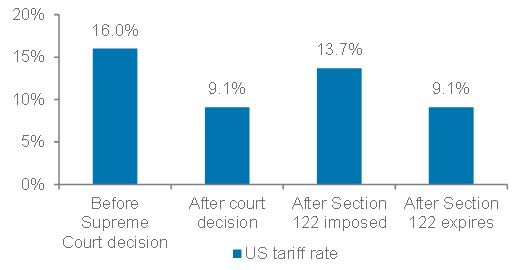
The latest US Supreme Court ruling implies US tariffs have peaked. The government is likely to recreate most of the lost tariffs through other statutes to meet its revenue targets, as expected.
Nevertheless, the net impact of the court ruling is marginally positive for risk sentiment as it reiterates the checks and balances in the US political system.
Meanwhile, the global fundamental and liquidity backdrop remains supportive of risk assets. We raise our AI capex growth estimates following strong semiconductor industry guidance.
A US-Iran conflict remains a near-term risk. We see a short spike in oil prices in our base scenario. Gold is likely to continue benefitting from geopolitical uncertainty.
Prefer semiconductors over software – stronger revenue and earnings outlook
Bullish EM government bonds – US Supreme Court ruling caps tariff impact
Prefer AUD bonds in carry strategies – we expect a stable AUD/CHF
Charts of the week: Peak tariffs
The US court ruling implies US tariffs have peaked; tariffs unlikely to change much, despite near-term winners and losers
US, Euro area and China economic surprise indices
Consensus 2026 earnings growth estimates for key markets
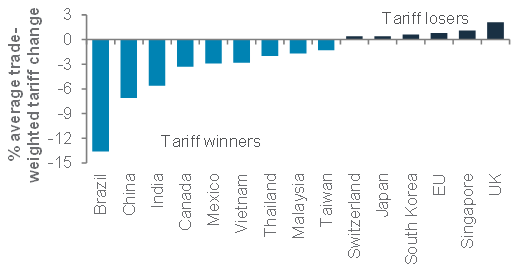
Source: Bloomberg, TS Lombard, Standard Chartered; *Following shift from IEEPA tariffs to Section 122 tariffs, assuming 15% rate
Editorial
Ignore tariff noise, focus on fundamentals
Strategy summary: The latest US Supreme Court ruling implies US tariffs have peaked. The government is likely to recreate most of the lost tariffs through other statutes to meet its revenue targets, as expected. Nevertheless, the net impact of the court ruling is marginally positive for risk sentiment as it reiterates the checks and balances in the US political system.
Meanwhile, the global fundamental and liquidity backdrop remains supportive of risk assets. We raise our AI capex growth estimates following strong semiconductor industry guidance. A US-Iran conflict remains a near-term risk. We see a short spike in oil prices in our base scenario. Gold is likely to continue benefitting from geopolitical uncertainty.
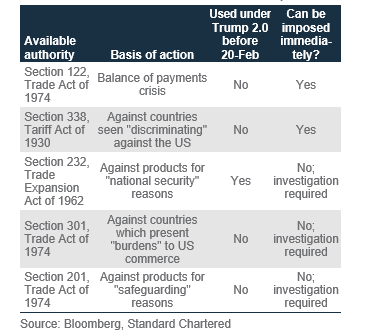
Peak US tariffs: The US Supreme Court ruling restricts the president’s ability to impose long-term tariffs without Congressional approval. While Trump responded by imposing a 10% tariff for 150 days under different legislation and proposed increasing the rate to 15% for several trading partners, the overall effect is that US tariffs have likely peaked, especially given their unpopularity ahead of the November mid-term elections. Our pro-risk investment strategy remains intact, anchored by strong fundamentals and supportive liquidity. “Peak US tariff”, fiscal stimulus from last year’s tax cuts, lower borrowing costs due to Fed rate cuts, and AI-driven investments should underpin US corporate earnings. The USD’s recovery since January is likely to fade amid potential fiscal deficit concerns. (See Market Watch on 23 February for details).
Raising global AI capex estimates: The semiconductor industry had a strong Q4 2025 earnings season as ongoing AI investments fuel demand for high-end chips. We now forecast global AI capital expenditure growth of 54% in 2026, up from 45%, and anticipate a compounded annual growth rate of 27% between 2025 and 2030. The technology cycle for AI remains in its early stages, benefiting the semiconductor sector. Within technology, we recommend shifting from software towards sub-sectors that are direct beneficiaries of AI monetisation, such as semiconductors and internet companies (see page 4).
Oil faces short-term upside; gold to benefit from structural demand: We see a temporary rise in oil prices towards USD 70/bbl should US-Iran tensions flare before stabilising, following patterns seen in July 2025. After this spike, prices are likely to retreat toward USD 60/bbl amid ample global supply. However, sustained disruption of Mideast oil supplies could drive prices above USD 80/bbl. Gold stands to benefit both from short-term geopolitical tensions and structural demand from EM central banks and investors, supported by ongoing uncertainty. We expect gold to reach USD 5,350/oz within twelve months.
Dovish BoJ tilt? Japan PM Takaichi appointed two reflationist academics to the Bank of Japan board, signalling a more dovish monetary stance after earlier reportedly expressing concerns about rate hikes. USD/JPY, Japan bond yields and equities rose following the announcement. Money markets now expect the next BoJ rate hike in June or July, but a dovish tilt to the BoJ board could stagger rate hikes, especially after headline inflation cooled below BoJ’s target for the first time since 2022.
Boost for Japan equities: Japan stocks have performed well lately even with JPY strength, which suggests domestic-driven reflation aided by Takaichi’s fiscal stimulus plans is starting to become a bigger positive driver of the equity market, than JPY weakness. We are monitoring the evolving policies closely. A reflationary BoJ slant and Takaichi’s apprehensions against BoJ rate hikes presents an upside risk to the equity rally.
Watching China’s National People’s Congress (NPC): China is expected to set a 4.5–5.0% GDP growth target at the upcoming NPC, slightly below 2025’s goal, consistent with its ambition to become a “moderately developed” economy by 2035. Policy will likely aim to boost consumption and innovation, countering deflationary pressures. Modest fiscal support is likely as trade uncertainty ebbs. We expect modest cuts to bank reserve requirements and policy rates, and ongoing bond purchases. We remain bullish on China equities, particularly in technology and communication services, where valuations are more attractive than their US peers.
The weekly macro balance sheet
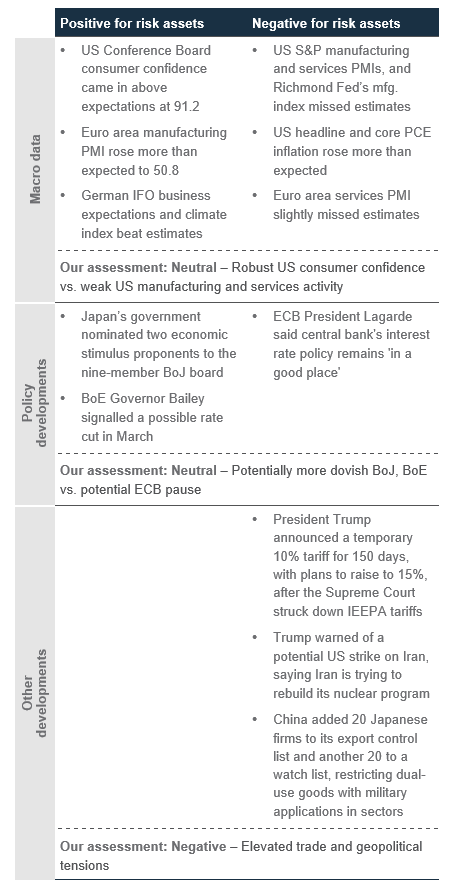
Our weekly net assessment: : On balance, we see the past week’s data and policy as neutral for risk assets in the near-term
(+) factors: Robust US consumer confidence; potentially more dovish BoJ, BoE
(-) factors: Weak US mfg. and services data; elevated trade tensions
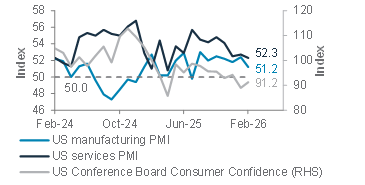
US manufacturing and services PMIs missed estimates in February, although consumer confidence ticked up
US S&P manufacturing and services PMIs; US Conference Board consumer confidence
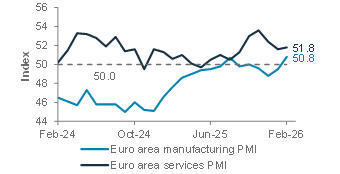
Euro area manufacturing PMI rose to a 44-month high in February, while services PMI continued to expand
Euro area HCOB manufacturing and services PMIs
Trump has authority to impose various shorter-term or targeted tariffs
Tariff authorities available to President Trump
Top client questions
What are the implications of the semiconductor industry’s Q4 2025 earnings season?
Our view: We favour semiconductors, as it is leading the broader technology sector’s earnings growth in 2026. Significant AI capital expenditure (capex) growth is also benefiting related sectors, such as utilities.
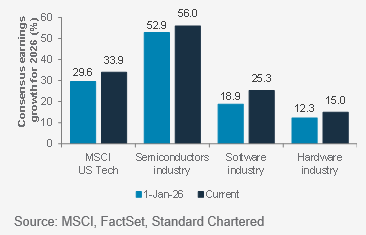
Rationale: The semiconductor industry’s Q4 2025 earnings has been strong, as AI investments continue to drive strong demand and provide solid visibility into future growth. We now estimate a 2026 global AI capex growth of 54% (up from 45% previously), with a 2025-30 CAGR of 27% (from 26% previously). We are still in the early stages of the AI investment cycle, which will benefit the semiconductor industry. Consensus 2026 earnings growth estimates for the semiconductor industry have been revised up to 56% from 53%, outpacing the broader technology sector’s growth.
The significant AI capex is also likely to benefit companies involved in data centre buildout. Thermal management and power supply are key areas in data centres. We expect demand for necessary grid upgrades to benefit providers of such services. Electric utilities could also benefit from the surge in power demand.
— Fook Hien Yap, Senior Investment Strategist
2026 earnings growth for the US semiconductor industry has been revised up to 56% from 53%, outpacing growth for the wider technology sector
Consensus 2026 earnings growth across US technology industries on 1-Jan-2026 and currently
Will the US software sector recover from its recent slump?
Our view: Rotate from software into sub-sectors benefiting from AI monetisation, such as semiconductors and internet.
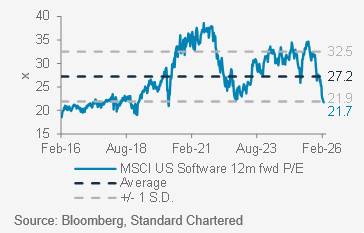
Rationale: The software sector has significantly underperformed the broader technology sector year to date (YTD). A relief rebound is possible, following partnerships announced by a leading AI research lab with other software companies, which eases concerns that AI agents will cannibalise enterprise software demand. However, near‑term sentiment will likely remain pressured by lacklustre earnings guidance from major software players.
We expect the software sector volatility to persist and recommend a selective approach. There is continued pressure on front-end platforms focused on customer engagement, human resources and visualisation, as they face greater AI displacement risk. Firms with high employee cost intensity are also vulnerable to AI‑driven disruption. In contrast, infrastructure software, including operating systems and cybersecurity, is more resilient, supported by high switching costs and deep customer integration.
Overall, we favour sectors benefiting directly from rising AI capex, namely internet and semiconductors, over software.
— Michelle Kam, Investment Strategist
US software industry valuations have de-rated drastically
12-month forward P/E ratio for the MSCI US Software index
Top client questions (cont’d)
Will the US Supreme Court tariff ruling impact US and Emerging Market (EM) bond markets in the near term?
Our view: The ruling provides short-term relief to EM assets. We remain Overweight EM USD and local currency (LCY) bonds.
Rationale: US government bonds rallied this week as risk-off sentiment intensified, largely due to recurring tariff threats, heightened geopolitical uncertainty and reduction of term-premium (the excess return that investors require for holding long-term bonds). The benchmark 10-year yield edged closer to 4%, the lower bound of our three-month target. We anticipate that upside pressure on yields will resurface, driven by fiscal volatility, as government bond supply mounts and the Trump administration explores alternative revenue sources to offset potential trade-related losses.
The court verdict invalidated several unilateral International Emergency Economic Powers Act (IEEPA)-authorised tariffs, providing a short-term relief to the EM trade landscape. The ruling axed reciprocal duties on key trade partners, such as India and Vietnam, plus additional levies on China, providing much-needed legal clarity. Combined with easing inflationary pressures, resilient global growth and a projected weakening USD, we expect EM bond credit spreads to tighten. Market focus is likely to shift to next week’s National People’s Congress (NPC) in China, which will shed light on the country’s 2026 GDP growth target and signs of monetary shifts.
— Cedric Lam, Senior Investment Strategist
Are there any alternatives to USD bonds for carry strategies looking to avoid risk from a further USD decline?
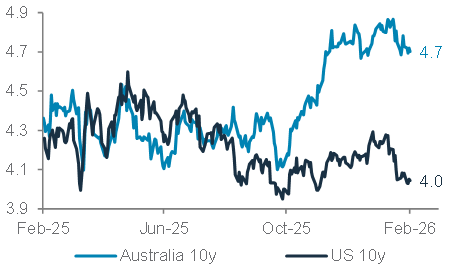
Our view: AUD bonds are attractive relative to USD bonds due to higher yields and expectations of AUD resilience even vs. haven currencies. We have a stable AUD/CHF view as Australian policy rates rise, while the Fed cuts rates.
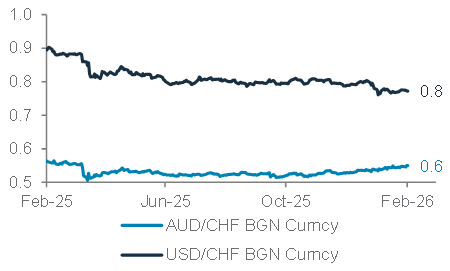
Rationale: USD weakness means carry strategies are increasingly likely to focus on more resilient currencies. The CHF has appreciated 16% vs. USD over the past year and 2.4% so far this year, hurting carry strategies based on borrowing in CHF and investing in USD assets. US policy uncertainty is likely to continue undermining the USD for a second year. This makes carry strategies increasingly vulnerable as further USD weakness erodes any extra yield pickup.
In this context, we hold a stable view on AUD/CHF. AUD government bonds offer a higher yield pickup than USD peers. Also, we believe AUD is on an appreciating path as RBA is the first Developed Market central bank to hike rates in this cycle, while we expect the Fed to cut rates further this year. This policy divergence implies AUD/CHF is likely to stabilise around 0.55 over 12 months, while the USD continues to decline vs. CHF towards 0.74 over the same period.
— Rajat Bhattacharya, Senior Investment Strategist
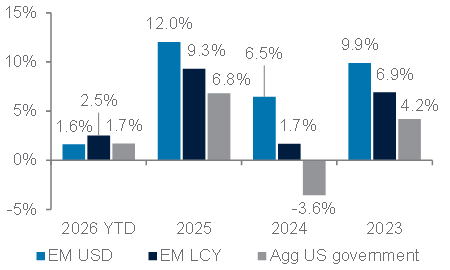
EM bonds have delivered solid returns alongside USD bonds
Return of EM USD, EM LCY and aggregate USD government bond indices
AUD government bonds offer a significant yield pickup over US government bonds
Australian and US 10-year government bond yields
We expect AUD/CHF to remain stable over a 12-month period, while the USD continues to depreciate against CHF
USD/CHF, AUD/CHF
Top client questions (cont’d)
How might Iran-US tensions affect gold and oil prices?
Our view: Our base case is a temporary oil risk premium driven by geopolitical tensions. Gold is likely to stay structurally supported beyond geopolitics.
Rationale: Rising US-Iran tensions have impacted oil prices, given potential risks to global oil supply and transit routes. Markets have tended to embed a ‘geopolitical premium’ into crude oil prices as such risks rise.
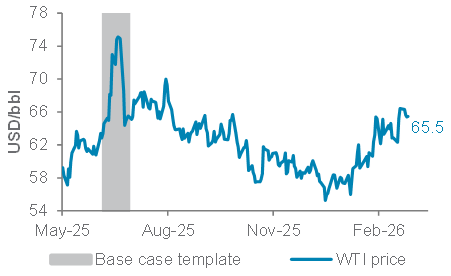
A base case scenario of a limited flare-up followed by gradual stabilisation, such as the June 2025 episode, is expected to result in only a modest and temporary West Texas Intermediate (WTI) oil price upside. A short-lived spike in the risk premium could lift prices towards our USD 70/bbl 3-month forecast before fading as geopolitical tensions ease.
A scenario of a more significant and/or sustained escalation, particularly one that disrupts supply, shipping routes or results in tighter sanctions, could drive a sharper and more sustained move higher, pushing prices above USD 80/bbl.
Conversely, if tensions ease following successful US-Iran negotiations, the geopolitical premium should fade, pulling oil towards our 12-month USD 60/bbl forecast, consistent with a more comfortable supply backdrop.
Gold has also benefited from the risk-off tone. However, beyond the US-Iran dynamic, it is driven more broadly by structural haven demand and trade policy uncertainty. Geopolitics could accelerate gains, but with multiple forces at play, the marginal impact from this episode alone is unlikely to generate a major standalone effect. We prefer hedging any pass-through inflation risks from higher oil by adding to US Treasury Inflation-Protected Securities (TIPS) exposure. US energy sector equities can also offer reasonable correlation to oil prices.
— Anthony Naab, CFA, Senior Investment Strategist
Our central scenario mirrors the June 2025 Iran nuclear episode – a temporary lift in oil prices that dissipates as tensions ease
WTI price and base case template
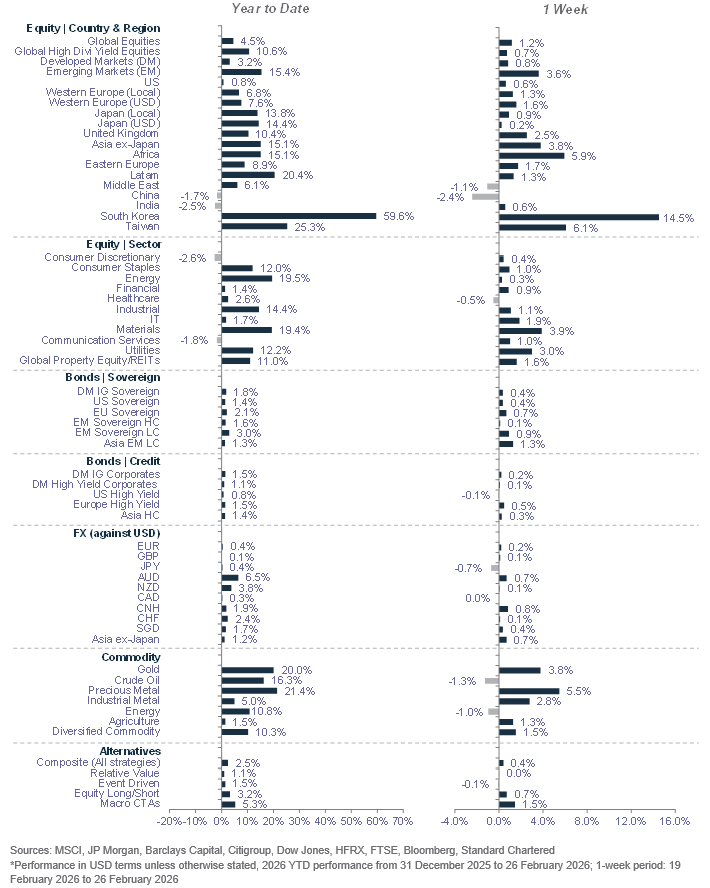
Market performance summary*
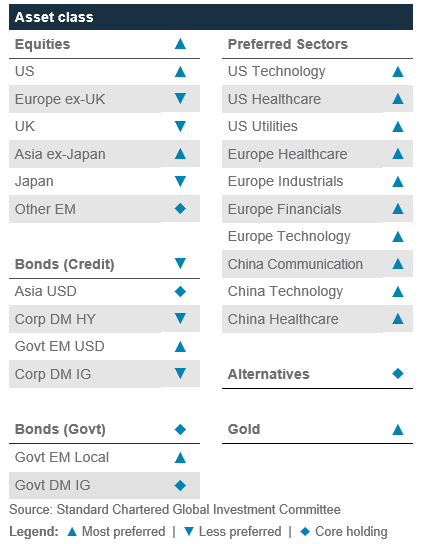
Our 12-month asset class views at a glance
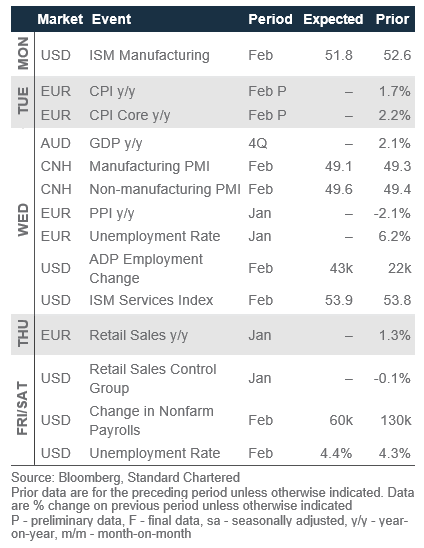
Economic and market calendar
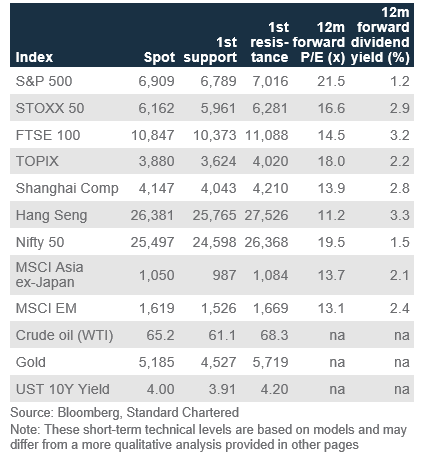
The S&P500 has next interim resistance at 7,016
Technical indicators for key markets as of 26 Feb close
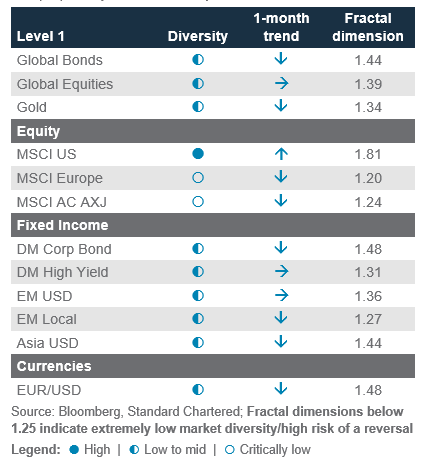
Investor diversity in Europe has fallen below key threshold
Our proprietary market diversity indicators as of 26 Feb close
Disclosure
This document is confidential and may also be privileged. If you are not the intended recipient, please destroy all copies and notify the sender immediately. This document is being distributed for general information only and is subject to the relevant disclaimers available at our Standard Chartered website under Regulatory disclosures. It is not and does not constitute research material, independent research, an offer, recommendation or solicitation to enter into any transaction or adopt any hedging, trading or investment strategy, in relation to any securities or other financial instruments. This document is for general evaluation only. It does not take into account the specific investment objectives, financial situation or particular needs of any particular person or class of persons and it has not been prepared for any particular person or class of persons. You should not rely on any contents of this document in making any investment decisions. Before making any investment, you should carefully read the relevant offering documents and seek independent legal, tax and regulatory advice. In particular, we recommend you to seek advice regarding the suitability of the investment product, taking into account your specific investment objectives, financial situation or particular needs, before you make a commitment to purchase the investment product. Opinions, projections and estimates are solely those of SC at the date of this document and subject to change without notice. Past performance is not indicative of future results and no representation or warranty is made regarding future performance. The value of investments, and the income from them, can go down as well as up, and you may not recover the amount of your original investment. You are not certain to make a profit and may lose money. Any forecast contained herein as to likely future movements in rates or prices or likely future events or occurrences constitutes an opinion only and is not indicative of actual future movements in rates or prices or actual future events or occurrences (as the case may be). This document must not be forwarded or otherwise made available to any other person without the express written consent of the Standard Chartered Group (as defined below). Standard Chartered Bank is incorporated in England with limited liability by Royal Charter 1853 Reference Number ZC18. The Principal Office of the Company is situated in England at 1 Basinghall Avenue, London, EC2V 5DD. Standard Chartered Bank is authorised by the Prudential Regulation Authority and regulated by the Financial Conduct Authority and Prudential Regulation Authority. Standard Chartered PLC, the ultimate parent company of Standard Chartered Bank, together with its subsidiaries and affiliates (including each branch or representative office), form the Standard Chartered Group. Standard Chartered Private Bank is the private banking division of Standard Chartered. Private banking activities may be carried out internationally by different legal entities and affiliates within the Standard Chartered Group (each an “SC Group Entity”) according to local regulatory requirements. Not all products and services are provided by all branches, subsidiaries and affiliates within the Standard Chartered Group. Some of the SC Group Entities only act as representatives of Standard Chartered Private Bank and may not be able to offer products and services or offer advice to clients.
Copyright © 2026, Accounting Research & Analytics, LLC d/b/a CFRA (and its affiliates, as applicable). Reproduction of content provided by CFRA in any form is prohibited except with the prior written permission of CFRA. CFRA content is not investment advice and a reference to or observation concerning a security or investment provided in the CFRA SERVICES is not a recommendation to buy, sell or hold such investment or security or make any other investment decisions. The CFRA content contains opinions of CFRA based upon publicly-available information that CFRA believes to be reliable and the opinions are subject to change without notice. This analysis has not been submitted to, nor received approval from, the United States Securities and Exchange Commission or any other regulatory body. While CFRA exercised due care in compiling this analysis, CFRA, ITS THIRD-PARTY SUPPLIERS, AND ALL RELATED ENTITIES SPECIFICALLY DISCLAIM ALL WARRANTIES, EXPRESS OR IMPLIED, INCLUDING, BUT NOT LIMITED TO, ANY WARRANTIES OF MERCHANTABILITY OR FITNESS FOR A PARTICULAR PURPOSE OR USE, to the full extent permitted by law, regarding the accuracy, completeness, or usefulness of this information and assumes no liability with respect to the consequences of relying on this information for investment or other purposes. No content provided by CFRA (including ratings, credit-related analyses and data, valuations, model, software or other application or output therefrom) or any part thereof may be modified, reverse engineered, reproduced or distributed in any form by any means, or stored in a database or retrieval system, without the prior written permission of CFRA, and such content shall not be used for any unlawful or unauthorized purposes. CFRA and any third-party providers, as well as their directors, officers, shareholders, employees or agents do not guarantee the accuracy, completeness, timeliness or availability of such content. In no event shall CFRA, its affiliates, or their third-party suppliers be liable for any direct, indirect, special, or consequential damages, costs, expenses, legal fees, or losses (including lost income or lost profit and opportunity costs) in connection with a subscriber’s, subscriber’s customer’s, or other’s use of CFRA’s content.
Market Abuse Regulation (MAR) Disclaimer
Banking activities may be carried out internationally by different branches, subsidiaries and affiliates within the Standard Chartered Group according to local regulatory requirements. Opinions may contain outright “buy”, “sell”, “hold” or other opinions. The time horizon of this opinion is dependent on prevailing market conditions and there is no planned frequency for updates to the opinion. This opinion is not independent of Standard Chartered Group’s trading strategies or positions. Standard Chartered Group and/or its affiliates or its respective officers, directors, employee benefit programmes or employees, including persons involved in the preparation or issuance of this document may at any time, to the extent permitted by applicable law and/or regulation, be long or short any securities or financial instruments referred to in this document or have material interest in any such securities or related investments. Therefore, it is possible, and you should assume, that Standard Chartered Group has a material interest in one or more of the financial instruments mentioned herein. Please refer to our Standard Chartered website under Regulatory disclosures for more detailed disclosures, including past opinions/ recommendations in the last 12 months and conflict of interests, as well as disclaimers. A covering strategist may have a financial interest in the debt or equity securities of this company/issuer. All covering strategist are licensed to provide investment recommendations under Monetary Authority of Singapore or Hong Kong Monetary Authority. This document must not be forwarded or otherwise made available to any other person without the express written consent of Standard Chartered Group.
Sustainable Investments
Any ESG data used or referred to has been provided by Morningstar, Sustainalytics, MSCI or Bloomberg. Refer to 1) Morningstar website under Sustainable Investing, 2) Sustainalytics website under ESG Risk Ratings, 3) MCSI website under ESG Business Involvement Screening Research and 4) Bloomberg green, social & sustainability bonds guide for more information. The ESG data is as at the date of publication based on data provided, is for informational purpose only and is not warranted to be complete, timely, accurate or suitable for a particular purpose, and it may be subject to change. Sustainable Investments (SI): This refers to funds that have been classified as ‘ESG Intentional Investments – Overall’ by Morningstar. SI funds have explicitly stated in their prospectus and regulatory filings that they either incorporate ESG factors into the investment process or have a thematic focus on the environment, gender diversity, low carbon, renewable energy, water or community development. For equity, it refers to shares/stocks issued by companies with Sustainalytics ESG Risk Rating of Low/Negligible. For bonds, it refers to debt instruments issued by issuers with Sustainalytics ESG Risk Rating of Low/Negligible, and/or those being certified green, social, sustainable bonds by Bloomberg. For structured products, it refers to products that are issued by any issuer who has a Sustainable Finance framework that aligns with Standard Chartered’s Green and Sustainable Product Framework, with underlying assets that are part of the Sustainable Investment universe or separately approved by Standard Chartered’s Sustainable Finance Governance Committee. Sustainalytics ESG risk ratings shown are factual and are not an indicator that the product is classified or marketed as “green”, “sustainable” or similar under any particular classification system or framework.
Country/Market Specific Disclosures
Bahrain: This document is being distributed in Bahrain by Standard Chartered Bank, Bahrain Branch, having its address at P.O. 29, Manama, Kingdom of Bahrain, is a branch of Standard Chartered Bank and is licensed by the Central Bank of Bahrain as a conventional retail bank. Botswana: This document is being distributed in Botswana by, and is attributable to, Standard Chartered Bank Botswana Limited which is a financial institution licensed under the Section 6 of the Banking Act CAP 46.04 and is listed in the Botswana Stock Exchange. Brunei Darussalam: This document is being distributed in Brunei Darussalam by, and is attributable to, Standard Chartered Bank (Brunei Branch) | Registration Number RFC/61 and Standard Chartered Securities (B) Sdn Bhd | Registration Number RC20001003. Standard Chartered Bank is incorporated in England with limited liability by Royal Charter 1853 Reference Number ZC18. Standard Chartered Securities (B) Sdn Bhd is a limited liability company registered with the Registry of Companies with Registration Number RC20001003 and licensed by Brunei Darussalam Central Bank as a Capital Markets Service License Holder with License Number BDCB/R/CMU/S3-CL and it is authorised to conduct Islamic investment business through an Islamic window. China Mainland: This document is being distributed in China by, and is attributable to, Standard Chartered Bank (China) Limited which is mainly regulated by National Financial Regulatory Administration (NFRA), State Administration of Foreign Exchange (SAFE), and People’s Bank of China (PBOC). Hong Kong: In Hong Kong, this document, except for any portion advising on or facilitating any decision on futures contracts trading, is distributed by Standard Chartered Bank (Hong Kong) Limited (“SCBHK”), a subsidiary of Standard Chartered PLC. SCBHK has its registered address at 32/F, Standard Chartered Bank Building, 4-4A Des Voeux Road Central, Hong Kong and is regulated by the Hong Kong Monetary Authority and registered with the Securities and Futures Commission (“SFC”) to carry on Type 1 (dealing in securities), Type 4 (advising on securities), Type 6 (advising on corporate finance) and Type 9 (asset management) regulated activity under the Securities and Futures Ordinance (Cap. 571) (“SFO”) (CE No. AJI614). The contents of this document have not been reviewed by any regulatory authority in Hong Kong and you are advised to exercise caution in relation to any offer set out herein. If you are in doubt about any of the contents of this document, you should obtain independent professional advice. Any product named herein may not be offered or sold in Hong Kong by means of any document at any time other than to “professional investors” as defined in the SFO and any rules made under that ordinance. In addition, this document may not be issued or possessed for the purposes of issue, whether in Hong Kong or elsewhere, and any interests may not be disposed of, to any person unless such person is outside Hong Kong or is a “professional investor” as defined in the SFO and any rules made under that ordinance, or as otherwise may be permitted by that ordinance. In Hong Kong, Standard Chartered Private Bank is the private banking division of SCBHK, a subsidiary of Standard Chartered PLC. Ghana: Standard Chartered Bank Ghana Limited accepts no liability and will not be liable for any loss or damage arising directly or indirectly (including special, incidental or consequential loss or damage) from your use of these documents. Past performance is not indicative of future results and no representation or warranty is made regarding future performance. You should seek advice from a financial adviser on the suitability of an investment for you, taking into account these factors before making a commitment to invest in an investment. To unsubscribe from receiving further updates, please send an email to feedback.ghana@sc.com. Please do not reply to this email. Call our Priority Banking on 0302610750 for any questions or service queries. You are advised not to send any confidential and/or important information to Standard Chartered via e-mail, as Standard Chartered makes no representations or warranties as to the security or accuracy of any information transmitted via e-mail. Standard Chartered shall not be responsible for any loss or damage suffered by you arising from your decision to use e-mail to communicate with the Bank. India: This document is being distributed in India by Standard Chartered in its capacity as a distributor of mutual funds and referrer of any other third party financial products. Standard Chartered does not offer any ‘Investment Advice’ as defined in the Securities and Exchange Board of India (Investment Advisers) Regulations, 2013 or otherwise. Services/products related securities business offered by Standard Charted are not intended for any person, who is a resident of any jurisdiction, the laws of which imposes prohibition on soliciting the securities business in that jurisdiction without going through the registration requirements and/or prohibit the use of any information contained in this document. Indonesia: This document is being distributed in Indonesia by Standard Chartered Bank, Indonesia branch, which is a financial institution licensed and supervised by Otoritas Jasa Keuangan (Financial Service Authority) and Bank Indonesia. Jersey: In Jersey, Standard Chartered Private Bank is the Registered Business Name of the Jersey Branch of Standard Chartered Bank. The Jersey Branch of Standard Chartered Bank is regulated by the Jersey Financial Services Commission. Copies of the latest audited accounts of Standard Chartered Bank are available from its principal place of business in Jersey: PO Box 80, 15 Castle Street, St Helier, Jersey JE4 8PT. Standard Chartered Bank is incorporated in England with limited liability by Royal Charter in 1853 Reference Number ZC 18. The Principal Office of the Company is situated in England at 1 Basinghall Avenue, London, EC2V 5DD. Standard Chartered Bank is authorised by the Prudential Regulation Authority and regulated by the Financial Conduct Authority and Prudential Regulation Authority. The Jersey Branch of Standard Chartered Bank is also an authorised financial services provider under license number 44946 issued by the Financial Sector Conduct Authority of the Republic of South Africa. Jersey is not part of the United Kingdom and all business transacted with Standard Chartered Bank, Jersey Branch and other SC Group Entity outside of the United Kingdom, are not subject to some or any of the investor protection and compensation schemes available under United Kingdom law. Kenya: This document is being distributed in Kenya by and is attributable to Standard Chartered Bank Kenya Limited. Investment Products and Services are distributed by Standard Chartered Investment Services Limited, a wholly owned subsidiary of Standard Chartered Bank Kenya Limited that is licensed by the Capital Markets Authority in Kenya, as a Fund Manager. Standard Chartered Bank Kenya Limited is regulated by the Central Bank of Kenya. Malaysia: This document is being distributed in Malaysia by Standard Chartered Bank Malaysia Berhad (“SCBMB”). Recipients in Malaysia should contact SCBMB in relation to any matters arising from, or in connection with, this document. This document has not been reviewed by the Securities Commission Malaysia. The product lodgement, registration, submission or approval by the Securities Commission of Malaysia does not amount to nor indicate recommendation or endorsement of the product, service or promotional activity. Investment products are not deposits and are not obligations of, not guaranteed by, and not protected by SCBMB or any of the affiliates or subsidiaries, or by Perbadanan Insurans Deposit Malaysia, any government or insurance agency. Investment products are subject to investment risks, including the possible loss of the principal amount invested. SCBMB expressly disclaim any liability and responsibility for any loss arising directly or indirectly (including special, incidental or consequential loss or damage) arising from the financial losses of the Investment Products due to market condition. Nigeria: This document is being distributed in Nigeria by Standard Chartered Bank Nigeria Limited (SCB Nigeria), a bank duly licensed and regulated by the Central Bank of Nigeria. SCB Nigeria accepts no liability for any loss or damage arising directly or indirectly (including special, incidental or consequential loss or damage) from your use of these documents. You should seek advice from a financial adviser on the suitability of an investment for you, taking into account these factors before making a commitment to invest in an investment. To unsubscribe from receiving further updates, please send an email to clientcare.ng@sc.com requesting to be removed from our mailing list. Please do not reply to this email. Call our Priority Banking on 02 012772514 for any questions or service queries. SCB Nigeria shall not be responsible for any loss or damage arising from your decision to send confidential and/or important information to Standard Chartered via e-mail. SCB Nigeria makes no representations or warranties as to the security or accuracy of any information transmitted via e-mail. Pakistan: This document is being distributed in Pakistan by, and attributable to Standard Chartered Bank (Pakistan) Limited having its registered office at PO Box 5556, I.I Chundrigar Road Karachi, which is a banking company registered with State Bank of Pakistan under Banking Companies Ordinance 1962 and is also having licensed issued by Securities & Exchange Commission of Pakistan for Security Advisors. Standard Chartered Bank (Pakistan) Limited acts as a distributor of mutual funds and referrer of other third-party financial products. Singapore: This document is being distributed in Singapore by, and is attributable to, Standard Chartered Bank (Singapore) Limited (Registration No. 201224747C/ GST Group Registration No. MR-8500053-0, “SCBSL”). Recipients in Singapore should contact SCBSL in relation to any matters arising from, or in connection with, this document. SCBSL is an indirect wholly owned subsidiary of Standard Chartered Bank and is licensed to conduct banking business in Singapore under the Singapore Banking Act, 1970. Standard Chartered Private Bank is the private banking division of SCBSL. IN RELATION TO ANY SECURITY OR SECURITIES-BASED DERIVATIVES CONTRACT REFERRED TO IN THIS DOCUMENT, THIS DOCUMENT, TOGETHER WITH THE ISSUER DOCUMENTATION, SHALL BE DEEMED AN INFORMATION MEMORANDUM (AS DEFINED IN SECTION 275 OF THE SECURITIES AND FUTURES ACT, 2001 (“SFA”)). THIS DOCUMENT IS INTENDED FOR DISTRIBUTION TO ACCREDITED INVESTORS, AS DEFINED IN SECTION 4A(1)(a) OF THE SFA, OR ON THE BASIS THAT THE SECURITY OR SECURITIES-BASED DERIVATIVES CONTRACT MAY ONLY BE ACQUIRED AT A CONSIDERATION OF NOT LESS THAN S$200,000 (OR ITS EQUIVALENT IN A FOREIGN CURRENCY) FOR EACH TRANSACTION. Further, in relation to any security or securities-based derivatives contract, neither this document nor the Issuer Documentation has been registered as a prospectus with the Monetary Authority of Singapore under the SFA. Accordingly, this document and any other document or material in connection with the offer or sale, or invitation for subscription or purchase, of the product may not be circulated or distributed, nor may the product be offered or sold, or be made the subject of an invitation for subscription or purchase, whether directly or indirectly, to persons other than a relevant person pursuant to section 275(1) of the SFA, or any person pursuant to section 275(1A) of the SFA, and in accordance with the conditions specified in section 275 of the SFA, or pursuant to, and in accordance with the conditions of, any other applicable provision of the SFA. In relation to any collective investment schemes referred to in this document, this document is for general information purposes only and is not an offering document or prospectus (as defined in the SFA). This document is not, nor is it intended to be (i) an offer or solicitation of an offer to buy or sell any capital markets product; or (ii) an advertisement of an offer or intended offer of any capital markets product. Deposit Insurance Scheme: Singapore dollar deposits of non-bank depositors are insured by the Singapore Deposit Insurance Corporation, for up to S$100,000 in aggregate per depositor per Scheme member by law. Foreign currency deposits, dual currency investments, structured deposits and other investment products are not insured. This advertisement has not been reviewed by the Monetary Authority of Singapore. Taiwan: SC Group Entity or Standard Chartered Bank (Taiwan) Limited (“SCB (Taiwan)”) may be involved in the financial instruments contained herein or other related financial instruments. The author of this document may have discussed the information contained herein with other employees or agents of SC or SCB (Taiwan). The author and the above-mentioned employees of SC or SCB (Taiwan) may have taken related actions in respect of the information involved (including communication with customers of SC or SCB (Taiwan) as to the information contained herein). The opinions contained in this document may change, or differ from the opinions of employees of SC or SCB (Taiwan). SC and SCB (Taiwan) will not provide any notice of any changes to or differences between the above-mentioned opinions. This document may cover companies with which SC or SCB (Taiwan) seeks to do business at times and issuers of financial instruments. Therefore, investors should understand that the information contained herein may serve as specific purposes as a result of conflict of interests of SC or SCB (Taiwan). SC, SCB (Taiwan), the employees (including those who have discussions with the author) or customers of SC or SCB (Taiwan) may have an interest in the products, related financial instruments or related derivative financial products contained herein; invest in those products at various prices and on different market conditions; have different or conflicting interests in those products. The potential impacts include market makers’ related activities, such as dealing, investment, acting as agents, or performing financial or consulting services in relation to any of the products referred to in this document. UAE: DIFC – Standard Chartered Bank is incorporated in England with limited liability by Royal Charter 1853 Reference Number ZC18.The Principal Office of the Company is situated in England at 1 Basinghall Avenue, London, EC2V 5DD. Standard Chartered Bank is authorised by the Prudential Regulation Authority and regulated by the Financial Conduct Authority and Prudential Regulation Authority. Standard Chartered Bank, Dubai International Financial Centre having its offices at Dubai International Financial Centre, Building 1, Gate Precinct, P.O. Box 999, Dubai, UAE is a branch of Standard Chartered Bank and is regulated by the Dubai Financial Services Authority (“DFSA”). This document is intended for use only by Professional Clients and is not directed at Retail Clients as defined by the DFSA Rulebook. In the DIFC we are authorised to provide financial services only to clients who qualify as Professional Clients and Market Counterparties and not to Retail Clients. As a Professional Client you will not be given the higher retail client protection and compensation rights and if you use your right to be classified as a Retail Client we will be unable to provide financial services and products to you as we do not hold the required license to undertake such activities. For Islamic transactions, we are acting under the supervision of our Shariah Supervisory Committee. Relevant information on our Shariah Supervisory Committee is currently available on the Standard Chartered Bank website in the Islamic banking section. For residents of the UAE – Standard Chartered UAE (“SC UAE”) is licensed by the Central Bank of the U.A.E. SC UAE is licensed by Securities and Commodities Authority to practice Promotion Activity. SC UAE does not provide financial analysis or consultation services in or into the UAE within the meaning of UAE Securities and Commodities Authority Decision No. 48/r of 2008 concerning financial consultation and financial analysis. Uganda: Our Investment products and services are distributed by Standard Chartered Bank Uganda Limited, which is licensed by the Capital Markets Authority as an investment adviser. United Kingdom: In the UK, Standard Chartered Bank is authorised by the Prudential Regulation Authority and regulated by the Financial Conduct Authority and Prudential Regulation Authority. This communication has been approved by Standard Chartered Bank for the purposes of Section 21 (2) (b) of the United Kingdom’s Financial Services and Markets Act 2000 (“FSMA”) as amended in 2010 and 2012 only. Standard Chartered Bank (trading as Standard Chartered Private Bank) is also an authorised financial services provider (license number 45747) in terms of the South African Financial Advisory and Intermediary Services Act, 2002. The Materials have not been prepared in accordance with UK legal requirements designed to promote the independence of investment research, and that it is not subject to any prohibition on dealing ahead of the dissemination of investment research. Vietnam: This document is being distributed in Vietnam by, and is attributable to, Standard Chartered Bank (Vietnam) Limited which is mainly regulated by State Bank of Vietnam (SBV). Recipients in Vietnam should contact Standard Chartered Bank (Vietnam) Limited for any queries regarding any content of this document. Zambia: This document is distributed by Standard Chartered Bank Zambia Plc, a company incorporated in Zambia and registered as a commercial bank and licensed by the Bank of Zambia under the Banking and Financial Services Act Chapter 387 of the Laws of Zambia.