

13 November 2026
Weekly Market View
Tactical plays within
a diversified allocation
Our calls to dial down risk since early October have helped mitigate a bear market in semiconductors and the sharpest single-day post-mid-term election downturn in US equities in over three decades.
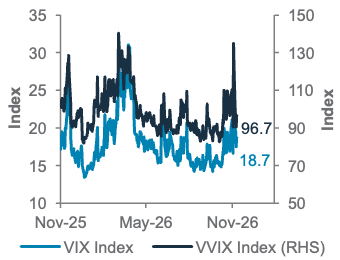
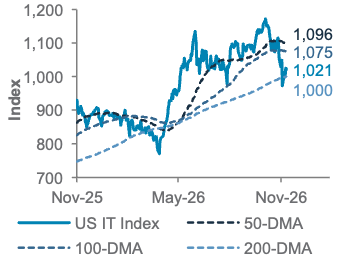
Volatility has eased after the post-election spike, helping the IT sector partly recover. We see further upside in our opportunistic US IT and healthcare sector equity ideas.
A strong job market is likely to keep the Fed focused on lowering inflation, cementing the prospect of a December rate hike, potentially followed by another in Q1 2027. A strong economy and elevated interest rates support our overweight allocation to US financial sector equities.
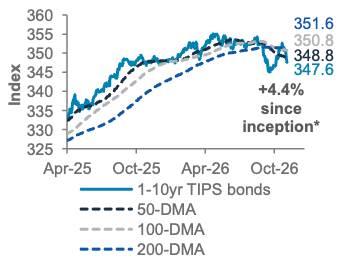
In bonds, we lock in gains on US inflation-protected bonds as inflation nears a peak.
Where do you see the most favourable risk-reward within the US tech sector?
How do falling oil prices and hot US inflation data impact your Fed and bonds outlook?
Does the USD rally have further to run?
Charts of the week: Volatility drops, reviving tactical plays
US equity volatility has dropped after a spike; we stay bullish on US IT equities and lock in gains in inflation-linked bonds
US S&P500 volatility (VIX) and volatility of volatility (VVIX) indices
US IT sector equities total return index
US government inflation-linked 1-10 years total return index*
Source: Bloomberg, Standard Chartered. *Initiated on 11 April 2025.
Editorial
Tactical plays within a diversified allocation
Strategy summary: Our calls to dial down risk since early October have helped mitigate a bear market in semiconductors and the sharpest single-day post-mid-term election downturn in US equities in over three decades. Volatility has eased after the post-election spike, helping the IT sector partly recover. We see further upside in our opportunistic US IT and healthcare sector equity ideas. In bonds, we lock in gains on US inflation-protected bonds as inflation nears a peak.
Navigating volatility. Almost five weeks ago, we cut our semiconductor segment equity exposure as market breadth narrowed ahead of the US election. Two weeks ago, we cut equities from Overweight to a core allocation, positioning for mid-cycle market dynamics. Last week, as the US equity market volatility index VIX surged above 25, we partially dialled up risk with a tactical idea on the more diversified US IT sector.
Staying tactical within a diversified allocation. Equity volatility following last week’s Democratic clean sweep in the US elections has subsided. Questions about the pace of AI data centre buildout are likely to linger until Democrats take office in in January. Nvidia’s turmoil adds uncertainty. We remain broadly diversified and balanced in our core allocation across assets, sector and regions, while seeking tactical opportunities. History suggests sharp selloffs are followed by near-term volatility, particularly during macroeconomic stress. However, the balance of historical outcomes has typically shifted strongly to the upside over a three- to six-month horizon. Besides, historically, US equity markets have delivered the strongest 12-month returns after opposition clean sweeps in the mid-terms.
Rotation driving US IT sector recovery: As volatility eases, our opportunistic US IT equities idea, launched a week ago, has performed well, despite some significantly negative company specific developments. Attractive valuations support further upside. Investors are rotating within IT from semiconductors, affected by concerns over the pace of AI data centre buildout and Nvidia’s troubles, towards software and hardware providers. The latter have strong cash flows and balance sheets and are likely to benefit from AI monetisation. Together, they account for more than 60% of the IT sector (see page 4).
.
Remain constructive on US healthcare. US healthcare earnings are projected to grow almost 23% in 2027, the second-fastest among MSCI US sectors. We see scope for further upside in the sector as innovation underpins long-term earnings growth. With the market rotating away from concentrated AI exposure, healthcare’s stable, non-cyclical demand profile offers a compelling exposure as a diversifier (see page 5).
Outside the US, Switzerland and India offer diversified returns. The Swiss equity market consists of 41% healthcare, 19% financial services and 14% consumer staples, providing a defensive alternative to investors seeking to diversify away from tech-heavy exposure. The Indian equity market has been classified as an “anti-AI” trade. Historically narrow valuation premiums vs. EMs, low foreign investor positioning and c. 15% expected 2027 earnings growth make it an attractive diversifier.
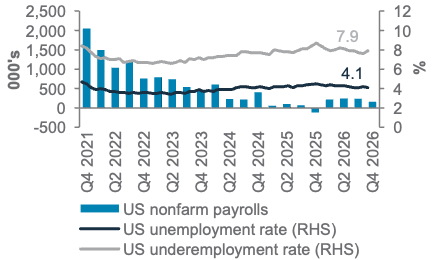
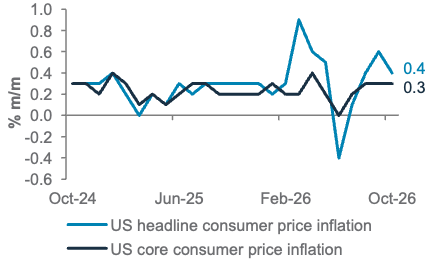
Strong jobs and inflation reports cement December Fed rate hike. The US economy added 165,000 jobs in October, more than twice the 70,000 consensus estimate. The unemployment rate fell to 4.1%. Meanwhile, headline and core inflation in October, at 0.4% and 0.3% m/m, respectively, exceeded expectations as elevated fuel prices, ‘techflation’ and earlier tariffs fed into directly exposed sectors, including food, utilities and transportation services. A healthy job market keeps the Fed focused on lowering inflation, cementing the prospect of a December rate hike, potentially followed by another in Q1 2027. A strong economy and elevated interest rates support our overweight allocation to US financial sector equities.
Locking in gains from our bullish US inflation-protected bonds idea. While near-term price pressures remain elevated, we expect inflation to ease with energy costs over the coming year. Republicans’ heavy losses in the US mid-term elections increase pressure on the Trump administration to end the Iran conflict. One-year US inflation expectations have slumped alongside oil prices. A potential slowdown in the pace of AI buildout is also likely to ease techflation. Meanwhile, Fed rate hikes should further tighten financial conditions, tempering price pressures. This disinflationary outlook makes the risk-reward for US inflation-protected bonds less compelling. We close the idea, locking in a 4.4% gain (page 6).
— Rajat Bhattacharya
The weekly macro balance sheet
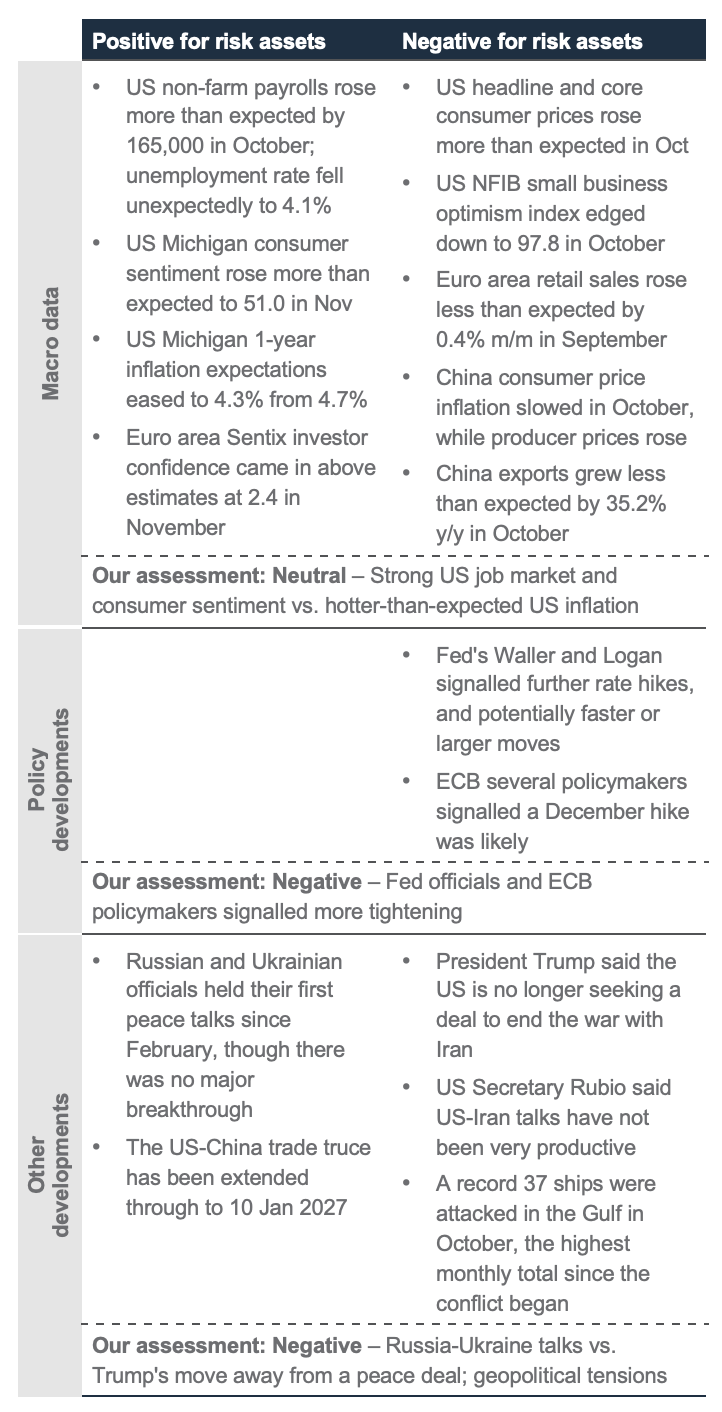
Our weekly net assessment: On balance, we see the past week’s data and policy as neutral for risk assets in the near-term
(+) factors: Strong US job market; improving US consumer sentiment
(-)factors: Hotter-than-expected US inflation; rising odds of Fed hikes
US job creation surged in October, with non-farm payrolls beating expectations, and the unemployment rate falling back to 4.1%
Quarterly US non-farm payrolls, unemployment rate and underemployment rate
Source: Bloomberg, Standard Chartered.
*Q4 2026 represents October data only
US headline and core consumer prices rose more than expected by 0.4% m/m and 0.3% m/m in October respectively, raising odds of Fed hikes
US headline and core consumer price inflation
Source: Bloomberg, Standard Chartered
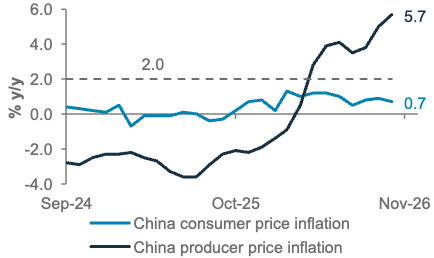
China’s consumer inflation eased further, while factory-gate prices accelerated in October
China consumer and producer price inflation
Source: Bloomberg, Standard Chartered
Top client questions
What does history tell us about the aftermath of a single-day sell-off of 4% or more in the S&P500 index?
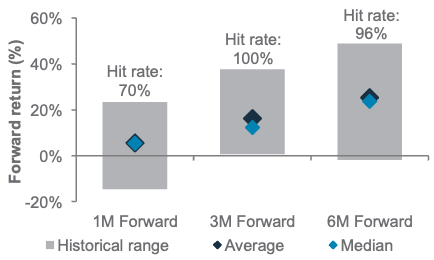
Our view: The S&P500 fell 4.36% on 5 November 2026, a rare daily move of 3.8 standard deviations. Since 2009, there have been only 24 occasions when the index declined by 4% or more in a single session. The immediate aftermath of such sell-offs has historically been mixed. One-month returns ranged from around -15% to +23%, with positive returns in 70% of cases. The weaker outcomes were concentrated around periods of significant macro stress, including the tail end of the 2008 Global Financial Crisis (GFC), the 2020 COVID-19 pandemic and the 2022 monetary policy tightening cycle.
The historical picture becomes considerably more constructive beyond the first month. All 24 episodes generated positive three-month returns, ranging from roughly +0.5% to +38%, while six-month returns were positive in 96% of cases, with gains reaching as much as +49%. Overall, history suggests sharp sell-offs can be followed by near-term volatility, particularly during periods of broader macro stress. However, the balance of historical outcomes has shifted strongly to the upside over a 3-6-month horizon.
— Maggie Au Yeung, Quantitative Analyst
— Francis Lim, Senior Quantitative Strategist
S&P500 forward returns following large sell-offs
Average forward returns for S&P500 index following sharp sell-offs
Source: Bloomberg, Standard Chartered
Note: 1. Since 2009 • 23 completed events • November 2026 excluded. 2. Hit rate refers to % of positive returns
Where do you see the most favourable risk-reward within the US technology sector?
Our view: We favour high-quality Big Tech companies with strong balance sheets and prefer diversified exposure through our US Information Technology (IT) opportunistic idea.
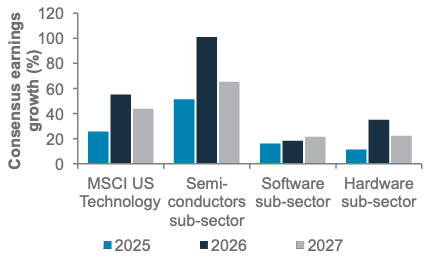
Rationale: The recent pullback in US semiconductor stocks has improved their risk-reward profile. Earnings for these companies are forecast to grow by 65% in 2027, the fastest rate among technology subsectors. Despite this outlook, recent regulatory and corporate governance concerns are weighing on sentiment. Potential state-level restrictions on data centre development following the recent US mid-term election results could weigh on semiconductor demand growth. However, we believe these risks are manageable and continued AI adoption should support demand for AI inference. We prefer diversified exposure to quality semiconductor companies with durable demand and strong volume growth.
To navigate volatility in the US technology sector, we favour Big Tech companies with strong balance sheets and resilient cash generation, as they are better positioned to sustain AI investments without relying heavily on external financing. Our US IT opportunistic idea combines these preferences through exposure to semiconductors, software and hardware, allowing investors to participate in a potential recovery across a broader range of earnings drivers.
— Ryan Goh, Investment Strategist
The semiconductor segment is expected to continue to lead US technology earnings growth in 2027
Consensus earnings growth (y/y) by US technology subsector, 2025-27 (%)
Source: FactSet, Standard Chartered
Top client questions (cont’d)
Do fundamental drivers support a constructive view on the US healthcare sector?
Our view: We remain constructive on US healthcare, supported by its defensive characteristics and robust earnings growth.
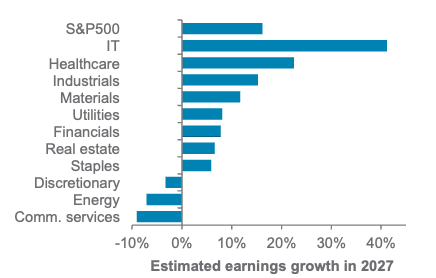
Rationale: US healthcare earnings are projected to grow by 22.5% in 2027, the second-fastest among MSCI US sectors, driven by improving biopharma earnings. The US healthcare sector’s valuation gap against the broader market has been recovering from a steep historical discount a year ago. The sector’s forward price-to-earnings (P/E) ratio of c. 20x now exceeds the broader US market’s c. 18.4x, but we see scope for the valuation to be supported amid investor demand for defensive growth. The sector’s broad legislative policy overhang has materially faded following the US election cycle, while targeted regulatory and oversight risks remain on the watchlist.
Healthcare innovation also underpins structural growth. Wider adoption of obesity and diabetes treatments, alongside advances in oncology treatments, medical devices and robotic surgery, should support long-term earnings growth. With the market rotating away from concentrated AI exposure, healthcare’s stable, non-cyclical demand profile presents compelling opportunities for investors seeking both defensiveness and growth in the near term.
— Jason Wong, Senior Equity Analyst
US healthcare sector earnings are projected to grow 22.5% in 2027 – the second-fastest among MSCI US sectors
Consensus 2027 earnings growth by sector in the S&P500 Index
Source: LSEG I/B/E/S, Standard Chartered
What is your outlook for China’s Big Tech sector?
Our view: We remain positive on China’s Big Tech sector, consistent with our Overweight stance on the country’s IT and communication services sector.
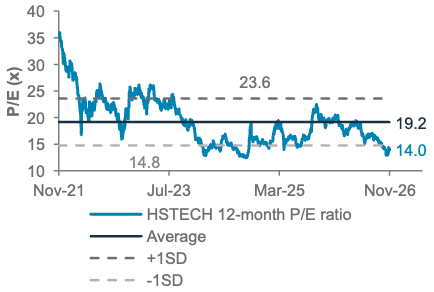
Rationale: Valuations across China’s technology sector remain inexpensive at 14.2x, with investor attention centred on whether AI-driven revenue can offset elevated AI-related spending, which is currently compressing margins. Elevated AI capex and negative free cash flow remain key investor concerns in the Q3 earnings season. Top-line momentum also remains uneven: soft domestic consumption continues to weigh on e-commerce, advertising and local services, whereas gaming and cloud computing are delivering resilient growth. The broader narrative is steadily transitioning towards commercialisation, with rapid enterprise penetration by AI workplace agents and upcoming AI model launches shifting the market focus towards active deployment and conversion to paid usage. Evolving regulatory frameworks covering AI governance, agent self-regulation, tax scrutiny and compliance requirements remain important variables influencing medium-term margin trajectories. Ultimately, valuation support, gradual monetisation of AI capabilities and resilient core segments support our Overweight positioning.
— Cindy Lam, CFA, Senior Investment Strategist
China’s technology sector valuations remain inexpensive at 14.2x, nearly 1 standard deviation below the mean
Hang Seng Technology (HSTECH Index) 12-month forward P/E ratio
Source: Bloomberg, Standard Chartered
Top client questions (cont’d)
Why are you closing your US Treasury Inflation-Protected Securities (TIPS) opportunistic idea?
Our view: We are closing our opportunistic bullish US TIPS position, as the risk-reward profile has become less compelling. The trade returned 4.4% since its initiation on 11 April 2025.
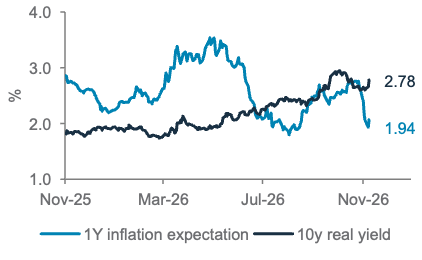
Rationale: We initiated an opportunistic bullish position in US TIPS on 11 April 2025 as an oil and inflation hedge, expecting geopolitical uncertainty to keep inflation expectations elevated. The risk-reward, however, has since become less compelling, as hawkish Fed commentary, easing geopolitical risks and a potential slowdown in the pace of AI buildout are now likely to ease broader inflation and ‘techflation’ pressures. We have therefore closed the opportunistic idea, realising a gain of 4.4%.
— Cedric Lam, Senior Investment Strategist
While real (net-of-inflation) yields remain elevated, the inflation-protection function of US TIPS has diminished as inflation expectations ease
One-year USD inflation swap, 10-year US real yield
Source: Bloomberg, Standard Chartered
How do falling oil prices and October’s US inflation data affect your Fed and bond market outlook?
Our view: Our base case envisages two further 25bps Fed hikes by mid-2027, with scope for cuts in H2 2027 if energy prices remain consistently lower and growth trajectory normalises. We favour income over chasing duration gains, focusing on higher-quality corporate bonds with 3-7-year maturities.
Rationale: Lower oil prices have a two-sided effect: they ease inflationary pressures and support growth by boosting purchasing power and lowering business costs. Cheaper energy, therefore, does not automatically justify Fed easing. Our base case envisages two further 25bps hikes by mid-2027, with scope for cuts in H2 2027 if energy prices remain consistently lower. Sustained moderation in core inflation would challenge the near-term tightening path. However, October’s US consumer inflation print reinforced our assessment that each Fed meeting now remains a ‘live’ decision.
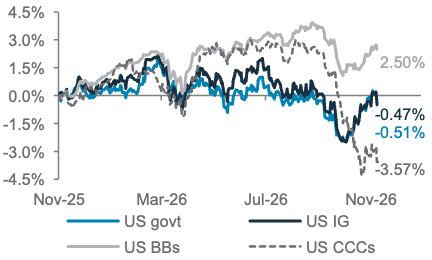
With the US 10-year government bond yield already within our 5.0-5.25% 3-month range, we favour income over chasing duration gains. Credit performance has diverged: Developed Market high-yield bonds have outperformed both investment-grade credit and government bonds. Credit still offers attractive income, and we retain our preference for 3-7-year maturities, although heavy primary issuance remains a counterweight. We favour selective carry, with a preference for higher-quality corporate bonds. These include bonds issued by leading AI hyperscalers, where risk-reward has become more attractive. Our emphasis is on generating steady income, rather than relying on further declines in bond yields or spreads.
— Cedric Lam, Senior Investment Strategist
Corporate bonds still offer attractive income, but fundamental quality matters
Total returns of Bloomberg US government, US investment-grade corporate, US BB-rated high-yield and US CCC-rated high-yield indices over the last 12 months
Source: Bloomberg, Standard Chartered
Top client questions (cont’d)
Does the USD’s rally have further to run?
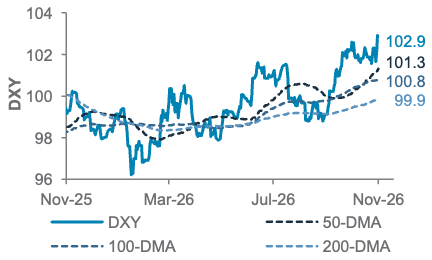
Our view: Further upside appears limited. Stronger-than-expected US core inflation in October and hawkish Fed comments have pushed the US Dollar Index (DXY) above 103. However, markets already price in more Fed tightening than we expect. We see the DXY returning to its 101.00-102.95 range in the near term, before gradually weakening towards our 12-month forecast of 98.5.
Rationale: US core consumer prices rose 0.3% m/m in October, above the 0.2% m/m expected, meeting Fed Governor Waller’s threshold for considering a 50bps December rate hike. This pushed US government bond yields higher, supporting the USD rally. However, futures now imply a Fed rate peak of 4.50-4.75% by mid-2027, compared with our expectation of 4.25-4.50% following two 25bps hikes, one in December and the second in H1 2027. We expect the Fed to begin easing in H2 2027. As market expectations gradually converge towards our view, USD support from US bond yields should weaken.
Meanwhile, falling oil and petrol prices should help ease headline inflation in the coming months, reducing pressure for further Fed tightening. This reinforces our expectation of limited USD upside, although persistent services inflation remains a key risk.
— Vincent Tan, Senior Investment Strategist
US dollar index’s rally above 103 looks stretched
USD index (DXY) and technicals
Source: Bloomberg, Standard Chartered
Do you expect USD/JPY to sustainably break out above 160 in the near term?
Our view: We see USD/JPY rangebound with a downside bias, as growing BoJ tightening expectations and potential policy convergence will support gradual JPY appreciation.
Rationale: Renewed tech optimism has encouraged the re-establishment of carry trades, providing support to the pair lately. Meanwhile, US core inflation beat expectations for a third consecutive month in October, reinforcing expectations for a December Fed hike. Further upside inflation surprises could widen the US-Japan interest rate differential and push USD/JPY higher.
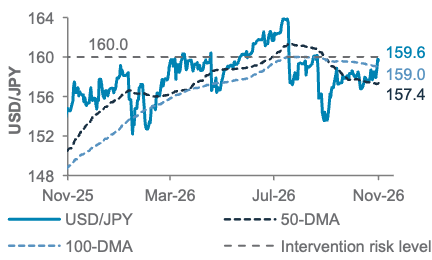
However, the risk of intervention by Japan’s Ministry of Finance is likely to rise materially around 160, limiting the scope for sustained upside. On the downside, a 25bps BoJ hike to 1.50%, accompanied by clear signals of consecutive hikes in March and June 2027, would be a significant yen-positive catalyst. A more non-linear downside scenario would be a disorderly equity sell-off, which could trigger rapid JPY appreciation through carry-trade unwinding. We see scope for the pair to test support towards 156 in the coming weeks.
— Iris Yuen, Investment Strategist
USD/JPY is exposed to intervention risk
USD/JPY and technical indicators
Source: Bloomberg, Standard Chartered
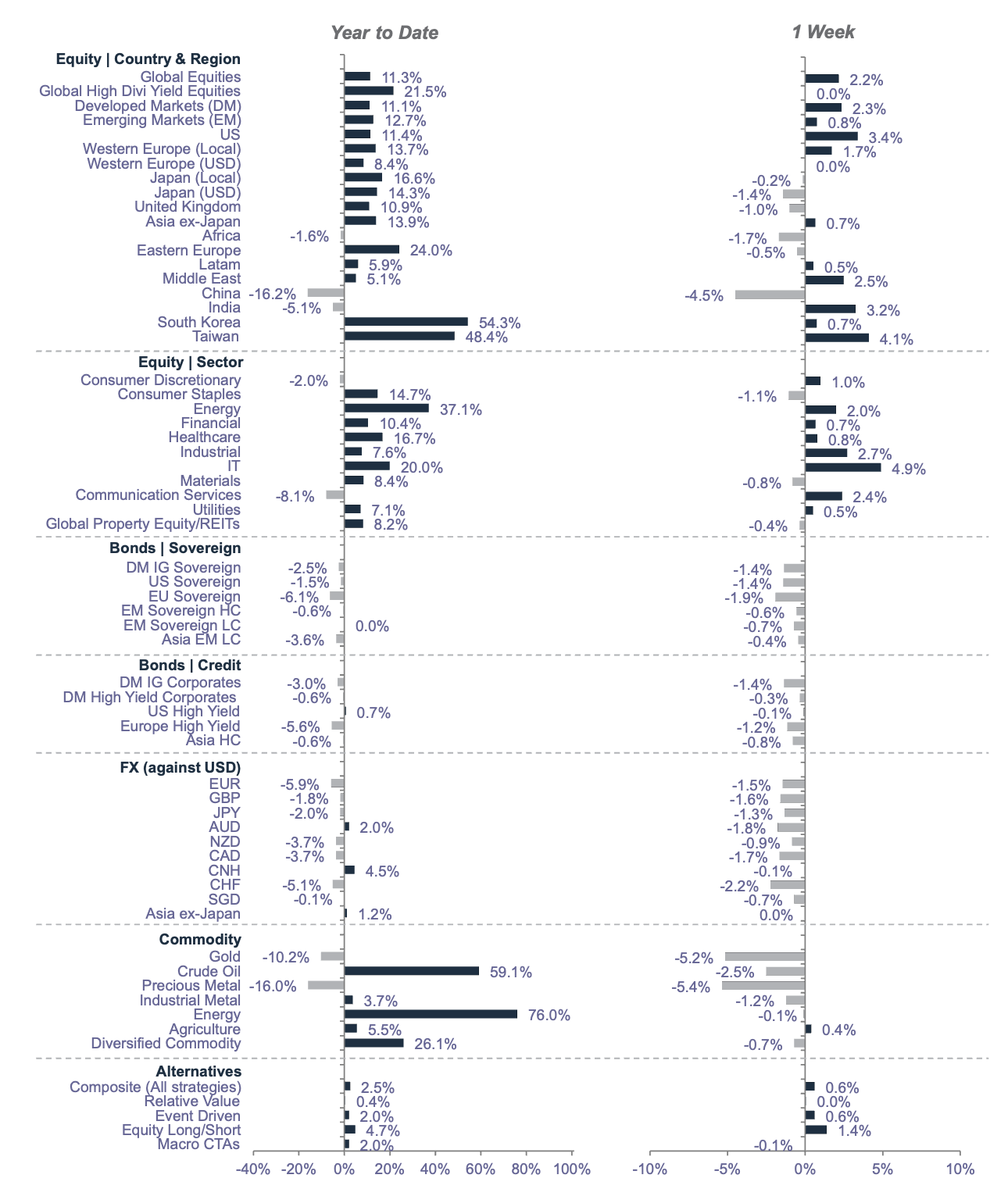
Market performance summary*
Sources: MSCI, JP Morgan, Barclays Capital, Citigroup, Dow Jones, HFRX, FTSE, Bloomberg, Standard Chartered
*Performance in USD terms unless otherwise stated, 2026 YTD performance from 31 December 2025 to 12 November 2026; 1-week period: 5 November 2026 to 12 November 2026
Our 12-month asset class views at a glance
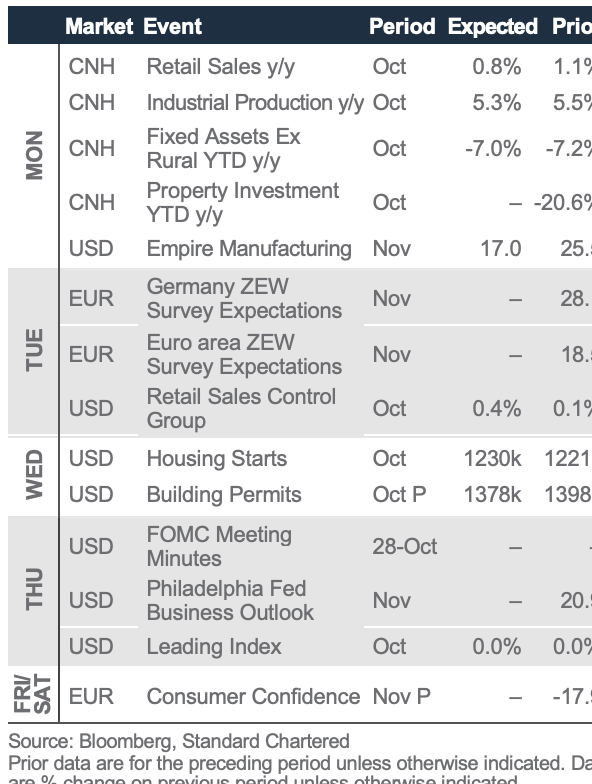
Economic and market calendar
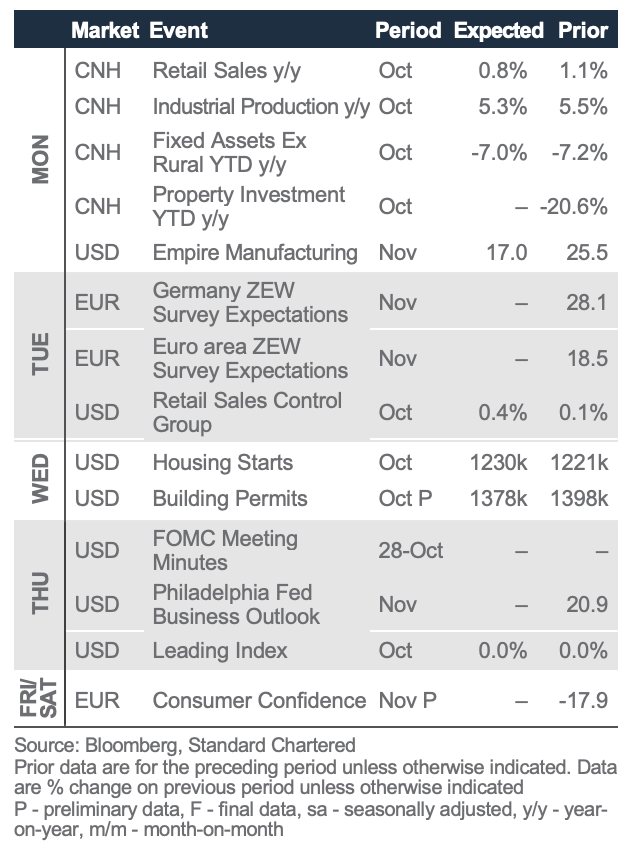
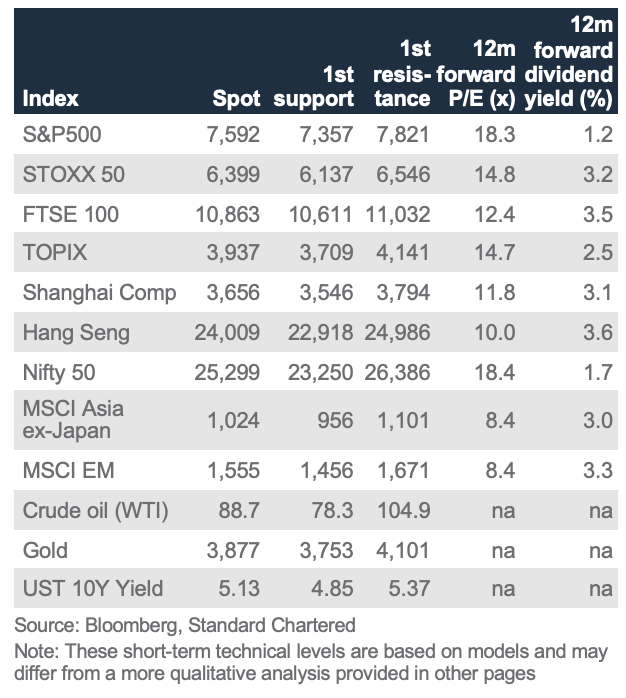
The S&P500 has next interim resistance at 7,821
Technical indicators for key markets as of 12 Nov close
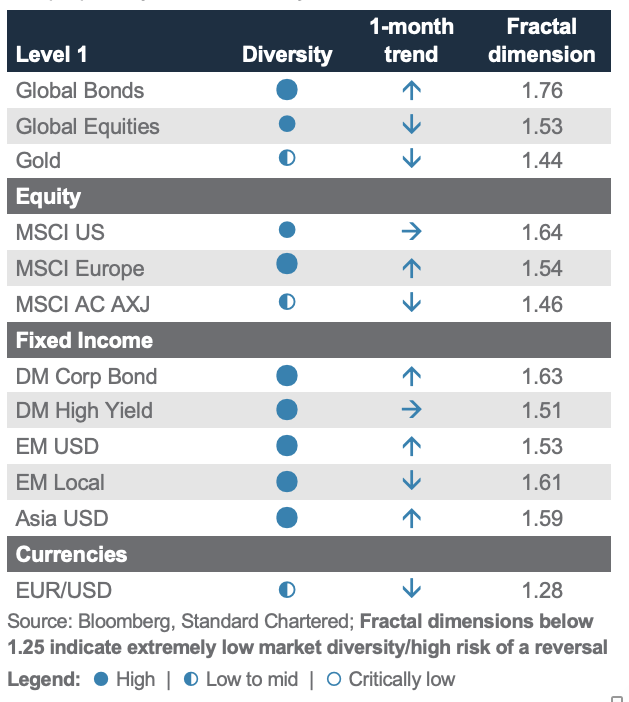
Investor diversity has normalised across asset classes
Our proprietary market diversity indicators as of 12 Nov close
Disclosure
This document is confidential and may also be privileged. If you are not the intended recipient, please destroy all copies and notify the sender immediately. This document is being distributed for general information only and is subject to the relevant disclaimers available at our Standard Chartered website under Regulatory disclosures. It is not and does not constitute research material, independent research, an offer, recommendation or solicitation to enter into any transaction or adopt any hedging, trading or investment strategy, in relation to any securities or other financial instruments. This document is for general evaluation only. It does not take into account the specific investment objectives, financial situation or particular needs of any particular person or class of persons and it has not been prepared for any particular person or class of persons. You should not rely on any contents of this document in making any investment decisions. Before making any investment, you should carefully read the relevant offering documents and seek independent legal, tax and regulatory advice. In particular, we recommend you to seek advice regarding the suitability of the investment product, taking into account your specific investment objectives, financial situation or particular needs, before you make a commitment to purchase the investment product. Opinions, projections and estimates are solely those of SC at the date of this document and subject to change without notice. Past performance is not indicative of future results and no representation or warranty is made regarding future performance. The value of investments, and the income from them, can go down as well as up, and you may not recover the amount of your original investment. You are not certain to make a profit and may lose money. Any forecast contained herein as to likely future movements in rates or prices or likely future events or occurrences constitutes an opinion only and is not indicative of actual future movements in rates or prices or actual future events or occurrences (as the case may be). This document must not be forwarded or otherwise made available to any other person without the express written consent of the Standard Chartered Group (as defined below). Standard Chartered Bank is incorporated in England with limited liability by Royal Charter 1853 Reference Number ZC18. The Principal Office of the Company is situated in England at 1 Basinghall Avenue, London, EC2V 5DD. Standard Chartered Bank is authorised by the Prudential Regulation Authority and regulated by the Financial Conduct Authority and Prudential Regulation Authority. Standard Chartered PLC, the ultimate parent company of Standard Chartered Bank, together with its subsidiaries and affiliates (including each branch or representative office), form the Standard Chartered Group. Standard Chartered Global Private Bank is the private banking division of Standard Chartered. Private banking activities may be carried out internationally by different legal entities and affiliates within the Standard Chartered Group (each an “SC Group Entity”) according to local regulatory requirements. Not all products and services are provided by all branches, subsidiaries and affiliates within the Standard Chartered Group. Some of the SC Group Entities only act as representatives of Standard Chartered Global Private Bank and may not be able to offer products and services or offer advice to clients.
Copyright © 2026, Accounting Research & Analytics, LLC d/b/a CFRA (and its affiliates, as applicable). Reproduction of content provided by CFRA in any form is prohibited except with the prior written permission of CFRA. CFRA content is not investment advice and a reference to or observation concerning a security or investment provided in the CFRA SERVICES is not a recommendation to buy, sell or hold such investment or security or make any other investment decisions. The CFRA content contains opinions of CFRA based upon publicly-available information that CFRA believes to be reliable and the opinions are subject to change without notice. This analysis has not been submitted to, nor received approval from, the United States Securities and Exchange Commission or any other regulatory body. While CFRA exercised due care in compiling this analysis, CFRA, ITS THIRD-PARTY SUPPLIERS, AND ALL RELATED ENTITIES SPECIFICALLY DISCLAIM ALL WARRANTIES, EXPRESS OR IMPLIED, INCLUDING, BUT NOT LIMITED TO, ANY WARRANTIES OF MERCHANTABILITY OR FITNESS FOR A PARTICULAR PURPOSE OR USE, to the full extent permitted by law, regarding the accuracy, completeness, or usefulness of this information and assumes no liability with respect to the consequences of relying on this information for investment or other purposes. No content provided by CFRA (including ratings, credit-related analyses and data, valuations, model, software or other application or output therefrom) or any part thereof may be modified, reverse engineered, reproduced or distributed in any form by any means, or stored in a database or retrieval system, without the prior written permission of CFRA, and such content shall not be used for any unlawful or unauthorized purposes. CFRA and any third-party providers, as well as their directors, officers, shareholders, employees or agents do not guarantee the accuracy, completeness, timeliness or availability of such content. In no event shall CFRA, its affiliates, or their third-party suppliers be liable for any direct, indirect, special, or consequential damages, costs, expenses, legal fees, or losses (including lost income or lost profit and opportunity costs) in connection with a subscriber’s, subscriber’s customer’s, or other’s use of CFRA’s content.
Market Abuse Regulation (MAR) Disclaimer
Banking activities may be carried out internationally by different branches, subsidiaries and affiliates within the Standard Chartered Group according to local regulatory requirements. Opinions may contain outright “buy”, “sell”, “hold” or other opinions. The time horizon of this opinion is dependent on prevailing market conditions and there is no planned frequency for updates to the opinion. This opinion is not independent of Standard Chartered Group’s trading strategies or positions. Standard Chartered Group and/or its affiliates or its respective officers, directors, employee benefit programmes or employees, including persons involved in the preparation or issuance of this document may at any time, to the extent permitted by applicable law and/or regulation, be long or short any securities or financial instruments referred to in this document or have material interest in any such securities or related investments. Therefore, it is possible, and you should assume, that Standard Chartered Group has a material interest in one or more of the financial instruments mentioned herein. Please refer to our Standard Chartered website under Regulatory disclosures for more detailed disclosures, including past opinions/ recommendations in the last 12 months and conflict of interests, as well as disclaimers. A covering strategist may have a financial interest in the debt or equity securities of this company/issuer. All covering strategist are licensed to provide investment recommendations under Monetary Authority of Singapore or Hong Kong Monetary Authority. This document must not be forwarded or otherwise made available to any other person without the express written consent of Standard Chartered Group.
Sustainable Investments
Any ESG data used or referred to has been provided by Morningstar, Sustainalytics, MSCI or Bloomberg. Refer to 1) Morningstar website under Sustainable Investing, 2) Sustainalytics website under ESG Risk Ratings, 3) MCSI website under ESG Business Involvement Screening Research and 4) Bloomberg green, social & sustainability bonds guide for more information. The ESG data is as at the date of publication based on data provided, is for informational purpose only and is not warranted to be complete, timely, accurate or suitable for a particular purpose, and it may be subject to change. The ESG data providers may not provide data coverage of all companies or securities in our Sustainable Investment Universe or Fund Select funds. As a result, a small subset of companies or securities will not be in scope for exclusionary screening. Sustainable Investments (SI): This refers to funds that have been classified as ‘ESG Intentional Investments – Overall’ by Morningstar. SI funds have explicitly stated in their prospectus and regulatory filings that they either incorporate ESG factors into the investment process or have a thematic focus on the environment, gender diversity, low carbon, renewable energy, water or community development. For equity, it refers to shares/stocks issued by companies with Sustainalytics ESG Risk Rating of Low/Negligible. For bonds, it refers to debt instruments issued by issuers with Sustainalytics ESG Risk Rating of Low/Negligible, and/or those being certified green, social, sustainable bonds by Bloomberg. For structured products, it refers to products that are issued by any issuer who has a Sustainable Finance framework that aligns with Standard Chartered’s Green and Sustainable Product Framework, with underlying assets that are part of the Sustainable Investment universe or separately approved by Standard Chartered’s Sustainable Finance Governance Committee. Sustainalytics ESG risk ratings shown are factual and are not an indicator that the product is classified or marketed as “green”, “sustainable” or similar under any particular classification system or framework.
Shariah (“Shariah Compliant or Shariah Compliance”)
For any reason to enter only into transactions which comply or are consistent with the principles of the Shariah, the client certifies that he/she/it has made his /her/its own investigation into and satisfied itself as to the Shariah compliance of the Islamic security and all necessary action to confirm that the Islamic security is Shariah compliant has been taken (including the obtaining of a fatwa, where required) and the Client will not claim any dispute on the grounds of any lack of Shariah compliance of these investments. The Client has not relied on Standard Chartered Group or any written declaration, fatwa, opinion or other documents prepared by, on behalf or at the request of Standard Chartered Group for the purposes of a determination or confirmation that these instruments are Shariah compliant.
Country/Market Specific Disclosures
Bahrain: This document is being distributed in Bahrain by Standard Chartered Bank, Bahrain Branch, having its address at P.O. 29, Manama, Kingdom of Bahrain, is a branch of Standard Chartered Bank and is licensed by the Central Bank of Bahrain as a conventional retail bank. Botswana: This document is being distributed in Botswana by, and is attributable to, Standard Chartered Bank Botswana Limited which is a financial institution licensed under the Section 6 of the Banking Act CAP 46.04 and is listed in the Botswana Stock Exchange. Brunei Darussalam: This document is being distributed in Brunei Darussalam by, and is attributable to, Standard Chartered Bank (Brunei Branch) | Registration Number RFC/61 and Standard Chartered Securities (B) Sdn Bhd | Registration Number RC20001003. Standard Chartered Bank is incorporated in England with limited liability by Royal Charter 1853 Reference Number ZC18. Standard Chartered Securities (B) Sdn Bhd is a limited liability company registered with the Registry of Companies with Registration Number RC20001003 and licensed by Brunei Darussalam Central Bank as a Capital Markets Service License Holder with License Number BDCB/R/CMU/S3-CL and it is authorised to conduct Islamic investment business through an Islamic window. China Mainland: This document is being distributed in China by, and is attributable to, Standard Chartered Bank (China) Limited which is mainly regulated by National Financial Regulatory Administration (NFRA), State Administration of Foreign Exchange (SAFE), and People’s Bank of China (PBOC). Hong Kong: In Hong Kong, this document, except for any portion advising on or facilitating any decision on futures contracts trading, is distributed by Standard Chartered Bank (Hong Kong) Limited (“SCBHK”), a subsidiary of Standard Chartered PLC. SCBHK has its registered address at 32/F, Standard Chartered Bank Building, 4-4A Des Voeux Road Central, Hong Kong and is regulated by the Hong Kong Monetary Authority and registered with the Securities and Futures Commission (“SFC”) to carry on Type 1 (dealing in securities), Type 4 (advising on securities), Type 6 (advising on corporate finance) and Type 9 (asset management) regulated activity under the Securities and Futures Ordinance (Cap. 571) (“SFO”) (CE No. AJI614). The contents of this document have not been reviewed by any regulatory authority in Hong Kong and you are advised to exercise caution in relation to any offer set out herein. If you are in doubt about any of the contents of this document, you should obtain independent professional advice. Any product named herein may not be offered or sold in Hong Kong by means of any document at any time other than to “professional investors” as defined in the SFO and any rules made under that ordinance. In addition, this document may not be issued or possessed for the purposes of issue, whether in Hong Kong or elsewhere, and any interests may not be disposed of, to any person unless such person is outside Hong Kong or is a “professional investor” as defined in the SFO and any rules made under that ordinance, or as otherwise may be permitted by that ordinance. In Hong Kong, Standard Chartered Global Private Bank is the private banking division of SCBHK, a subsidiary of Standard Chartered PLC. Ghana: Standard Chartered Bank Ghana Limited accepts no liability and will not be liable for any loss or damage arising directly or indirectly (including special, incidental or consequential loss or damage) from your use of these documents. Past performance is not indicative of future results and no representation or warranty is made regarding future performance. You should seek advice from a financial adviser on the suitability of an investment for you, taking into account these factors before making a commitment to invest in an investment. To unsubscribe from receiving further updates, please send an email to feedback.ghana@sc.com. Please do not reply to this email. Call our Priority Banking on 0302610750 for any questions or service queries. You are advised not to send any confidential and/or important information to Standard Chartered via e-mail, as Standard Chartered makes no representations or warranties as to the security or accuracy of any information transmitted via e-mail. Standard Chartered shall not be responsible for any loss or damage suffered by you arising from your decision to use e-mail to communicate with the Bank. India: Standard Chartered Bank, India (“Bank”) (ARN-1209) is an AMFI-registered distributor of select Mutual Funds and a referrer of certain third-party financial products. The Bank is not registered with SEBI as an Investment Adviser and does not provide investment advisory services or financial planning services as defined under the SEBI (Investment Advisers) Regulations, 2013. Any information contained herein is for informational purposes only and should not be construed as investment advice, recommendation, research report, or an offer to buy or sell any security or financial product. Mutual Fund investments are subject to market risks. Please read all scheme-related documents carefully before investing. The services/products described herein are not intended for any person resident in a jurisdiction where their distribution, solicitation or use would be contrary to local laws or regulations. Indonesia: This document is being distributed in Indonesia by Standard Chartered Bank, Indonesia branch, which is a financial institution licensed and supervised by Otoritas Jasa Keuangan (Financial Service Authority) and Bank Indonesia. Jersey: The Jersey Branch of Standard Chartered Bank is regulated by the Jersey Financial Services Commission. Copies of the latest audited accounts of Standard Chartered Bank are available from its principal place of business in Jersey: PO Box 80, 15 Castle Street, St Helier, Jersey JE4 8PT. Standard Chartered Bank is incorporated in England with limited liability by Royal Charter in 1853 Reference Number ZC 18. The Principal Office of the Company is situated in England at 1 Basinghall Avenue, London, EC2V 5DD. Standard Chartered Bank is authorised by the Prudential Regulation Authority and regulated by the Financial Conduct Authority and Prudential Regulation Authority. The Jersey Branch of Standard Chartered Bank is also an authorised financial services provider under license number 44946 issued by the Financial Sector Conduct Authority of the Republic of South Africa. Jersey is not part of the United Kingdom, and all business transacted with Standard Chartered Bank, Jersey Branch and other Standard Chartered Group Offices outside of the United Kingdom, are not subject to some or any of the investor protection and compensation schemes available under United Kingdom law. Kenya: This document is being distributed in Kenya by and is attributable to Standard Chartered Bank Kenya Limited. Investment Products and Services are distributed by Standard Chartered Investment Services Limited, a wholly owned subsidiary of Standard Chartered Bank Kenya Limited that is licensed by the Capital Markets Authority in Kenya, as a Fund Manager. Standard Chartered Bank Kenya Limited is regulated by the Central Bank of Kenya. Malaysia: This document is being distributed in Malaysia by Standard Chartered Bank Malaysia Berhad (“SCBMB”). Recipients in Malaysia should contact SCBMB in relation to any matters arising from, or in connection with, this document. This document has not been reviewed by the Securities Commission Malaysia. The product lodgement, registration, submission or approval by the Securities Commission of Malaysia does not amount to nor indicate recommendation or endorsement of the product, service or promotional activity. Investment products are not deposits and are not obligations of, not guaranteed by, and not protected by SCBMB or any of the affiliates or subsidiaries, or by Perbadanan Insurans Deposit Malaysia, any government or insurance agency. Investment products are subject to investment risks, including the possible loss of the principal amount invested. SCBMB expressly disclaim any liability and responsibility for any loss arising directly or indirectly (including special, incidental or consequential loss or damage) arising from the financial losses of the Investment Products due to market condition. Nigeria: This document is being distributed in Nigeria by Standard Chartered Bank Nigeria Limited (SCB Nigeria), a bank duly licensed and regulated by the Central Bank of Nigeria. SCB Nigeria accepts no liability for any loss or damage arising directly or indirectly (including special, incidental or consequential loss or damage) from your use of these documents. You should seek advice from a financial adviser on the suitability of an investment for you, taking into account these factors before making a commitment to invest in an investment. To unsubscribe from receiving further updates, please send an email to clientcare.ng@sc.com requesting to be removed from our mailing list. Please do not reply to this email. Call our Priority Banking on 02 012772514 for any questions or service queries. SCB Nigeria shall not be responsible for any loss or damage arising from your decision to send confidential and/or important information to Standard Chartered via e-mail. SCB Nigeria makes no representations or warranties as to the security or accuracy of any information transmitted via e-mail. Pakistan: This document is being distributed in Pakistan by, and attributable to Standard Chartered Bank (Pakistan) Limited having its registered office at PO Box 5556, I.I Chundrigar Road Karachi, which is a banking company registered with State Bank of Pakistan under Banking Companies Ordinance 1962 and is also having licensed issued by Securities & Exchange Commission of Pakistan for Security Advisors. Standard Chartered Bank (Pakistan) Limited acts as a distributor of mutual funds and referrer of other third-party financial products. Singapore: This document is being distributed in Singapore by, and is attributable to, Standard Chartered Bank (Singapore) Limited (Registration No. 201224747C/ GST Group Registration No. MR-8500053-0, “SCBSL”). Recipients in Singapore should contact SCBSL in relation to any matters arising from, or in connection with, this document. SCBSL is an indirect wholly owned subsidiary of Standard Chartered Bank and is licensed to conduct banking business in Singapore under the Singapore Banking Act, 1970. Standard Chartered Global Private Bank is the private banking division of SCBSL. IN RELATION TO ANY SECURITY OR SECURITIES-BASED DERIVATIVES CONTRACT REFERRED TO IN THIS DOCUMENT, THIS DOCUMENT, TOGETHER WITH THE ISSUER DOCUMENTATION, SHALL BE DEEMED AN INFORMATION MEMORANDUM (AS DEFINED IN SECTION 275 OF THE SECURITIES AND FUTURES ACT, 2001 (“SFA”)). THIS DOCUMENT IS INTENDED FOR DISTRIBUTION TO ACCREDITED INVESTORS, AS DEFINED IN SECTION 4A(1)(a) OF THE SFA, OR ON THE BASIS THAT THE SECURITY OR SECURITIES-BASED DERIVATIVES CONTRACT MAY ONLY BE ACQUIRED AT A CONSIDERATION OF NOT LESS THAN S$200,000 (OR ITS EQUIVALENT IN A FOREIGN CURRENCY) FOR EACH TRANSACTION. Further, in relation to any security or securities-based derivatives contract, neither this document nor the Issuer Documentation has been registered as a prospectus with the Monetary Authority of Singapore under the SFA. Accordingly, this document and any other document or material in connection with the offer or sale, or invitation for subscription or purchase, of the product may not be circulated or distributed, nor may the product be offered or sold, or be made the subject of an invitation for subscription or purchase, whether directly or indirectly, to persons other than a relevant person pursuant to section 275(1) of the SFA, or any person pursuant to section 275(1A) of the SFA, and in accordance with the conditions specified in section 275 of the SFA, or pursuant to, and in accordance with the conditions of, any other applicable provision of the SFA. In relation to any collective investment schemes referred to in this document, this document is for general information purposes only and is not an offering document or prospectus (as defined in the SFA). This document is not, nor is it intended to be (i) an offer or solicitation of an offer to buy or sell any capital markets product; or (ii) an advertisement of an offer or intended offer of any capital markets product. Deposit Insurance Scheme: Singapore dollar deposits of non-bank depositors are insured by the Singapore Deposit Insurance Corporation, for up to S$100,000 in aggregate per depositor per Scheme member by law. Foreign currency deposits, dual currency investments, structured deposits and other investment products are not insured. This advertisement has not been reviewed by the Monetary Authority of Singapore. Taiwan: SC Group Entity or Standard Chartered Bank (Taiwan) Limited (“SCB (Taiwan)”) may be involved in the financial instruments contained herein or other related financial instruments. The author of this document may have discussed the information contained herein with other employees or agents of SC or SCB (Taiwan). The author and the above-mentioned employees of SC or SCB (Taiwan) may have taken related actions in respect of the information involved (including communication with customers of SC or SCB (Taiwan) as to the information contained herein). The opinions contained in this document may change, or differ from the opinions of employees of SC or SCB (Taiwan). SC and SCB (Taiwan) will not provide any notice of any changes to or differences between the above-mentioned opinions. This document may cover companies with which SC or SCB (Taiwan) seeks to do business at times and issuers of financial instruments. Therefore, investors should understand that the information contained herein may serve as specific purposes as a result of conflict of interests of SC or SCB (Taiwan). SC, SCB (Taiwan), the employees (including those who have discussions with the author) or customers of SC or SCB (Taiwan) may have an interest in the products, related financial instruments or related derivative financial products contained herein; invest in those products at various prices and on different market conditions; have different or conflicting interests in those products. The potential impacts include market makers’ related activities, such as dealing, investment, acting as agents, or performing financial or consulting services in relation to any of the products referred to in this document. UAE: DIFC – Standard Chartered Bank is incorporated in England with limited liability by Royal Charter 1853 Reference Number ZC18.The Principal Office of the Company is situated in England at 1 Basinghall Avenue, London, EC2V 5DD. Standard Chartered Bank is authorised by the Prudential Regulation Authority and regulated by the Financial Conduct Authority and Prudential Regulation Authority. Standard Chartered Bank, Dubai International Financial Centre having its offices at Dubai International Financial Centre, Building 1, Gate Precinct, P.O. Box 999, Dubai, UAE is a branch of Standard Chartered Bank and is regulated by the Dubai Financial Services Authority (“DFSA”). This document is intended for use only by Professional Clients and is not directed at Retail Clients as defined by the DFSA Rulebook. In the DIFC we are authorised to provide financial services only to clients who qualify as Professional Clients and Market Counterparties and not to Retail Clients. As a Professional Client you will not be given the higher retail client protection and compensation rights and if you use your right to be classified as a Retail Client we will be unable to provide financial services and products to you as we do not hold the required license to undertake such activities. For Islamic transactions, we are acting under the supervision of our Shariah Supervisory Committee. Relevant information on our Shariah Supervisory Committee is currently available on the Standard Chartered Bank website in the Islamic banking section. For residents of the UAE – Standard Chartered UAE (“SC UAE”) is licensed by the Central Bank of the U.A.E. SC UAE is licensed by Securities and Commodities Authority to practice Promotion Activity. SC UAE does not provide financial analysis or consultation services in or into the UAE within the meaning of UAE Securities and Commodities Authority Decision No. 48/r of 2008 concerning financial consultation and financial analysis. Uganda: Our Investment products and services are distributed by Standard Chartered Bank Uganda Limited, which is licensed by the Capital Markets Authority as an investment adviser. United Kingdom: In the UK, Standard Chartered Bank is authorised by the Prudential Regulation Authority and regulated by the Financial Conduct Authority and Prudential Regulation Authority. This communication has been approved by Standard Chartered Bank for the purposes of Section 21 (2) (b) of the United Kingdom’s Financial Services and Markets Act 2000 (“FSMA”) as amended in 2010 and 2012 only. Standard Chartered Bank (trading as Standard Chartered Global Private Bank) is also an authorised financial services provider (license number 45747) in terms of the South African Financial Advisory and Intermediary Services Act, 2002. The Materials have not been prepared in accordance with UK legal requirements designed to promote the independence of investment research, and that it is not subject to any prohibition on dealing ahead of the dissemination of investment research. Vietnam: This document is being distributed in Vietnam by, and is attributable to, Standard Chartered Bank (Vietnam) Limited which is mainly regulated by State Bank of Vietnam (SBV). Recipients in Vietnam should contact Standard Chartered Bank (Vietnam) Limited for any queries regarding any content of this document. Zambia: This document is distributed by Standard Chartered Bank Zambia Plc, a company incorporated in Zambia and registered as a commercial bank and licensed by the Bank of Zambia under the Banking and Financial Services Act Chapter 387 of the Laws of Zambia.