

27 November 2026
Weekly Market View
Upgrading equities,
downgrading gold
US equity volatility has returned to levels previously seen during last year’s Liberation Day tariffs. The downturn in US equities from their October record high has taken valuations back to 2022 bear market levels.
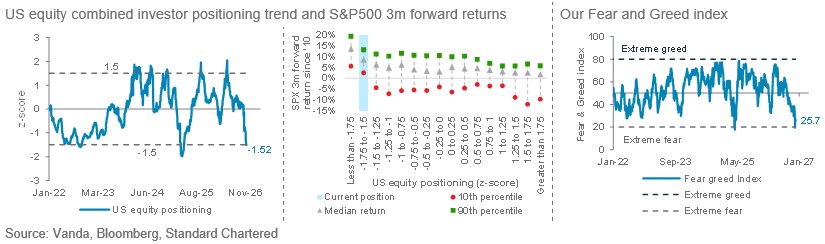
Our quantitative models still signal caution, but investor positioning and sentiment suggest the market is oversold, with potential for strong forward returns, based on history.
Having stayed Neutral through the sell-off, we are raising global equities to Overweight as valuations improve. President Trump’s intervention at Nvidia reinforces our view that AI spending remains central to the US growth outlook.
We are also cutting gold to a Neutral allocation in our balanced foundation portfolio. However, gold’s long-term case remains intact investors with a long-term horizon who are below their target weight can use the recent sell-off to average in.
What would signal US tech equities are stabilising?
How does the recent US and European data impact your rates and credit strategy?
Could a recovery in risk sentiment weaken CHF and JPY?
Charts of the week: Downbeat investor positioning, sentiment
Investor positioning and sentiment indicators suggest limited further downside in US equities
Editorial
Upgrading equities, downgrading gold
Strategy summary: US equity volatility has returned to levels previously seen during last year’s Liberation Day tariffs. Three factors drove the spike: uncertainty over AI spending after the Democrats’ landslide mid-term victory, Nvidia CEO Jensen Huang’s abrupt departure and reinstatement less than two weeks later, and concern that reaccelerating inflation could prompt a more aggressive Fed response.
The sharp downturn in US equities from their October record high has taken valuations back to 2022 bear market levels. Our quantitative models still signal caution, but investor positioning and sentiment suggest the market is oversold. Having stayed Neutral through the sell-off, we are raising global equities to Overweight as valuations improve. President Trump’s intervention at Nvidia reinforces our view that AI spending remains central to the US growth outlook. We are also cutting gold to a Neutral allocation in our balanced foundation portfolio.
Upgrading global equities to Overweight: We cut global equities to Neutral in our foundation asset allocation in late October, because market breadth was narrowing and we expected volatility around the US mid-terms. That move helped cushion the portfolio against the subsequent sell-off. Despite the Democrats’ landslide, we still expect AI spending to grow, though more slowly than over the past three years. Our forecast for AI capex remains below consensus, but we think the sell-off prices in a sharper spending cut than is warranted (page 4).
Criticality of AI capex to US growth. President Trump’s intervention in Nvidia’s leadership underscores the importance of AI investment to US growth and competitiveness with China. S&P500 valuations are now 11% below their 10-year average, 2027 earnings growth outlook remains resilient, while sentiment and positioning suggest strong 3-month forward returns (see chart). That combination supports a return to Overweight in global equities. We remain Overweight US and Asia ex-Japan equities, which we see as the main beneficiaries of AI spending.
Near-term risk from Congress in transition, divided Fed: Volatility is likely to stay elevated as control of Congress shifts from Republicans to Democrats. The next flashpoint is 11 December, when government funding expires. Defence spending and the Iran conflict are the main sticking points. We expect a continuing resolution to keep the government funded temporarily, leaving longer-term decisions until after 3 January, when Democrats take control of both chambers.
Tariffs add uncertainty. The latest US tariff proposal against trade partners, if it survives a potential challenge by the new Democrat-led Congress, will lift the average tariff rate by 2.5ppt to c. 14%. That will take the rate back to February levels when the Supreme Court struck down prior tariffs, but well below the 2025 shock. The tariff rates align with what has been agreed in trade deals, but they are likely to marginally fuel US inflation.
Disinflation, equity volatility to challenge Fed hawks. We expect the Fed to raise rates for the second time this cycle on 9 December after stronger-than-expected inflation and jobs reports, then hike once more in Q1 2027 as near-term inflation remains elevated. However, US crude oil and gasoline prices have fallen 20% from their October highs, and oil supply could exceed demand in Q1 as Middle East output returns to pre-conflict levels. We expect inflation to ease by mid-2027. Along with tighter financial conditions following the equity sell-off, that could make Fed hawks less inclined to tighten and pave the way for rate cut in the second half of 2027. Equities should benefit as markets price out further tightening.
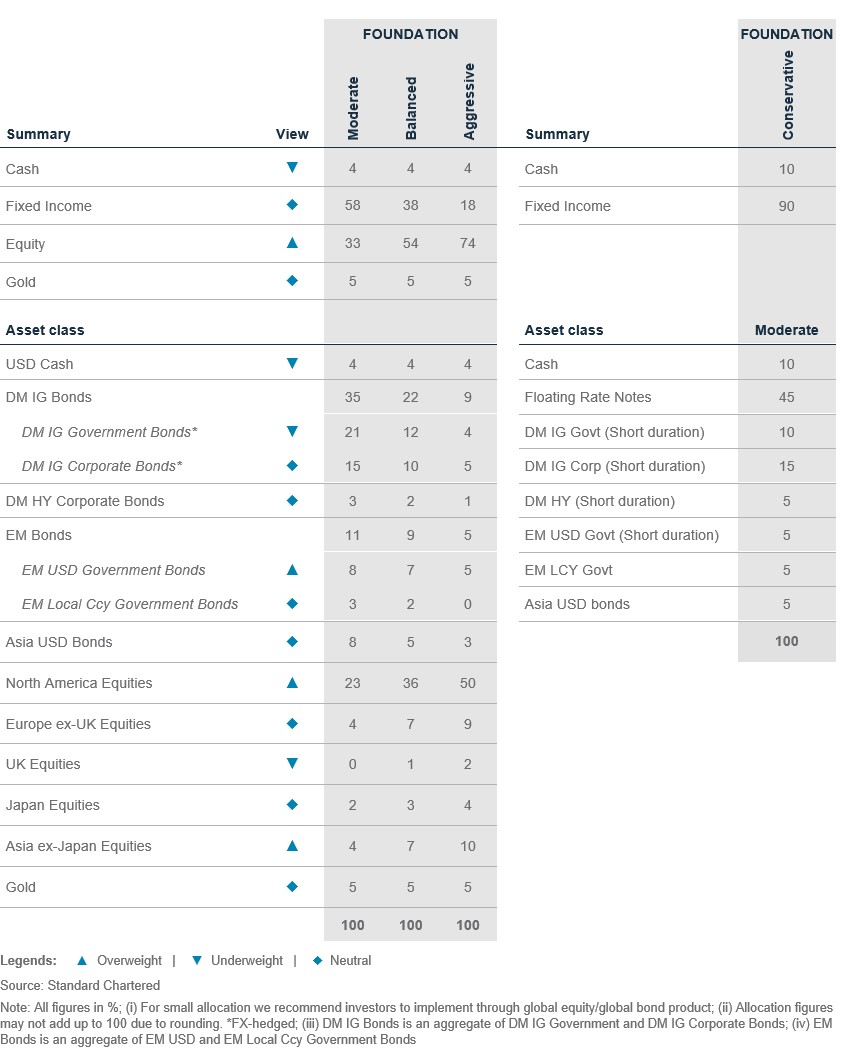
Downgrading gold to Neutral: Alongside the equity upgrade, we are cutting gold from Overweight to Neutral, reducing its weight in our balanced allocation from 6% to 5%. Last week, we lowered our three-month and 12-month gold price forecasts to USD 4,000/oz and USD 4,500/oz, respectively. A resilient dollar, expectations of higher Fed rates and liquidity needs amid the equity selloff have weighed on gold this year (see page 4).
Opportunity for those under-invested in gold. Gold’s long-term case remains intact. Fiscal concerns and geopolitical risks are likely to sustain Emerging Market (EM) central bank buying. Gold is likely to remain volatile as markets reassess the Fed outlook. Still, investors with a long-term horizon who are below their target weight can use the recent sell-off to average in.
— Rajat Bhattacharya
The weekly macro balance sheet
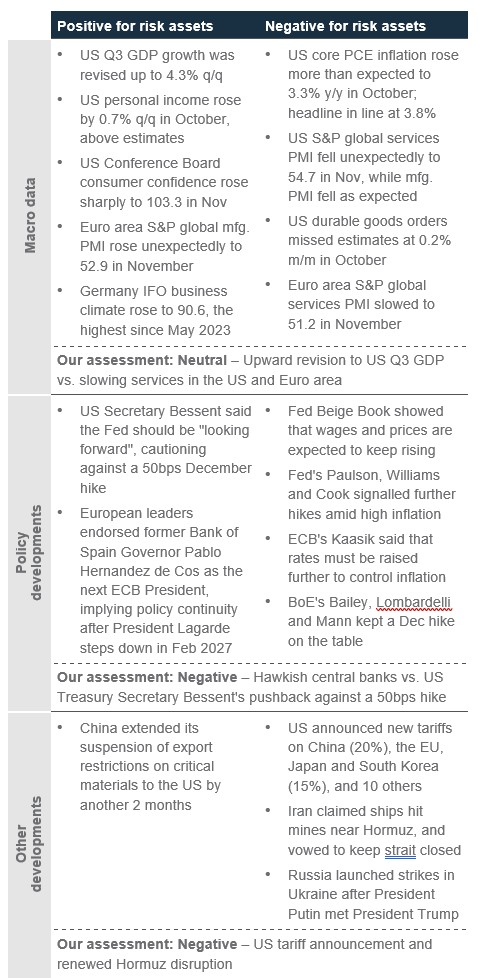
Our weekly net assessment: On balance, we see the past week’s data and policy as negative for risk assets in the near-term
(+) factors: Upward revision to US Q3 GDP; resilient Euro area mfg.
(-) factors: Elevated US core PCE; hawkish central banks; new US tariffs
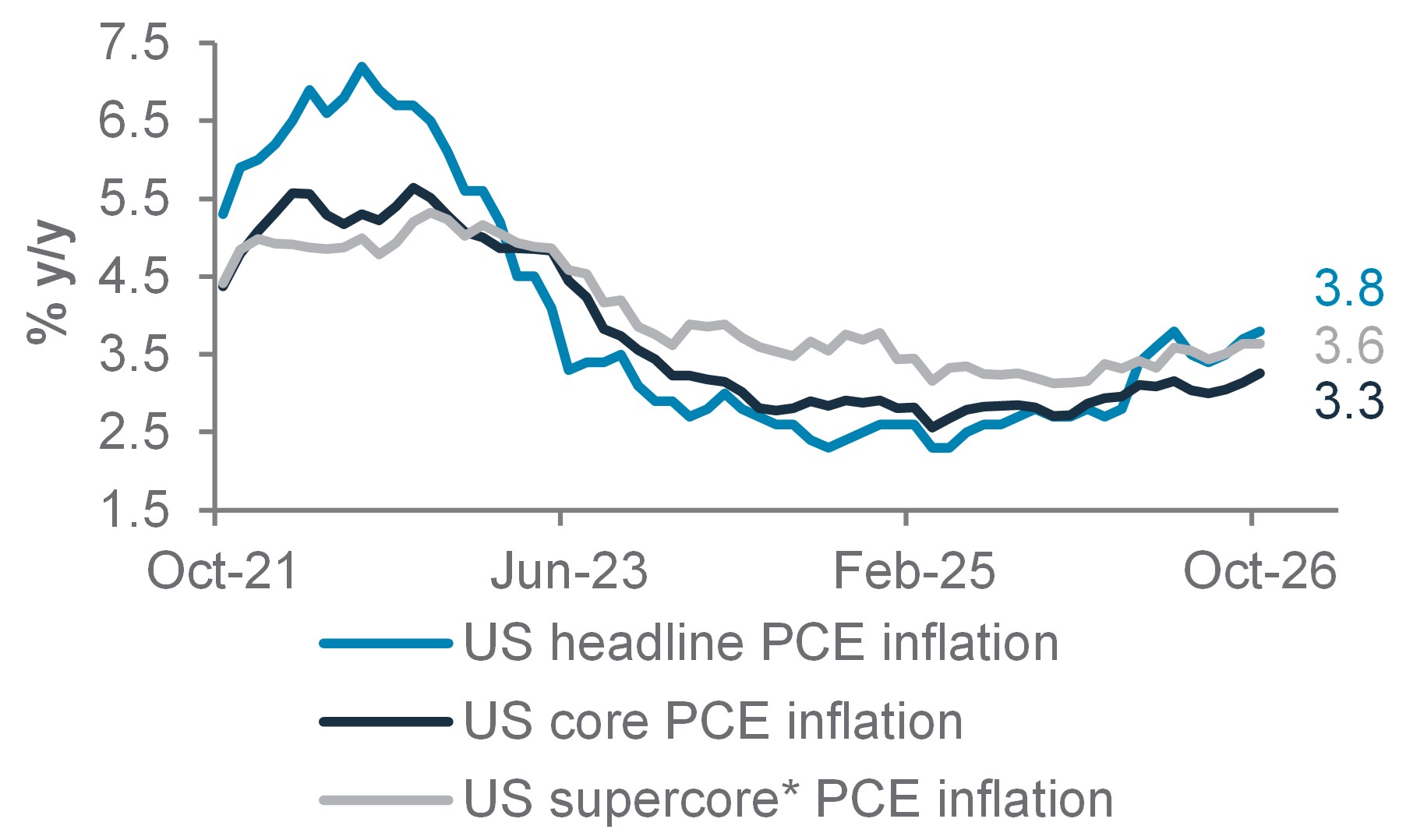
US core PCE inflation accelerated to a three-year high, sealing a 25bps December Fed rate hike
US headline, core and supercore* (services excluding energy and housing) PCE inflation
Source: Bloomberg, Standard Chartered
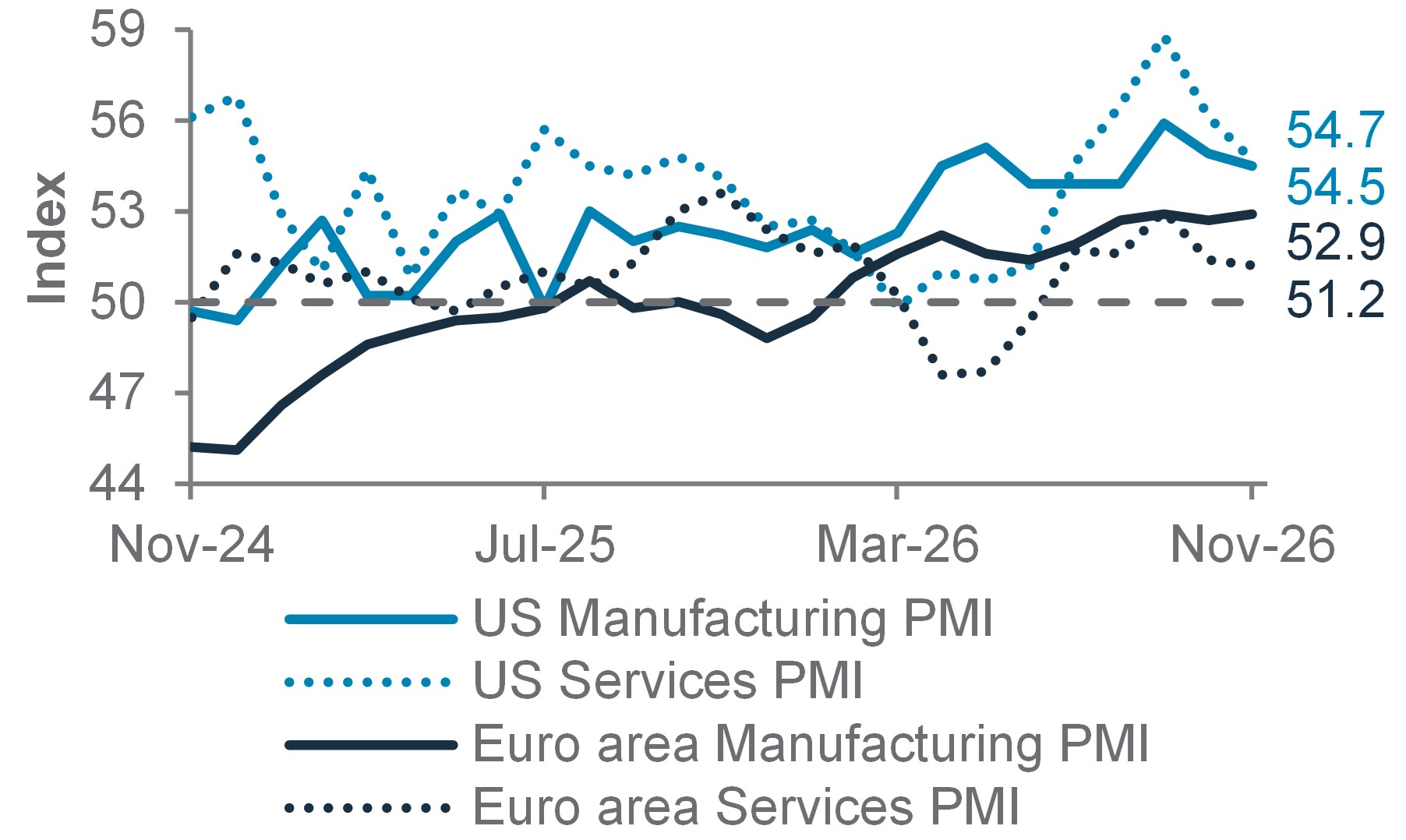
US and Euro area services sector confidence cooled, while manufacturing sector confidence remained largely resilient
US and Euro area S&P Global manufacturing and services PMI
Source: Bloomberg, Standard Chartered
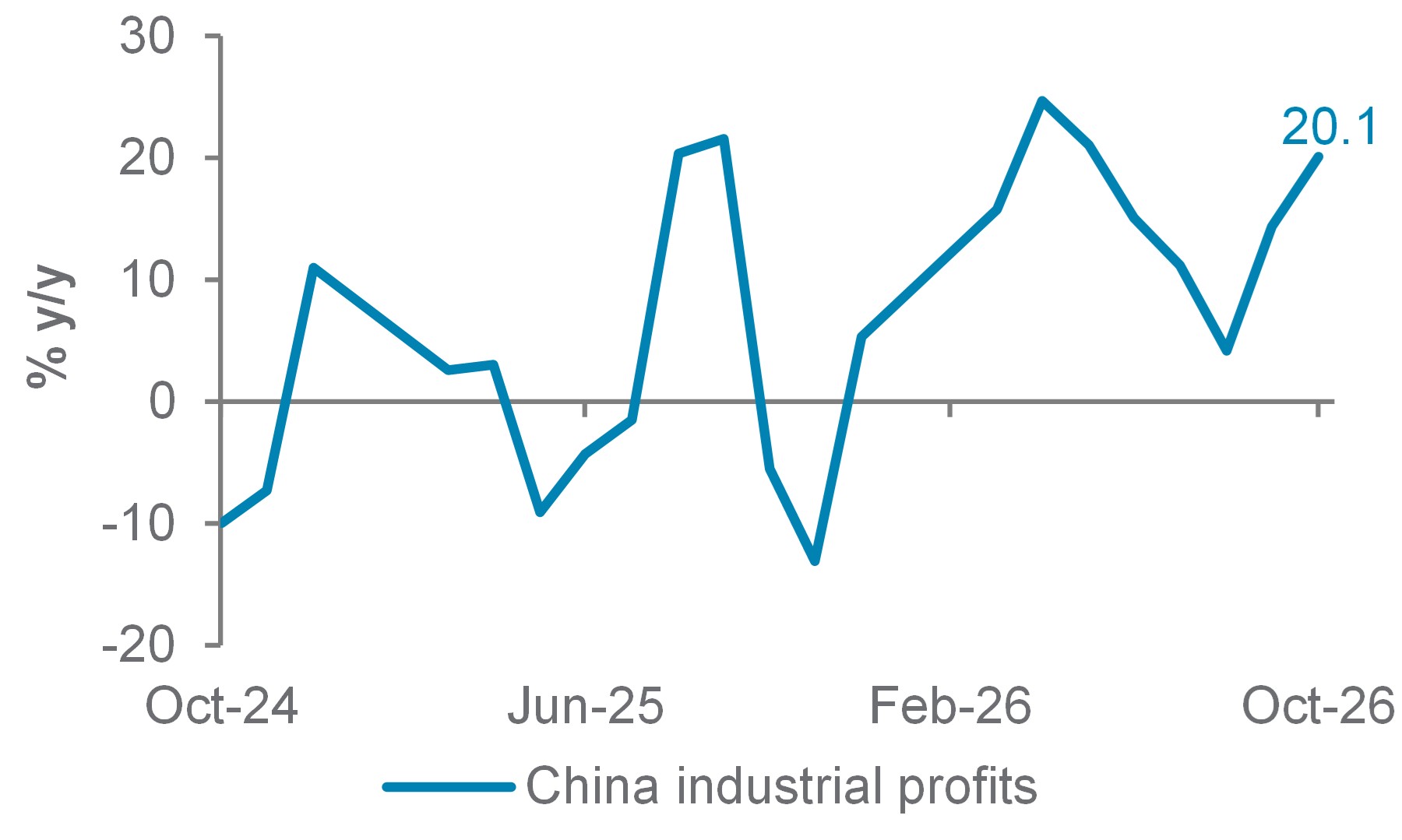
China’s industrial profits jumped 20.1% y/y in October 2026, reaching a five-month high and accelerating from 14.4% in September
China industrial profits
Source: Bloomberg, Standard Chartered
Top client questions
What are the drivers behind your decision to upgrade equities to Overweight and downgrade gold to Neutral?
Our view: We upgrade global equities to Overweight from a Neutral allocation. The risks now appear priced in, while earnings growth remains robust for a market in a mid-cycle phase. This improved risk-reward strengthens our relative preference for equities, and despite near-term volatility, underpins our decision to downgrade gold to a Neutral allocation. While we remain constructive on the precious metal’s recovery towards USD 4,000/oz, our latest stance on it reflects a more measured allocation.
Rationale: We downgraded global equities to a Neutral allocation in our Global Market Outlook published on 30 October 2026. At the time, we expected higher near-term volatility in an equity market transition to a mid-cycle bull market. However, the recent sell-off has gone further than we expected, with much of the risks now priced in. The sell-off has been centred on the AI theme. While we acknowledge downside risk to AI capex estimates, this risk is more than priced in by markets, in our view.
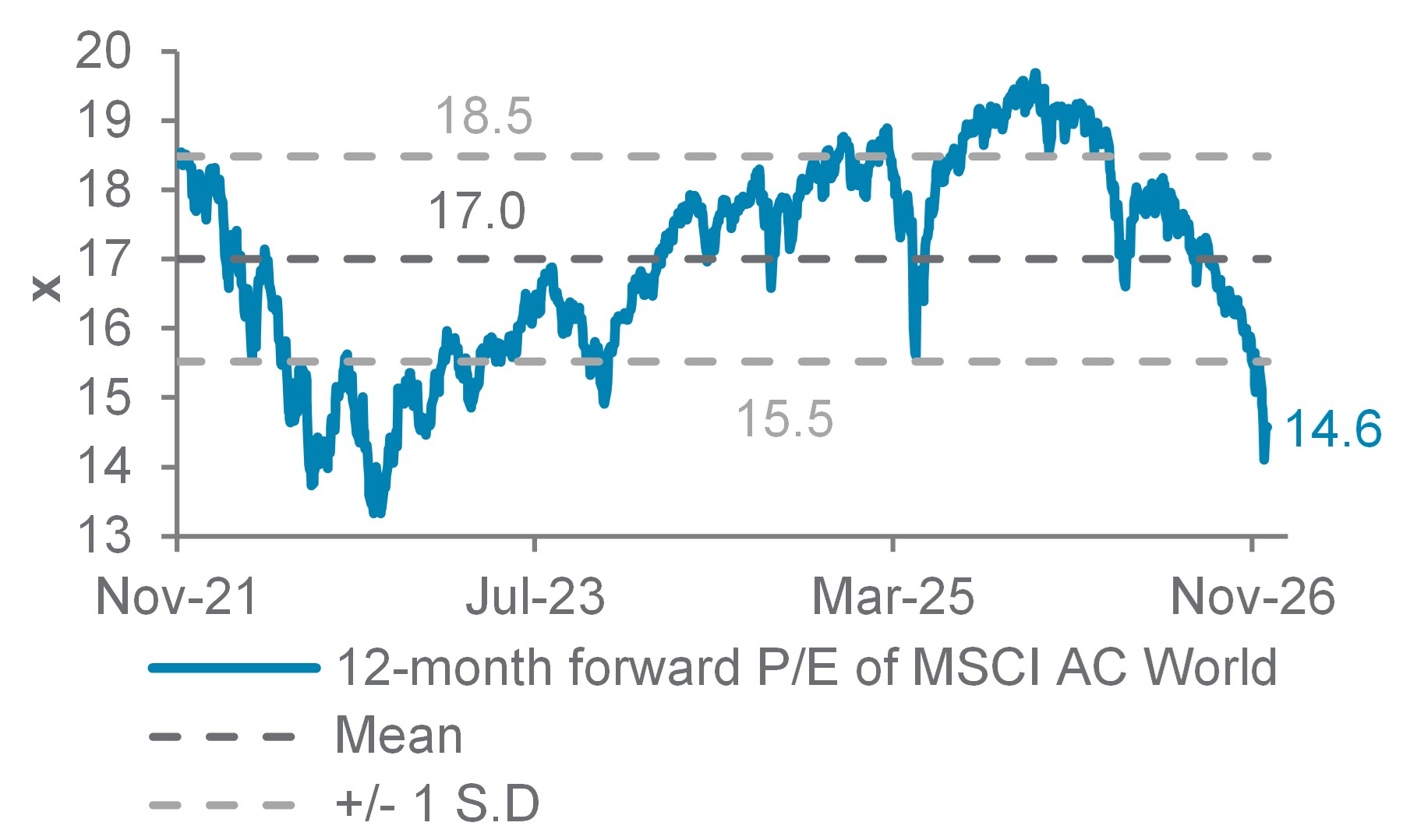
Global equity valuations have fallen to a 14.6x 12-month forward price-to-earnings (P/E) ratio, a level last seen in the 2022 bear market. The consensus 2027 earnings growth estimate remains robust at 16%, which we expect to largely materialise. We favour broad diversification across sectors, with an Overweight stance on the US IT, US healthcare, US financial, US materials, Europe ex-UK financial and Japan financial sectors. Regionally, we remain Overweight US and Asia ex-Japan equities, which are expected to offer the highest earnings growth in 2027.
In contrast, near-term headwinds drive our decision to downgrade gold to Neutral, as the metal has faced pressure from a resilient USD, hawkish Fed expectations and liquidation to meet margin calls during the equity drawdown. However, fiscal concerns and continued demand from EM central banks support its longer-term appeal.
Substantial Fed tightening is already priced into rates markets. Moderating inflation, helped by sustained lower oil prices, could allow the central bank to signal an earlier or lower rate peak than markets expect. This would ease upward pressure on US bond yields and soften the USD, supporting gold’s recovery.
In the near term, strong US data could sustain USD strength and prolong gold’s volatility. We see firm support around USD 3,300/oz, while a sustained break above USD 3,650/oz would strengthen our conviction in a recovery towards USD 4,000/oz. Our Neutral stance on gold, therefore, balances its recovery potential with near-term volatility and stronger expected returns from equities. We retain gold as a Neutral allocation, with a 5% weight in our balanced portfolio, maintaining exposure to its recovery while favouring equities on a relative basis.
— Fook Hien Yap, Senior Investment Strategist
— Vincent Tan, Senior Investment Strategist
Global equity valuations reflect a more attractive risk-reward following the recent sell-off
MSCI AC World 12-month forward P/E ratio
Source: FactSet, Bloomberg, Standard Chartered
What would signal that US tech equities are stabilising?
Our view: Key indicators include steadier US government bond yields, confirmation that major cloud providers can fund their AI spending plans and evidence that customers are paying for AI services at scale. We favour staying invested and selectively adding exposure through our latest opportunistic equity ideas, such as US IT and US Mega Caps. The recent sell-off appears to have priced in a steeper cut to AI spending than we expected. We prefer companies with strong free cash flow generation and volume-led earnings growth rather than price-driven gains.
Rationale: Steadier US government bond yields would ease pressure on tech valuations. On earnings, the next test is whether cloud providers can reaffirm their capex guidance and show that rising AI usage is translating into revenue. Longer-term customer commitments would give us greater confidence that demand can hold up beyond 2027.
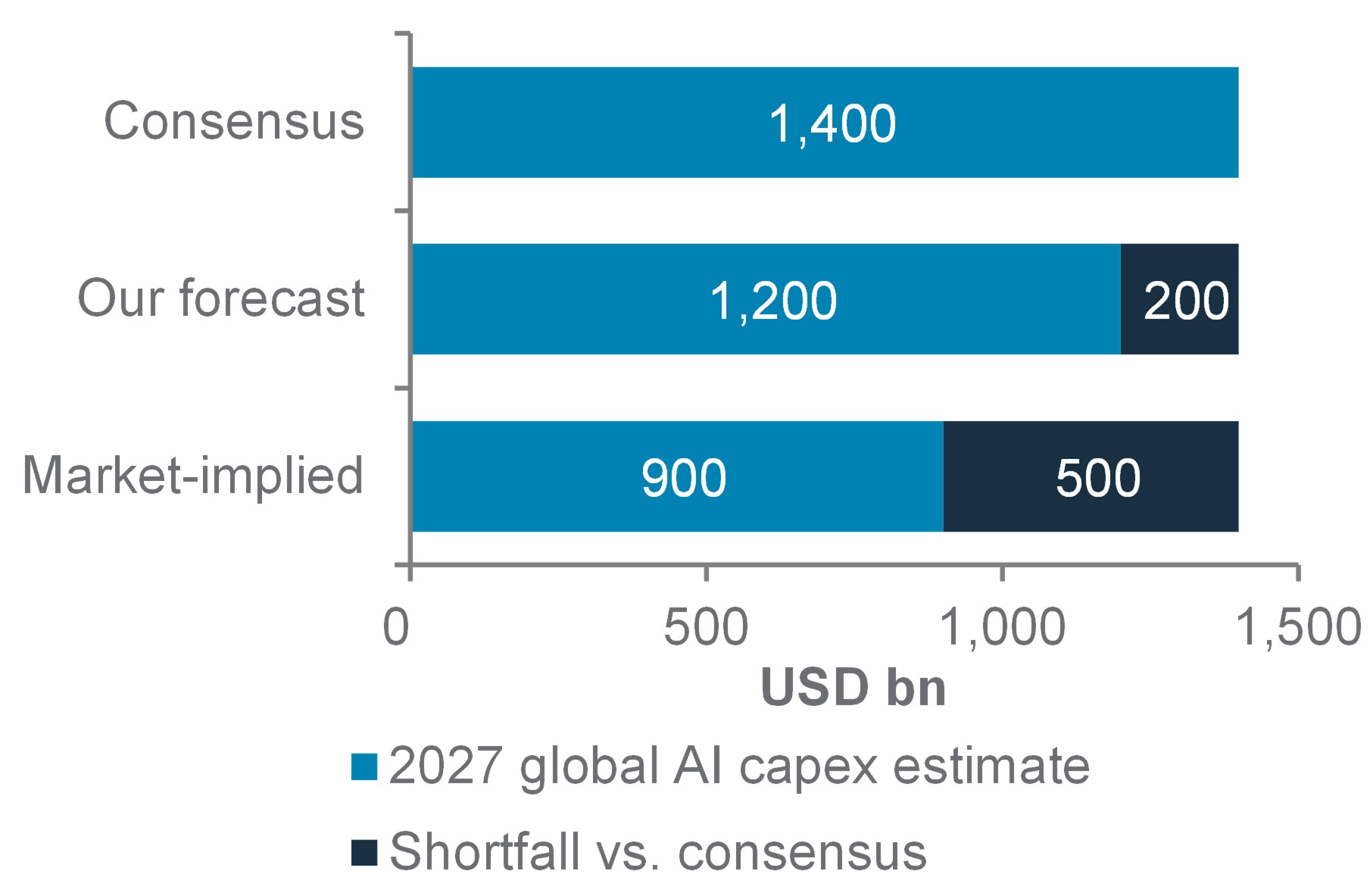
Our analysis suggests semiconductor valuations imply around USD 900bn of global AI capex in 2027 versus our forecast of USD 1.2trn and consensus estimate of USD 1.4trn. Although we expect near-term volatility to remain elevated, long-term investors who have remained on the sidelines can gradually rebuild exposure while continuing to diversify across sectors and regions to manage concentration risk.
— Robin Xie, CFA, Senior Investment Strategist
We see downside risk of USD 200bn per annum to global AI capex estimates, while markets are pricing in a USD 500bn shortfall against consensus
Scenarios for global AI capex in 2027 (USD bn)
Source: Bloomberg, Standard Chartered
Top client questions (cont’d)
Is now a good time to add to Japanese bank equities?
Our view: Yes, Japanese banks remain one of our opportunistic equity ideas, and we favour adding exposure after their recent results. Wider lending spreads and firm corporate borrowing support earnings, while higher dividends and new buybacks return more capital to shareholders. We prefer banks with strong deposit franchises as interest rates rise.
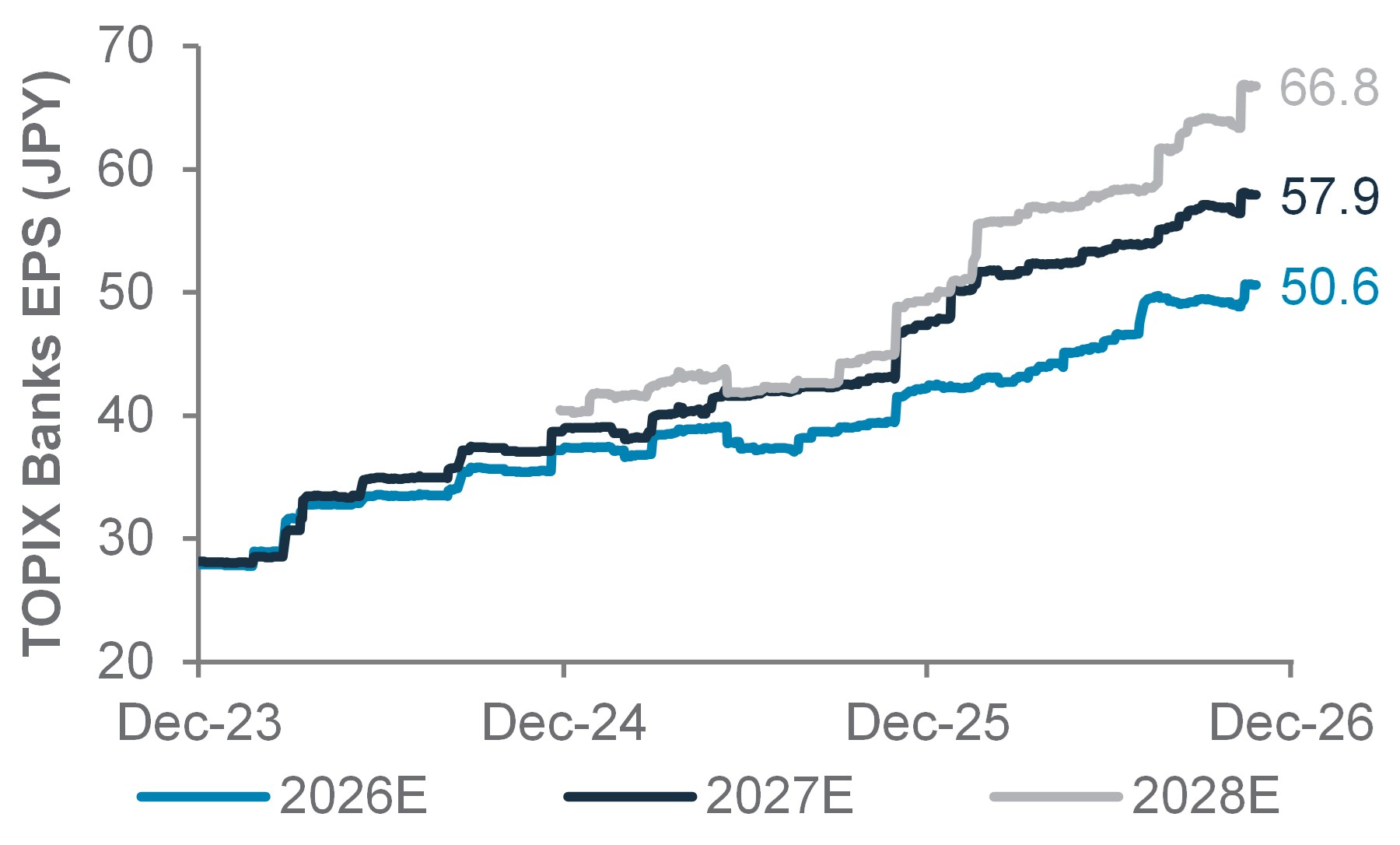
Rationale: All three Japanese megabanks beat September-quarter net profit expectations and raised their FY Mar-27 profit targets by 4-14%. Consensus earnings estimates for the TOPIX Banks Index have since risen by 3-5%. Companies continued to borrow for investment and acquisitions between March and September, while non-performing loan ratios fell at each bank.
We expect three further 25bps BoJ rate hikes by mid-2027, taking the policy rate from 1.25% to 2%. Rate hikes before the March year-end could lift earnings above guidance, with a fuller benefit in FY Mar-28 as loans reprice. Faster increases in deposit costs or weaker loan demand could temper that upside.
— Robin Xie, CFA, Senior Investment Strategist
Japanese banks’ earnings expectations have been revised up by 3-5% post September-quarter results
TOPIX Banks Index consensus earnings-per-share (EPS) estimates for 2026-2028 (JPY)
Source: Bloomberg, Standard Chartered
Top client questions (cont’d)
How does the recent US and European macro data impact your rates and credit strategy?
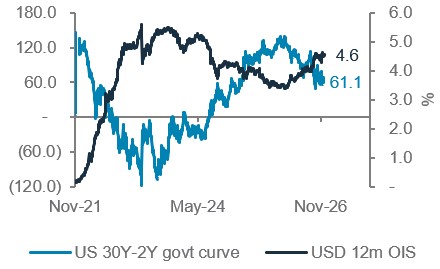
Our view: We continue to expect 25bps rate hikes from both the Fed and the ECB in December. Given the upside risk to yields, we avoid long-duration USD bonds, favouring the 3-7-year USD area. Meanwhile, we maintain a neutral stance on German Bunds and EUR credit ahead of the April 2027 French presidential election.
Rationale: The reacceleration in US personal consumption expenditures (PCE) inflation in October validates the Fed’s hawkish stance following its 25bps rate hike in September. While rhetoric points to a potential 50bps move in December after the October hold, our base case continues to project a 25bps hike in December, as November’s retreat in fuel costs is expected to temper headline pressures. Given the risk of higher yields, we remain cautious on long-duration USD bonds. Conversely, resilient spreads and muted primary issuance support our preference for USD credit over rates, particularly in the 3-7-year segment.
Euro area inflation is similarly re-accelerating above the ECB’s 2% medium-term target, while resilient economic activity data removes any near-term case for ECB easing, reinforcing our forecast for one 25bps rate hike in December. With the Germany 10-year bond (Bund) yield trading within our three-month target corridor of 3.25-3.50% and French political instability driving defensive flows, we maintain a neutral stance on Bunds and EUR credit ahead of the April 2027 French presidential election.
— Cedric Lam, Senior Investment Strategist
Fed rate hike expectations keep the front end of the US government bond yield curve elevated, driving recent yield curve flattening
US 30-year minus 2-year government bond yield differential and USD 12-month Overnight Index Swap (OIS)
Source: Bloomberg, Standard Chartered
How will Australia’s October inflation and Q3 2026 capex data impact the AUD?
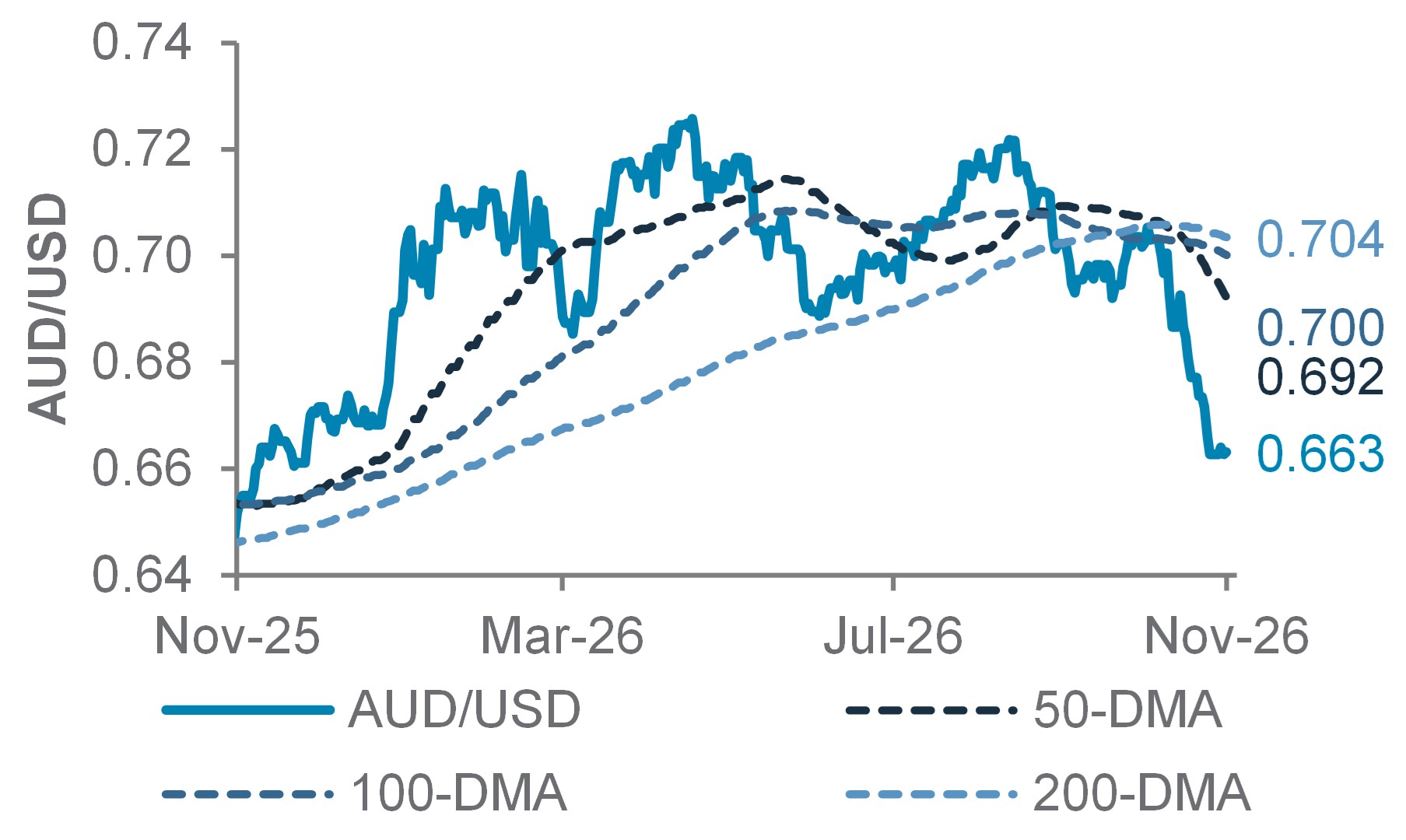
Our view: Firmer October inflation and stronger Q3 private new capex data strengthen the case for AUD stabilisation. We remain constructive over the next 12 months, but expect AUD/USD to remain rangebound between 0.65 and 0.69 in the near term, with global equity volatility restraining gains.
Rationale: Australia’s October trimmed mean inflation of 3.8% y/y and the Q3 capex surge of +12.2% reinforce the case for the RBA to hold rates at 4.85% and challenge expectations of early easing.
Further RBA policy tightening remains a risk if inflation persists, although weaker employment warrants caution. Capex strength also remains concentrated in data centres, limiting evidence of a broad recovery. These developments temper one source of AUD weakness. A sustained recovery still requires more favourable US rate expectations and global risk sentiment. Our expectation of a Fed rate peak by March 2027, followed by easing in late 2027, supports AUD/USD’s recovery towards our medium-term target of 0.74.
— Vincent Tan, Senior Investment Strategist
Australia’s firmer inflation and strong Q3 2026 private new capex support AUD/USD
AUD/USD and technicals
Source: Bloomberg, Standard Chartered
Top client questions (cont’d)
Could a recovery risk sentiment weaken the Swiss franc (CHF) and the Japanese yen (JPY) in the near term?
Our view: Yes, but only modestly for now. We expect CHF and JPY to retain near-term support as equity volatility persists. A sustained improvement in risk sentiment would be needed to drive more meaningful weakness in both currencies.
Rationale: While improving risk sentiment would ultimately reduce safe-haven demand for CHF and JPY, we do not think this transition is complete yet. Equity volatility remains elevated following the recent AI-led sell-off, keeping markets vulnerable to renewed bouts of risk aversion. This should preserve haven demand and limit near-term depreciation in both currencies.
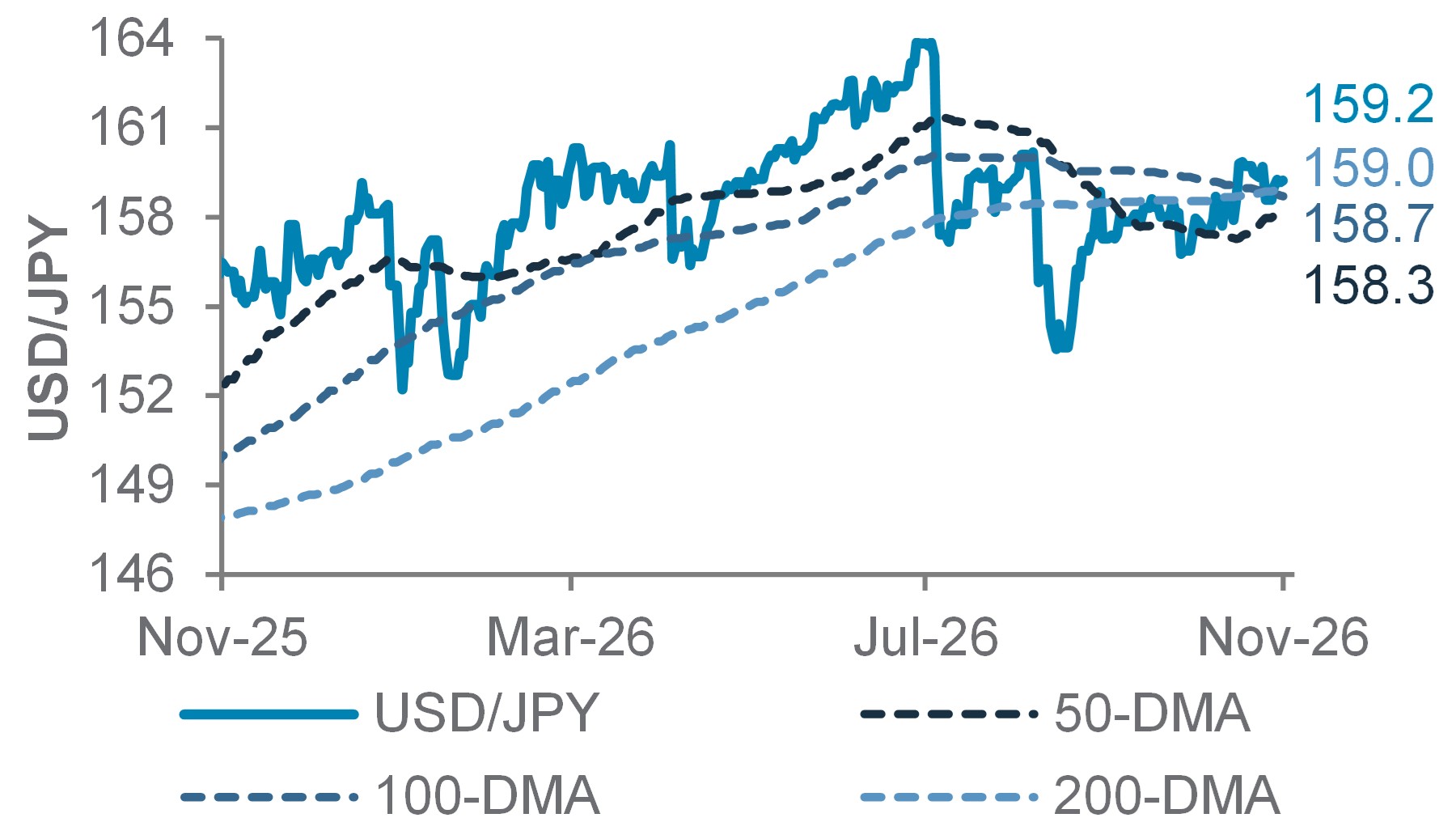
For the JPY, persistent equity volatility should provide support by discouraging carry trades and restraining risk-seeking capital outflows. Meanwhile, USD/JPY approaching 160 increases intervention concerns, which should limit the extent of further JPY weakness. Expectations for further BoJ normalisation also offer an underlying policy backstop.
We expect USD/JPY to test support towards 156. For the CHF, lingering market uncertainty should similarly sustain haven demand. While the CHF typically weakens in risk-on environments, it has historically underperformed the JPY during acute risk-off episodes. We expect JPY to outperform CHF as risk sentiment improves, capping CHF/JPY upside at around 193.7.
— Iris Yuen, Investment Strategist
USD/JPY downside risk builds
USD/JPY and technicals
Source: Bloomberg, Standard Chartered
Market performance summary*
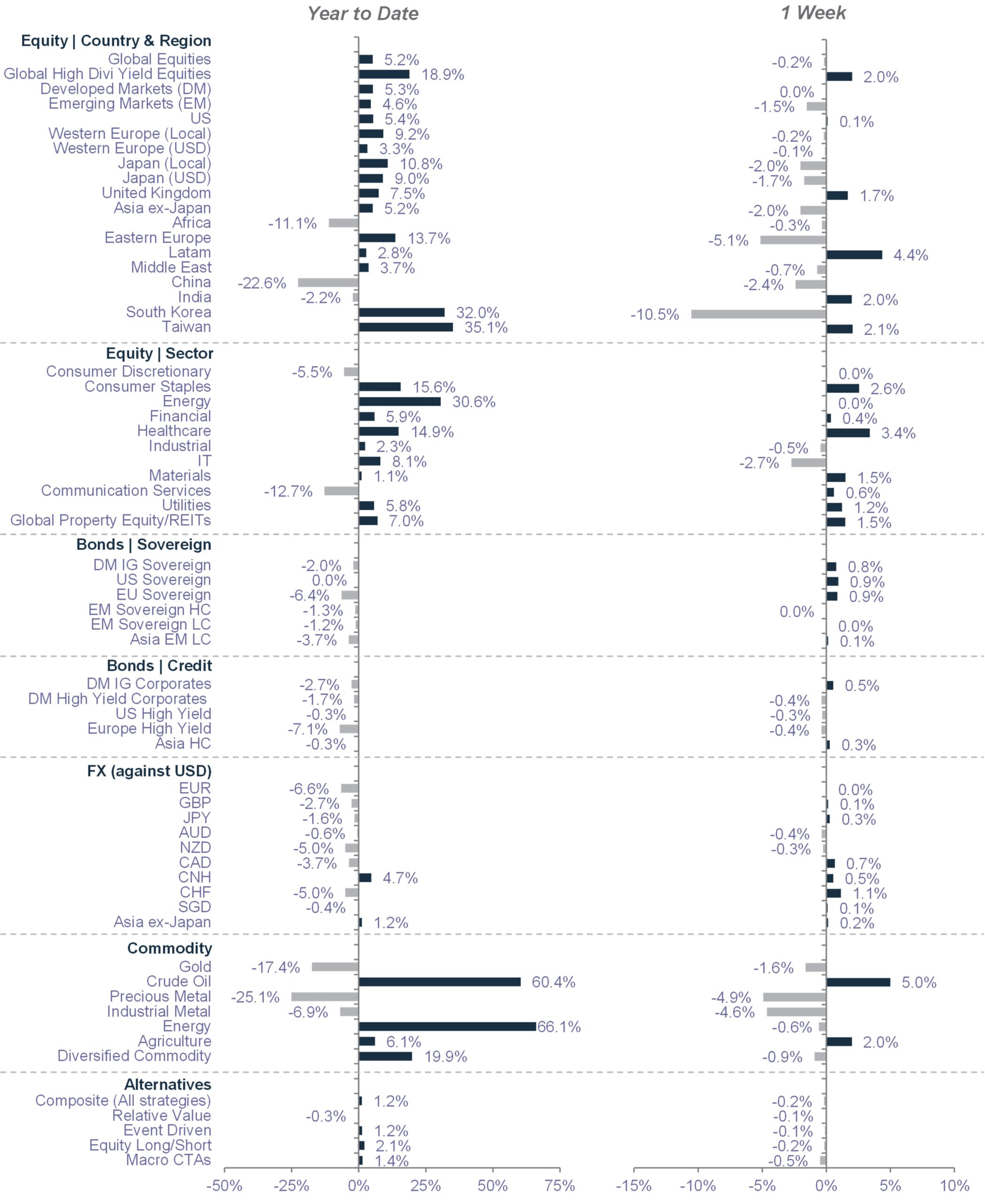
Sources: MSCI, JP Morgan, Barclays Capital, Citigroup, Dow Jones, HFRX, FTSE, Bloomberg, Standard Chartered
*Performance in USD terms unless otherwise stated, 2026 YTD performance from 31 December 2025 to 26 November 2026; 1-week period: 19 November 2026 to 26 November 2026
Our 12-month asset class views at a glance
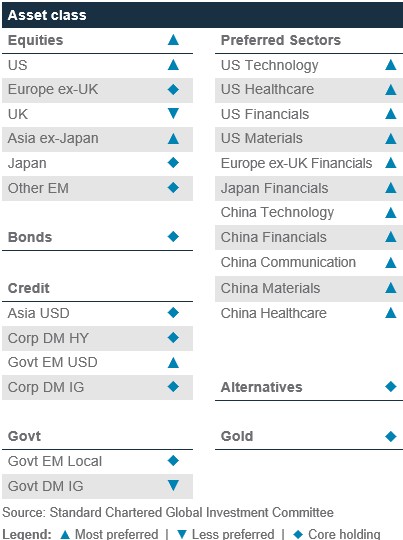
Economic and market calendar
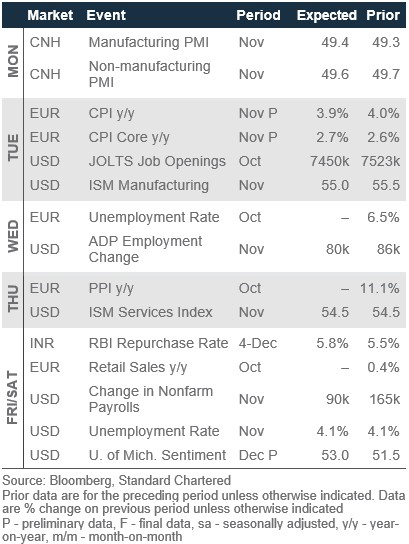
The S&P500 has next interim resistance at 7,667
Technical indicators for key markets as of 26 Nov close
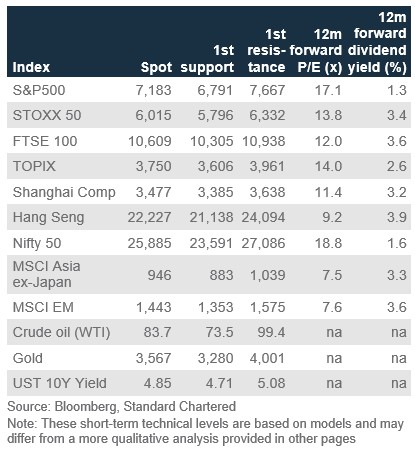
Investor diversity in EUR has fallen below key threshold
Our proprietary market diversity indicators as of 26 Nov close
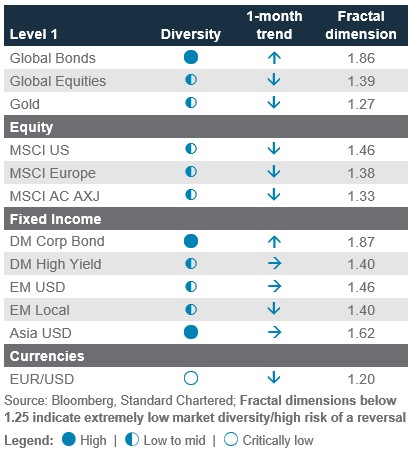
Foundation: Asset allocation summary
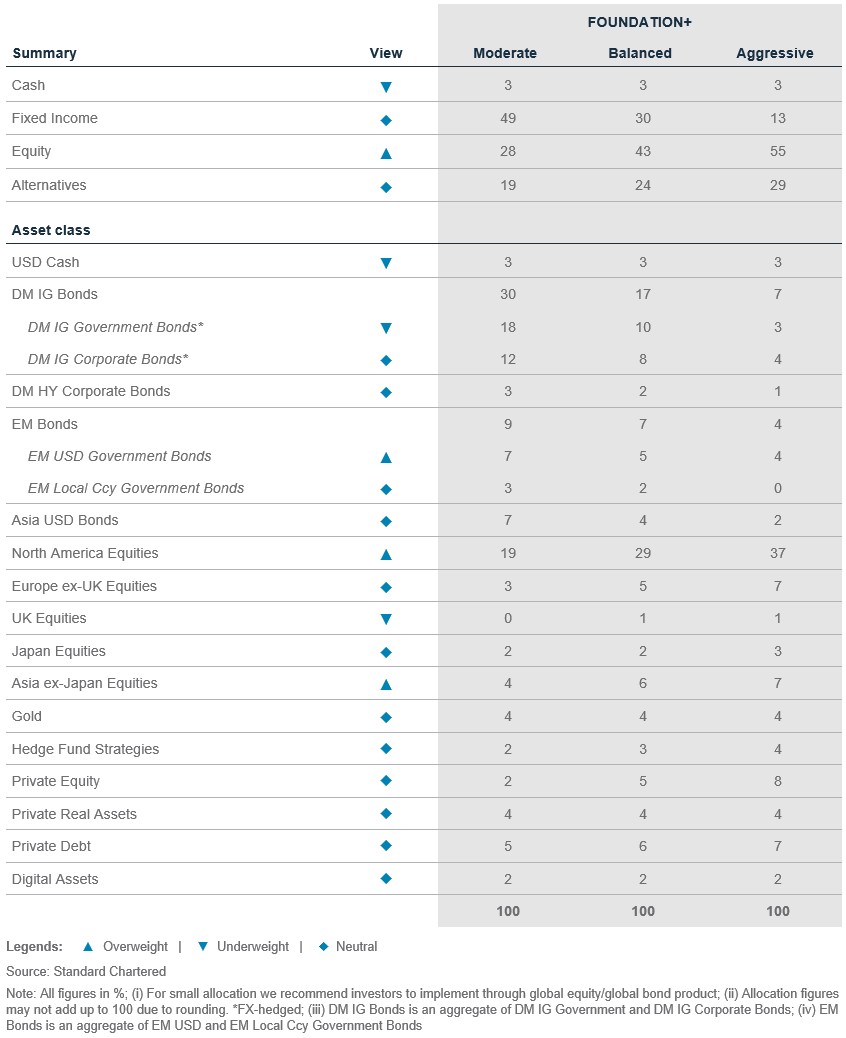
Foundation+: Asset allocation summary
Disclosure
This document is confidential and may also be privileged. If you are not the intended recipient, please destroy all copies and notify the sender immediately. This document is being distributed for general information only and is subject to the relevant disclaimers available at our Standard Chartered website under Regulatory disclosures. It is not and does not constitute research material, independent research, an offer, recommendation or solicitation to enter into any transaction or adopt any hedging, trading or investment strategy, in relation to any securities or other financial instruments. This document is for general evaluation only. It does not take into account the specific investment objectives, financial situation or particular needs of any particular person or class of persons and it has not been prepared for any particular person or class of persons. You should not rely on any contents of this document in making any investment decisions. Before making any investment, you should carefully read the relevant offering documents and seek independent legal, tax and regulatory advice. In particular, we recommend you to seek advice regarding the suitability of the investment product, taking into account your specific investment objectives, financial situation or particular needs, before you make a commitment to purchase the investment product. Opinions, projections and estimates are solely those of SC at the date of this document and subject to change without notice. Past performance is not indicative of future results and no representation or warranty is made regarding future performance. The value of investments, and the income from them, can go down as well as up, and you may not recover the amount of your original investment. You are not certain to make a profit and may lose money. Any forecast contained herein as to likely future movements in rates or prices or likely future events or occurrences constitutes an opinion only and is not indicative of actual future movements in rates or prices or actual future events or occurrences (as the case may be). This document must not be forwarded or otherwise made available to any other person without the express written consent of the Standard Chartered Group (as defined below). Standard Chartered Bank is incorporated in England with limited liability by Royal Charter 1853 Reference Number ZC18. The Principal Office of the Company is situated in England at 1 Basinghall Avenue, London, EC2V 5DD. Standard Chartered Bank is authorised by the Prudential Regulation Authority and regulated by the Financial Conduct Authority and Prudential Regulation Authority. Standard Chartered PLC, the ultimate parent company of Standard Chartered Bank, together with its subsidiaries and affiliates (including each branch or representative office), form the Standard Chartered Group. Standard Chartered Global Private Bank is the private banking division of Standard Chartered. Private banking activities may be carried out internationally by different legal entities and affiliates within the Standard Chartered Group (each an “SC Group Entity”) according to local regulatory requirements. Not all products and services are provided by all branches, subsidiaries and affiliates within the Standard Chartered Group. Some of the SC Group Entities only act as representatives of Standard Chartered Global Private Bank and may not be able to offer products and services or offer advice to clients.
Copyright © 2026, Accounting Research & Analytics, LLC d/b/a CFRA (and its affiliates, as applicable). Reproduction of content provided by CFRA in any form is prohibited except with the prior written permission of CFRA. CFRA content is not investment advice and a reference to or observation concerning a security or investment provided in the CFRA SERVICES is not a recommendation to buy, sell or hold such investment or security or make any other investment decisions. The CFRA content contains opinions of CFRA based upon publicly-available information that CFRA believes to be reliable and the opinions are subject to change without notice. This analysis has not been submitted to, nor received approval from, the United States Securities and Exchange Commission or any other regulatory body. While CFRA exercised due care in compiling this analysis, CFRA, ITS THIRD-PARTY SUPPLIERS, AND ALL RELATED ENTITIES SPECIFICALLY DISCLAIM ALL WARRANTIES, EXPRESS OR IMPLIED, INCLUDING, BUT NOT LIMITED TO, ANY WARRANTIES OF MERCHANTABILITY OR FITNESS FOR A PARTICULAR PURPOSE OR USE, to the full extent permitted by law, regarding the accuracy, completeness, or usefulness of this information and assumes no liability with respect to the consequences of relying on this information for investment or other purposes. No content provided by CFRA (including ratings, credit-related analyses and data, valuations, model, software or other application or output therefrom) or any part thereof may be modified, reverse engineered, reproduced or distributed in any form by any means, or stored in a database or retrieval system, without the prior written permission of CFRA, and such content shall not be used for any unlawful or unauthorized purposes. CFRA and any third-party providers, as well as their directors, officers, shareholders, employees or agents do not guarantee the accuracy, completeness, timeliness or availability of such content. In no event shall CFRA, its affiliates, or their third-party suppliers be liable for any direct, indirect, special, or consequential damages, costs, expenses, legal fees, or losses (including lost income or lost profit and opportunity costs) in connection with a subscriber’s, subscriber’s customer’s, or other’s use of CFRA’s content.
Market Abuse Regulation (MAR) Disclaimer
Banking activities may be carried out internationally by different branches, subsidiaries and affiliates within the Standard Chartered Group according to local regulatory requirements. Opinions may contain outright “buy”, “sell”, “hold” or other opinions. The time horizon of this opinion is dependent on prevailing market conditions and there is no planned frequency for updates to the opinion. This opinion is not independent of Standard Chartered Group’s trading strategies or positions. Standard Chartered Group and/or its affiliates or its respective officers, directors, employee benefit programmes or employees, including persons involved in the preparation or issuance of this document may at any time, to the extent permitted by applicable law and/or regulation, be long or short any securities or financial instruments referred to in this document or have material interest in any such securities or related investments. Therefore, it is possible, and you should assume, that Standard Chartered Group has a material interest in one or more of the financial instruments mentioned herein. Please refer to our Standard Chartered website under Regulatory disclosures for more detailed disclosures, including past opinions/ recommendations in the last 12 months and conflict of interests, as well as disclaimers. A covering strategist may have a financial interest in the debt or equity securities of this company/issuer. All covering strategist are licensed to provide investment recommendations under Monetary Authority of Singapore or Hong Kong Monetary Authority. This document must not be forwarded or otherwise made available to any other person without the express written consent of Standard Chartered Group.
Sustainable Investments
Any ESG data used or referred to has been provided by Morningstar, Sustainalytics, MSCI or Bloomberg. Refer to 1) Morningstar website under Sustainable Investing, 2) Sustainalytics website under ESG Risk Ratings, 3) MCSI website under ESG Business Involvement Screening Research and 4) Bloomberg green, social & sustainability bonds guide for more information. The ESG data is as at the date of publication based on data provided, is for informational purpose only and is not warranted to be complete, timely, accurate or suitable for a particular purpose, and it may be subject to change. The ESG data providers may not provide data coverage of all companies or securities in our Sustainable Investment Universe or Fund Select funds. As a result, a small subset of companies or securities will not be in scope for exclusionary screening. Sustainable Investments (SI): This refers to funds that have been classified as ‘ESG Intentional Investments – Overall’ by Morningstar. SI funds have explicitly stated in their prospectus and regulatory filings that they either incorporate ESG factors into the investment process or have a thematic focus on the environment, gender diversity, low carbon, renewable energy, water or community development. For equity, it refers to shares/stocks issued by companies with Sustainalytics ESG Risk Rating of Low/Negligible. For bonds, it refers to debt instruments issued by issuers with Sustainalytics ESG Risk Rating of Low/Negligible, and/or those being certified green, social, sustainable bonds by Bloomberg. For structured products, it refers to products that are issued by any issuer who has a Sustainable Finance framework that aligns with Standard Chartered’s Green and Sustainable Product Framework, with underlying assets that are part of the Sustainable Investment universe or separately approved by Standard Chartered’s Sustainable Finance Governance Committee. Sustainalytics ESG risk ratings shown are factual and are not an indicator that the product is classified or marketed as “green”, “sustainable” or similar under any particular classification system or framework.
Shariah (“Shariah Compliant or Shariah Compliance”)
For any reason to enter only into transactions which comply or are consistent with the principles of the Shariah, the client certifies that he/she/it has made his /her/its own investigation into and satisfied itself as to the Shariah compliance of the Islamic security and all necessary action to confirm that the Islamic security is Shariah compliant has been taken (including the obtaining of a fatwa, where required) and the Client will not claim any dispute on the grounds of any lack of Shariah compliance of these investments. The Client has not relied on Standard Chartered Group or any written declaration, fatwa, opinion or other documents prepared by, on behalf or at the request of Standard Chartered Group for the purposes of a determination or confirmation that these instruments are Shariah compliant.
Country/Market Specific Disclosures
Bahrain: This document is being distributed in Bahrain by Standard Chartered Bank, Bahrain Branch, having its address at P.O. 29, Manama, Kingdom of Bahrain, is a branch of Standard Chartered Bank and is licensed by the Central Bank of Bahrain as a conventional retail bank. Botswana: This document is being distributed in Botswana by, and is attributable to, Standard Chartered Bank Botswana Limited which is a financial institution licensed under the Section 6 of the Banking Act CAP 46.04 and is listed in the Botswana Stock Exchange. Brunei Darussalam: This document is being distributed in Brunei Darussalam by, and is attributable to, Standard Chartered Bank (Brunei Branch) | Registration Number RFC/61 and Standard Chartered Securities (B) Sdn Bhd | Registration Number RC20001003. Standard Chartered Bank is incorporated in England with limited liability by Royal Charter 1853 Reference Number ZC18. Standard Chartered Securities (B) Sdn Bhd is a limited liability company registered with the Registry of Companies with Registration Number RC20001003 and licensed by Brunei Darussalam Central Bank as a Capital Markets Service License Holder with License Number BDCB/R/CMU/S3-CL and it is authorised to conduct Islamic investment business through an Islamic window. China Mainland: This document is being distributed in China by, and is attributable to, Standard Chartered Bank (China) Limited which is mainly regulated by National Financial Regulatory Administration (NFRA), State Administration of Foreign Exchange (SAFE), and People’s Bank of China (PBOC). Hong Kong: In Hong Kong, this document, except for any portion advising on or facilitating any decision on futures contracts trading, is distributed by Standard Chartered Bank (Hong Kong) Limited (“SCBHK”), a subsidiary of Standard Chartered PLC. SCBHK has its registered address at 32/F, Standard Chartered Bank Building, 4-4A Des Voeux Road Central, Hong Kong and is regulated by the Hong Kong Monetary Authority and registered with the Securities and Futures Commission (“SFC”) to carry on Type 1 (dealing in securities), Type 4 (advising on securities), Type 6 (advising on corporate finance) and Type 9 (asset management) regulated activity under the Securities and Futures Ordinance (Cap. 571) (“SFO”) (CE No. AJI614). The contents of this document have not been reviewed by any regulatory authority in Hong Kong and you are advised to exercise caution in relation to any offer set out herein. If you are in doubt about any of the contents of this document, you should obtain independent professional advice. Any product named herein may not be offered or sold in Hong Kong by means of any document at any time other than to “professional investors” as defined in the SFO and any rules made under that ordinance. In addition, this document may not be issued or possessed for the purposes of issue, whether in Hong Kong or elsewhere, and any interests may not be disposed of, to any person unless such person is outside Hong Kong or is a “professional investor” as defined in the SFO and any rules made under that ordinance, or as otherwise may be permitted by that ordinance. In Hong Kong, Standard Chartered Global Private Bank is the private banking division of SCBHK, a subsidiary of Standard Chartered PLC. Ghana: Standard Chartered Bank Ghana Limited accepts no liability and will not be liable for any loss or damage arising directly or indirectly (including special, incidental or consequential loss or damage) from your use of these documents. Past performance is not indicative of future results and no representation or warranty is made regarding future performance. You should seek advice from a financial adviser on the suitability of an investment for you, taking into account these factors before making a commitment to invest in an investment. To unsubscribe from receiving further updates, please send an email to feedback.ghana@sc.com. Please do not reply to this email. Call our Priority Banking on 0302610750 for any questions or service queries. You are advised not to send any confidential and/or important information to Standard Chartered via e-mail, as Standard Chartered makes no representations or warranties as to the security or accuracy of any information transmitted via e-mail. Standard Chartered shall not be responsible for any loss or damage suffered by you arising from your decision to use e-mail to communicate with the Bank. India: Standard Chartered Bank, India (“Bank”) (ARN-1209) is an AMFI-registered distributor of select Mutual Funds and a referrer of certain third-party financial products. The Bank is not registered with SEBI as an Investment Adviser and does not provide investment advisory services or financial planning services as defined under the SEBI (Investment Advisers) Regulations, 2013. Any information contained herein is for informational purposes only and should not be construed as investment advice, recommendation, research report, or an offer to buy or sell any security or financial product. Mutual Fund investments are subject to market risks. Please read all scheme-related documents carefully before investing. The services/products described herein are not intended for any person resident in a jurisdiction where their distribution, solicitation or use would be contrary to local laws or regulations. Indonesia: This document is being distributed in Indonesia by Standard Chartered Bank, Indonesia branch, which is a financial institution licensed and supervised by Otoritas Jasa Keuangan (Financial Service Authority) and Bank Indonesia. Jersey: The Jersey Branch of Standard Chartered Bank is regulated by the Jersey Financial Services Commission. Copies of the latest audited accounts of Standard Chartered Bank are available from its principal place of business in Jersey: PO Box 80, 15 Castle Street, St Helier, Jersey JE4 8PT. Standard Chartered Bank is incorporated in England with limited liability by Royal Charter in 1853 Reference Number ZC 18. The Principal Office of the Company is situated in England at 1 Basinghall Avenue, London, EC2V 5DD. Standard Chartered Bank is authorised by the Prudential Regulation Authority and regulated by the Financial Conduct Authority and Prudential Regulation Authority. The Jersey Branch of Standard Chartered Bank is also an authorised financial services provider under license number 44946 issued by the Financial Sector Conduct Authority of the Republic of South Africa. Jersey is not part of the United Kingdom, and all business transacted with Standard Chartered Bank, Jersey Branch and other Standard Chartered Group Offices outside of the United Kingdom, are not subject to some or any of the investor protection and compensation schemes available under United Kingdom law. Kenya: This document is being distributed in Kenya by and is attributable to Standard Chartered Bank Kenya Limited. Investment Products and Services are distributed by Standard Chartered Investment Services Limited, a wholly owned subsidiary of Standard Chartered Bank Kenya Limited that is licensed by the Capital Markets Authority in Kenya, as a Fund Manager. Standard Chartered Bank Kenya Limited is regulated by the Central Bank of Kenya. Malaysia: This document is being distributed in Malaysia by Standard Chartered Bank Malaysia Berhad (“SCBMB”). Recipients in Malaysia should contact SCBMB in relation to any matters arising from, or in connection with, this document. This document has not been reviewed by the Securities Commission Malaysia. The product lodgement, registration, submission or approval by the Securities Commission of Malaysia does not amount to nor indicate recommendation or endorsement of the product, service or promotional activity. Investment products are not deposits and are not obligations of, not guaranteed by, and not protected by SCBMB or any of the affiliates or subsidiaries, or by Perbadanan Insurans Deposit Malaysia, any government or insurance agency. Investment products are subject to investment risks, including the possible loss of the principal amount invested. SCBMB expressly disclaim any liability and responsibility for any loss arising directly or indirectly (including special, incidental or consequential loss or damage) arising from the financial losses of the Investment Products due to market condition. Nigeria: This document is being distributed in Nigeria by Standard Chartered Bank Nigeria Limited (SCB Nigeria), a bank duly licensed and regulated by the Central Bank of Nigeria. SCB Nigeria accepts no liability for any loss or damage arising directly or indirectly (including special, incidental or consequential loss or damage) from your use of these documents. You should seek advice from a financial adviser on the suitability of an investment for you, taking into account these factors before making a commitment to invest in an investment. To unsubscribe from receiving further updates, please send an email to clientcare.ng@sc.com requesting to be removed from our mailing list. Please do not reply to this email. Call our Priority Banking on 02 012772514 for any questions or service queries. SCB Nigeria shall not be responsible for any loss or damage arising from your decision to send confidential and/or important information to Standard Chartered via e-mail. SCB Nigeria makes no representations or warranties as to the security or accuracy of any information transmitted via e-mail. Pakistan: This document is being distributed in Pakistan by, and attributable to Standard Chartered Bank (Pakistan) Limited having its registered office at PO Box 5556, I.I Chundrigar Road Karachi, which is a banking company registered with State Bank of Pakistan under Banking Companies Ordinance 1962 and is also having licensed issued by Securities & Exchange Commission of Pakistan for Security Advisors. Standard Chartered Bank (Pakistan) Limited acts as a distributor of mutual funds and referrer of other third-party financial products. Singapore: This document is being distributed in Singapore by, and is attributable to, Standard Chartered Bank (Singapore) Limited (Registration No. 201224747C/ GST Group Registration No. MR-8500053-0, “SCBSL”). Recipients in Singapore should contact SCBSL in relation to any matters arising from, or in connection with, this document. SCBSL is an indirect wholly owned subsidiary of Standard Chartered Bank and is licensed to conduct banking business in Singapore under the Singapore Banking Act, 1970. Standard Chartered Global Private Bank is the private banking division of SCBSL. IN RELATION TO ANY SECURITY OR SECURITIES-BASED DERIVATIVES CONTRACT REFERRED TO IN THIS DOCUMENT, THIS DOCUMENT, TOGETHER WITH THE ISSUER DOCUMENTATION, SHALL BE DEEMED AN INFORMATION MEMORANDUM (AS DEFINED IN SECTION 275 OF THE SECURITIES AND FUTURES ACT, 2001 (“SFA”)). THIS DOCUMENT IS INTENDED FOR DISTRIBUTION TO ACCREDITED INVESTORS, AS DEFINED IN SECTION 4A(1)(a) OF THE SFA, OR ON THE BASIS THAT THE SECURITY OR SECURITIES-BASED DERIVATIVES CONTRACT MAY ONLY BE ACQUIRED AT A CONSIDERATION OF NOT LESS THAN S$200,000 (OR ITS EQUIVALENT IN A FOREIGN CURRENCY) FOR EACH TRANSACTION. Further, in relation to any security or securities-based derivatives contract, neither this document nor the Issuer Documentation has been registered as a prospectus with the Monetary Authority of Singapore under the SFA. Accordingly, this document and any other document or material in connection with the offer or sale, or invitation for subscription or purchase, of the product may not be circulated or distributed, nor may the product be offered or sold, or be made the subject of an invitation for subscription or purchase, whether directly or indirectly, to persons other than a relevant person pursuant to section 275(1) of the SFA, or any person pursuant to section 275(1A) of the SFA, and in accordance with the conditions specified in section 275 of the SFA, or pursuant to, and in accordance with the conditions of, any other applicable provision of the SFA. In relation to any collective investment schemes referred to in this document, this document is for general information purposes only and is not an offering document or prospectus (as defined in the SFA). This document is not, nor is it intended to be (i) an offer or solicitation of an offer to buy or sell any capital markets product; or (ii) an advertisement of an offer or intended offer of any capital markets product. Deposit Insurance Scheme: Singapore dollar deposits of non-bank depositors are insured by the Singapore Deposit Insurance Corporation, for up to S$100,000 in aggregate per depositor per Scheme member by law. Foreign currency deposits, dual currency investments, structured deposits and other investment products are not insured. This advertisement has not been reviewed by the Monetary Authority of Singapore. Taiwan: SC Group Entity or Standard Chartered Bank (Taiwan) Limited (“SCB (Taiwan)”) may be involved in the financial instruments contained herein or other related financial instruments. The author of this document may have discussed the information contained herein with other employees or agents of SC or SCB (Taiwan). The author and the above-mentioned employees of SC or SCB (Taiwan) may have taken related actions in respect of the information involved (including communication with customers of SC or SCB (Taiwan) as to the information contained herein). The opinions contained in this document may change, or differ from the opinions of employees of SC or SCB (Taiwan). SC and SCB (Taiwan) will not provide any notice of any changes to or differences between the above-mentioned opinions. This document may cover companies with which SC or SCB (Taiwan) seeks to do business at times and issuers of financial instruments. Therefore, investors should understand that the information contained herein may serve as specific purposes as a result of conflict of interests of SC or SCB (Taiwan). SC, SCB (Taiwan), the employees (including those who have discussions with the author) or customers of SC or SCB (Taiwan) may have an interest in the products, related financial instruments or related derivative financial products contained herein; invest in those products at various prices and on different market conditions; have different or conflicting interests in those products. The potential impacts include market makers’ related activities, such as dealing, investment, acting as agents, or performing financial or consulting services in relation to any of the products referred to in this document. UAE: DIFC – Standard Chartered Bank is incorporated in England with limited liability by Royal Charter 1853 Reference Number ZC18.The Principal Office of the Company is situated in England at 1 Basinghall Avenue, London, EC2V 5DD. Standard Chartered Bank is authorised by the Prudential Regulation Authority and regulated by the Financial Conduct Authority and Prudential Regulation Authority. Standard Chartered Bank, Dubai International Financial Centre having its offices at Dubai International Financial Centre, Building 1, Gate Precinct, P.O. Box 999, Dubai, UAE is a branch of Standard Chartered Bank and is regulated by the Dubai Financial Services Authority (“DFSA”). This document is intended for use only by Professional Clients and is not directed at Retail Clients as defined by the DFSA Rulebook. In the DIFC we are authorised to provide financial services only to clients who qualify as Professional Clients and Market Counterparties and not to Retail Clients. As a Professional Client you will not be given the higher retail client protection and compensation rights and if you use your right to be classified as a Retail Client we will be unable to provide financial services and products to you as we do not hold the required license to undertake such activities. For Islamic transactions, we are acting under the supervision of our Shariah Supervisory Committee. Relevant information on our Shariah Supervisory Committee is currently available on the Standard Chartered Bank website in the Islamic banking section. For residents of the UAE – Standard Chartered UAE (“SC UAE”) is licensed by the Central Bank of the U.A.E. SC UAE is licensed by Securities and Commodities Authority to practice Promotion Activity. SC UAE does not provide financial analysis or consultation services in or into the UAE within the meaning of UAE Securities and Commodities Authority Decision No. 48/r of 2008 concerning financial consultation and financial analysis. Uganda: Our Investment products and services are distributed by Standard Chartered Bank Uganda Limited, which is licensed by the Capital Markets Authority as an investment adviser. United Kingdom: In the UK, Standard Chartered Bank is authorised by the Prudential Regulation Authority and regulated by the Financial Conduct Authority and Prudential Regulation Authority. This communication has been approved by Standard Chartered Bank for the purposes of Section 21 (2) (b) of the United Kingdom’s Financial Services and Markets Act 2000 (“FSMA”) as amended in 2010 and 2012 only. Standard Chartered Bank (trading as Standard Chartered Global Private Bank) is also an authorised financial services provider (license number 45747) in terms of the South African Financial Advisory and Intermediary Services Act, 2002. The Materials have not been prepared in accordance with UK legal requirements designed to promote the independence of investment research, and that it is not subject to any prohibition on dealing ahead of the dissemination of investment research. Vietnam: This document is being distributed in Vietnam by, and is attributable to, Standard Chartered Bank (Vietnam) Limited which is mainly regulated by State Bank of Vietnam (SBV). Recipients in Vietnam should contact Standard Chartered Bank (Vietnam) Limited for any queries regarding any content of this document. Zambia: This document is distributed by Standard Chartered Bank Zambia Plc, a company incorporated in Zambia and registered as a commercial bank and licensed by the Bank of Zambia under the Banking and Financial Services Act Chapter 387 of the Laws of Zambia.