
12 Jun 2026
This article is for informational purposes only.
💡 What is a Long-Short Equity Strategy?
A long-short equity strategy is an alternative investment that primarily seeks to generate returns by simultaneously buying stocks that are expected to outperform (holding long positions) and selling stocks that are expected to underperform (holding short positions), in order to achieve better risk-adjusted returns 📈 in various market conditions 📊.
💡What is risk-adjusted return?
Imagine a scenario with two hypothetical investments:
- Investment A returns 1% each month, resulting in a total return of 12% for 1 year, but with low volatility. At one point during the year, the investment was down by 5%.
- Investment B also returns 1% each month, resulting in a total of return of 12% for 1 year, but with high volatility and wild price swings. At one point during the year, the investment was down by 10%.
In this hypothetical scenario, Investment A has better risk-adjusted returns than Investment B.
💡Two Key Advantages of Long-Short Equity Strategy
1️⃣ Strong long-term returns with lower volatility
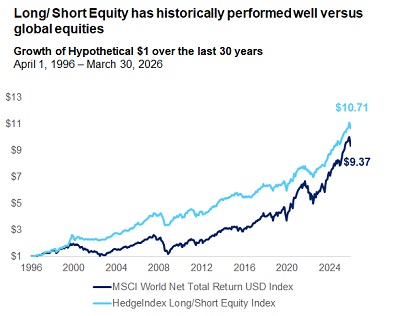
Historically, Long‑Short Equity strategies have delivered competitive long‑term returns with significantly lower volatility compared to long‑only global equities, resulting in higher risk-adjusted returns.
An investment of HK$1 in a Long‑Short Equity strategy in April 1996 would have grown to HK$10.71 by March 2026, equivalent to an 8.2% annualized return over the past 30 years. Over the same period, Long-Short strategies exhibited an annualized volatility of around ~9%, substantially lower than the ~15% annualized volatility of long‑only global equities.

Source: AQR. Data from 4/1/1996 to 3/30/2026. Index returns are for illustrative purposes only and do not represent actual fund performance. Clients cannot invest directly in an index. Investment involves risks. Past performance does not guarantee future results.
2️⃣ Smaller drawdown during market corrections.
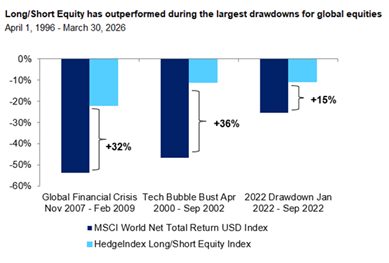
Long‑Short Equity strategies have historically demonstrated stronger resilience during equity market downturns. Across the three most recent major market corrections, Long‑Short Equity strategies experienced approximately 15% to 32% smaller drawdowns than long-only Equity strategies.
Source: AQR. Data from 4/1/1996 to 3/30/2026. Index returns are for illustrative purposes only and do not represent actual fund performance. Clients cannot invest directly in an index. Investment involves risks. Past performance does not guarantee future results.
💡 What advantages does a Long-Short Equity Strategy have over Traditional Equity Investing?
Unlike traditional equity strategies that only hold long positions, the long-short equity strategy aims to reduce the correlation to the market direction and focus on the performance of individual stocks. This should help mitigate portfolio risk in volatile markets 🌊 and strive for better risk-adjusted returns.
💡What risks should investors be aware of a Long-Short Equity Strategy?
Although a long-short equity strategy can effectively reduce correlation with the market, it is important to be aware that the potential upside of the strategy may not directly correlate 🔗 with market movements.
Additionally, since the strategy involves short positions, if the underlying investment value of the short position rises, it could negatively impact the investment value of the long-short equity strategy.
💡Want to understand more on Long Short Equity Strategy?
Speak to your RM via myRM* on SC Mobile App now to learn more. *Exclusive for Priority Private or Priority Banking clients.