

22 May 2026
Global Market Outlook
A fragile equilibrium
Earnings positivity remains dominant in the tussle with inflation worries. However, oil markets warrant close monitoring given the ongoing risk they reach a tipping point where inventories can no longer cushion against supply disruption.
We remain Overweight global equities, but look to broaden exposure across sectors and regions. Regionally, we took profit on top-performing Asia ex-Japan equities and rebalanced gains to Euro area equities. We stay Overweight the US.
Favour Emerging Market bonds, but limit long maturities. Long maturity bonds remain most at risk from any renewed inflation worries. We continue to see attractive risk/reward in Emerging Market bonds.
Why gold remains a safe haven
Are global central banks overly hawkish?
Are the quant models still bullish on risk assets?
Strategy
Investment strategy and key themes
|
|
||||
|

12m Foundation Overweights:
- Global equities, gold
- US equities
- Emerging Market (EM) USD and local currency (LCY)
Opportunistic ideas – Equities
- Global: MSCI World equal-weight^, gold miners
- US: Aerospace and defence
- China: Hang Seng Technology Index
Top Global Sectors:
- US: Technology, communication services, healthcare
- Europe ex-UK: Financials
Opportunistic ideas – Bonds
- US: Treasury Inflation-protected Securities (TIPS), short-duration high-yield (HY) bonds, AAA CLOs, utility sector hybrids
- EU: Bank AT1s FX-hedged
- Others: AUD corporate bonds
^New
A fragile equilibrium
- Earnings positivity remains dominant in the tussle with inflation worries. However, oil markets warrant close monitoring given the ongoing risk they reach a tipping point where inventories can no longer cushion against supply disruptions.
- We remain Overweight global equities, but look to broaden exposure across sectors and regions. Regionally, we took profit on top-performing Asia ex-Japan (AxJ) equities and rebalanced gains to Euro area equities. We stay Overweight the US.
- Favour Emerging Market (EM) bonds, but limit long maturities. Long maturity bonds remain most at risk from any renewed inflation worries. We continue to see attractive risk-reward in EM bonds.
Oil inventories help balance inflation worries
Corporate earnings and oil prices are two key themes dominating the narrative for financial markets. Year-to-date (YTD), positivity around the earnings growth outlook has dominated, helping drive global equities close to double-digit gains. However, renewed US threats of military action in the Middle East are starting to return the focus to oil prices and the resultant risks of inflation.
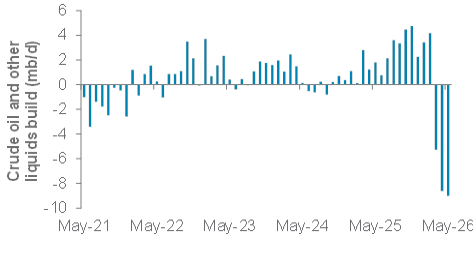
Some perspective on oil and its impact on macroeconomics may be helpful at this stage. The Strait of Hormuz closure and damage to energy facilities in the Middle East have thus far reduced global crude oil supply by approximately 20%. However, the impact on oil prices and market expectations of inflation has been more muted than feared at the start of the Middle East conflict. This is likely due to (i) oil prices holding at lower levels in inflation-adjusted terms relative to past oil price shocks, (ii) steadily improving energy efficiency in recent years and decades and (iii) tactical policymaker use of inventories to help bridge the supply gap since the start of the conflict.
We draw confidence from these three factors that a much worse energy impact (i.e., one that results in a significant impact on inflation) can be avoided as long as the Hormuz strait closure is relatively limited in length – with the length defined by how long crude oil inventories can continue to offset lost output from the Middle East.
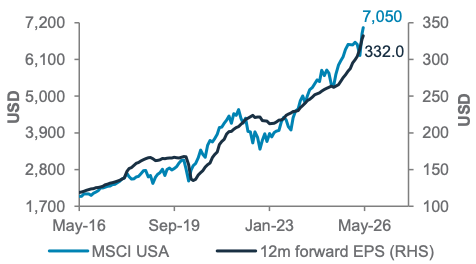
Fig. 1 Robust earnings growth expectations are a key driver for US equity markets
US equities (MSCI US) vs. earnings expectations
However, ‘time is of the essence’. Several projections have argued that while inventories can help avoid a much larger oil price rise through early summer, a failure to resume supply shipments through the Strait of Hormuz before the end of summer will start to raise the risk of a sharp oil price rise – a scenario that would risk a bigger inflation and growth shock.
Overweight equities, but broaden exposure
AI-related earnings, particularly in the semiconductor sector, have helped drive a strong equity market rally, albeit a narrow one disproportionately focused on the semiconductor sub-sector. We remain Overweight global equities, given our constructive view on long-term earnings growth. However, in our view, it is time to broaden exposure. This is not only expected to capture returns from a catch-up rally outside of semiconductors, but also helps manage near-term volatility caused by rising bond yields.
Specifically, within equities, three strategies can help achieve a broadening of exposure. First, take some profit and rebalance towards laggards. At a regional level, this was our logic behind trimming our prior Overweight view on AxJ (which has significantly outperformed other major regions YTD) to a core holding on 5 May and balancing this by raising Euro area equities from Underweight to a Core holding. Within Asia, we retain our preference for broader exposure to China, India and Taiwan equities, in contrast to YTD gains, which have been largely led by South Korea and Taiwan equities alone.
Second, within the US technology sector, we closed our opportunistic idea on the semiconductor sub-sector and broadened it to include other sub-sectors, such as Internet, which should benefit at this stage of the technology adoption cycle. We also open a new opportunistic idea on equally weighted global equities (MSCI World), which should benefit directly from a broadening of the equity market rally.
Third, we close our Overweight on the US utilities sector. This leaves our sector preferences spread across the US technology, communication services and healthcare sectors.
Fig. 2 Rapid inventory drawdown has thus far helped cushion oil prices
Global crude oil inventories change
Markets likely to test Warsh
Several studies have argued that markets tend to test new Fed governors early in their terms on their commitment to fighting inflation. Kevin Warsh takes over as Fed Chair at a time when inflation worries are not far from the spotlight. Having said that, we take some comfort in the fact that the most recent US inflation release showed limited spillover of high oil prices into broader inflation measures while the market’s long-term inflation expectations remain capped. On balance, thus, we see room for the Fed to stay on hold for a large part of the year, even if Warsh chooses to strike a moderately more hawkish tone in his initial days.
For investors in bond markets, we believe this remains consistent with our current view to stay Overweight EM bonds and balance with an Underweight on G3 government bonds.
Between the two major drivers of returns in bonds – credit risk or duration risk – we see more value in adding credit risk. The yield premium offered over government bonds remains most attractive for EM bonds, particularly since this universe includes a significant share of commodity exporters (especially outside Asia).
Duration risk, i.e., buying longer-maturity bonds for the additional yield, is less attractive, in our view, because of the relatively small gap between long and short maturity bonds relative to history. Prices of longer maturity bonds are also more sensitive to inflation worries. Together, we believe this means investors are paid well to focus on the belly of the curve (5-7 years) and Underweight long-dated tenors.
Gold remains in a long-term uptrend
In the very short term, gold has once again become sensitive to bond yields, falling when bond yields rise to reflect the opportunity cost of holding the non-yielding metal. In the long term, however, data shows EM central bank demand for gold remains intact, and history shows gold can perform well in stagflationary environments. We remain Overweight gold.
Foundation asset allocation models
The Foundation and Foundation+ models are allocations that you can use as the starting point for building a diversified investment portfolio. The Foundation model showcases a set of allocations focusing on traditional asset classes that are accessible to most investors, while the Foundation+ model includes allocations to private assets that may be accessible to investors in some jurisdictions, but not others.
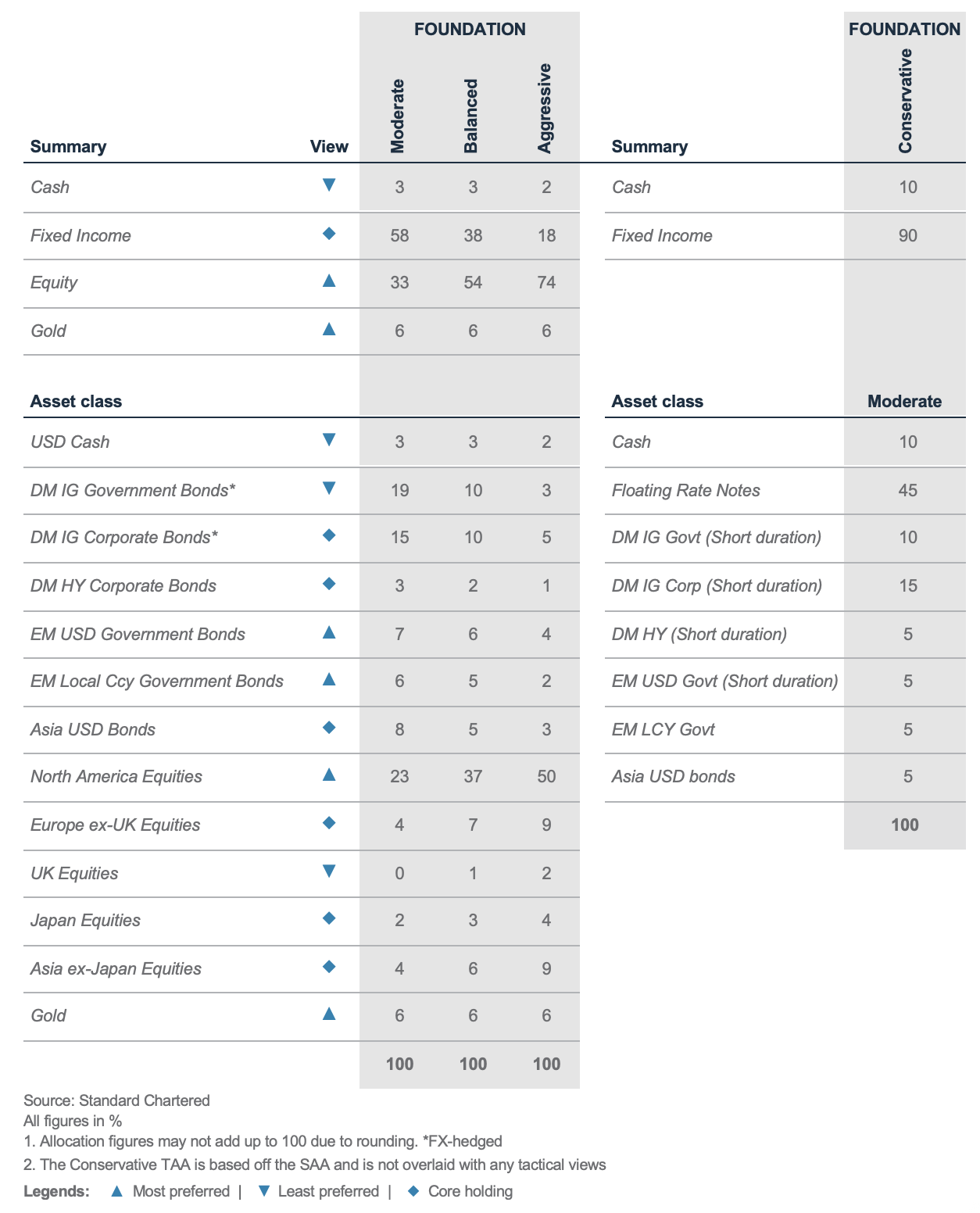
Fig. 3 Foundation asset allocation for a balanced risk profile
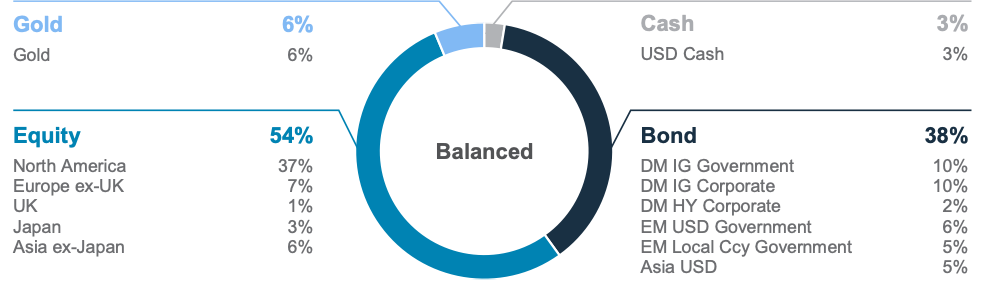
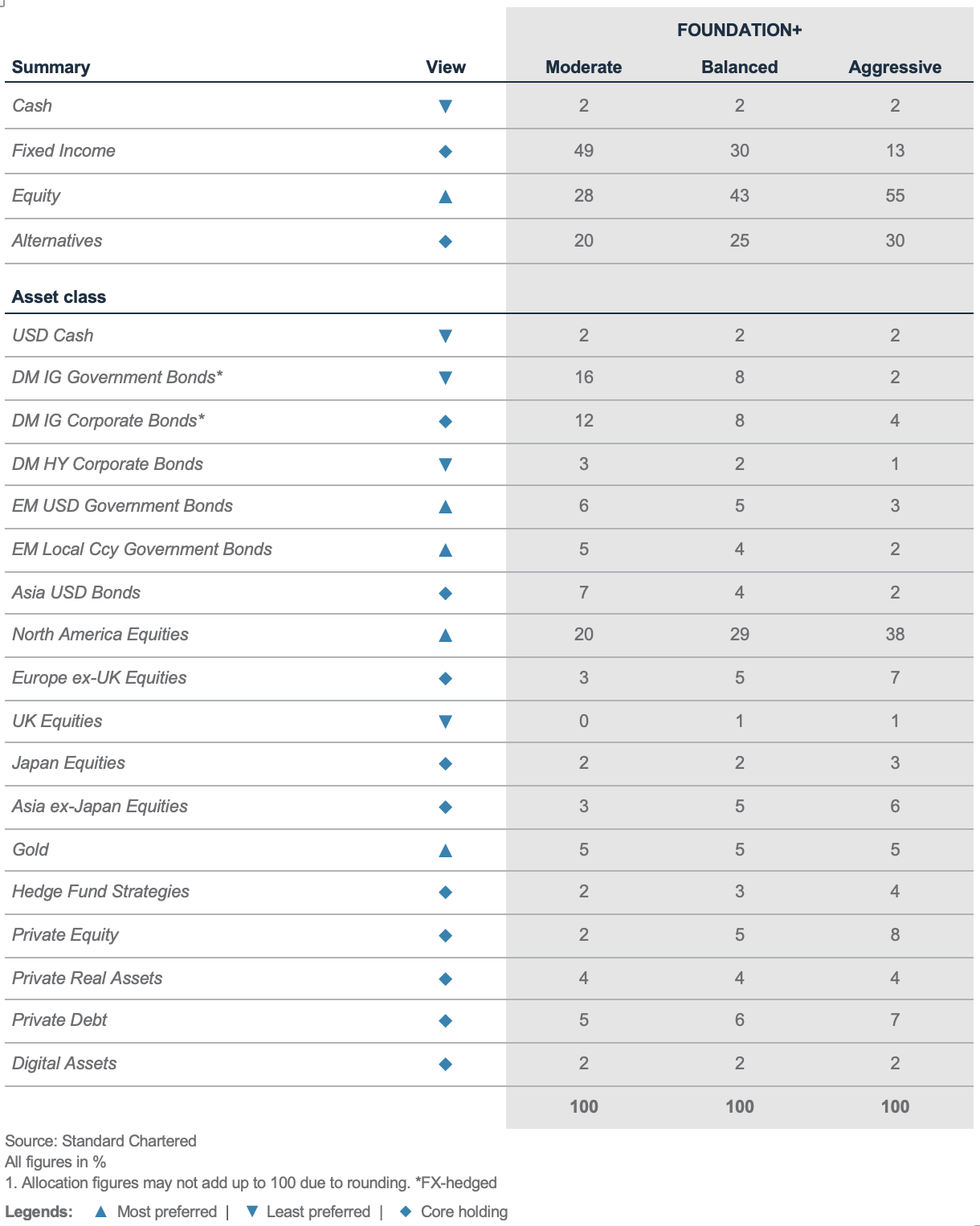
Fig. 4 Foundation+ asset allocation for a balanced risk profile
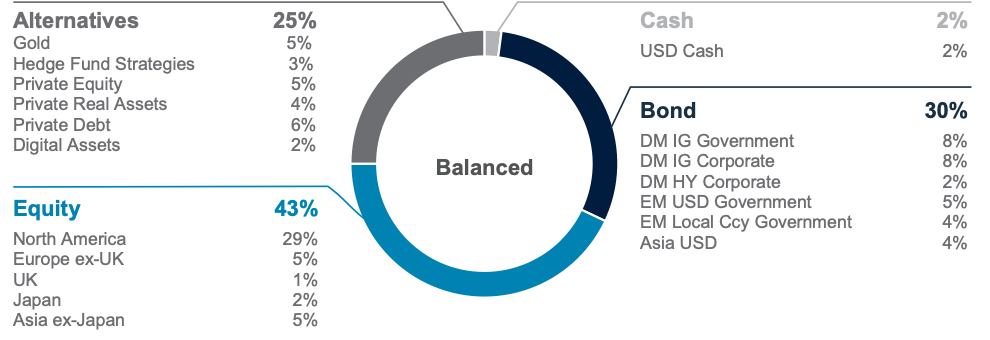
Fig. 5 Multi-asset income allocation for a moderate risk profile
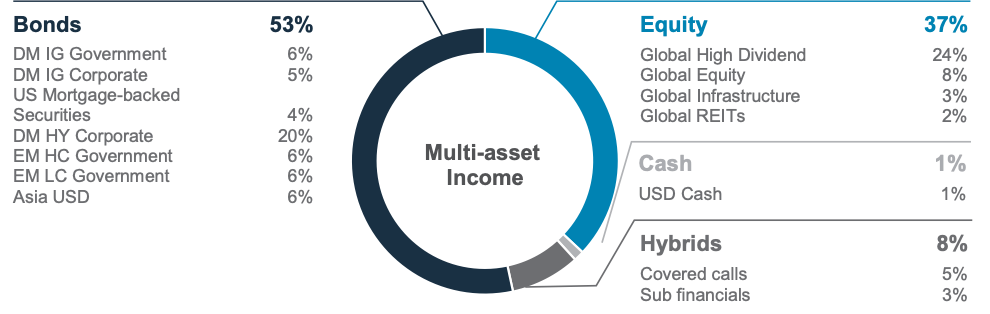
Source: Standard Chartered
Foundation: Our tactical asset allocation views
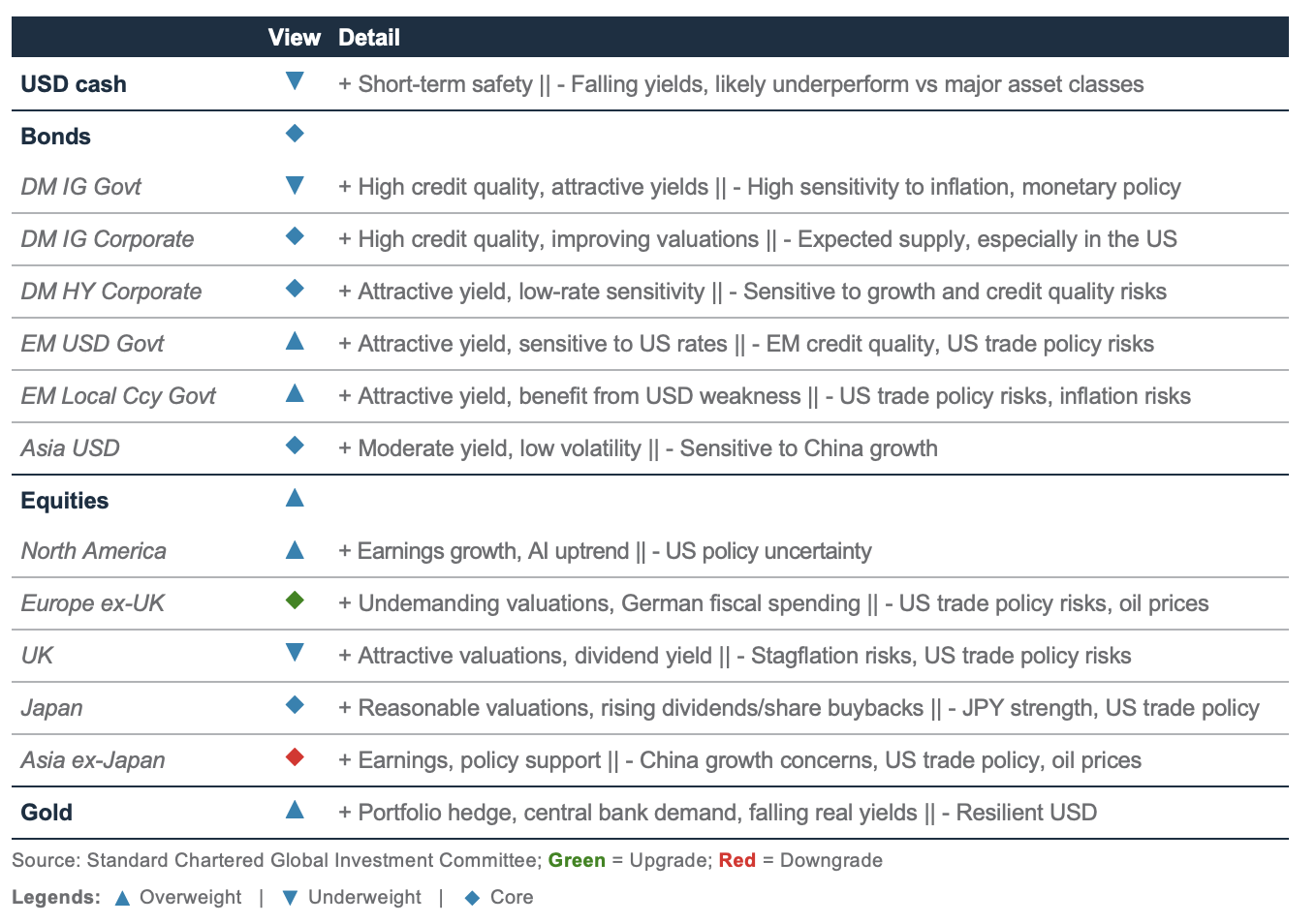
Fig. 6 Performance of our Foundation Allocations*
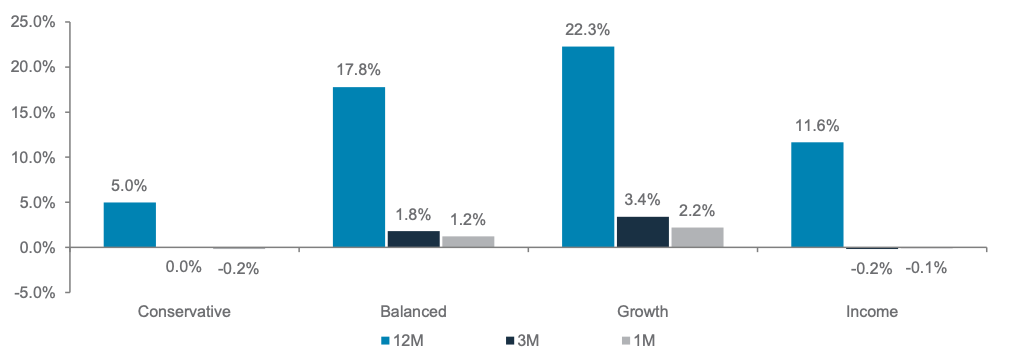
Source: Bloomberg, Standard Chartered; *12-month performance data from 20 May 2025 to 20 May 2026, three-month performance from 20 February 2026 to 20 May 2026, one-month performance from 20 April 2026 to 20 May 2026
Perspectives on key client questions
|
|
|
Gold market dynamics – revisiting the safe haven
Gold remains an enduring portfolio stabiliser amid geopolitical friction and macroeconomic fragmentation. The World Gold Council (WGC) estimated the global above-ground gold stock was at 220,000 tonnes as of early 2025, which came to be valued at approximately USD 33trn by March 2026-end – a 53% surge in just one year.
Historically, gold has been viewed as a currency, largely due to its role as a store of value. More notably, beyond its use in jewellery and electronics, gold’s low correlation with equities and bonds cements its role as one of the key hedges against market volatility.
Why consider gold?
Evaluating gold’s role in an investment portfolio requires a close look at how it handles macroeconomic shocks and serves as a resilient safe haven during systemic stress. To examine the strategic case for gold, we review its track record in protecting against inflation, driving portfolio diversification and protecting wealth during crises.
Inflation hedge
Gold is a time-tested defence against inflation. Over the last 40-plus years, it has consistently held or grown in value during inflationary periods. A recent WGC study showed that between 1971 and 2020, gold delivered an annual growth rate of 8-10%, significantly outpacing consumer inflation. However, it is not immune to policy shifts; aggressive Fed tightening can trigger sharp reversals, as seen in 1981 when gold fell over 30%.Fig.

Fig. 7 Major fiat currencies vs gold
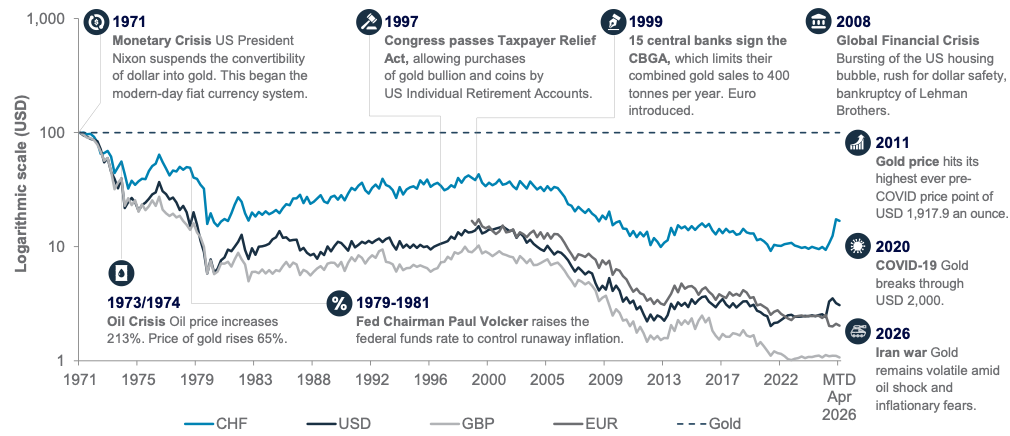
More recently, gold hit an all-time high of USD 5,589/oz in January 2026, before crashing nearly 25% by March 2026 amid the Middle East conflict to approximately USD 4,130/oz and finally rebounding to its long-term uptrend. Despite geopolitical tensions that had driven safe-haven demand, the oil shock, inflation fears and expectations of higher rates pressured gold downward.
The aforementioned instances indicate that gold may not be the ‘perfect’ safe haven at all times and that it too can succumb to the vagaries of economic and market cycles. However, over the past 50 years, the average annual rate of return from gold has been around 8%. Such performance
suggests that while gold can face temporary headwinds, it can potentially provide inflation-beating returns in the long term.
Portfolio diversification
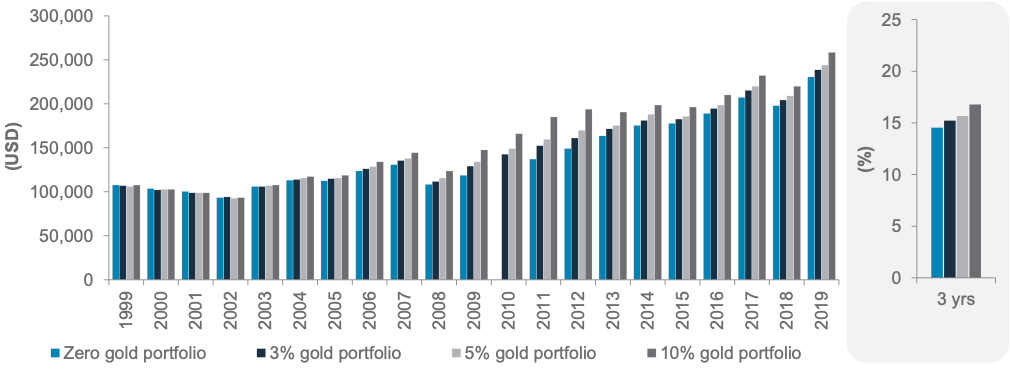
Gold’s superpower is its largely low correlation with traditional assets. While it shares a generally negative correlation with US government bonds during inflationary spikes, its long-term relationship with bonds remains low. Data from 1999-2019 shows that a traditional 60:40 portfolio of equity and bonds consistently underperformed those with a gold allocation. As shown in Fig 8, adding even a 5-10% gold allocation can raise annual returns by 1-2% while reducing drawdowns during equity bear markets.
Fig. 8 Portfolio performance with and without gold
Safe haven in uncertain times
1. Gold during recession
Since 1973, gold has outperformed the S&P500 by an average of 37% during six out of eight documented US
recessions. The exceptions occurred when interest rates were hiked aggressively (1981) or when central banks became net sellers (1990). The historical resilience of the metal during downturns is illustrated below:
Fig. 9 Gold during recession
2. Gold during stagflation
Stagflation – stalled economic growth paired with high inflation – creates a winning environment for gold. Typically, during periods of slowing growth, monetary stimulus and fiscal intervention can bring down borrowing costs and help businesses resume economic activities, eventually translating to sustained growth and lower unemployment. However,
during stagflation, policy stimulus is constrained because it can risk worsening inflation.
When traditional assets face stress due to weak investor sentiment and low real (net-of-inflation) interest rates amid a ‘stagflationary’ environment, investors pivot to the safety of the ‘yellow metal’. In the past, the US experienced stagflation in mid-to-late 1970s as high oil prices fuelled inflation and stalled economic growth.
Fig. 10 Gold during stagflation
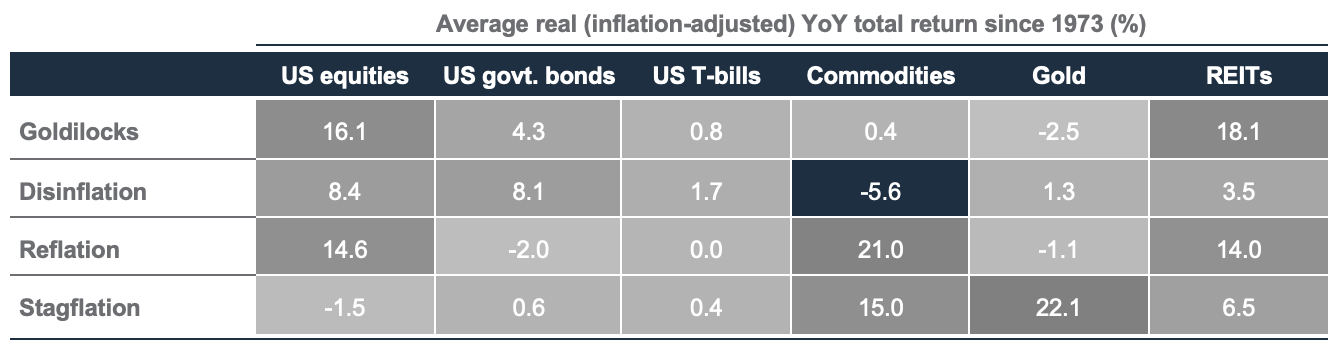
Notes: Growth is proxied using US Conference Board Leading Economic Index and inflation is US core CPI. Goldilocks = accelerating growth and falling inflation; Disinflation = decelerating growth and inflation; Reflation = accelerating growth and inflation; Stagflation = decelerating growth and inflation above 10-year average
3. Gold during crises
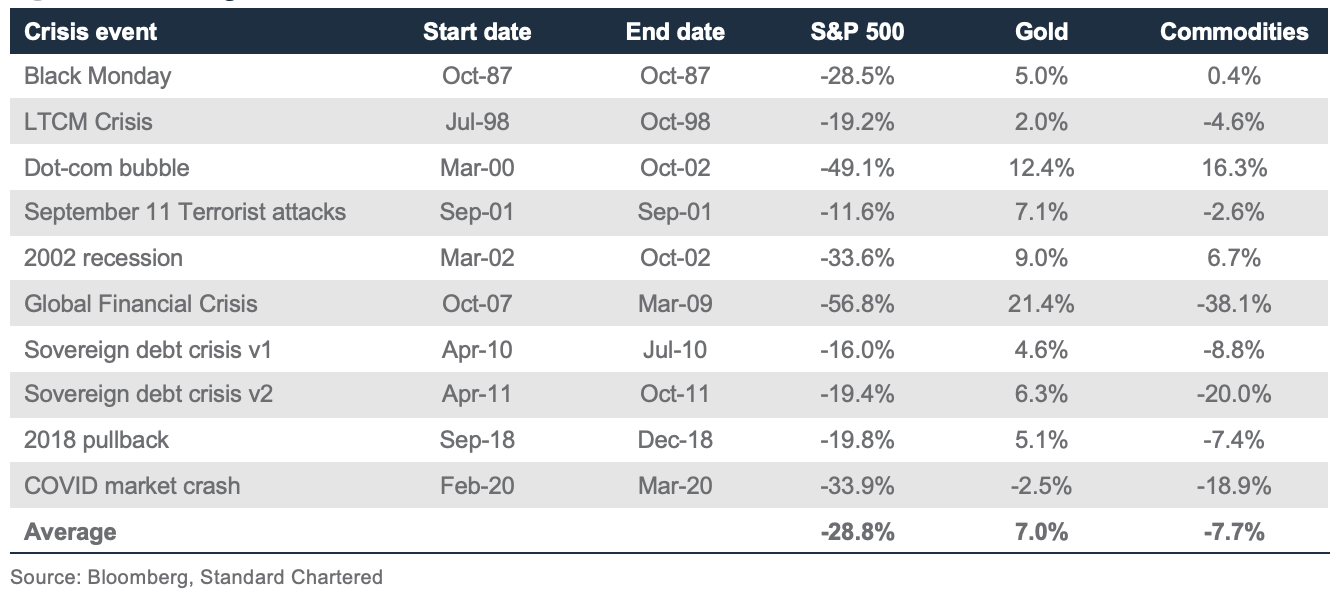
Gold insulates portfolios against extreme tail risks. It carries no credit risk during periods of economic uncertainty – when credit-related losses are higher than usual – and maintains high liquidity without withdrawal restrictions. Historically,
during events such as the Global Financial Crisis (where the S&P500 Index fell 56.8%), gold surged by 21.4%. On average, across major modern crises, gold has returned 7.0%, while the S&P500 averaged a 28.8% loss – a trend captured below.
Fig. 11 Gold during crisis
As explained, gold is a strategic asset for wealth preservation and not just a commodity. Its low correlation with equities and bonds makes it an essential diversifier that thrives during
periods of market stress and economic uncertainty. Whether held physically or virtually, the ‘yellow metal’ continues to prove its worth as the ultimate safe haven for the long haul.
Macro overview – at a glance
Our macroeconomic outlook and key questions
|
Key themes
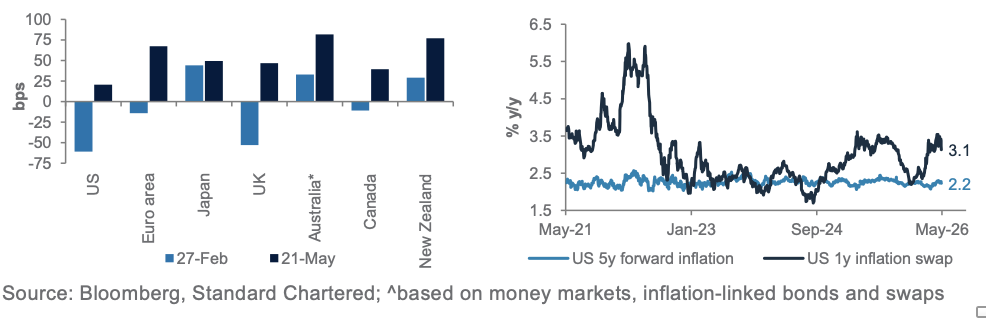
Core scenario (soft landing, 60% probability): We assign a 60% probability that the Hormuz strait will reopen in the next few weeks, given the incentive on all sides to avoid an oil price shock. This should help economies achieve a soft landing this year. In this scenario, long-term inflation expectations should remain subdued. Hence, we believe rate markets are overly hawkish – policymakers are likely to largely look through the brief inflation spike and focus on the lagged growth impact of the oil shock. Hence, we expect the Fed, under new Chair Warsh, to cut rates by 25bps by year-end as focus turns to supporting growth. ECB is likely to deliver one, and BoJ two “insurance” hikes to counter inflation, while China eases to revive domestic consumption.
Downside risk (hard landing, 20% probability): We lower the risk of a hard landing from 30%, as a short-term spike in oil prices is unlikely to cause a recession, especially with soaring AI-focused investment and global defence spending supporting growth. A prolonged blockade of the Hormuz strait, or a stock/bond market downturn on inflation/debt concerns remain tail risks.
Upside risk (no landing, 20% probability): If the Hormuz strait is reopened and global trade and investment pick up following the Trump-Xi meeting, there is a chance that US tax cuts, the wealth effect from booming equities and fiscal easing in Germany, China and Japan could revive “animal spirits”. A Russia-Ukraine peace deal or a defence spending boom can lift global growth.
Key chart
We expect the Fed to cut its policy rate by 25bps, the ECB to hike by 25bps and the BoJ to hike by 50bps by December 2026.*Australia rate change estimate includes 50bps of rate hikes already delivered
Fig. 12 Rate markets appear overly hawkish amid subdued inflation expectations
Expected change in policy rates by Dec 2026; US one- and five-year inflation estimates^
Policy rates watch
Fed to pause until Q3, cut rate by 25bps by December: The US economy appears resilient on the surface but fragile underneath. Q1 real GDP grew at an annualised 2%, with private domestic demand up 2.5% and AI-related capex contributing more than 1ppt to growth. However, the oil shock is delivering a c.0.5% hit to consumer disposable incomes. History shows oil shocks bite with a 4-6 quarter lag. Buffers (oil stockpiles, tax refunds, USD 400mn/day of federal military spending, wealth effect from booming equities) are masking weakness that should surface in H2 2026. Our base case remains a soft landing, with 2026 growth below 2% trend. Headline inflation in April accelerated to 3.8% y/y, the highest since 2023, driven by gasoline (+28% over two months), food, airfares and a one-off statistical quirk for measuring shelter inflation. Stripping out the rent distortion, core inflation was just 0.26% m/m, signalling underlying disinflation is intact. Core goods inflation remains cool as Liberation Day tariff
pass-through fades, average wage gains are muted at 3.6% y/y, and long-term inflation expectations remain anchored. Headline inflation is likely to peak in Q2 before easing below 3% by Q1 2027 as crude oil prices fall towards USD 75/bbl.
Against this backdrop, the Fed is likely to remain on hold for now, especially after three hawkish dissents at the April policy meeting. Our base case remains a pause through summer, then a 25bps cut by December under incoming Chair Warsh, as the lagged growth damage from the oil shock forces a pivot toward supporting the labour market, currently at a fragile equilibrium. Risks: a prolonged Hormuz closure could de-anchor expectations and trigger hawkish policy repricing.
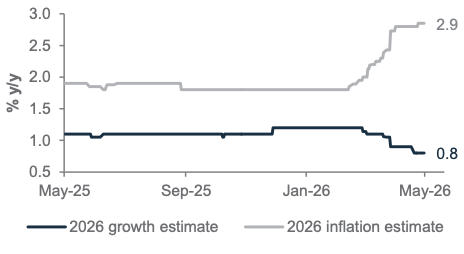
ECB to hike rate by 25bps in June, before pausing: Euro area growth is softening, with Q1 2026 GDP printing just 0.1% q/q, dragged down by weak French private demand, while Spain and Germany surprised to the upside. Underlying momentum across core economies is cooling, with May PMIs, ZEW expectations and consumer confidence softening,
pointing to weaker Q2 momentum. The energy shock from the Iran crisis and Strait of Hormuz closure poses the key downside risk, with pessimistic scenarios suggesting a 0.7-0.9% GDP hit. However, structural buffers, including reduced gas dependence, Germany’s EUR 500bn fiscal stimulus and recovering credit demand, limit recession risk.
Euro area headline inflation jumped to 3.0% y/y in April (from 2.6%), entirely energy-driven, while core inflation eased to 2.2%, suggesting no broadening of price pressures yet. European Commission surveys point to rising selling-price expectations, keeping second-round risks alive. However, loose labour markets, the ECB’s survey showing firms have no intention to raise wages and weak consumer confidence constrain a wage-price spiral. Inflation expectations remain anchored.
At the last meeting, ECB President Lagarde de facto pre-announced a hike, stating “directionally, I know where we’re heading,” with the ECB’s baseline already embedding two 25bps hikes for this year. Our base case remains a 25bps insurance hike to 2.25% in June, followed by a pause. Market pricing of c.70bps of hikes by year-end looks excessive, given weakening growth and absent second-round inflation effects.
China to ease policies modestly to support growth. After a Q1 growth beat, China’s April data showed a notable cooling in domestic demand: retail sales growth slowed to just 0.2% y/y (from 1.7%), while fixed asset investment (FAI) swung from +1.7% YTD in Q1 to -1.6% YTD. Real estate investment remained the main drag (-13.7% y/y YTD), and infrastructure and manufacturing FAI both reversed their Q1 rebounds. Export growth remains the main offset, with industrial export value up 10.6% y/y, the fastest pace since 2022, fuelled by an AI-driven surge in semiconductors (+100% y/y) and computer (+47% y/y) shipments. The Xi-Trump summit, which could potentially lead to tariff reduction on some US imports from China, should help revitalise US exports and restore some business confidence. We expect the economy to achieve the 4.5-5.0% growth target for this year. Reflation is continuing, but for the “wrong” reasons. April’s price firmness was largely cost-driven, reflecting surging imported commodity prices on the back of the AI investment
boom and Middle East conflict, rather than a genuine pickup in domestic demand. With consumption soft and housing still contracting, underlying disinflationary pressure persists.
Against this backdrop, China’s policy is set to lean moderately accommodative. The PBoC is likely to keep liquidity ample by modestly easing bank reserve requirements. Fiscally, Beijing is likely to accelerate allocated fiscal spending in the coming months to stabilise investment amid Middle East-related uncertainty. Externally, the “Constructive Strategic Stability” framework with the US, including a Board of Trade and Board of Investment, reduces tail risks and sets the stage for further engagement at upcoming summits.
BoJ to hike rate by 50bps to 1.25% by December: Japan’s growth outlook is cautiously constructive. The BoJ lowered its FY26 (April 26-March 27) real GDP forecast from +1.0% to +0.5%, as the oil-driven terms-of-trade shock weighs on purchasing power. The yen’s depreciation and inflation pressures are impacting household disposable income. Still, underlying momentum remains solid: real wages are growing strongly, business confidence (especially in manufacturing) and investment are resilient, and exports and new orders remain robust. Under our base scenario of a restart in Hormuz shipping by June, we expect growth to re-accelerate in H2.
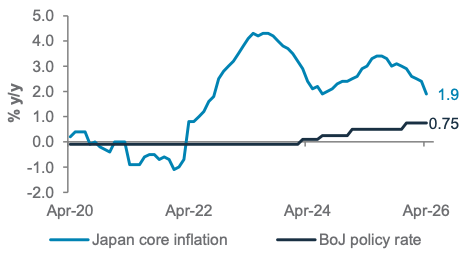
Although April inflation cooled, primarily due to base effects and subsidies, underlying price pressures remain. The BoJ significantly raised its FY26 core inflation (ex-fresh food) forecast from +1.9% to +2.8%, and core-core inflation (ex-fresh food and energy) from +2.2% to +2.6% due to higher oil and naphtha costs. Robust wage gains amid a structurally tight job market are a key transmission channel for sustained inflation, while a weak yen adds imported price pressure.
The BoJ held its policy at 0.75% in April via a hawkish 6-3 vote, setting up a June hike, contingent on a tacit approval from the government. The ongoing depreciation pressure on the JPY, which has forced the BoJ to intervene in FX markets since April-end, and government plans to lift fiscal spending have added urgency for a rate hike. After a June hike, we expect the BoJ to follow through with another rate hike to 1.25% in H2 2026 to bring its policy rate closer to inflation.
Fig. 13 ECB to hike once to counter inflation risks
Euro area consensus 2026 growth and inflation estimates
Source: Bloomberg, Standard Chartered
Fig. 14 BoJ to narrow inflation gap with two rate hikes
Japan core inflation (ex-fresh food, energy); BoJ policy rate
Asset classes
Fixed Income – at a glance
|
|
||||
|
|
||||
Our view
Foundation: We view fixed income as a Core holding. Within it, we continue to be Overweight EM USD and local currency bonds while maintaining an Underweight stance on Developed Market (DM) government bonds. With the Fed on hold since January and Middle East tensions keeping oil above USD 100/bbl, EM bonds have outperformed, supported by improving fundamentals, attractive valuations vs. DM peers and a stable USD. DM Investment-grade (IG) and High-yield (HY) are both Core holdings as corporate bonds still offer carry, though there’s little room for further spread compression. Corporate fundamentals remain resilient, with leverage stable and interest coverage strong, supporting our preference for credit over rates.
Opportunistic ideas: We are bullish (i) European bank AT1 bonds (CoCos1; FX-hedged), (ii) US TIPS, (iii) short-duration US HY bonds, (iv) AAA-rated collateralised loan obligations (CLOs), (v) US utilities corporate hybrids and (vi) AUD corporate bonds.
Key charts
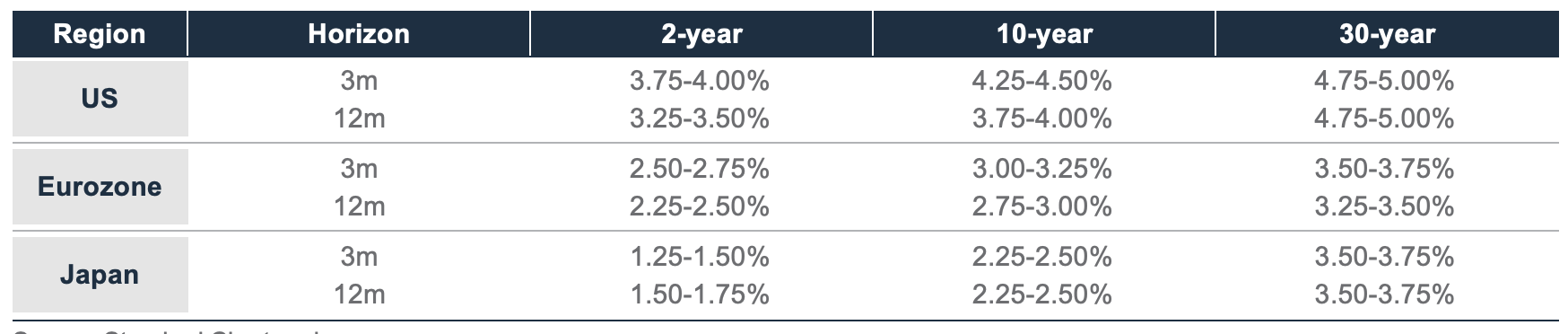
Fig. 15 Summary of rate forecasts
DM rates – Underweight
We are Underweight DM IG government bonds. In the US, April inflation surprised to the upside, strengthening our expectation that the term premium (compensation for holding long-duration bonds) is set to remain elevated, alongside a growing fiscal burden and the uncertain cost of the Iran crisis. We hence revised the 10-year bond yield as of Q4 2026 higher to 4.00-4.25%. We still expect the Fed to cut rates once to 3.5% by year-end 2026, assuming the Strait of Hormuz
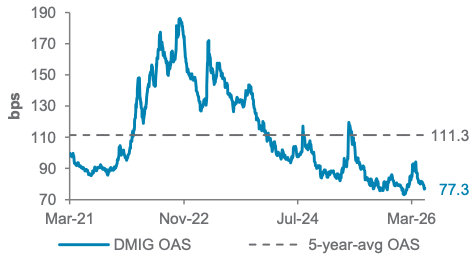
Fig. 16 DM IG corporate spreads tightened back towards the lows
Bloomberg Global Agg Corp index, OAS
reopens, and as the Fed shifts its focus towards emerging weakness in the labour market. We expect the US curve to bull-steepen as markets begin pricing in a resumption of Fed rate cuts. We continue to favour positioning in the belly of the curve (5-7 years) and remain Underweight long-dated tenors. We believe higher energy prices will have a greater impact on the Euro area and Japan. We expect both the ECB and the BoJ to raise policy rates once and twice by year-end 2026, respectively, leading their government bonds to underperform vs. the US on an FX-hedged basis.
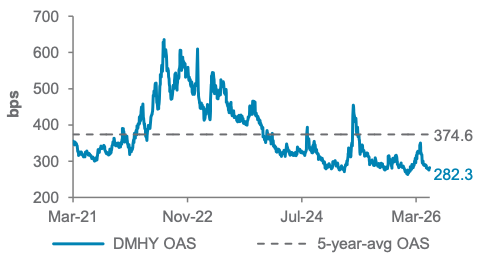
Fig. 17 Similar to IG, DM HY corporate spreads are also almost close to recent tights
Bloomberg Global HY Corp Index, OAS
DM corporates – Core holding
We maintain a Neutral allocation to both DM IG and DM HY corporate bonds, with a relative preference for HY over IG. While we recognise there is little room for corporate spreads to compress further, we expect dispersion to rise from here. As an income proposition, HY is supported by attractive all-in yields in the 6%+ range and benign default expectations of around 2.5–3.5%. On the IG side, spreads remain tight, in our view. In the US, AI capex-driven issuance has reached record levels but has generally been well-absorbed by still-strong demand. Recent issuances have come with fewer concessions, leading to some secondary underperformance post initial issuance. Nevertheless, fundamentals across both IG and HY corporates remain resilient, underpinned by solid profitability and stable credit metrics.
EM bonds – Overweight
We continue to prefer EM bonds over DM bonds, supported
Fig. 18 EM USD yields still offer 2%-plus pickup over DM yields
Bloomberg EM USD Quasi/Sov 10% Capped Index, yield to worst, and yield over Bloomberg Global Treasury Index
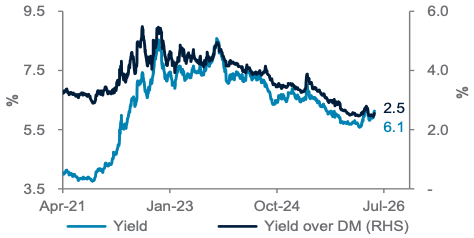
by a more compelling carry and a broadly constructive macro backdrop. We are Overweight both EM USD sovereign and EM local currency government bonds. While geopolitical risks may still trigger bouts of volatility, a Fed on hold and stronger EM fiscal and external positions should limit broader repricing, with income remaining the dominant driver of returns.
Within EM, we favour sovereigns with resilient external accounts and supportive terms of trade, particularly non-Gulf Cooperation Council (GCC) oil exporters in Latin America and select African producers. Latin America benefits from higher carry, commodity exposure and leverage to the US growth cycle, while firmer oil prices should continue to support fiscal revenues and external balances across both regions.
We retain a Neutral allocation to Asia USD bonds, which offer attractive nominal yields, favourable supply-demand dynamics, and strong credit fundamentals – backed by healthy cashflows, low leverage and a high share of sovereign-linked issuers.
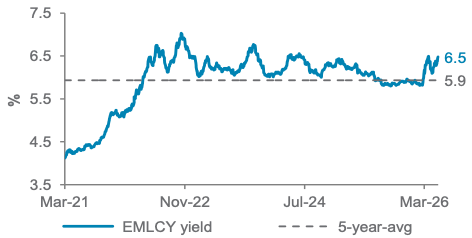
Fig. 19 EM LCY yields remain attractive
Bloomberg EM LCY Govt Index, yield to worst
Equity – at a glance
|
|
||||
|
|
||||
Our view
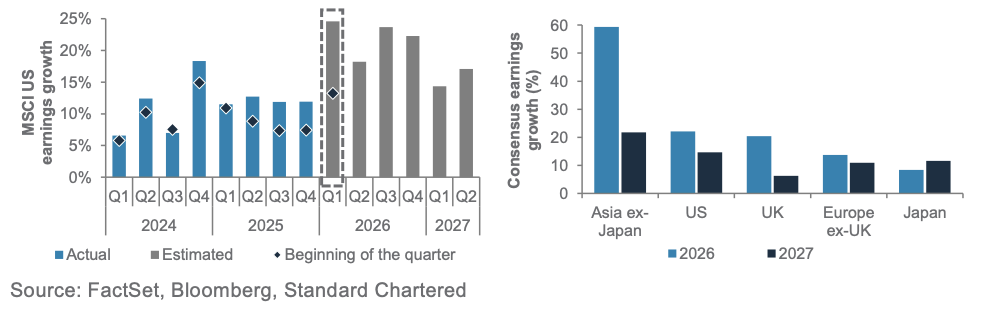
We remain Overweight global equities. While we expect equities to end the year higher, we see near-term volatility due to elevated rates and as the focus shifts to macro developments, now that the reporting season is over. With earnings growth across various market segments, we expect a broadening of the equity rally, as published in our Market Watch on 5 May. We took profit in key outperformers, such as Asia ex-Japan (AxJ) – downgraded from Overweight to Core allocation – and rotated into the underperforming Europe ex-UK region (upgraded from Underweight to Core). We remain Overweight US equities, where the Q1 earnings season led to upward earnings revisions. Consensus US earnings growth sits at 22%/15% for 2026/2027.
Within AxJ, we retain our diversified preference. We are Overweight Taiwan for structural semiconductor growth exposure, Overweight China for the valuation discount and Overweight India for domestic driven growth.
We have a Core allocation to Japan, where expansionary fiscal plans are a positive offset to energy import sensitivities. We remain Underweight UK equities, which has relatively muted earnings growth heading into 2027.
Key chart
US equities’ forecasts revised higher post Q1 2026 results
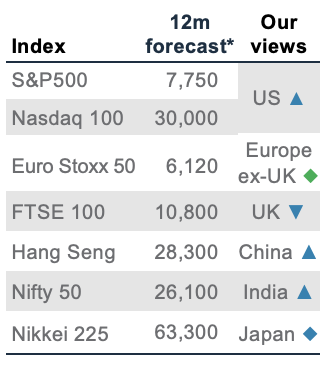
Fig. 20 US equities saw healthy upgrades to earnings growth following the Q1 2026 earnings season; earnings growth estimates for AxJ and the US are leading other regions, but AxJ has outperformed global equities significantly YTD
MSCI US quarterly earnings growth; consensus 12-month forward earnings growth estimates for MSCI equity indices
Still coping with the conflict
The Middle East conflict has led to elevated oil prices and supply chain disruptions, which have severely impacted some industries. However, the negative impact has been manageable overall for global equities, with upward revisions to earnings growth since the start of the year, even for oil importing regions like AxJ, Europe ex-UK and Japan. Rising inflation along with a rise in bond yields remains a key risk to watch, as it would impact equity valuations adversely.
In US equities, on which we are Overweight, AI capex continues to sustain strong growth in the technology sector. The Q1 earnings season was solid as all sectors delivered positive earnings surprises. As an oil exporter, the US economy is less vulnerable to energy shocks. AxJ is expected to enjoy the strongest earnings growth in 2026 and 2027, primarily driven by the technology sector,
which carries the largest weight in AxJ. However, we believe this has been reflected in its significant outperformance of global equities YTD. We see a more balanced risk-reward and prefer a Core allocation to AxJ equities now.
Within AxJ, we are Overweight Taiwan, consistent with the AI investment theme driving structural semiconductor growth. We also seek out other drivers with our Overweight on China and India. China offers an attractive valuation discount, supported by resilient growth and domestic policy support. Although India is exposed to a spike in oil prices as an energy importer, our base case for a reopening of the Hormuz strait supports attractive mid-teens earnings growth, driven by domestic factors less correlated to the AI theme. Japan and Europe ex-UK are Core holdings to us, with reasonable earnings growth supported by fiscal stimulus.
Equity opportunistic views
|
|
||||
|
|
||||
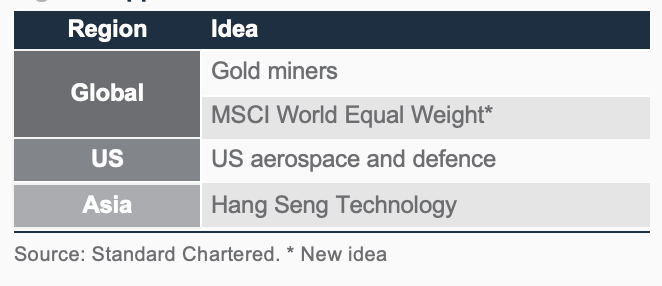
Add MSCI World equal weight idea
- We initiate an Opportunistic idea on the MSCI World Equal Weight to ride the broadening rally beyond AI leaders and hedge against concentration risk in cap-weighted benchmarks. Equal-weighting structurally tilts the index toward cyclicals – industrials and financials – which are set to benefit from resilient macro data and a soft-landing backdrop. The index also trades at a notable valuation discount to its cap-weighted parent.
- We recently took profit on global semiconductors, locking in a 31.4% gain (19 March 2026 to 4 May 2026). Within technology, we switched our preference from semis to internet names, which lagged the semis’ run and should benefit as participation broadens. The AI thesis remains intact, but with valuations re-rated, less-stretched sub-sectors offer a more attractive risk-adjusted entry.
- We take profit on global ex-US buybacks, locking in a 5.2% gain (19 March 2026 to 21 May 2026). The idea served as a defensive-with-upside anchor through geopolitical and stagflation concerns. It benefited from sizeable exposure to the energy sector (over 20% of the buybacks index). We prefer to take profit now, with our base scenario that the Hormuz strait will reopen in weeks.
- We take profit on US Utilities, tracking a 1.3% gain (30 October 2025 to 21 May 2026). This is in line with our downgrade of the sector globally from Overweight to a Core holding (see below).
Fig. 21 Opportunistic ideas
Ongoing ideas
Gold miners: We remain constructive on gold and expect investors to look past near-term, liquidity-driven weakness. Structural central bank demand remains, and we also expect a Fed rate cut in H2 2026 to be supportive. Higher oil prices would raise cost for miners, but we expect the gold price to rise faster. Elevated spreads between all-in sustaining costs (AISC) and gold prices continue to support miners’ margins. Hawkish central bank stances are risks.
US aerospace and defence: Major US aerospace names rallied into the Trump-Xi summit but pared gains after China committed to fewer US aircraft purchases than expected. Looking past this, upward revisions to the US defence budget and structural demand for air travel should support earnings growth. Weaker-than-expected defence spending is a risk.
Hang Seng Technology: Tech innovation remains a priority under China’s 15th Five-year Plan, while a strong AI-related IPO pipeline and reasonable valuations support sentiment. Decades of renewable investment leave Chinese firms relatively insulated from energy shocks, enhancing resilience amid geopolitical risks. Adverse regulatory changes are risks.
Sector views: Maintain a barbell approach
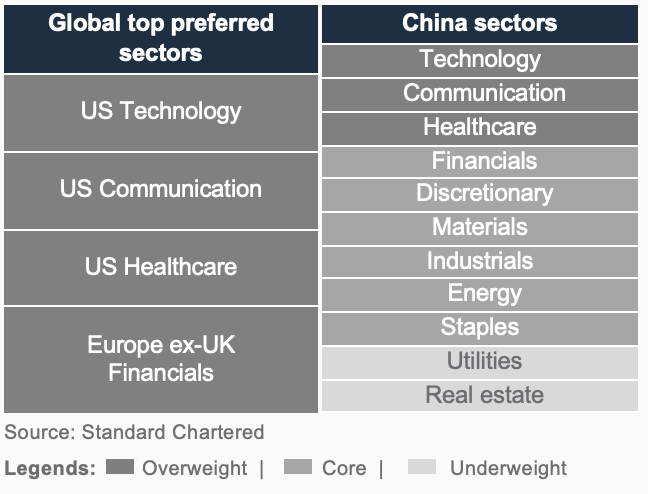
We downgrade US utilities to a core holding. Although the sector enjoys a powerful long-term tailwind from AI-driven power demand, there is a near-term headwind from potentially higher-for-longer interest rates. We maintain a barbell strategy with growth exposure to US technology and US communication services, balanced by defensive exposure to US healthcare. Structural AI tailwinds continue to drive technology, while an improving digital advertising backdrop and AI monetisation support communication services. We also stay Overweight Europe ex-UK financials, underpinned by strong balance sheets and attractive shareholder returns.
In China, we keep a barbell approach – growth via technology and communication services – where policy stimulus could accelerate self-reliance around domestic chips and support AI monetisation across internet platforms – balanced by defensive exposure to healthcare, where the quality of drug innovation continues to improve.
Fig. 22 Our sector views
Gold, crude oil – at a glance
|
Our view
We are Overweight gold and maintain our three- and 12-month price targets at USD 5,200/oz and USD 5,500/oz, respectively.
We raise our three-month WTI oil price forecast to USD 90/bbl on expectations that full output normalisation will take time.
Key chart
Fig. 23 Structural buying from central banks continues to support higher prices, despite a minority net selling
Global gold demand from central bank quarterly purchases
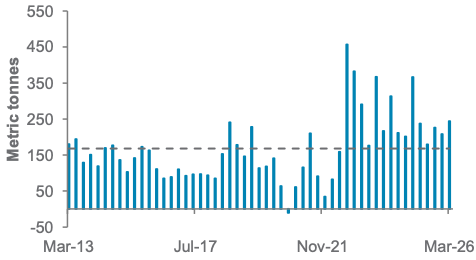
Fig. 25 Global inventory draws surged in April, significantly exceeding five-year averages
World Crude Oil and Other Liquids Net Withdrawals
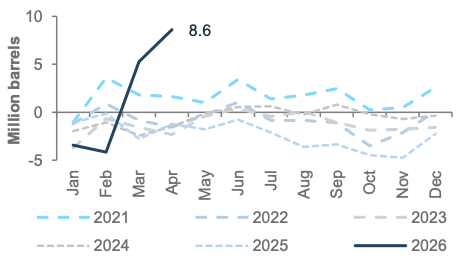
Fig. 24 Gold-silver ratio is normalising towards its historical average
Gold-silver ratio
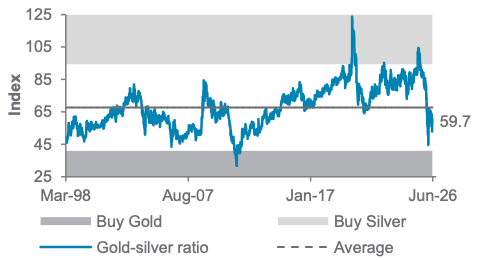
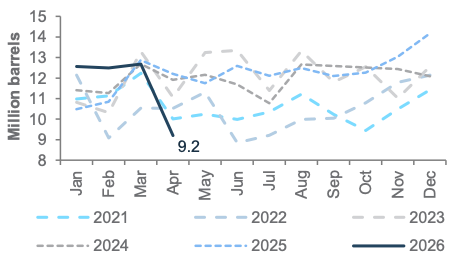
Fig. 26 China’s seaborne oil imports drop as domestic inventories are tapped
China Crude Oil and Refined Petroleum Imports
Gold outlook: Gold remains in a structural bull market, anchored by persistent central bank buying and long-term diversification away from US assets. While higher yields have triggered near-term liquidation, underlying fundamentals remain exceptionally strong. We expect sporadic institutional selling to be outweighed by robust official sector demand. As geopolitical hostilities stabilise, these drivers are expected to resume gold’s broader rally towards new highs.
Oil outlook: Oil prices remain capped despite tensions, anchored by a 3.8mb/d US seaborne export surge and a
reported sharp decline in Chinese imports in April. While our base case assumes a near-term resolution, the normalisation window is narrowing towards a late summer inventory deadline. With OECD stocks drawing rapidly towards operational minimums, markets remain vulnerable to any diplomatic impasse. We expect a return to surplus within the next 12 months, but the immediate need for inventory rebuilding should sustain prices near USD 90/bbl over the next three months.
FX – at a glance
|
|
||||
USD view
We have raised our three-month forecast for the US Dollar Index (DXY) to 98, up from 96. This upward revision is driven by the surprisingly strong US economic data and an expanding growth differential relative to the Euro area, both of which are underpinning the USD’s resilience. In addition, two key factors have emerged to support the greenback in the near term: 1) persistently high energy prices and the US’s position as a net energy exporter and 2) the market’s recalibration of expectations for the Fed to remain on hold for this year. Finally, as the Strait of Hormuz remains closed and positive economic surprises outside the US begin to wane, these dynamics are likely to keep the USD anchored within its recent range in the coming months.
We maintain our twelve-month DXY forecast at 96. We expect that, as global inflationary pressures ease, the market’s current preference for the USD will fade, paving the way for pro-cyclical currencies to rebound. The USD continues to trade at a substantial premium compared to other currencies. We expect this overvaluation to recede as the US fiscal deficit and current account imbalances widen. Should the structural twin deficits reassert themselves, we foresee the USD gradually moving towards our target as the global economic environment transitions from a defensive stance to one of more synchronised growth.
Key charts
Fig. 27 USD is consolidating recently, but narrowing interest-rate differentials likely to drive downside risk on a 12-month-forward basis
DXY, weighted interest-rate differentials and five-year average
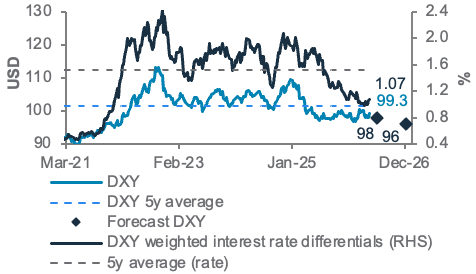
Fig. 29 Great British Pound (GBP) faces downside risk on political risks and yield spread capped at 0.75%
GBP/USD and yield spread
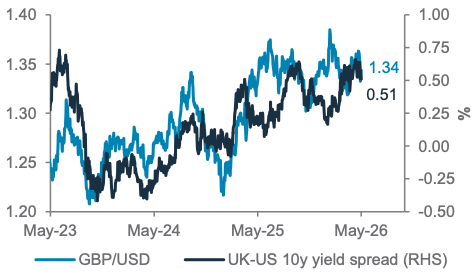
Fig. 28 Japanese Yen (JPY) gains offset by rising oil prices, which is likely to depress growth
USD/JPY and oil price
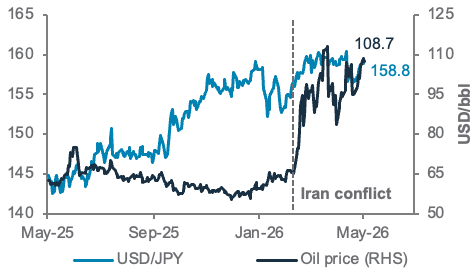
Fig. 30 Offshore Chinese Yuan (CNH) is strengthening as the PBoC lowers USD/CNH fixing
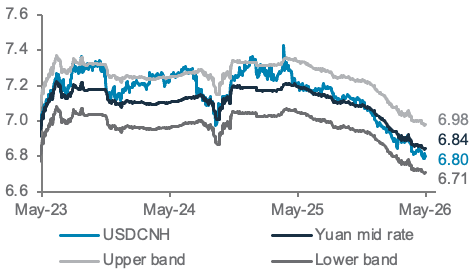
Fig. 33 Summary of currency forecasts and drivers
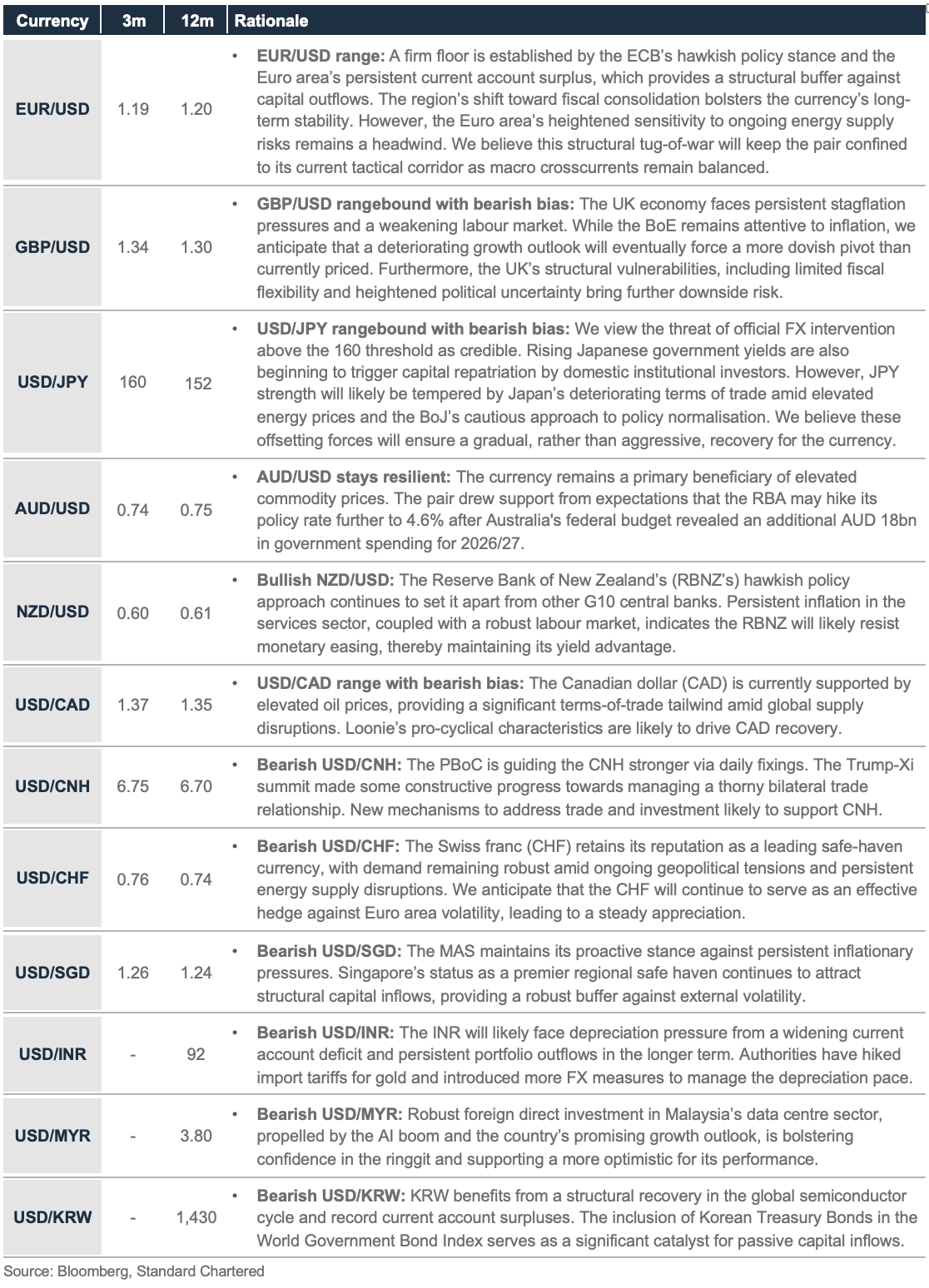
Additional perspectives
Quant perspective: Bullish equities
Bullish equities over both short and long term
|
|
||||
Summary
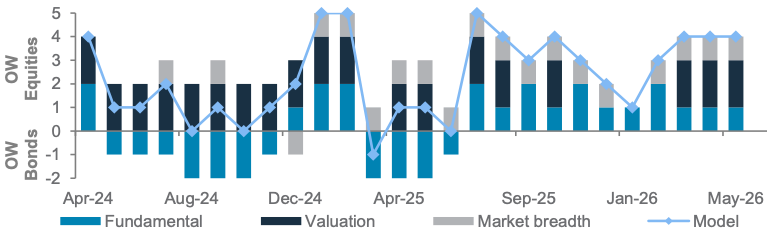
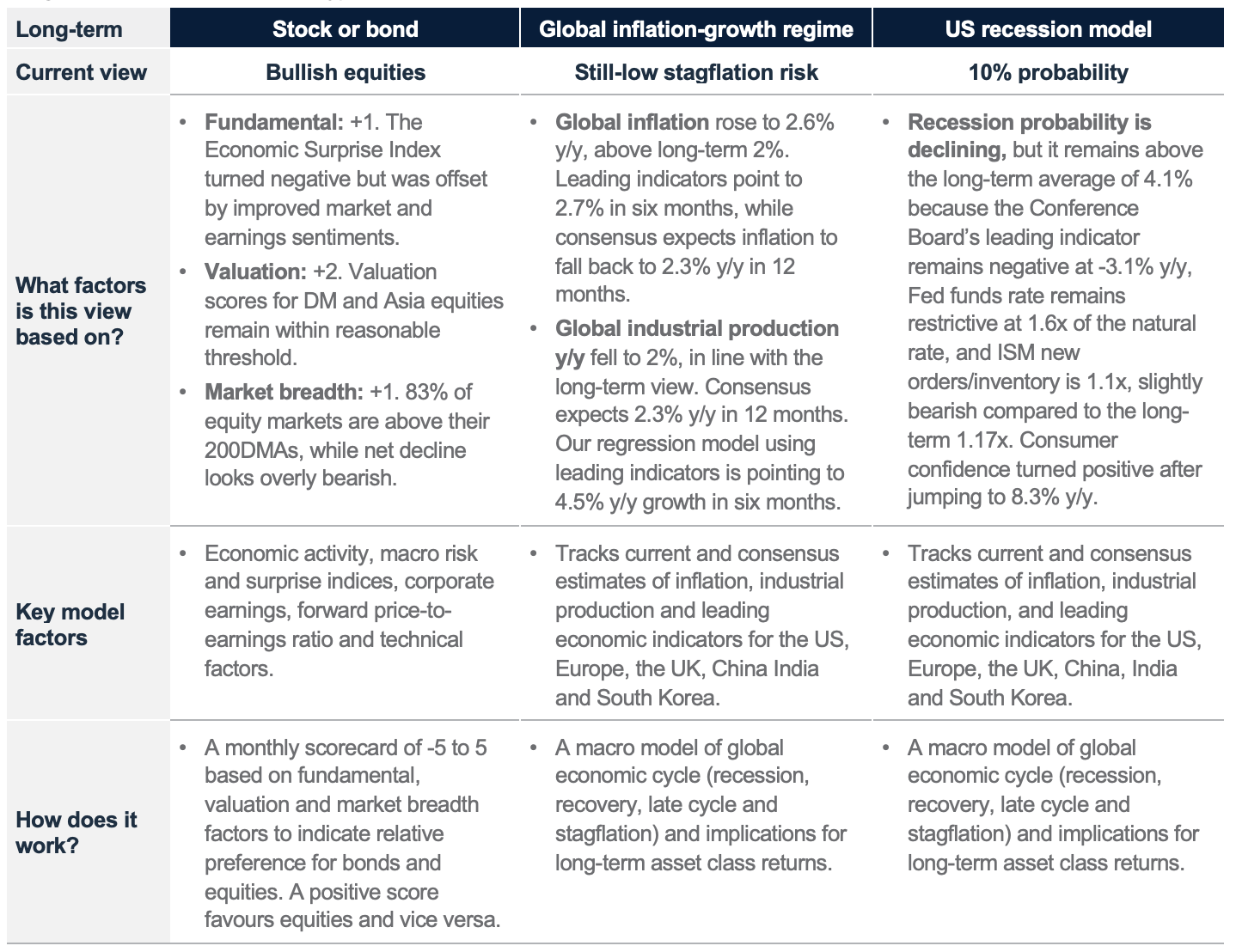
Our 3-6-month stock-bond model continues to heavily Overweight global equities, as the model score stays at +4 out of 5. This comes even as the strong rebound in global equities has seemingly hit a pause. The reasons are that (1) valuation signals for DM and Asian equities still remain within reasonable thresholds to stay long equities, (2) fundamentals are still bullish for risk assets and (3) market technicals are supportive of equities, with 83% of individual equity markets staying above their 200-day moving averages (DMAs), while the likelihood of an upward reversal has risen due to a net decline in stocks looking overly bearish. YTD return sits at 9.6%, outperforming the 60/40 equity-bond benchmark by 3.2%.
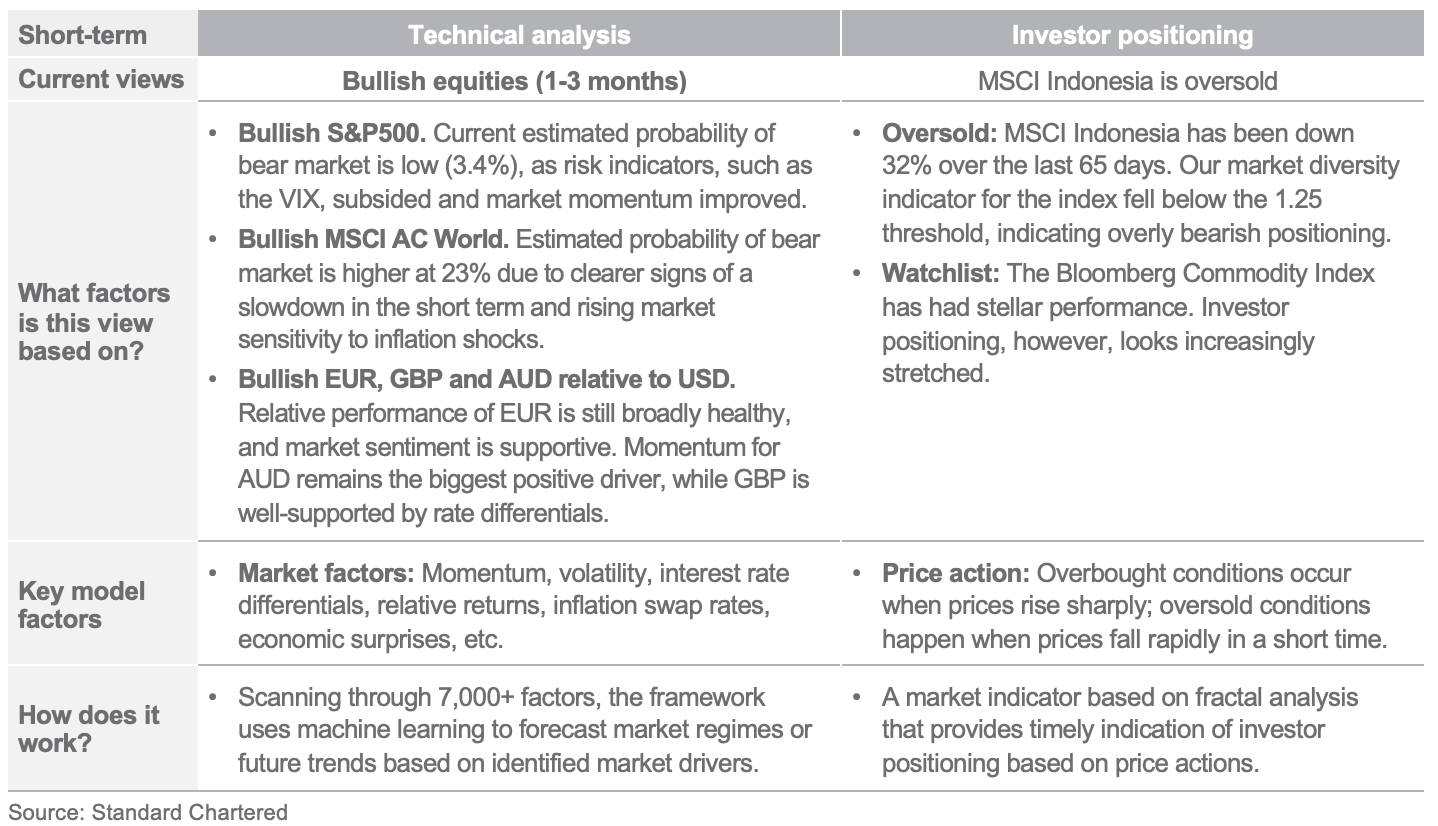
Our 1-3-month short-term equity technical models remain bullish on the S&P500 and MSCI AC World, as the risk indicator Volatility Index (VIX) has subsided and remains below 20%. The estimated bear market probabilities for both indices are 3.4% and 23% respectively. The higher bear market probability for the MSCI AC World is driven by clearer signs of a slowdown in the short term and a higher correlation between agricultural prices and global government bond yields, which indicate greater market sensitivity to potential inflation shocks.
It was a quiet month for our market diversity indicator, as only MSCI Indonesia is currently being flagged as oversold. Theindex has been down 32% over the last 65 days, significantly underperforming its other equity markets. Our market diversity indicator for the index is currently below 1.25, a threshold where the likelihood of a short-term reversal rises significantly. The Bloomberg Commodity Index is also looking increasingly overbought based on the indicator, but it has yet to cross the threshold.
Key chart
Our stock-bond model increased its Overweight allocation to equity in March, on the back of improved equity valuation, still-supportive fundamentals and a healthy market breadth.
Fig. 32 Breakdown of our stock-bond rotation model’s scores
Model score in May 2026 remained at +4
Our short-term models turned bullish on equities, as option-market implied volatilities tapered off sharply.
Fig. 33 Our technical model turned bullish on S&P500
S&P500 Index; model’s bearish signal; technical support and resistance levels
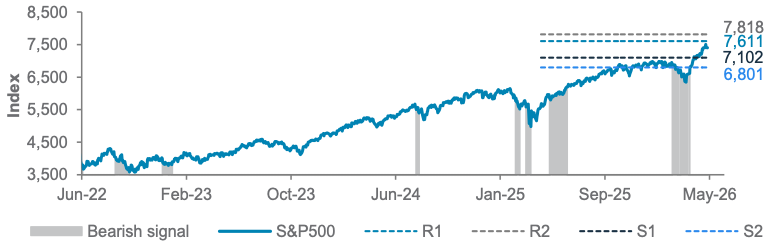
Fig. 37 Long- and short-term quantitative models remain bullish risk assets
Long-term models below have a typical time horizon of 3-6 months, while short-term models have a 1-3-month horizon
Performance review
Foundation: Asset allocation summary
Foundation+: Asset allocation summary
Market performance summary
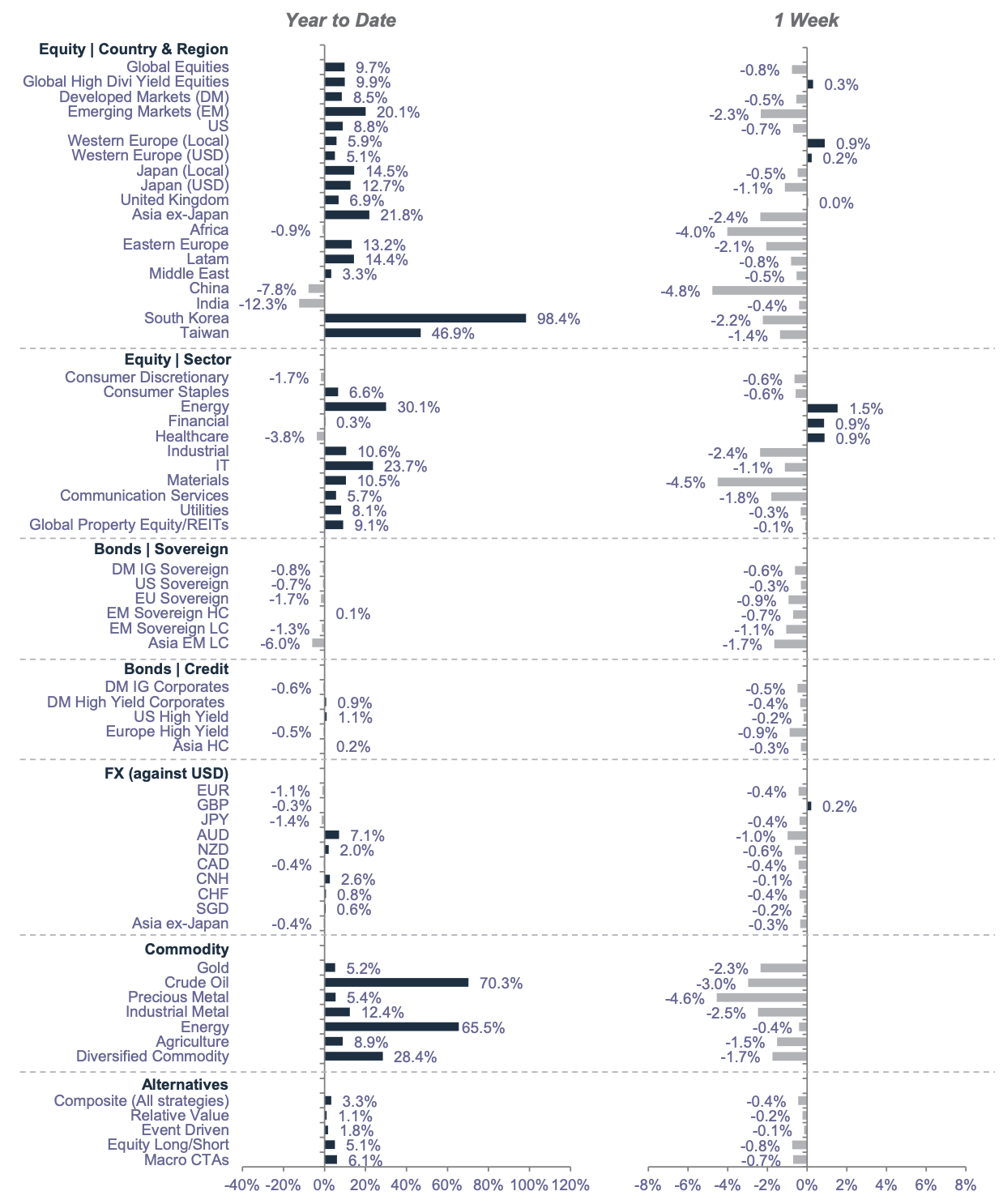
*All performance shown in USD terms, unless otherwise stated
*YTD performance data from 31 December 2025 to 23 April 2026; 1-week performance from 16 April 2026 to 23 April 2026
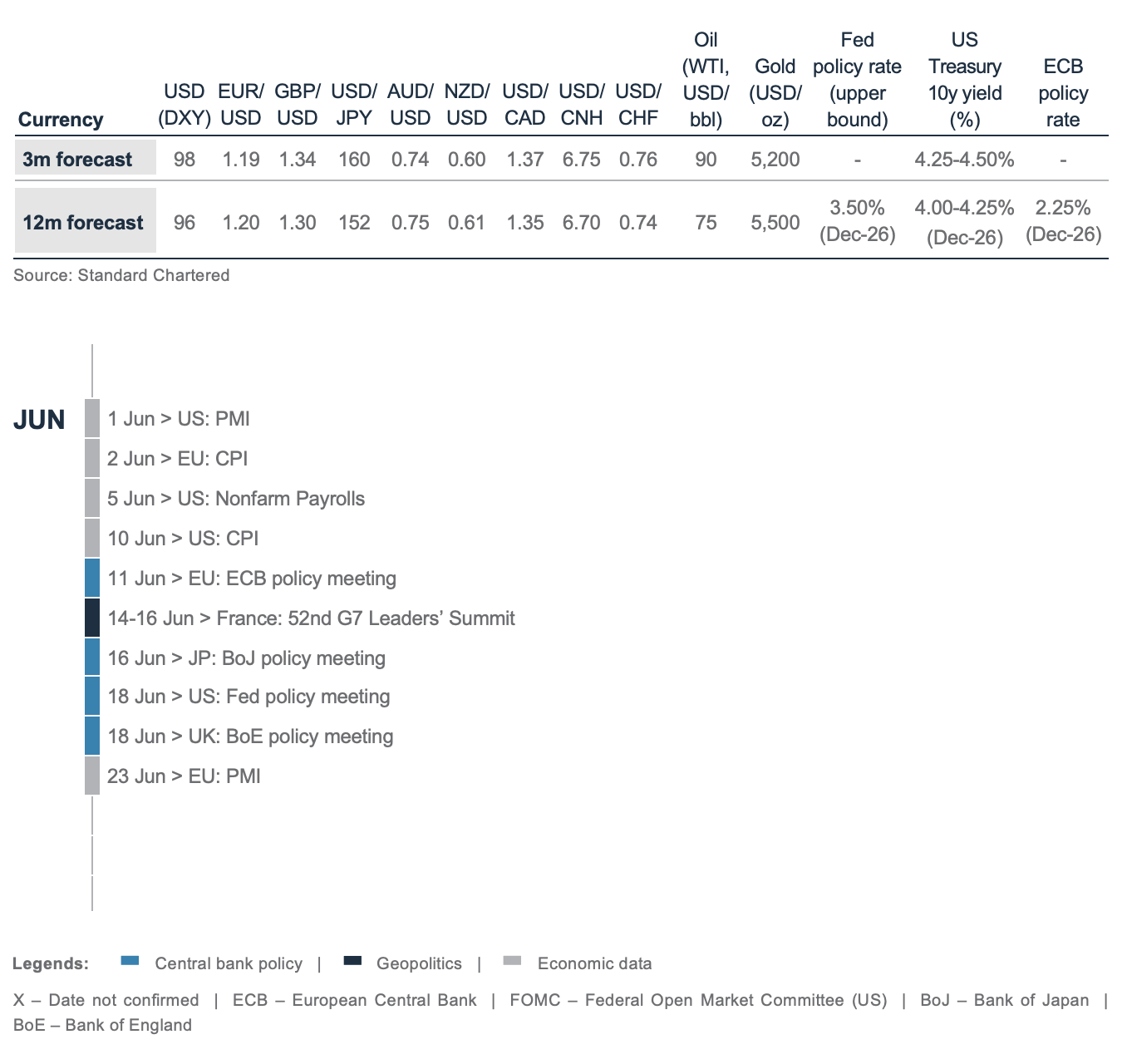
Our key forecasts and calendar events
SC Wealth Select

Explanatory notes
- The figures on page 5 show allocations for a moderately aggressive risk profile only – different risk profiles may produce significantly different asset allocation results. Page 5 is only an example, provided for general information only and they do not constitute investment advice, an offer, recommendation or solicitation. They do not take into account the specific investment objectives, needs or risk tolerances of a particular person or class of persons and they have not been prepared for any particular person or class of persons.
- Contingent Convertibles are complex financial instruments and are not a suitable or appropriate investment for all investors. This document is not an offer to sell or an invitation to buy any securities or any beneficial interests therein. Contingent convertible securities are not intended to be sold and should not be sold to retail clients in the European Economic Area (EEA) (each as defined in the Policy Statement on the Restrictions on the Retail Distribution of Regulatory Capital Instruments (Feedback to CP14/23 and Final Rules) (“Policy Statement”), read together with the Product Intervention (Contingent Convertible Instruments and Mutual Society Shares) Instrument 2015 (“Instrument”, and together with the Policy Statement, the “Permanent Marketing Restrictions”), which were published by the United Kingdom’s Financial Conduct Authority in June 2015), other than in circumstances that do not give rise to a contravention of the Permanent Marketing Restrictions.
Disclosure
This document is confidential and may also be privileged. If you are not the intended recipient, please destroy all copies and notify the sender immediately. This document is being distributed for general information only and is subject to the relevant disclaimers available at our Standard Chartered website under Regulatory disclosures. It is not and does not constitute research material, independent research, an offer, recommendation or solicitation to enter into any transaction or adopt any hedging, trading or investment strategy, in relation to any securities or other financial instruments. This document is for general evaluation only. It does not take into account the specific investment objectives, financial situation or particular needs of any particular person or class of persons and it has not been prepared for any particular person or class of persons. You should not rely on any contents of this document in making any investment decisions. Before making any investment, you should carefully read the relevant offering documents and seek independent legal, tax and regulatory advice. In particular, we recommend you to seek advice regarding the suitability of the investment product, taking into account your specific investment objectives, financial situation or particular needs, before you make a commitment to purchase the investment product. Opinions, projections and estimates are solely those of SC at the date of this document and subject to change without notice. Past performance is not indicative of future results and no representation or warranty is made regarding future performance. The value of investments, and the income from them, can go down as well as up, and you may not recover the amount of your original investment. You are not certain to make a profit and may lose money. Any forecast contained herein as to likely future movements in rates or prices or likely future events or occurrences constitutes an opinion only and is not indicative of actual future movements in rates or prices or actual future events or occurrences (as the case may be). This document must not be forwarded or otherwise made available to any other person without the express written consent of the Standard Chartered Group (as defined below). Standard Chartered Bank is incorporated in England with limited liability by Royal Charter 1853 Reference Number ZC18. The Principal Office of the Company is situated in England at 1 Basinghall Avenue, London, EC2V 5DD. Standard Chartered Bank is authorised by the Prudential Regulation Authority and regulated by the Financial Conduct Authority and Prudential Regulation Authority. Standard Chartered PLC, the ultimate parent company of Standard Chartered Bank, together with its subsidiaries and affiliates (including each branch or representative office), form the Standard Chartered Group. Standard Chartered Private Bank is the private banking division of Standard Chartered. Private banking activities may be carried out internationally by different legal entities and affiliates within the Standard Chartered Group (each an “SC Group Entity”) according to local regulatory requirements. Not all products and services are provided by all branches, subsidiaries and affiliates within the Standard Chartered Group. Some of the SC Group Entities only act as representatives of Standard Chartered Private Bank and may not be able to offer products and services or offer advice to clients.
Copyright © 2026, Accounting Research & Analytics, LLC d/b/a CFRA (and its affiliates, as applicable). Reproduction of content provided by CFRA in any form is prohibited except with the prior written permission of CFRA. CFRA content is not investment advice and a reference to or observation concerning a security or investment provided in the CFRA SERVICES is not a recommendation to buy, sell or hold such investment or security or make any other investment decisions. The CFRA content contains opinions of CFRA based upon publicly-available information that CFRA believes to be reliable and the opinions are subject to change without notice. This analysis has not been submitted to, nor received approval from, the United States Securities and Exchange Commission or any other regulatory body. While CFRA exercised due care in compiling this analysis, CFRA, ITS THIRD-PARTY SUPPLIERS, AND ALL RELATED ENTITIES SPECIFICALLY DISCLAIM ALL WARRANTIES, EXPRESS OR IMPLIED, INCLUDING, BUT NOT LIMITED TO, ANY WARRANTIES OF MERCHANTABILITY OR FITNESS FOR A PARTICULAR PURPOSE OR USE, to the full extent permitted by law, regarding the accuracy, completeness, or usefulness of this information and assumes no liability with respect to the consequences of relying on this information for investment or other purposes. No content provided by CFRA (including ratings, credit-related analyses and data, valuations, model, software or other application or output therefrom) or any part thereof may be modified, reverse engineered, reproduced or distributed in any form by any means, or stored in a database or retrieval system, without the prior written permission of CFRA, and such content shall not be used for any unlawful or unauthorized purposes. CFRA and any third-party providers, as well as their directors, officers, shareholders, employees or agents do not guarantee the accuracy, completeness, timeliness or availability of such content. In no event shall CFRA, its affiliates, or their third-party suppliers be liable for any direct, indirect, special, or consequential damages, costs, expenses, legal fees, or losses (including lost income or lost profit and opportunity costs) in connection with a subscriber’s, subscriber’s customer’s, or other’s use of CFRA’s content.
Market Abuse Regulation (MAR) Disclaimer
Banking activities may be carried out internationally by different branches, subsidiaries and affiliates within the Standard Chartered Group according to local regulatory requirements. Opinions may contain outright “buy”, “sell”, “hold” or other opinions. The time horizon of this opinion is dependent on prevailing market conditions and there is no planned frequency for updates to the opinion. This opinion is not independent of Standard Chartered Group’s trading strategies or positions. Standard Chartered Group and/or its affiliates or its respective officers, directors, employee benefit programmes or employees, including persons involved in the preparation or issuance of this document may at any time, to the extent permitted by applicable law and/or regulation, be long or short any securities or financial instruments referred to in this document or have material interest in any such securities or related investments. Therefore, it is possible, and you should assume, that Standard Chartered Group has a material interest in one or more of the financial instruments mentioned herein. Please refer to our Standard Chartered website under Regulatory disclosures for more detailed disclosures, including past opinions/ recommendations in the last 12 months and conflict of interests, as well as disclaimers. A covering strategist may have a financial interest in the debt or equity securities of this company/issuer. All covering strategist are licensed to provide investment recommendations under Monetary Authority of Singapore or Hong Kong Monetary Authority. This document must not be forwarded or otherwise made available to any other person without the express written consent of Standard Chartered Group.
Sustainable Investments
Any ESG data used or referred to has been provided by Morningstar, Sustainalytics, MSCI or Bloomberg. Refer to 1) Morningstar website under Sustainable Investing, 2) Sustainalytics website under ESG Risk Ratings, 3) MCSI website under ESG Business Involvement Screening Research and 4) Bloomberg green, social & sustainability bonds guide for more information. The ESG data is as at the date of publication based on data provided, is for informational purpose only and is not warranted to be complete, timely, accurate or suitable for a particular purpose, and it may be subject to change. Sustainable Investments (SI): This refers to funds that have been classified as ‘ESG Intentional Investments – Overall’ by Morningstar. SI funds have explicitly stated in their prospectus and regulatory filings that they either incorporate ESG factors into the investment process or have a thematic focus on the environment, gender diversity, low carbon, renewable energy, water or community development. For equity, it refers to shares/stocks issued by companies with Sustainalytics ESG Risk Rating of Low/Negligible. For bonds, it refers to debt instruments issued by issuers with Sustainalytics ESG Risk Rating of Low/Negligible, and/or those being certified green, social, sustainable bonds by Bloomberg. For structured products, it refers to products that are issued by any issuer who has a Sustainable Finance framework that aligns with Standard Chartered’s Green and Sustainable Product Framework, with underlying assets that are part of the Sustainable Investment universe or separately approved by Standard Chartered’s Sustainable Finance Governance Committee. Sustainalytics ESG risk ratings shown are factual and are not an indicator that the product is classified or marketed as “green”, “sustainable” or similar under any particular classification system or framework.
Country/Market Specific Disclosures
Bahrain: This document is being distributed in Bahrain by Standard Chartered Bank, Bahrain Branch, having its address at P.O. 29, Manama, Kingdom of Bahrain, is a branch of Standard Chartered Bank and is licensed by the Central Bank of Bahrain as a conventional retail bank. Botswana: This document is being distributed in Botswana by, and is attributable to, Standard Chartered Bank Botswana Limited which is a financial institution licensed under the Section 6 of the Banking Act CAP 46.04 and is listed in the Botswana Stock Exchange. Brunei Darussalam: This document is being distributed in Brunei Darussalam by, and is attributable to, Standard Chartered Bank (Brunei Branch) | Registration Number RFC/61 and Standard Chartered Securities (B) Sdn Bhd | Registration Number RC20001003. Standard Chartered Bank is incorporated in England with limited liability by Royal Charter 1853 Reference Number ZC18. Standard Chartered Securities (B) Sdn Bhd is a limited liability company registered with the Registry of Companies with Registration Number RC20001003 and licensed by Brunei Darussalam Central Bank as a Capital Markets Service License Holder with License Number BDCB/R/CMU/S3-CL and it is authorised to conduct Islamic investment business through an Islamic window. China Mainland: This document is being distributed in China by, and is attributable to, Standard Chartered Bank (China) Limited which is mainly regulated by National Financial Regulatory Administration (NFRA), State Administration of Foreign Exchange (SAFE), and People’s Bank of China (PBOC). Hong Kong: In Hong Kong, this document, except for any portion advising on or facilitating any decision on futures contracts trading, is distributed by Standard Chartered Bank (Hong Kong) Limited (“SCBHK”), a subsidiary of Standard Chartered PLC. SCBHK has its registered address at 32/F, Standard Chartered Bank Building, 4-4A Des Voeux Road Central, Hong Kong and is regulated by the Hong Kong Monetary Authority and registered with the Securities and Futures Commission (“SFC”) to carry on Type 1 (dealing in securities), Type 4 (advising on securities), Type 6 (advising on corporate finance) and Type 9 (asset management) regulated activity under the Securities and Futures Ordinance (Cap. 571) (“SFO”) (CE No. AJI614). The contents of this document have not been reviewed by any regulatory authority in Hong Kong and you are advised to exercise caution in relation to any offer set out herein. If you are in doubt about any of the contents of this document, you should obtain independent professional advice. Any product named herein may not be offered or sold in Hong Kong by means of any document at any time other than to “professional investors” as defined in the SFO and any rules made under that ordinance. In addition, this document may not be issued or possessed for the purposes of issue, whether in Hong Kong or elsewhere, and any interests may not be disposed of, to any person unless such person is outside Hong Kong or is a “professional investor” as defined in the SFO and any rules made under that ordinance, or as otherwise may be permitted by that ordinance. In Hong Kong, Standard Chartered Private Bank is the private banking division of SCBHK, a subsidiary of Standard Chartered PLC. Ghana: Standard Chartered Bank Ghana Limited accepts no liability and will not be liable for any loss or damage arising directly or indirectly (including special, incidental or consequential loss or damage) from your use of these documents. Past performance is not indicative of future results and no representation or warranty is made regarding future performance. You should seek advice from a financial adviser on the suitability of an investment for you, taking into account these factors before making a commitment to invest in an investment. To unsubscribe from receiving further updates, please send an email to feedback.ghana@sc.com. Please do not reply to this email. Call our Priority Banking on 0302610750 for any questions or service queries. You are advised not to send any confidential and/or important information to Standard Chartered via e-mail, as Standard Chartered makes no representations or warranties as to the security or accuracy of any information transmitted via e-mail. Standard Chartered shall not be responsible for any loss or damage suffered by you arising from your decision to use e-mail to communicate with the Bank. India: This document is being distributed in India by Standard Chartered in its capacity as a distributor of mutual funds and referrer of any other third party financial products. Standard Chartered does not offer any ‘Investment Advice’ as defined in the Securities and Exchange Board of India (Investment Advisers) Regulations, 2013 or otherwise. Services/products related securities business offered by Standard Charted are not intended for any person, who is a resident of any jurisdiction, the laws of which imposes prohibition on soliciting the securities business in that jurisdiction without going through the registration requirements and/or prohibit the use of any information contained in this document. Indonesia: This document is being distributed in Indonesia by Standard Chartered Bank, Indonesia branch, which is a financial institution licensed and supervised by Otoritas Jasa Keuangan (Financial Service Authority) and Bank Indonesia. Jersey: In Jersey, Standard Chartered Private Bank is the Registered Business Name of the Jersey Branch of Standard Chartered Bank. The Jersey Branch of Standard Chartered Bank is regulated by the Jersey Financial Services Commission. Copies of the latest audited accounts of Standard Chartered Bank are available from its principal place of business in Jersey: PO Box 80, 15 Castle Street, St Helier, Jersey JE4 8PT. Standard Chartered Bank is incorporated in England with limited liability by Royal Charter in 1853 Reference Number ZC 18. The Principal Office of the Company is situated in England at 1 Basinghall Avenue, London, EC2V 5DD. Standard Chartered Bank is authorised by the Prudential Regulation Authority and regulated by the Financial Conduct Authority and Prudential Regulation Authority. The Jersey Branch of Standard Chartered Bank is also an authorised financial services provider under license number 44946 issued by the Financial Sector Conduct Authority of the Republic of South Africa. Jersey is not part of the United Kingdom and all business transacted with Standard Chartered Bank, Jersey Branch and other SC Group Entity outside of the United Kingdom, are not subject to some or any of the investor protection and compensation schemes available under United Kingdom law. Kenya: This document is being distributed in Kenya by and is attributable to Standard Chartered Bank Kenya Limited. Investment Products and Services are distributed by Standard Chartered Investment Services Limited, a wholly owned subsidiary of Standard Chartered Bank Kenya Limited that is licensed by the Capital Markets Authority in Kenya, as a Fund Manager. Standard Chartered Bank Kenya Limited is regulated by the Central Bank of Kenya. Malaysia: This document is being distributed in Malaysia by Standard Chartered Bank Malaysia Berhad (“SCBMB”). Recipients in Malaysia should contact SCBMB in relation to any matters arising from, or in connection with, this document. This document has not been reviewed by the Securities Commission Malaysia. The product lodgement, registration, submission or approval by the Securities Commission of Malaysia does not amount to nor indicate recommendation or endorsement of the product, service or promotional activity. Investment products are not deposits and are not obligations of, not guaranteed by, and not protected by SCBMB or any of the affiliates or subsidiaries, or by Perbadanan Insurans Deposit Malaysia, any government or insurance agency. Investment products are subject to investment risks, including the possible loss of the principal amount invested. SCBMB expressly disclaim any liability and responsibility for any loss arising directly or indirectly (including special, incidental or consequential loss or damage) arising from the financial losses of the Investment Products due to market condition. Nigeria: This document is being distributed in Nigeria by Standard Chartered Bank Nigeria Limited (SCB Nigeria), a bank duly licensed and regulated by the Central Bank of Nigeria. SCB Nigeria accepts no liability for any loss or damage arising directly or indirectly (including special, incidental or consequential loss or damage) from your use of these documents. You should seek advice from a financial adviser on the suitability of an investment for you, taking into account these factors before making a commitment to invest in an investment. To unsubscribe from receiving further updates, please send an email to clientcare.ng@sc.com requesting to be removed from our mailing list. Please do not reply to this email. Call our Priority Banking on 02 012772514 for any questions or service queries. SCB Nigeria shall not be responsible for any loss or damage arising from your decision to send confidential and/or important information to Standard Chartered via e-mail. SCB Nigeria makes no representations or warranties as to the security or accuracy of any information transmitted via e-mail. Pakistan: This document is being distributed in Pakistan by, and attributable to Standard Chartered Bank (Pakistan) Limited having its registered office at PO Box 5556, I.I Chundrigar Road Karachi, which is a banking company registered with State Bank of Pakistan under Banking Companies Ordinance 1962 and is also having licensed issued by Securities & Exchange Commission of Pakistan for Security Advisors. Standard Chartered Bank (Pakistan) Limited acts as a distributor of mutual funds and referrer of other third-party financial products. Singapore: This document is being distributed in Singapore by, and is attributable to, Standard Chartered Bank (Singapore) Limited (Registration No. 201224747C/ GST Group Registration No. MR-8500053-0, “SCBSL”). Recipients in Singapore should contact SCBSL in relation to any matters arising from, or in connection with, this document. SCBSL is an indirect wholly owned subsidiary of Standard Chartered Bank and is licensed to conduct banking business in Singapore under the Singapore Banking Act, 1970. Standard Chartered Private Bank is the private banking division of SCBSL. IN RELATION TO ANY SECURITY OR SECURITIES-BASED DERIVATIVES CONTRACT REFERRED TO IN THIS DOCUMENT, THIS DOCUMENT, TOGETHER WITH THE ISSUER DOCUMENTATION, SHALL BE DEEMED AN INFORMATION MEMORANDUM (AS DEFINED IN SECTION 275 OF THE SECURITIES AND FUTURES ACT, 2001 (“SFA”)). THIS DOCUMENT IS INTENDED FOR DISTRIBUTION TO ACCREDITED INVESTORS, AS DEFINED IN SECTION 4A(1)(a) OF THE SFA, OR ON THE BASIS THAT THE SECURITY OR SECURITIES-BASED DERIVATIVES CONTRACT MAY ONLY BE ACQUIRED AT A CONSIDERATION OF NOT LESS THAN S$200,000 (OR ITS EQUIVALENT IN A FOREIGN CURRENCY) FOR EACH TRANSACTION. Further, in relation to any security or securities-based derivatives contract, neither this document nor the Issuer Documentation has been registered as a prospectus with the Monetary Authority of Singapore under the SFA. Accordingly, this document and any other document or material in connection with the offer or sale, or invitation for subscription or purchase, of the product may not be circulated or distributed, nor may the product be offered or sold, or be made the subject of an invitation for subscription or purchase, whether directly or indirectly, to persons other than a relevant person pursuant to section 275(1) of the SFA, or any person pursuant to section 275(1A) of the SFA, and in accordance with the conditions specified in section 275 of the SFA, or pursuant to, and in accordance with the conditions of, any other applicable provision of the SFA. In relation to any collective investment schemes referred to in this document, this document is for general information purposes only and is not an offering document or prospectus (as defined in the SFA). This document is not, nor is it intended to be (i) an offer or solicitation of an offer to buy or sell any capital markets product; or (ii) an advertisement of an offer or intended offer of any capital markets product. Deposit Insurance Scheme: Singapore dollar deposits of non-bank depositors are insured by the Singapore Deposit Insurance Corporation, for up to S$100,000 in aggregate per depositor per Scheme member by law. Foreign currency deposits, dual currency investments, structured deposits and other investment products are not insured. This advertisement has not been reviewed by the Monetary Authority of Singapore. Taiwan: SC Group Entity or Standard Chartered Bank (Taiwan) Limited (“SCB (Taiwan)”) may be involved in the financial instruments contained herein or other related financial instruments. The author of this document may have discussed the information contained herein with other employees or agents of SC or SCB (Taiwan). The author and the above-mentioned employees of SC or SCB (Taiwan) may have taken related actions in respect of the information involved (including communication with customers of SC or SCB (Taiwan) as to the information contained herein). The opinions contained in this document may change, or differ from the opinions of employees of SC or SCB (Taiwan). SC and SCB (Taiwan) will not provide any notice of any changes to or differences between the above-mentioned opinions. This document may cover companies with which SC or SCB (Taiwan) seeks to do business at times and issuers of financial instruments. Therefore, investors should understand that the information contained herein may serve as specific purposes as a result of conflict of interests of SC or SCB (Taiwan). SC, SCB (Taiwan), the employees (including those who have discussions with the author) or customers of SC or SCB (Taiwan) may have an interest in the products, related financial instruments or related derivative financial products contained herein; invest in those products at various prices and on different market conditions; have different or conflicting interests in those products. The potential impacts include market makers’ related activities, such as dealing, investment, acting as agents, or performing financial or consulting services in relation to any of the products referred to in this document. UAE: DIFC – Standard Chartered Bank is incorporated in England with limited liability by Royal Charter 1853 Reference Number ZC18.The Principal Office of the Company is situated in England at 1 Basinghall Avenue, London, EC2V 5DD. Standard Chartered Bank is authorised by the Prudential Regulation Authority and regulated by the Financial Conduct Authority and Prudential Regulation Authority. Standard Chartered Bank, Dubai International Financial Centre having its offices at Dubai International Financial Centre, Building 1, Gate Precinct, P.O. Box 999, Dubai, UAE is a branch of Standard Chartered Bank and is regulated by the Dubai Financial Services Authority (“DFSA”). This document is intended for use only by Professional Clients and is not directed at Retail Clients as defined by the DFSA Rulebook. In the DIFC we are authorised to provide financial services only to clients who qualify as Professional Clients and Market Counterparties and not to Retail Clients. As a Professional Client you will not be given the higher retail client protection and compensation rights and if you use your right to be classified as a Retail Client we will be unable to provide financial services and products to you as we do not hold the required license to undertake such activities. For Islamic transactions, we are acting under the supervision of our Shariah Supervisory Committee. Relevant information on our Shariah Supervisory Committee is currently available on the Standard Chartered Bank website in the Islamic banking section. For residents of the UAE – Standard Chartered UAE (“SC UAE”) is licensed by the Central Bank of the U.A.E. SC UAE is licensed by Securities and Commodities Authority to practice Promotion Activity. SC UAE does not provide financial analysis or consultation services in or into the UAE within the meaning of UAE Securities and Commodities Authority Decision No. 48/r of 2008 concerning financial consultation and financial analysis. Uganda: Our Investment products and services are distributed by Standard Chartered Bank Uganda Limited, which is licensed by the Capital Markets Authority as an investment adviser. United Kingdom: In the UK, Standard Chartered Bank is authorised by the Prudential Regulation Authority and regulated by the Financial Conduct Authority and Prudential Regulation Authority. This communication has been approved by Standard Chartered Bank for the purposes of Section 21 (2) (b) of the United Kingdom’s Financial Services and Markets Act 2000 (“FSMA”) as amended in 2010 and 2012 only. Standard Chartered Bank (trading as Standard Chartered Private Bank) is also an authorised financial services provider (license number 45747) in terms of the South African Financial Advisory and Intermediary Services Act, 2002. The Materials have not been prepared in accordance with UK legal requirements designed to promote the independence of investment research, and that it is not subject to any prohibition on dealing ahead of the dissemination of investment research. Vietnam: This document is being distributed in Vietnam by, and is attributable to, Standard Chartered Bank (Vietnam) Limited which is mainly regulated by State Bank of Vietnam (SBV). Recipients in Vietnam should contact Standard Chartered Bank (Vietnam) Limited for any queries regarding any content of this document. Zambia: This document is distributed by Standard Chartered Bank Zambia Plc, a company incorporated in Zambia and registered as a commercial bank and licensed by the Bank of Zambia under the Banking and Financial Services Act Chapter 387 of the Laws of Zambia.