

1 March 2024
Global Market Outlook
Global Market Outlook
Riding the wave
Major equity markets have risen to all-time highs. In foundation allocations, we remain Overweight global equities, led by the US and Japan, on resilient earnings growth. Meanwhile, a policy catalyst is likely needed for a sustained rebound in China.
We remain Overweight high quality government bonds. The pushback in market expectations of the Fed’s first likely rate cut to June now fits with our own view, making current bond yields attractive once again, particularly against cash. The bonds also offer the potential for capital gains.
In opportunistic allocations, we remain Overweight US technology, communication services and healthcare sectors as earnings in these sectors are likely to outperform the broader market this year.
Are Chinese equities poised for a sustained turnaround?
What is outlook for US and Euro area policy rates?
Are quant models pointing to a sustained equity rally?
Strategy
Investment strategy and key themes
|
|
||||
|

Our top preferences
(12-month outlook)
Foundation overweights
- Global equities, govt. bonds
- In equities: US, Japan
- In bonds: DM IG government
Sector overweights
- US: Comms. services, technology, healthcare
- Europe: Tech, healthcare
- China: Comms. services, consumer discretionary
FX views
- Rangebound (bearish bias) USD
Ride the wave
- Major equity markets have risen to all-time highs. In foundation allocations, we remain Overweight global equities, led by the US and Japan, on resilient earnings growth. A policy catalyst is likely needed for a sustained rebound in China.
- We remain Overweight high quality government bonds. The pushback in market expectations of the Fed’s first likely rate cut to June now fits with our own view, making current bond yields attractive once again, particularly against cash. The bonds also offer the potential for capital gains once the Fed starts cutting rates.
- In opportunistic allocations, we remain Overweight the US technology, communication services and healthcare sectors as earnings in these sectors are likely to outperform the broader market this year.
A strong start to 2024
2024 has opened on a strong note. Since we published our Outlook 2024, our growth-oriented foundation allocation has risen over 4.0%. Much of the gains have been driven by equities (global equities up about 6.5% over the same period), with our preferred markets, the US (up almost 8.1%) and Japan (up almost 9.9%), outperforming.
Bonds, however, have had a more muted start to the year. Positive returns have been led by riskier and more ‘equity-like’ high yield bonds. High quality Investment Grade (IG) bonds are down slightly as markets have pushed back expectations of the first Fed rate cut to June, as sticky inflation led Fed policymakers to signal delaying the start of policy easing. We, however, view this positively for high quality bonds as it brings the market’s assessment now in line with our own outlook for Fed rates.
Growth optimism or exuberance?
Can gains in US equities continue? Optimists argue that the underlying earnings fundamentals remain strong, the labour market remains resilient and the Fed could cut rates pre-emptively to head-off a recession as inflation softens. Pessimists, however, argue that valuations are now lofty and that the concentration of the rally among the technology leaders (the ‘Magnificent Six/Seven’) is unusually narrow.
Fig. 1 US equities are likely to keep outperforming amid strong earnings growth in our preferred sectors
2024 earnings growth estimates of US equity sectors
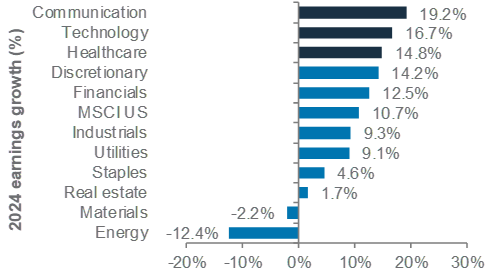
Insights from the technology sector can help. There is undoubtedly some merit to the view that earnings growth is strong – the US technology and communication services sectors rank among the top 3 sectors in terms of 2024 expected earnings growth (see Fig. 1). This follows a 70% y/y surge in earnings growth in Q4 23 for the so-called ‘Magnificent Six’. This is also likely why technology sector gains are no longer about falling bond yields – this relationship appears to have started breaking down from last year.
A second insight likely comes from investor positioning. Our own market diversity indicator continues to warn that US equities, and the technology sector, face a two-thirds chance of a temporary consolidation. Fund manager surveys similarly show falling cash levels among institutional investors and rising consensus on US equity allocations. The ‘Magnificent Six’ are potentially the most crowded trade today.
On balance, we believe the risk/reward favours maintaining Overweight on US equities in foundation allocations and our existing sector preferences for technology, communication services and healthcare in opportunistic allocations. While the risk of a temporary pullback or consolidation are higher than usual, we believe the resilience in economic and earnings growth, supported by strong corporate margins, is likely sufficient to help maintain the market’s momentum.
Japan and Asia
The standout gains in Japanese equity markets (and indeed in Indian equities within Asia) elicit a similar question – can the gains extend? In Japan, the jump in stock buybacks argues there is substance behind the optimism about improving corporate reforms. This, along with relatively fewer short-term positioning concerns, is why we retain our Overweight view.
Within Asia ex-Japan, though, the debate between India and China equities remains an intense one. The outlook for Indian equities is potentially similar to that for US markets – strong gains since Q4 2023, arguably justified by growth and earnings optimism, but now at high valuations. In contrast, Chinese equities offer unusually cheap valuations, but greater uncertainty about the growth outlook.
Fig. 2 We expect US government bond yields and the USD to fall later this year as the Fed starts cutting rates
Fed rate expectations vs. 10yr bond yield & USD
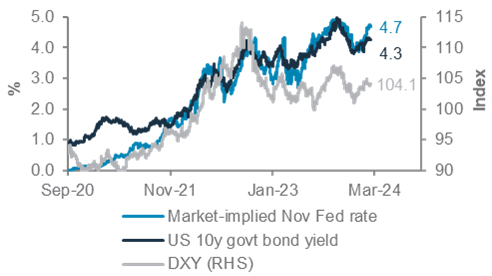
In China, markets continue to look towards policymakers for a catalyst. Measures thus far have not revived the equity market sentiment in a significant way, but the Hang Seng Index’s outperformance compared with global equities since its late January low suggests some investors believe policy support is approaching a critical level. As we detail in our Perspectives section, the emergence of positive momentum can be an important factor in driving Chinese equities higher in the short term. The upcoming National People’s Congress (NPC) could sustain the momentum with further policy support.
On balance, we believe a neutral allocation to both Indian and Chinese equities within Asia ex-Japan offers the most attractive risk/reward. For Indian equities, this ensures maintaining moderate exposure without taking excessive risk (by maintaining a preference for large cap over small/medium cap equities). For Chinese equities, a neutral stance ensures exposure to what could be an unexpectedly rapid rebound, given the unusually bearish sentiment and positioning. Raising exposure to the market as momentum improves, or adding exposure to preferred equity sectors, can be additional ways to improve the risk/reward in Chinese equities.
Staying the course on bonds
Unlike equities, bonds have faced headwinds from rising yields as markets went through a repricing of the likely start of a potential Fed rate cutting cycle. However, this repricing now brings market expectations closer to our own, ie, the Fed to start cutting rates only by mid-year. We believe this is more reasonable given the still-persistent inflation pressure and resilient growth.
Nevertheless, we expect growth and inflation to continue to slow in the coming quarters as the impact of past Fed rate hikes starts to bite. As the Fed starts cutting rates, high quality bonds are likely to offer an attractive risk/reward. Therefore, we believe the recent backup in yields offers a renewed opportunity to add exposure. This is particularly true relative to staying in cash. History shows us that USD cash returns failed to beat inflation in four of the past six decades, regardless of the starting yield level.
Foundation asset allocation models
The Foundation and Foundation+ models are allocations that you can use as the starting point for building a diversified investment portfolio. The Foundation model showcases a set of allocations focusing on traditional asset classes that are accessible to most investors, while the Foundation+ model includes allocations to private assets that may be accessible to investors in some jurisdictions, but not others.
Fig. 3 Foundation asset allocation for a moderately aggressive risk profile
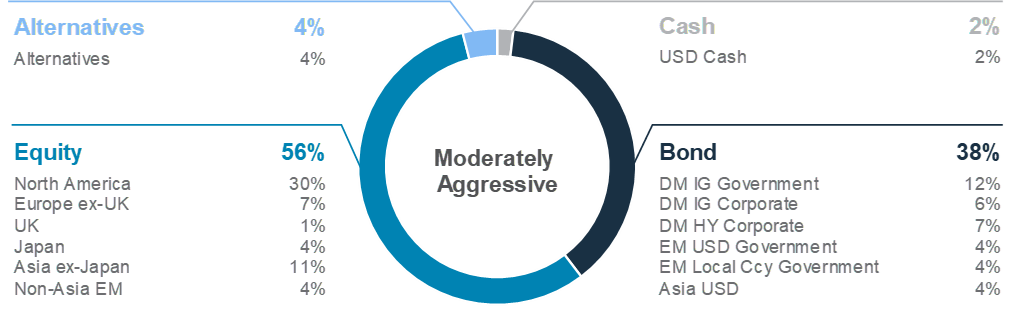
Fig. 4 Foundation+ asset allocation for a moderately aggressive risk profile
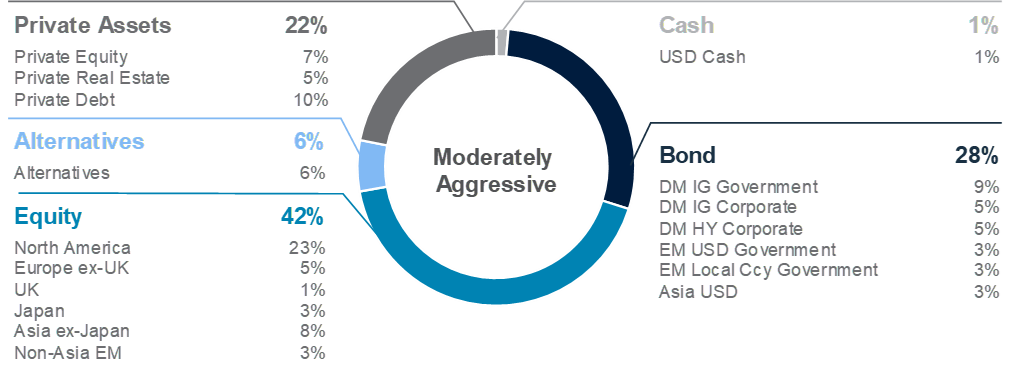
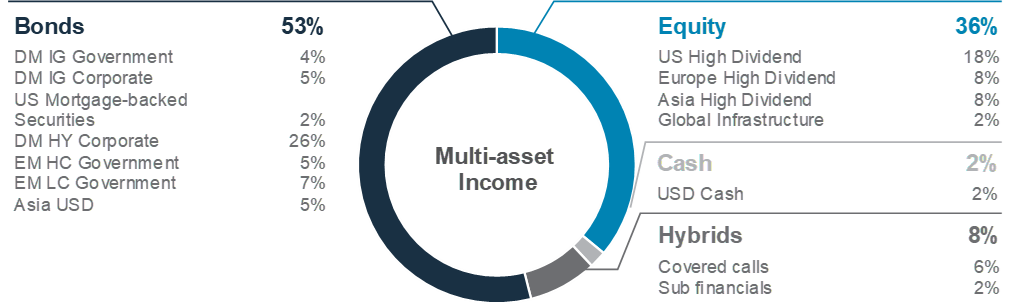
Fig. 5 Multi-asset income allocation for a moderate risk profile
Foundation: Our tactical asset allocation views
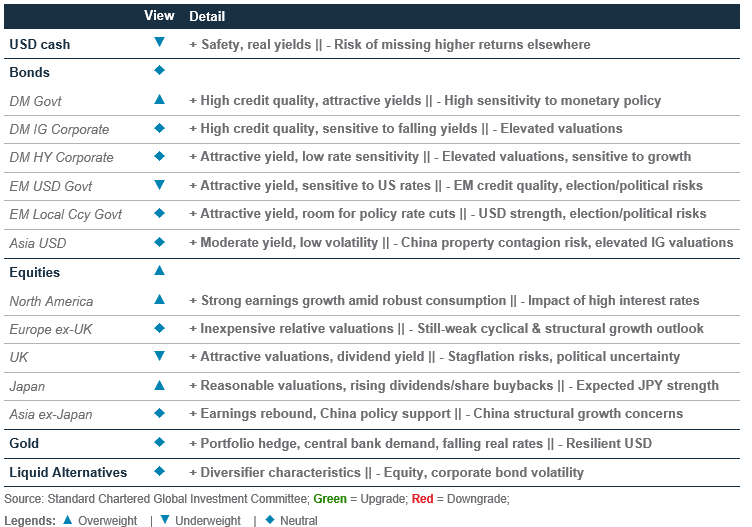
Fig. 6 Performance of our Foundation Allocations*

*12-month performance data from 28 February 2023 to 29 February 2024, 3-month performance from 29 November 2023 to 29 February 2024, 1-month performance from 29 January 2024 to 29 February 2024.
Perspectives on key client questions
|
|
||||
Are Chinese equities poised for a sustained turnaround?
The early weeks of 2024 offered no respite for investors in China’s stock market. After three consecutive years of losses, the MSCI China index plunged a further 12.2% to a trough in January, as lacklustre growth, deflationary concerns and ongoing worries about the property sector hurt investor confidence.
Since February, however, a series of policy measures have sparked expectations that the pain threshold for policymakers has finally been reached. State-controlled entities have been aggressively buying stocks, restrictions on stock sales have been imposed and the head of the Securities Regulatory Commission has been replaced. The stock market has in turn rebounded, with the MSCI China index rising 10.7% from its trough in January, trimming year-to-date losses to 2.9%.
The flurry of measures to put a floor under the stock market has raised the question whether Chinese equities are now poised for a turnaround. Our views are as follows:
- Valuation is a poor indicator of how markets may behave in the near term, but over a longer horizon, it does bear greater explanatory power for how stocks may perform. The currently depressed market valuation of Chinese stocks thus may represent an attractive opportunity for long-term investors.
- Momentum is instead a better guide to how much higher stocks can run in the coming months. Onshore Chinese stocks have shown a tendency to produce even greater returns whenever short-term returns exceed 10%.
- The upcoming National People’s Congress (NPC) meeting bears important implications. Coordinated policies to revive business and consumer confidence would help to reverse deflationary pressures and sustain the nascent rally in equity markets.
Valuation is cheap, but a poor indicator of near-term returns
The good news is valuation is cheap. However, valuation by itself is often a poor indicator of how markets behave in the near term. Over a longer horizon, though, market valuations do bear greater explanatory power for how stocks may perform. At a 12-month forward P/E ratio of 9.0x or less, which is where the MSCI China has been trading thus far this year, 5-year forward annualised returns dating back to 2005 have been positive almost 100% of the time, with average annualised returns

Fig. 7 Chinese stocks have underperformed against global equities and are currently the cheapest in years
Relative performance of the MSCI China vs. MSCI ACWI and the 12-month forward P/E of the MSCI China
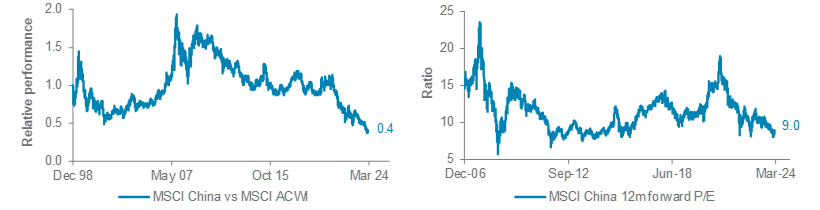
Fig. 8 At current valuation levels, the MSCI China has historically produced average annualised returns of 6.8%
MSCI China 12m forward P/E and 5-year annualised returns
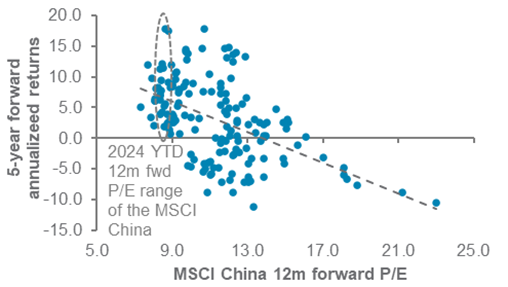
of 6.8%. Depressed valuations and light investor positioning make a compelling argument for limited downside from a long-term perspective. (Fig. 8)
Momentum is a better guide to near-term performance
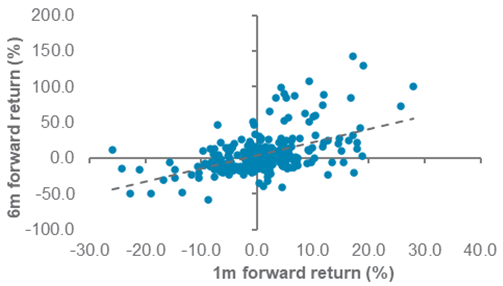
Instead of valuation, market momentum could determine when interest may be returning to China’s equity markets. Financial markets often operate in a self-reinforcing feedback loop, where higher prices attract more investors and push prices even higher. Momentum is particularly pronounced in China’s onshore stock market, where there is a higher proportion of individual investors who trade based on sentiment and technical factors rather than fundamentals. As a result, China equities often experience sharp swings in both prices and valuation multiples, with limited correlation to macro and policy variables. For instance, in the past 20 years, a one-month gain in excess of 10% in the CSI 300 index has led to even greater returns in the subsequent six months almost 70% of the time (Fig. 9).
Fig. 9 Rapid short-term gains have often snowballed into larger long-term returns in Chinese onshore stocks
1-month and 6-month forward returns of the CSI 300
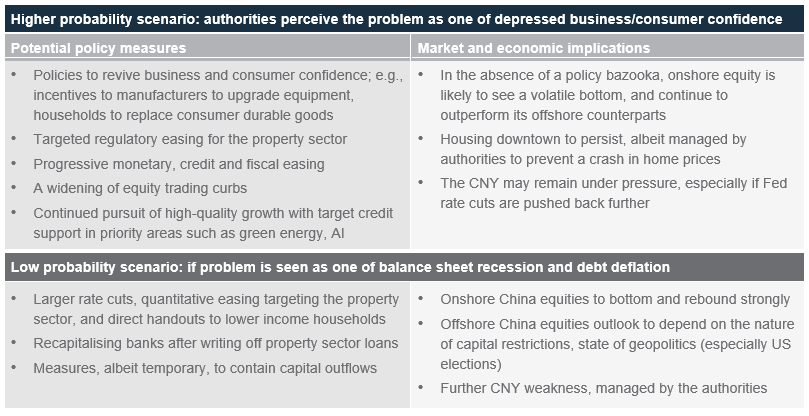
Upcoming NPC meeting to bear important implications
Beyond technical factors, the upcoming NPC meeting could also trigger a sustained turnaround in equities. The meeting sets the tone for China’s economic and policy direction for the year and will be closely watched for signs of more coordinated policy support for the economy (see the table below).
Conclusion
Investor confidence in China’s stock market is weak. However, the momentum-driven nature of Chinese stocks suggests a meaningful rebound is still possible given the nascent pick-up in momentum, even when economic conditions are poor. A series of measures introduced by the authorities lately have set the stage for this positive momentum. Also, depressed valuations suggest compelling longer-term returns for investors. The balance between risk and reward argues in favour of staying invested, as investors’ patience can be rewarded, especially if the NPC meeting produces a favourable outcome.
Macro overview – at a glance
Our macroeconomic outlook and key questions
|
Key themes
Strong US growth. US economic activity continues to surprise positively given sustained consumption and a revival in manufacturing. We expect growth to slow in the coming quarters due to the lagged impact of 525bps of rate hikes since March 2022 and the fading impact of pandemic stimulus. Excluding Germany, Euro area growth has held up well with the help of EU fiscal support. However, there too, activity is likely to slow as past rate hikes bite. China’s economy appears to have stabilised following a series of measures to support the property sector and overall growth.
Disinflation delayed: Excluding China, the pace of disinflation has slowed across major economies lately. This is largely due to resilient services inflation. We expect disinflation to resume as growth slows in the coming quarters. In the US, falling asking rents suggest shelter inflation is likely to decelerate, bringing overall inflation near the Fed’s 2% target by 2025. Policy rate cuts pushed back: Growth surprises and stalling disinflation have led markets to push back policy rate cut estimates. Markets are now aligned with our expectations of the first Fed rate cut in June. We expect the first ECB rate cut in Q3. China’s National People’s Congress is likely to unveil more actions to revive business/consumer confidence.
Key chart
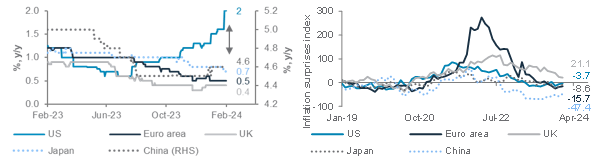
US growth has positively surprised lately due to sustained consumer demand and a pick-up in manufacturing; outside of China, the pace of global disinflation has slowed due to sticky services sector inflation
Fig. 10 US growth estimates upgraded this year, while global disinflation has slowed
2024 GDP growth estimates and inflation surprise indices across major economies
Macro factors to watch
US expansion extends. US growth continues to defy expectations of a sharp downturn. The Atlanta Fed’s GDPNow estimates Q1 24 q/q annualised growth at 3.0%, which follows 3.3% growth in Q4 23 and 4.9% in Q3 23. The still above-potential growth can be explained by robust financial health of households and companies thanks to the post-pandemic stimulus, which has delayed the impact of the most rapid Fed policy tightening since 1980s. President Biden’s infrastructure stimulus, corporate reshoring of plants and a nascent revival of global manufacturing could extend the expansion longer than previously expected. Nevertheless, we expect growth and inflation to continue slowing this year as the Fed’s tightening bites and the pandemic stimulus is exhausted. Thus, we expect the Fed to start cutting rates from June.
Germany vs. Euro area: Euro area economic activity has bifurcated. While Germany went into a technical recession in H2 23 due to a slump in global manufacturing and China, and higher energy costs following the Ukraine crisis, the rest of the Euro area continued to expand. In 2024, Germany faces fiscal
drag estimated at c.1.4% of GDP, the largest in the Euro area. Meanwhile, Spain and Italy are likely to benefit the most from the EU’s recovery fund disbursements, the impact of which will peak this year. Overall, while non-German growth is extending the Euro area expansion, we expect a sharper downturn caused by tightening financial and bank lending conditions to force the ECB to start cutting rates in H2.
China rebounding? China’s policymakers have stepped up measures lately to revive business and consumer confidence, suggesting the pain threshold has been reached. The record 25bps cut in a rate used for mortgages aims to revive property demand, which remains the biggest economic drag. The central bank is also expanding its balance sheet and boosting liquidity, which is leading to a recovery in money supply and credit growth. Authorities have taken measures to support the stock market, while regional governments have set a median 5.5% growth target for 2024. Lunar New Year holiday spending surpassing pre-pandemic levels is a sign of improving consumer confidence. The upcoming NPC will be closely watched for further stimulus measures.
Asset Classes
Bonds – at a glance
|
|
||||
Key themes
We remain Overweight Developed Market (DM) Investment Grade (IG) government bonds and see an attractive opportunity to add exposure following this year’s rebound in US bond yields. We raise our 3-month target for 10-year US government bond yield slightly to 4.00-4.25% amid market repricing of higher-for-longer Fed policy rate, rising Treasuries supply and quantitative tightening (QT). We still expect the yield to move to 3.25-3.50% over 12-months as Fed rate cuts start in June.
We remain Neutral DM IG and High Yield (HY) corporate bonds. Yield premiums over government bonds point to elevated valuations, but these are well supported by strong earnings and a favourable demand-supply balance. Nevertheless, we believe nominal yields of both the sub-asset classes are attractive when compared with cash.
We remain Neutral Asian USD bonds, with preference for HY over IG. Asia HY bonds have outperformed IG bonds year-to-date. We expect this to extend further on expectations of more stimulus measures from China’s authorities and given the bonds’ still-attractive relative value when compared to Asia IG bonds.
In Emerging Markets (EM), we are Neutral EM local currency government bonds. While USD strength and narrowing EM-DM yield differentials have weighed on the asset class year-to-date, we expect support from a weaker USD and falling bond yields in many EMs in the next 6-12 months. We remain Underweight USD government bonds as ongoing concerns about fundamentals and geopolitics in a year of intensive elections outweigh their sensitivity to decline in US bond yields.
Key chart
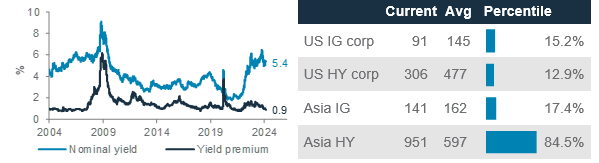
Corporate bond nominal yields have surged in recent years due to higher net-of-inflation (real) yields and inflation expectations; In terms of USD-denominated yield premiums over govt. bonds, Asia HY bonds continue to offer relative value to Asia IG peers
Fig. 11 Corporate bond nominal yields are attractive relative to their own history (LHS); Asia HY bond yield premium stands out among USD bond peers (RHS)
Should we add DM IG government bonds?
DM government bond yields started 2024 with a steep rebound as investors dialled back Fed rate cut expectations after stronger-than-expected US economic data releases. Expectation for a higher-for-longer Fed Funds rate, increases in Treasuries supply and QT prospects are likely to keep yields within a range in the near term. We believe the direction of monetary policy remains intact and will be key for DM IG government bond yields to break lower, as we continue to expect the Fed and the ECB to pivot before end-June.
We continue to view any short-term rise in bond yields as creating an attractive entry point to add exposure to DM IG government bonds.
Should we stick with cash when yields are comparable to bond yields?
Cash yields are optically attractive. However, holding too much cash in a portfolio raises reinvestment risk; i.e., investment return declines as investors fail to reinvest the proceeds, once the cash deposits mature, at a yield comparable to the current return. We believe this risk is likely to rise as we edge closer to the start of central bank rate cuts.
Bonds carry higher credit risk than cash. However, for total return investors, their longer maturity over cash offers better opportunity to manage reinvestment risk by locking in today’s yield into future years. In addition, our expectation for lower DM bond yields towards the end of the year leads us to believe that bond investments offer the prospect of capital gains.
In our Tactical Asset Allocation, we continue to view cash as a less preferred holding.
Equity – at a glance
|
|
||||
|
|
||||
Key themes
We are Overweight equities, and within that US equities, given our central scenario of a soft-landing in the US, at least in the first half of 2024. US companies are displaying strong pricing power, resulting in solid net margins. Stickier-than-expected inflation is a key risk, which may delay expected Fed rate cuts. Japan is the other Overweight region that continues to display a healthy combination of solid earnings, improving corporate governance and being less expensive than US equities.
We are Neutral Asia ex-Japan equities. The region potentially offers the highest earnings growth among our key regions. We are Overweight Korea – rising demand for AI-related technology products is likely to support earnings, and the government’s “Value-up” programme may narrow the “Korean discount” by addressing company cross-holdings and improving corporate governance. We are Neutral China equities. Deflationary forces remain the key risk, but the government has been intensifying its policy stimulus, with more likely at the National People’s Congress. We are Neutral Indian equities. Positive drivers include the government maintaining fiscal consolidation, while upgrading infrastructure, with higher outlay for railways, roads, renewable energy, housing and agriculture. This keeps domestic growth strong and supports job creation.
Elsewhere, we are Neutral Euro area equities. Growth prospects remain murky compared with the US, but cheap valuations and low investor positioning are counter-balancing factors. We stay Underweight UK equities – despite cheap valuations, the sector composition is overly defensive, leading to underperformance against global equities.
Key chart
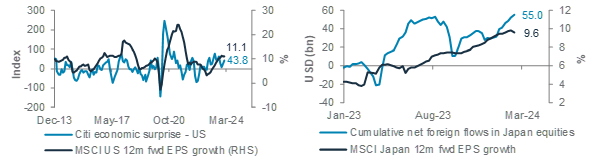
Strong US growth supporting corporate earnings. Improving fundamentals are supporting Japanese earnings growth and attracting foreign fund inflows
Fig. 12 US corporate earnings are riding on a strong economy. Japan’s drive to improve corporate governance is leading to improved earnings and fund inflows
Citi US economic surprise vs. MSCI US 12m forward EPS growth (left-hand chart); Cumulative net foreign flows into Japan equities vs. MSCI Japan 12m forward EPS growth
Global equities at record highs; more to come
Over the past month, we have seen record highs in US, Japan and global equities. We are staying bullish, particularly in our preferred regions of the US and Japan.
We expect earnings growth to be the key driver for US equities to move higher. Consensus expectations are for MSCI US earnings to grow by 11% in 2024 and 14% in 2025, rebounding from 1.2% in 2023. The Q4 2023 earnings season has been strong and positive economic surprises in the US are also supportive. Valuation of US equities are high, but we expect this to be supported by Fed rate cuts later in the year.
In addition, we are also Overweight Japan, where valuation is inexpensive. Japan’s 12-month forward P/E is at an 11% discount to global equities vs. a historical median of a 5% premium. Indeed, funds have been flowing into Japan and we
expect more, enticed not just by inexpensive valuation but also the positive earnings trend, improving corporate governance and relatively lower geopolitical risks.
We are Neutral Asia ex-Japan equities even though it has a low valuation (12-month forward P/E of 13x) and high expected earnings growth (21% consensus growth in 2024). Growth expectations could be at risk in major markets, such as China, which is facing deflation and weak business sentiment. There have been signs of improving consumer activity lately and we continue to watch closely China’s upcoming National People’s Congress for more stimulus measures to revive business and consumer confidence.
Risks to our view include stickier-than-expected inflation, weaker-than-expected growth in China and escalation in geopolitical risks.
FX – at a glance
|
Key themes
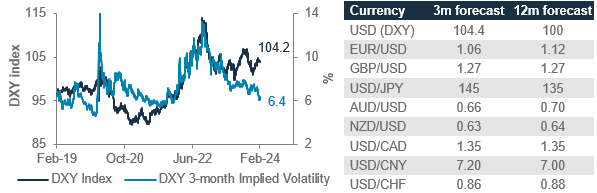
The FX market has been unusually muted lately, with the US dollar index’s (DXY) 3-month implied volatility reaching a 2-year low. We expect a rangebound USD, with a bullish bias, over the next 3 months. US economic activity indicators have remained resilient, especially relative to the non-US regions, and markets continue to push back their anticipated timing of the first Fed rate cut. These factors drive the rise in our DXY 3-month forecast to 104.4. However, this does not alter our view that a USD downtrend is likely to resume over 6-12-months, with US bond yields likely capped by the prospects of slowing growth.
Major currency pairs are likely to similarly consolidate over the next 3 months, as an increasingly intense debate over the timing of the first likely central bank rate cuts gather momentum, leading to more rangebound interest rate differentials. The Bank of Japan, however, stands out against this backdrop as it is likely on a different rate path. We continue to expect policy tightening this year, especially if wage growth proves to be robust. The RBA is likely to keep rates high amid sticky wage growth, while the RBNZ has forecast no rate cuts until 2025. We expect the JPY, AUD and NZD to be the key outperformers over 6-12 months.
Key chart
The FX market has been unusually muted lately, with the Dollar index (DXY) 3-month implied volatility reaching a 2-year low
Fig. 13 Low market volatility to drive a rangebound USD
USD Index (DXY); table of forecasts
Awaiting the first move
ECB President Lagarde is offering little sign that the central bank was considering rate cuts, while wage growth is recovering. However, other Euro area data has been largely underperforming expectations lately. Therefore, on balance, we see EUR/USD at 1.06 over the next 3 months. In the longer term, we see room for upside as the greenback softens. Currently, the market expects the implied policy rate spread between the ECB and Fed to narrow later this year. Thus, we expect the pair to rise to 1.12 over 6-12 months.
The BoE is likely to start rate cuts slightly later than the Fed as UK inflation remains stickier. However, this is likely priced and, therefore, likely to leave real yield differentiations in a narrow range. We continue to have a rangebound view on GBP/USD, expecting 1.27 over the next 12 months. We see USD/CHF moving modestly lower to 0.86 in the next 3 months as the SNB balances an easing of CHF purchases with moderating domestic data. Softer growth and inflation
data in Switzerland vs the US illustrates growing divergence. Unexpectedly soft Swiss inflation opens the door to expectations of an earlier SNB rate cut. This policy is likely to result in USD/CHF moving to 0.88 over 6-12 months.
Our expectation of a declining 10-year US government bond yield, tightening BoJ policy and intervention concerns mean we expect USD/JPY to continue to push lower as yield differentials turn increasingly supportive of the yen. However, near-term USD resilience could limit weakness near term. USD/JPY is likely to move to 145 over the next 3 months and push towards 135 over the next 6-12 months.
Commodity currencies are likely to appreciate versus the USD. Expectations of sticky Australian wage growth and inflation should keep RBA rates high, while the RBNZ has a tightening bias and forecasts no rate cuts until 2025. These should support AUD and NZD strength. However, USD/CAD remains an exception, given its low responsiveness to oil prices recently. We expect 1.35 over the next 3 months.
Gold, crude oil – at a glance
|
Key themes
Gold stays as a core allocation, with a 12-month forecast of USD 2,150/oz. The yellow metal started the year rangebound, caught between bullish drivers such as geopolitical tensions and seasonal demand, and bearish factors such as upside economic surprises and a stronger USD. We expect gold to continue trading around USD 2,030/oz over the next 3 months as the economic resilience buoys bond yields (hence, real yields). Global gold ETF outflows and a reduction in speculative positioning are also near-term drags. In the long run, however, a Fed rate-cutting cycle would bring down real yields and the USD, powering gold to record highs. Strong central bank demand and robust physical gold demand from China and India are structural tailwinds which, in our view, put a floor to gold prices even outside of our base scenario.
We maintain our 12-month WTI oil forecast at USD 75/bbl. Crude oil prices have been trading in a tight range over the past few weeks. But, year-to-date, oil has performed relatively well on the back of OPEC+ supply curbs, resilient US consumption and high geopolitical tensions. We expect oil markets to remain tight in the short term, hence, we are raising our 3-month forecast to USD 80/bbl. Geopolitical risks are also likely to create some bouts of volatility. In the longer term, we believe that a slowdown in the global economy would dampen oil demand. Together with OPEC+’s modulation, demand-supply is likely to be more balanced, limiting the upside for oil prices.
Key chart
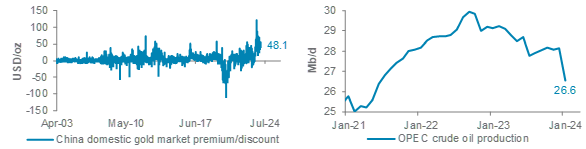
Gold demand in China is likely to remain strong
Global crude oil markets are tight in the short term, supportive of higher oil prices
Fig. 14 China’s gold market premium reflects strong domestic demand; OPEC member compliance with output targets has been better than expected
LHS chart: China domestic gold market premium/discount
RHS chart: OPEC crude oil production
China holds the key to gold demand
China dethroned India as the world’s largest gold jewellery buyer in 2023. Gold jewellery purchases in China rose 10% y/y. In addition, China has also maintained its position as the world’s largest gold consumer since 2013. Weak Chinese equity and property markets, as well as low domestic interest rates, have driven households to look for alternative investment opportunities. Gold has emerged as an attractive option given its ability to store value and to lower portfolio volatility. This is evidenced in the widening premium in the Shanghai Gold Exchange. We believe this trend will continue this year, supporting physical gold demand in China.
Meanwhile, the PBoC is also likely to continue increasing its gold reserves following record buying in 2023, considering its allocation is still significantly lower than other major central banks. Put together, we expect China to be a key source of gold demand this year.
OPEC+ oil supply curbs are coming through
Last November, when OPEC+ announced another round of supply cuts totalling 2.2mb/d, markets were sceptical about how compliant the bloc will be, especially given that the additional cut is not formalised in the output targets. The latest production data in January allayed some concerns. According to Bloomberg, OPEC crude output fell 1.6mb/d in January to 26.6mb/d. Output data from an alternate data source, Rystad Energy, also showed a broad-based decline across OPEC members. These data corroborate our earlier expectation that OPEC+ would follow through with significant cuts.
Oil demand, the other side of the equation, remained more resilient than expected in the first two months of this year. China, the second-largest oil consumer, appeared to be ramping up purchases following the lunar new year holiday, which saw a boom in travel. In aggregate, oil markets are likely to be in deficit in the near term.
Additional perspectives
Quant perspective
US risk model is neutral on equity market risks
|
Model is neutral on equity market risks
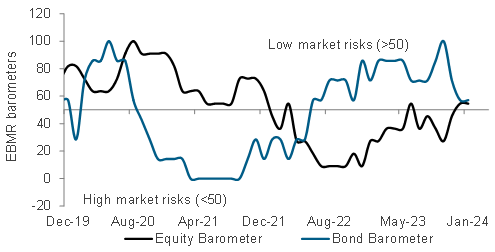
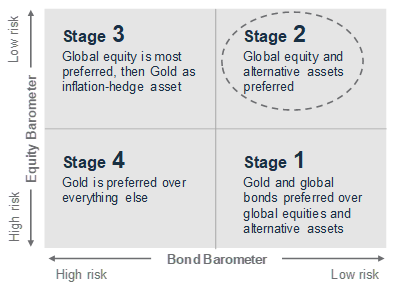
Our US Equity-Bond Market Risk (EBMR) models the downside risks in US equities and the US 10-year government bonds. It uses 11 economic and market factors to create equity and bond risk barometers. If the value of a barometer falls significantly below 50, it signals higher downside risks.
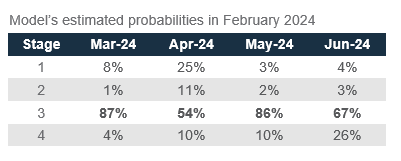
The model remains in Stage 2, where it has been since December 2023 despite it signalling a high probability of moving to Stage 3 in coming months. In Stage 2, the model signals low downside risks in US equities and US government bonds. The model’s view is driven by a positive year-on-year change in US housing starts in January. This factor, however, reversed in February, which risks moderating this improvement. Historical data suggests risky assets such as equities and alternatives should do well in Stage 2.
Fig. 15 EBMR model neutral on equity market risks
US equity and bond market risk barometers
Contrasting signals from our other models
Currently, our US EBMR model’s signals have become more aligned with our other key quantitative models.
Our stock-bond rotation model, which utilises a combination of fundamental, valuation and technical factors, has turned even more supportive of risk assets over the near term, with a score of 4 out of 5. This is primarily due to the rise in US PMI new orders, which also recently crossed above 50 to indicate a recovery in demand. Given its bullish view on equities, the model has generated a 1.1% excess return over a 60/40 equity-bond portfolio this year.
Our “fear and greed” indicator remains in the ‘greed’ territory but not at the extreme. The key driver is equity market momentum, which is at its strongest level in three years. While concerns have recently intensified due to the narrowing market breadth (the technology sector being the main contributor to market performance), history suggests the current level of ‘greed’ is not at a level that would guarantee a steep correction.
We also find supportive signals for equities based on our AI-driven technical model. The model continues to support an uptrend market regime for the S&P 500 Index since January 2023, as both realised and implied volatilities are nowhere close to past episodes of market downturns (such as Covid-19 in 2020 and the early onset of the rate hiking cycle in 2022).
Lastly, our global economic regime model is the only contrarian quantitative indicator as leading indicators of several key economies remain depressed and are pointing to a higher probability of a recession. This implies a defensive positioning, with heavy Overweight in bonds over equities.
Fig. 16 Scenarios over the coming months until June 2024
Probability of the evolution of financial market risk cycle from the current Stage 2 and preferred assets
Source: Standard Chartered
Tracking market diversity
|
About our market diversity indicators
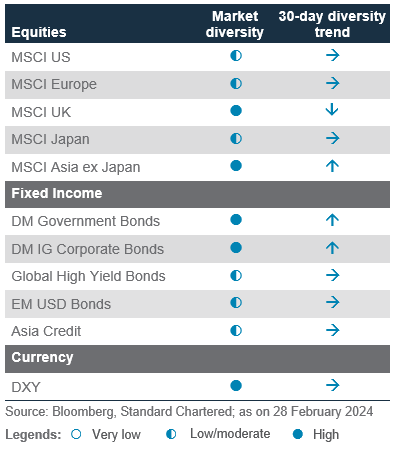
Our market diversity indicators help to identify a potential change in short-term trends due to a drop in the market breadth across equities, credit, FX and commodities. When market diversity falls, it implies either buyers or sellers are dominating, leading to a rapid rise or fall in asset prices. This is usually unsustainable and is likely to be followed by a slowdown or a reversal. Our diversity indicator is based on a statistical index called fractal dimension; a value below 1.25 serves as a guideline that prices are rising or falling too fast.
Where is diversity falling or rising this month?
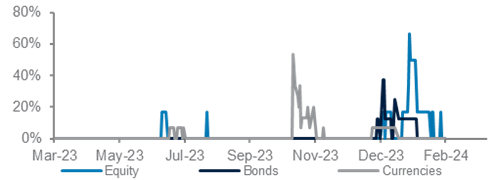
Market diversity across equity and bond markets has broadened over the past few weeks. This is seen in Fig. 17 and Fig. 18 where the average diversity index for equity and bond markets has risen above 1.25 after initially falling below this threshold; no single asset has a diversity below 1.25 currently.
Most equity markets have risen lately, despite our market diversity indicators flagging overbought conditions between mid-to-end of January. Better-than-expected earnings have been the main driver behind the rally. Since 19 January, MSCI US, MSCI Europe and MSCI Japan have gained 5.3%, 4.8% and 5.9%, respectively, and have closed at fresh record highs.
Within US equities, we still see elevated risks of a reversal or slowdown in financial, healthcare and industrial sectors. Their diversity indices are currently at 1.23, 1.23 and 1.21, respectively, which are significantly below the 1.25 threshold. All three sectors have generated good returns lately, with their 3-month returns at 14.4%, 11.8% and 14.8%, respectively.
Fig. 17 Average market diversity score by asset class
Market diversity has broadened recently
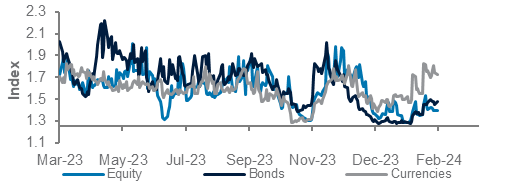
Fig. 18 Percentage of assets with diversity score <1.25
No major asset class is currently flagging reversal risk
Diversity in bond markets has also improved after initially falling below 1.25 at the beginning of year. Most bond markets gained 9-12% from October to December 2023, when the Fed was more dovish. These trends have either reversed or have slowed down after our diversity indicator flagged extremely low investor diversity. DM government bond has led the drop with a 2.8% decline.
Market diversity remains high in most currency markets. USDCHF is the only currency where our market indicator recently flagged a reversal signal in January. CHF has depreciated against the USD by 5.0% after it reached an 8-year high at the beginning of this year. Looking more broadly, the weakness in CHF against the dollar was partly due to USD strength as the USD index (DXY) has rebounded since December 2023 as Fed rate cut expectations were pushed back to June 2024.
Fig. 19 Diversity across key assets has normalised
Performance Review
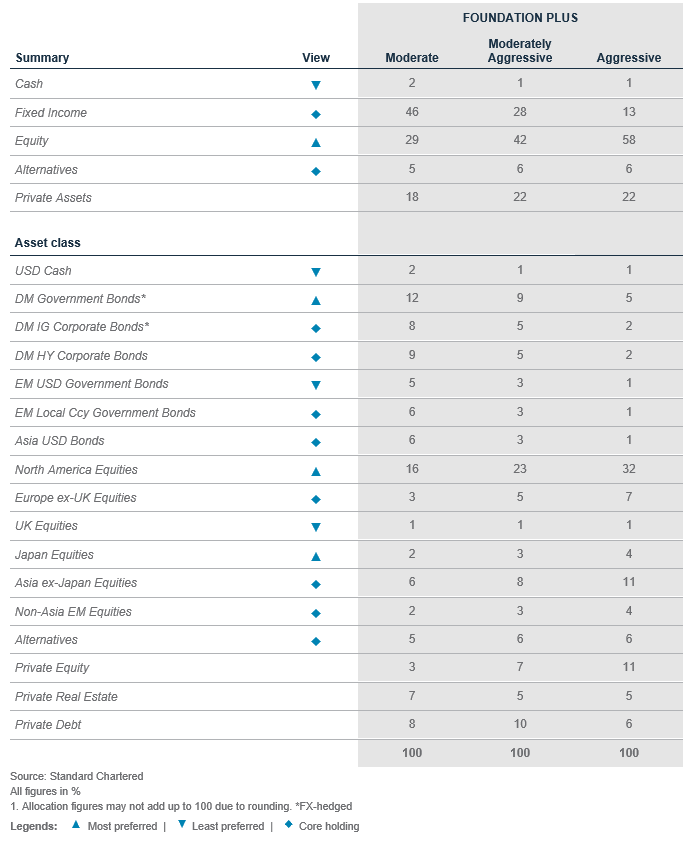
Foundation: Asset allocation summary

Foundation+: Asset allocation summary
Market performance summary

*All performance shown in USD terms, unless otherwise stated
*YTD performance data from 31 December 2023 to 29 February 2024 and 1-week performance from 22 February 2024 to 29 February 2024
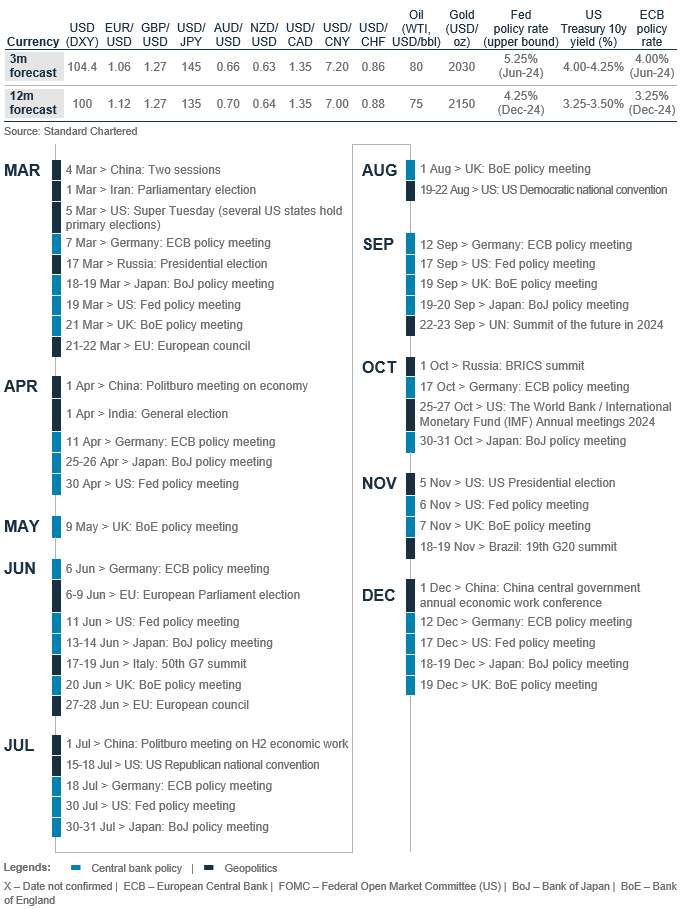
Our key forecasts and calendar events
For more CIO Office insights

Explanatory notes
1. The figures on page 5 show allocations for a moderately aggressive risk profile only – different risk profiles may produce significantly different asset allocation results. Page 5 is only an example, provided for general information only and they do not constitute investment advice, an offer, recommendation or solicitation. They do not take into account the specific investment objectives, needs or risk tolerances of a particular person or class of persons and they have not been prepared for any particular person or class of persons.
2. Contingent Convertibles are complex financial instruments and are not a suitable or appropriate investment for all investors. This document is not an offer to sell or an invitation to buy any securities or any beneficial interests therein. Contingent convertible securities are not intended to be sold and should not be sold to retail clients in the European Economic Area (EEA) (each as defined in the Policy Statement on the Restrictions on the Retail Distribution of Regulatory Capital Instruments (Feedback to CP14/23 and Final Rules) (“Policy Statement”), read together with the Product Intervention (Contingent Convertible Instruments and Mutual Society Shares) Instrument 2015 (“Instrument”, and together with the Policy Statement, the “Permanent Marketing Restrictions”), which were published by the United Kingdom’s Financial Conduct Authority in June 2015), other than in circumstances that do not give rise to a contravention of the Permanent Marketing Restrictions.
Disclosure
This document is confidential and may also be privileged. If you are not the intended recipient, please destroy all copies and notify the sender immediately. This document is being distributed for general information only and is subject to the relevant disclaimers available at our Standard Chartered website under Regulatory disclosures. It is not and does not constitute research material, independent research, an offer, recommendation or solicitation to enter into any transaction or adopt any hedging, trading or investment strategy, in relation to any securities or other financial instruments. This document is for general evaluation only. It does not take into account the specific investment objectives, financial situation or particular needs of any particular person or class of persons and it has not been prepared for any particular person or class of persons. You should not rely on any contents of this document in making any investment decisions. Before making any investment, you should carefully read the relevant offering documents and seek independent legal, tax and regulatory advice. In particular, we recommend you to seek advice regarding the suitability of the investment product, taking into account your specific investment objectives, financial situation or particular needs, before you make a commitment to purchase the investment product. Opinions, projections and estimates are solely those of SC at the date of this document and subject to change without notice. Past performance is not indicative of future results and no representation or warranty is made regarding future performance. The value of investments, and the income from them, can go down as well as up, and you may not recover the amount of your original investment. You are not certain to make a profit and may lose money. Any forecast contained herein as to likely future movements in rates or prices or likely future events or occurrences constitutes an opinion only and is not indicative of actual future movements in rates or prices or actual future events or occurrences (as the case may be). This document must not be forwarded or otherwise made available to any other person without the express written consent of the Standard Chartered Group (as defined below). Standard Chartered Bank is incorporated in England with limited liability by Royal Charter 1853 Reference Number ZC18. The Principal Office of the Company is situated in England at 1 Basinghall Avenue, London, EC2V 5DD. Standard Chartered Bank is authorised by the Prudential Regulation Authority and regulated by the Financial Conduct Authority and Prudential Regulation Authority. Standard Chartered PLC, the ultimate parent company of Standard Chartered Bank, together with its subsidiaries and affiliates (including each branch or representative office), form the Standard Chartered Group. Standard Chartered Private Bank is the private banking division of Standard Chartered. Private banking activities may be carried out internationally by different legal entities and affiliates within the Standard Chartered Group (each an “SC Group Entity”) according to local regulatory requirements. Not all products and services are provided by all branches, subsidiaries and affiliates within the Standard Chartered Group. Some of the SC Group Entities only act as representatives of Standard Chartered Private Bank and may not be able to offer products and services or offer advice to clients.
Copyright © 2026, Accounting Research & Analytics, LLC d/b/a CFRA (and its affiliates, as applicable). Reproduction of content provided by CFRA in any form is prohibited except with the prior written permission of CFRA. CFRA content is not investment advice and a reference to or observation concerning a security or investment provided in the CFRA SERVICES is not a recommendation to buy, sell or hold such investment or security or make any other investment decisions. The CFRA content contains opinions of CFRA based upon publicly-available information that CFRA believes to be reliable and the opinions are subject to change without notice. This analysis has not been submitted to, nor received approval from, the United States Securities and Exchange Commission or any other regulatory body. While CFRA exercised due care in compiling this analysis, CFRA, ITS THIRD-PARTY SUPPLIERS, AND ALL RELATED ENTITIES SPECIFICALLY DISCLAIM ALL WARRANTIES, EXPRESS OR IMPLIED, INCLUDING, BUT NOT LIMITED TO, ANY WARRANTIES OF MERCHANTABILITY OR FITNESS FOR A PARTICULAR PURPOSE OR USE, to the full extent permitted by law, regarding the accuracy, completeness, or usefulness of this information and assumes no liability with respect to the consequences of relying on this information for investment or other purposes. No content provided by CFRA (including ratings, credit-related analyses and data, valuations, model, software or other application or output therefrom) or any part thereof may be modified, reverse engineered, reproduced or distributed in any form by any means, or stored in a database or retrieval system, without the prior written permission of CFRA, and such content shall not be used for any unlawful or unauthorized purposes. CFRA and any third-party providers, as well as their directors, officers, shareholders, employees or agents do not guarantee the accuracy, completeness, timeliness or availability of such content. In no event shall CFRA, its affiliates, or their third-party suppliers be liable for any direct, indirect, special, or consequential damages, costs, expenses, legal fees, or losses (including lost income or lost profit and opportunity costs) in connection with a subscriber’s, subscriber’s customer’s, or other’s use of CFRA’s content.
Market Abuse Regulation (MAR) Disclaimer
Banking activities may be carried out internationally by different branches, subsidiaries and affiliates within the Standard Chartered Group according to local regulatory requirements. Opinions may contain outright “buy”, “sell”, “hold” or other opinions. The time horizon of this opinion is dependent on prevailing market conditions and there is no planned frequency for updates to the opinion. This opinion is not independent of Standard Chartered Group’s trading strategies or positions. Standard Chartered Group and/or its affiliates or its respective officers, directors, employee benefit programmes or employees, including persons involved in the preparation or issuance of this document may at any time, to the extent permitted by applicable law and/or regulation, be long or short any securities or financial instruments referred to in this document or have material interest in any such securities or related investments. Therefore, it is possible, and you should assume, that Standard Chartered Group has a material interest in one or more of the financial instruments mentioned herein. Please refer to our Standard Chartered website under Regulatory disclosures for more detailed disclosures, including past opinions/ recommendations in the last 12 months and conflict of interests, as well as disclaimers. A covering strategist may have a financial interest in the debt or equity securities of this company/issuer. All covering strategist are licensed to provide investment recommendations under Monetary Authority of Singapore or Hong Kong Monetary Authority. This document must not be forwarded or otherwise made available to any other person without the express written consent of Standard Chartered Group.
Sustainable Investments
Any ESG data used or referred to has been provided by Morningstar, Sustainalytics, MSCI or Bloomberg. Refer to 1) Morningstar website under Sustainable Investing, 2) Sustainalytics website under ESG Risk Ratings, 3) MCSI website under ESG Business Involvement Screening Research and 4) Bloomberg green, social & sustainability bonds guide for more information. The ESG data is as at the date of publication based on data provided, is for informational purpose only and is not warranted to be complete, timely, accurate or suitable for a particular purpose, and it may be subject to change. Sustainable Investments (SI): This refers to funds that have been classified as ‘ESG Intentional Investments – Overall’ by Morningstar. SI funds have explicitly stated in their prospectus and regulatory filings that they either incorporate ESG factors into the investment process or have a thematic focus on the environment, gender diversity, low carbon, renewable energy, water or community development. For equity, it refers to shares/stocks issued by companies with Sustainalytics ESG Risk Rating of Low/Negligible. For bonds, it refers to debt instruments issued by issuers with Sustainalytics ESG Risk Rating of Low/Negligible, and/or those being certified green, social, sustainable bonds by Bloomberg. For structured products, it refers to products that are issued by any issuer who has a Sustainable Finance framework that aligns with Standard Chartered’s Green and Sustainable Product Framework, with underlying assets that are part of the Sustainable Investment universe or separately approved by Standard Chartered’s Sustainable Finance Governance Committee. Sustainalytics ESG risk ratings shown are factual and are not an indicator that the product is classified or marketed as “green”, “sustainable” or similar under any particular classification system or framework.
Country/Market Specific Disclosures
Bahrain: This document is being distributed in Bahrain by Standard Chartered Bank, Bahrain Branch, having its address at P.O. 29, Manama, Kingdom of Bahrain, is a branch of Standard Chartered Bank and is licensed by the Central Bank of Bahrain as a conventional retail bank. Botswana: This document is being distributed in Botswana by, and is attributable to, Standard Chartered Bank Botswana Limited which is a financial institution licensed under the Section 6 of the Banking Act CAP 46.04 and is listed in the Botswana Stock Exchange. Brunei Darussalam: This document is being distributed in Brunei Darussalam by, and is attributable to, Standard Chartered Bank (Brunei Branch) | Registration Number RFC/61 and Standard Chartered Securities (B) Sdn Bhd | Registration Number RC20001003. Standard Chartered Bank is incorporated in England with limited liability by Royal Charter 1853 Reference Number ZC18. Standard Chartered Securities (B) Sdn Bhd is a limited liability company registered with the Registry of Companies with Registration Number RC20001003 and licensed by Brunei Darussalam Central Bank as a Capital Markets Service License Holder with License Number BDCB/R/CMU/S3-CL and it is authorised to conduct Islamic investment business through an Islamic window. China Mainland: This document is being distributed in China by, and is attributable to, Standard Chartered Bank (China) Limited which is mainly regulated by National Financial Regulatory Administration (NFRA), State Administration of Foreign Exchange (SAFE), and People’s Bank of China (PBOC). Hong Kong: In Hong Kong, this document, except for any portion advising on or facilitating any decision on futures contracts trading, is distributed by Standard Chartered Bank (Hong Kong) Limited (“SCBHK”), a subsidiary of Standard Chartered PLC. SCBHK has its registered address at 32/F, Standard Chartered Bank Building, 4-4A Des Voeux Road Central, Hong Kong and is regulated by the Hong Kong Monetary Authority and registered with the Securities and Futures Commission (“SFC”) to carry on Type 1 (dealing in securities), Type 4 (advising on securities), Type 6 (advising on corporate finance) and Type 9 (asset management) regulated activity under the Securities and Futures Ordinance (Cap. 571) (“SFO”) (CE No. AJI614). The contents of this document have not been reviewed by any regulatory authority in Hong Kong and you are advised to exercise caution in relation to any offer set out herein. If you are in doubt about any of the contents of this document, you should obtain independent professional advice. Any product named herein may not be offered or sold in Hong Kong by means of any document at any time other than to “professional investors” as defined in the SFO and any rules made under that ordinance. In addition, this document may not be issued or possessed for the purposes of issue, whether in Hong Kong or elsewhere, and any interests may not be disposed of, to any person unless such person is outside Hong Kong or is a “professional investor” as defined in the SFO and any rules made under that ordinance, or as otherwise may be permitted by that ordinance. In Hong Kong, Standard Chartered Private Bank is the private banking division of SCBHK, a subsidiary of Standard Chartered PLC. Ghana: Standard Chartered Bank Ghana Limited accepts no liability and will not be liable for any loss or damage arising directly or indirectly (including special, incidental or consequential loss or damage) from your use of these documents. Past performance is not indicative of future results and no representation or warranty is made regarding future performance. You should seek advice from a financial adviser on the suitability of an investment for you, taking into account these factors before making a commitment to invest in an investment. To unsubscribe from receiving further updates, please send an email to feedback.ghana@sc.com. Please do not reply to this email. Call our Priority Banking on 0302610750 for any questions or service queries. You are advised not to send any confidential and/or important information to Standard Chartered via e-mail, as Standard Chartered makes no representations or warranties as to the security or accuracy of any information transmitted via e-mail. Standard Chartered shall not be responsible for any loss or damage suffered by you arising from your decision to use e-mail to communicate with the Bank. India: This document is being distributed in India by Standard Chartered in its capacity as a distributor of mutual funds and referrer of any other third party financial products. Standard Chartered does not offer any ‘Investment Advice’ as defined in the Securities and Exchange Board of India (Investment Advisers) Regulations, 2013 or otherwise. Services/products related securities business offered by Standard Charted are not intended for any person, who is a resident of any jurisdiction, the laws of which imposes prohibition on soliciting the securities business in that jurisdiction without going through the registration requirements and/or prohibit the use of any information contained in this document. Indonesia: This document is being distributed in Indonesia by Standard Chartered Bank, Indonesia branch, which is a financial institution licensed and supervised by Otoritas Jasa Keuangan (Financial Service Authority) and Bank Indonesia. Jersey: In Jersey, Standard Chartered Private Bank is the Registered Business Name of the Jersey Branch of Standard Chartered Bank. The Jersey Branch of Standard Chartered Bank is regulated by the Jersey Financial Services Commission. Copies of the latest audited accounts of Standard Chartered Bank are available from its principal place of business in Jersey: PO Box 80, 15 Castle Street, St Helier, Jersey JE4 8PT. Standard Chartered Bank is incorporated in England with limited liability by Royal Charter in 1853 Reference Number ZC 18. The Principal Office of the Company is situated in England at 1 Basinghall Avenue, London, EC2V 5DD. Standard Chartered Bank is authorised by the Prudential Regulation Authority and regulated by the Financial Conduct Authority and Prudential Regulation Authority. The Jersey Branch of Standard Chartered Bank is also an authorised financial services provider under license number 44946 issued by the Financial Sector Conduct Authority of the Republic of South Africa. Jersey is not part of the United Kingdom and all business transacted with Standard Chartered Bank, Jersey Branch and other SC Group Entity outside of the United Kingdom, are not subject to some or any of the investor protection and compensation schemes available under United Kingdom law. Kenya: This document is being distributed in Kenya by and is attributable to Standard Chartered Bank Kenya Limited. Investment Products and Services are distributed by Standard Chartered Investment Services Limited, a wholly owned subsidiary of Standard Chartered Bank Kenya Limited that is licensed by the Capital Markets Authority in Kenya, as a Fund Manager. Standard Chartered Bank Kenya Limited is regulated by the Central Bank of Kenya. Malaysia: This document is being distributed in Malaysia by Standard Chartered Bank Malaysia Berhad (“SCBMB”). Recipients in Malaysia should contact SCBMB in relation to any matters arising from, or in connection with, this document. This document has not been reviewed by the Securities Commission Malaysia. The product lodgement, registration, submission or approval by the Securities Commission of Malaysia does not amount to nor indicate recommendation or endorsement of the product, service or promotional activity. Investment products are not deposits and are not obligations of, not guaranteed by, and not protected by SCBMB or any of the affiliates or subsidiaries, or by Perbadanan Insurans Deposit Malaysia, any government or insurance agency. Investment products are subject to investment risks, including the possible loss of the principal amount invested. SCBMB expressly disclaim any liability and responsibility for any loss arising directly or indirectly (including special, incidental or consequential loss or damage) arising from the financial losses of the Investment Products due to market condition. Nigeria: This document is being distributed in Nigeria by Standard Chartered Bank Nigeria Limited (SCB Nigeria), a bank duly licensed and regulated by the Central Bank of Nigeria. SCB Nigeria accepts no liability for any loss or damage arising directly or indirectly (including special, incidental or consequential loss or damage) from your use of these documents. You should seek advice from a financial adviser on the suitability of an investment for you, taking into account these factors before making a commitment to invest in an investment. To unsubscribe from receiving further updates, please send an email to clientcare.ng@sc.com requesting to be removed from our mailing list. Please do not reply to this email. Call our Priority Banking on 02 012772514 for any questions or service queries. SCB Nigeria shall not be responsible for any loss or damage arising from your decision to send confidential and/or important information to Standard Chartered via e-mail. SCB Nigeria makes no representations or warranties as to the security or accuracy of any information transmitted via e-mail. Pakistan: This document is being distributed in Pakistan by, and attributable to Standard Chartered Bank (Pakistan) Limited having its registered office at PO Box 5556, I.I Chundrigar Road Karachi, which is a banking company registered with State Bank of Pakistan under Banking Companies Ordinance 1962 and is also having licensed issued by Securities & Exchange Commission of Pakistan for Security Advisors. Standard Chartered Bank (Pakistan) Limited acts as a distributor of mutual funds and referrer of other third-party financial products. Singapore: This document is being distributed in Singapore by, and is attributable to, Standard Chartered Bank (Singapore) Limited (Registration No. 201224747C/ GST Group Registration No. MR-8500053-0, “SCBSL”). Recipients in Singapore should contact SCBSL in relation to any matters arising from, or in connection with, this document. SCBSL is an indirect wholly owned subsidiary of Standard Chartered Bank and is licensed to conduct banking business in Singapore under the Singapore Banking Act, 1970. Standard Chartered Private Bank is the private banking division of SCBSL. IN RELATION TO ANY SECURITY OR SECURITIES-BASED DERIVATIVES CONTRACT REFERRED TO IN THIS DOCUMENT, THIS DOCUMENT, TOGETHER WITH THE ISSUER DOCUMENTATION, SHALL BE DEEMED AN INFORMATION MEMORANDUM (AS DEFINED IN SECTION 275 OF THE SECURITIES AND FUTURES ACT, 2001 (“SFA”)). THIS DOCUMENT IS INTENDED FOR DISTRIBUTION TO ACCREDITED INVESTORS, AS DEFINED IN SECTION 4A(1)(a) OF THE SFA, OR ON THE BASIS THAT THE SECURITY OR SECURITIES-BASED DERIVATIVES CONTRACT MAY ONLY BE ACQUIRED AT A CONSIDERATION OF NOT LESS THAN S$200,000 (OR ITS EQUIVALENT IN A FOREIGN CURRENCY) FOR EACH TRANSACTION. Further, in relation to any security or securities-based derivatives contract, neither this document nor the Issuer Documentation has been registered as a prospectus with the Monetary Authority of Singapore under the SFA. Accordingly, this document and any other document or material in connection with the offer or sale, or invitation for subscription or purchase, of the product may not be circulated or distributed, nor may the product be offered or sold, or be made the subject of an invitation for subscription or purchase, whether directly or indirectly, to persons other than a relevant person pursuant to section 275(1) of the SFA, or any person pursuant to section 275(1A) of the SFA, and in accordance with the conditions specified in section 275 of the SFA, or pursuant to, and in accordance with the conditions of, any other applicable provision of the SFA. In relation to any collective investment schemes referred to in this document, this document is for general information purposes only and is not an offering document or prospectus (as defined in the SFA). This document is not, nor is it intended to be (i) an offer or solicitation of an offer to buy or sell any capital markets product; or (ii) an advertisement of an offer or intended offer of any capital markets product. Deposit Insurance Scheme: Singapore dollar deposits of non-bank depositors are insured by the Singapore Deposit Insurance Corporation, for up to S$100,000 in aggregate per depositor per Scheme member by law. Foreign currency deposits, dual currency investments, structured deposits and other investment products are not insured. This advertisement has not been reviewed by the Monetary Authority of Singapore. Taiwan: SC Group Entity or Standard Chartered Bank (Taiwan) Limited (“SCB (Taiwan)”) may be involved in the financial instruments contained herein or other related financial instruments. The author of this document may have discussed the information contained herein with other employees or agents of SC or SCB (Taiwan). The author and the above-mentioned employees of SC or SCB (Taiwan) may have taken related actions in respect of the information involved (including communication with customers of SC or SCB (Taiwan) as to the information contained herein). The opinions contained in this document may change, or differ from the opinions of employees of SC or SCB (Taiwan). SC and SCB (Taiwan) will not provide any notice of any changes to or differences between the above-mentioned opinions. This document may cover companies with which SC or SCB (Taiwan) seeks to do business at times and issuers of financial instruments. Therefore, investors should understand that the information contained herein may serve as specific purposes as a result of conflict of interests of SC or SCB (Taiwan). SC, SCB (Taiwan), the employees (including those who have discussions with the author) or customers of SC or SCB (Taiwan) may have an interest in the products, related financial instruments or related derivative financial products contained herein; invest in those products at various prices and on different market conditions; have different or conflicting interests in those products. The potential impacts include market makers’ related activities, such as dealing, investment, acting as agents, or performing financial or consulting services in relation to any of the products referred to in this document. UAE: DIFC – Standard Chartered Bank is incorporated in England with limited liability by Royal Charter 1853 Reference Number ZC18.The Principal Office of the Company is situated in England at 1 Basinghall Avenue, London, EC2V 5DD. Standard Chartered Bank is authorised by the Prudential Regulation Authority and regulated by the Financial Conduct Authority and Prudential Regulation Authority. Standard Chartered Bank, Dubai International Financial Centre having its offices at Dubai International Financial Centre, Building 1, Gate Precinct, P.O. Box 999, Dubai, UAE is a branch of Standard Chartered Bank and is regulated by the Dubai Financial Services Authority (“DFSA”). This document is intended for use only by Professional Clients and is not directed at Retail Clients as defined by the DFSA Rulebook. In the DIFC we are authorised to provide financial services only to clients who qualify as Professional Clients and Market Counterparties and not to Retail Clients. As a Professional Client you will not be given the higher retail client protection and compensation rights and if you use your right to be classified as a Retail Client we will be unable to provide financial services and products to you as we do not hold the required license to undertake such activities. For Islamic transactions, we are acting under the supervision of our Shariah Supervisory Committee. Relevant information on our Shariah Supervisory Committee is currently available on the Standard Chartered Bank website in the Islamic banking section. For residents of the UAE – Standard Chartered UAE (“SC UAE”) is licensed by the Central Bank of the U.A.E. SC UAE is licensed by Securities and Commodities Authority to practice Promotion Activity. SC UAE does not provide financial analysis or consultation services in or into the UAE within the meaning of UAE Securities and Commodities Authority Decision No. 48/r of 2008 concerning financial consultation and financial analysis. Uganda: Our Investment products and services are distributed by Standard Chartered Bank Uganda Limited, which is licensed by the Capital Markets Authority as an investment adviser. United Kingdom: In the UK, Standard Chartered Bank is authorised by the Prudential Regulation Authority and regulated by the Financial Conduct Authority and Prudential Regulation Authority. This communication has been approved by Standard Chartered Bank for the purposes of Section 21 (2) (b) of the United Kingdom’s Financial Services and Markets Act 2000 (“FSMA”) as amended in 2010 and 2012 only. Standard Chartered Bank (trading as Standard Chartered Private Bank) is also an authorised financial services provider (license number 45747) in terms of the South African Financial Advisory and Intermediary Services Act, 2002. The Materials have not been prepared in accordance with UK legal requirements designed to promote the independence of investment research, and that it is not subject to any prohibition on dealing ahead of the dissemination of investment research. Vietnam: This document is being distributed in Vietnam by, and is attributable to, Standard Chartered Bank (Vietnam) Limited which is mainly regulated by State Bank of Vietnam (SBV). Recipients in Vietnam should contact Standard Chartered Bank (Vietnam) Limited for any queries regarding any content of this document. Zambia: This document is distributed by Standard Chartered Bank Zambia Plc, a company incorporated in Zambia and registered as a commercial bank and licensed by the Bank of Zambia under the Banking and Financial Services Act Chapter 387 of the Laws of Zambia.