Asia’s shift to T+1: What does it take to be ready?
Custodian perspectives into preparedness, FX and funding.

These insights are drawn from a recent Asia Pacific T+1 survey by Standard Chartered, The Value Exchange and industry partners, exploring funding and FX strategies as institutions adapt to accelerated settlement cycles.
Gearing up for T+1 in Asia
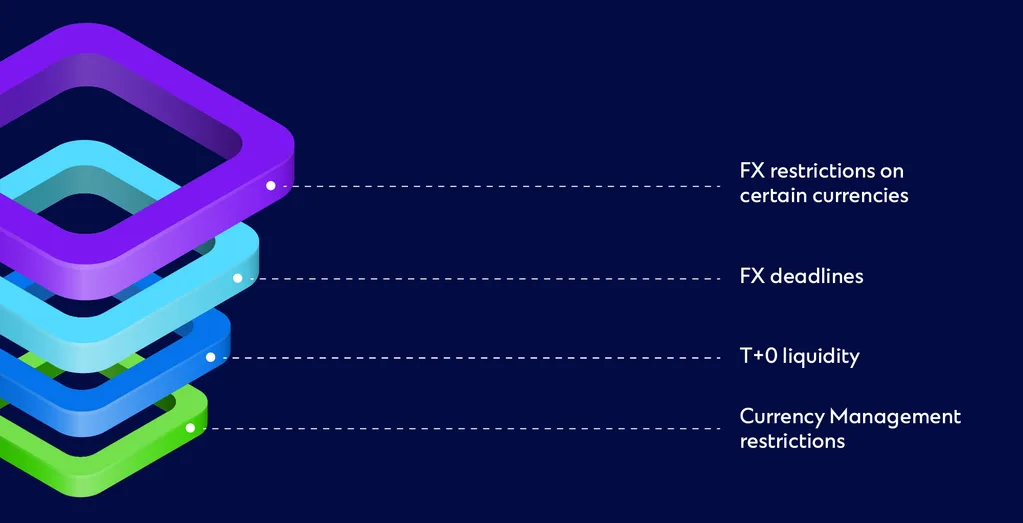
The shift to a T+1 settlement environment across Asia is reshaping the landscape for investors, demanding swift action to complete essential post-trade activities especially funding and FX execution. Survey results reveal that FX and funding risks are now at the forefront of investor concerns, with a striking 88 per cent expressing worries about the availability of key FX currencies on a T+0 basis.
Facing this compressed timeline, investors are exploring solutions like prefunding and same-day FX execution to stay ahead. These strategies become even more vital when dealing with restricted currencies or navigating complex time-zone differences. However, there’s no one-size-fits-all answer. The best approach hinges on your operating model, currency exposure, and internal processes.
Prefunding, while an option, tends to be less popular among asset managers. Why? Funds earmarked for prefunding sit idle until trades settle, meaning those assets aren’t working to grow your portfolio. Instead, many are turning to custodian FX services for same-day FX trades, empowering them to manage funding with greater flexibility and efficiency.
So, how can you prepare for T+1? Start by partnering closely with your custodians and banking teams to explore the full spectrum of funding and FX solutions tailored for faster settlement cycles. Review your internal processes, assess your currency exposures, and ensure you’re ready to adapt quickly to this new normal. The right preparation will help you navigate the challenges and seize the opportunities brought about by T+1.
Custodian perspectives into preparedness, FX and funding.

Custodian Insights from lessons learnt in Asia’s first transition to T+1
India’s adoption of T+1 settlement in 2022 and its subsequent T+0 pilot in 2024 showcases the dynamic response of custodians and market participants as they rose to the challenge of accelerated settlement cycles.
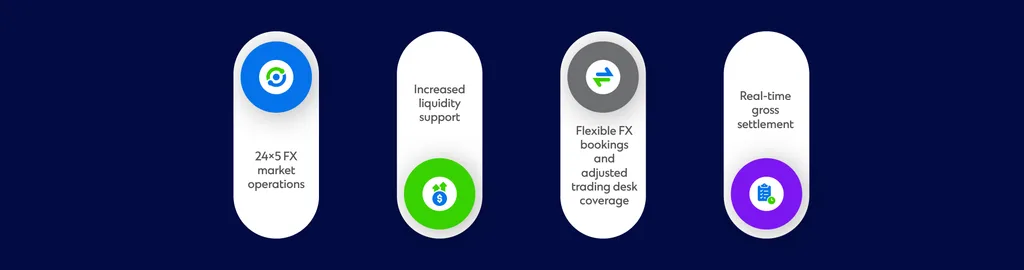
By rolling out 24×5 FX market operations, bolstering liquidity support, enabling real-time gross settlement, and offering flexible FX booking options, the industry empowered investors to navigate the pressures of condensed settlement windows with confidence. Crucially, custodians also implemented robust fail-safe FX instructions and broadened trading desk coverage, ensuring smooth funding processes and effectively managing operational risks.
These practical enhancements highlight a forward-thinking, collaborative approach to supporting seamless and resilient transitions to faster settlement timelines.
Custodians drive T+1 post trade adaptation in partnership with clients
As the shift to T+1 settlement approaches, firms should recognise this not merely as a regulatory adjustment, but as a strategic catalyst to enhance their operational resilience and future-proof their business. With global markets increasingly adopting shorter settlement cycles, now is the time for organisations to critically evaluate and refine their target operating models.
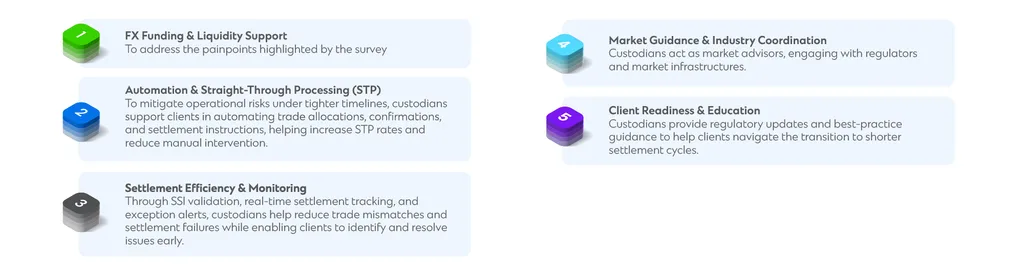
Prioritising investment in automation and straight-through processing (STP) across trade allocation, confirmation, and instruction workflows will be essential, enabling firms to minimise manual intervention and bolster efficiency.
To achieve a seamless transition to T+1, readiness across the entire post-trade value chain is paramount. We recommend that clients take a proactive approach: engage closely with custodians, foster collaborative partnerships, and ensure that processes, workflows, and systems are robustly aligned for the accelerated settlement timeline.
By embracing these recommendations, firms will not only comply with regulatory demands but also position themselves at the forefront of industry best practice, ready to navigate future market developments with confidence.
Related insights
Stablecoins and the emergence of 24/7 capital markets
How interoperable digital money could help tokenised funds and securities move from isolated issuance projects t…