



Table of Contents
Short on time? Here’s what to expect from the article:
- Equity-linked notes (ELNs) mix bonds and equities, offering higher returns with possible principal protection.
- Returns depend on equity performance, participation rate, and the issuer’s structure choices for equity-linked notes.
- Risks with ELNs may include loss of principal, market swings, low liquidity, and issuer default.
What is an equity-linked note?
An equity-linked note (ELN) is type of debt instrument similar to a bond that pays returns based on the performance of its underlying assets. Banks or financial institutions issue ELNs with a specific maturity date. An ELN may be principal-protected with a zero-coupon bond. This means investors won’t lose their principal investment. A zero-coupon bond is a bond that doesn’t offer interest during its life but is sold at a discount to its face value.
How equity-linked notes work
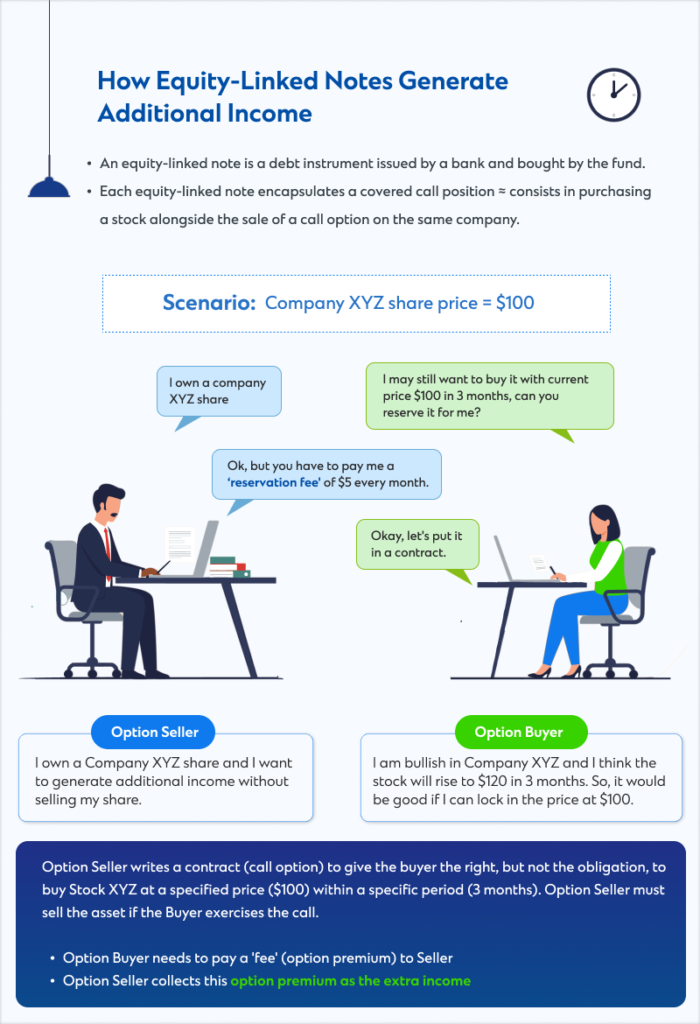
In general, an ELN has a bond component and equity options. The issuer may spend some portion of the ELN to buy a zero-coupon bond to ensure the 100% return of the principal at maturity. The remaining amount is used to purchase equity.
If equities perform well, the returns are shared with the investors. However, only the principal is returned if the underlying assets perform poorly.
If the issuer does not buy a zero-coupon bond, they may offer the investor a participation rate, promising to share a percentage of the returns from the overall performance of the underlying assets.
For example, if the participation rate is 80% and the underlying assets provide 10% returns at maturity, the investor receives their principal plus 8% (80% of 10%) of the underlying equity options’ overall returns. However, if the underlying equity undergoes a loss at maturity, you may lose your principal.
Benefits of equity-linked notes
Equity-linked notes come with several benefits as compared to other fixed income securities and may be better suited for risk-averse investors.
Opportunities to earn better returns
With investments tied to the underlying equities, ELNs offer higher returns that can pay more than fixed-income opportunities.
Lower risk
ELNs have a lower risk due to principal protection. If the issuer has ensured the principal with a zero-coupon bond, the principal is returned in full.
Short term
ELNs are short-term investments held for 1-4 months , ensuring you can receive the returns quickly and reinvest in other profitable investment options.
Flexibility
Equity-linked notes offer investors the option to choose their preferred underlying equities or stocks.
Risks with equity-linked notes
Like any other investment vehicle, ELNs carry some risks that investors should be aware of.
- Principal risk: Some issuers may not provide principal protection and instead offer returns based on the participation rate and the performance of the underlying equity. If the underlying equity performs poorly, the principal is lost, and there may be no returns.
- Market risk: Since the underlying equity determines the final returns, market volatility can affect ELN returns.
- Liquidity risk: ELNs have a certain maturity date, which makes them less liquid. If an investor wants to withdraw before maturity, it can be done at a discounted price, causing a loss.
- Issuer default risk: This is the risk associated with the ELN provider. The issuer may default on its obligations; if that happens, the investor may lose all their investment.
- Opportunity cost: ELNs only pay out on maturity, so there is an opportunity cost if they only pay the principal.
Who are equity-linked notes for?
Equity-linked notes may be a smart choice for investors in bullish markets, especially those seeking higher returns compared to fixed income securities. They may be a good fit for risk-averse investors who want to benefit from market trends without losing their initial investment. That said, ELNs can be complex with different features and fees. It’s important for investors to fully understand the product before investing. Consider reaching out to a financial advisor for more information.
Learn more about equity-linked investments. To get started, kindly leave your contact information on the lead form and one of our Relationship Managers will get in touch with you.
Your feedback is valuable to us. Did you find this article helpful?
This article is for general information only and it does not constitute an offer, recommendation or solicitation of an offer to enter into any transaction or adopt any hedging, trading or investment strategy, in relation to any securities or other financial instruments. This article has not been prepared for any particular person or class of persons and does not constitute and should not be construed as investment advice or an investment recommendation. It has been prepared without regard to the specific investment objectives, financial situation or particular needs of any person or class of persons. You should seek advice from a licensed or an exempt financial adviser on the suitability of a product for you, taking into account these factors before making a commitment to purchase any product or invest in an investment. In the event that you choose not to seek advice from a licensed or an exempt financial adviser, you should carefully consider whether the product or service described herein is suitable for you.
You are fully responsible for your investment decision, including whether the investment is suitable for you. The products/services involved are not principal-protected and you may lose all or part of your original investment amount. Investment products are not deposits and are not obligations of, not guaranteed by, and not protected by the Bank or any of the affiliates or subsidiaries, or by Perbadanan Insurans Deposit Malaysia (“PIDM”), any government or insurance agency.
Standard Chartered Bank Malaysia Berhad & Standard Chartered Saadiq Berhad (the “Bank”) expressly disclaim any liability and responsibility for any loss arising directly or indirectly (including special, incidental or consequential loss or damage) arising from the financial losses of the investment products due to market condition.
For Takaful / Insurance Benefits
The benefit(s) payable under eligible certificate is protected by PIDM up to certain limits. Please refer to PIDM’s Takaful and Insurance Benefits Protection System (“TIPS”) Brochure for more information.
The information stated in this article is accurate as at the date of publication.