



Table of Contents
- Unlock Smarter Investing with ETFs in Malaysia
- Understanding exchange-traded funds (ETFs)
- Knowing the fees of investing in ETFs and returns offered
- Types of ETFs available on Bursa Malaysia
- A snapshot of the Malaysian ETFs landscape
- Key benefits of choosing ETFs
- Downsides to keep in mind with ETFs investing
- The risks associated with buying an ETF
- Factors to consider when selecting an ETF
- Quick comparison: ETFs vs stocks vs unit trusts
- How you can start investing in ETFs
Unlock Smarter Investing with ETFs in Malaysia
Short on time? Here’s what to expect from the article:
- Exchange -Traded Funds (ETFs) mirror indexes, offering low-cost diversification to investors.
- Malaysia’s ETF market is growing: ~20+ products, RM7m to 10m daily turnover, RM2.5b+ AUM (end-2023).
- Key checks before buying: fees, tracking error, liquidity, and fit with goals (equity, bonds, gold, REITs).
Understanding exchange-traded funds (ETFs)
An exchange-traded fund, or ETF, is a collection of assets such as stocks and bonds that you buy and sell on Bursa Malaysia just like a regular stock. The main difference is that ETFs are passively managed.
Instead of trying to pick the winning stocks to beat the market, an ETF’s goal is to simply match the performance of a chosen ETF such as FTSE Bursa Malaysia KLCI (FBMKLCI). ETFs offer a simple way to invest in a broad market without having to pick individual stocks yourself.
Knowing the fees of investing in ETFs and returns offered
Since ETFs track specific indexes, their returns generally follow the performance of that benchmark and are influenced by market conditions and investment duration. Some ETFs like equity ETFs that track FTSE Bursa Malaysia KLCI (FBMKLCI) even pay dividends.
The final returns are calculated after deducting the investment fees.
The following are the costs involved:
- Brokerage charges: The charges can go up to 0.7% of the contract value.
- Other fees: You might also pay a management fee (usually under 1% of fund’s net asset value), and an annual expense ratio between 0.08%-1.09% of the net asset value (NAV) of the fund.
Types of ETFs available on Bursa Malaysia
Investors in Malaysia can choose from a growing number of ETFs, which generally fall under a few major categories:
Equity ETFs
These funds track major stock market indexes, like the FTSE Bursa Malaysia KLCI (FBMKLCI), or other regional benchmarks. They let you easily and broadly invest in the Malaysian stock market without needing to buy individual company stocks.
Bond ETFs
Bond ETFs provide exposure to Malaysian government and fixed-income assets. They are generally better for investors who want more stability and less risk than is found in stock-based investments.
Commodity ETFs
Commodity ETFs are structured to track the price movements of physical commodities. These products enable investors to participate in the performance of assets such as gold through a regulated exchange-traded structure.
REIT ETFs
REIT ETFs provide access to a diverse portfolio of REITs across sectors, both within Malaysia and across the Asia-Pacific region. These funds are suitable for those seeking income and diversification through listed property investments.
A snapshot of the Malaysian ETFs landscape
The ETF space in Malaysia may be small as compared to more developed countries, however it is gradually expanding.
Here are some facts and statements to support the trend:
- In 2024, the total traded volume grew by 18.3% YoY (year-over-year) to 133.1 million units on Bursa Malaysia
- The total value of the traded ETFs surged by 40.7% YoY to RM 227.3 million in 2024.
- The number of ETFs listed on Bursa Malaysia has grown to 16 ETFs from 3 in 2009. Even though the number is great compared to other markets, it points in the upward direction.
- Automated investing platforms, or robo-advisors have also made ETFs more popular, especially among young, first-time investors.
Key benefits of choosing ETFs
- Affordability: ETFs usually have lower fees compared to traditional unit trusts.
- Diversification made easy: One ETF purchase gives investors exposure to a basket of securities, such as the FTSE Bursa Malaysia KLCI ETF which follows the performance of the 30 largest companies in Malaysia listed on Bursa Malaysia.
- Less management needed: Since ETFs are passively managed, they require much less research and monitoring than actively trading individual stocks.
Downsides to keep in mind with ETFs investing
- Higher overall costs: The cost of buying ETFs is higher compared to buying individual stocks directly, due to management and handling fees.
- Limited opportunity: Investors have limitations to capture growth from smaller Malaysian companies that are not included in major indexes.
- Smaller dividends: The dividends from equity ETFs are often smaller than what you would get from directly investing in high-dividend stocks .
- Limited control over portfolio: Investors cannot choose which individual stocks to exclude from the index, which means you have less control over portfolio’s contents.
The risks associated with buying an ETF
As with all investments, an ETF investment carries its fair share of risk. Since ETFs track the market, it is subjected to market volatility, and an economic downturn will directly affect the value of an investment. Additionally, some ETFs in Malaysia are not traded very often which can make it difficult to buy or sell them quickly at fair prices.
ETFs may not perfectly match the performance of their target index due to costs or other factors, and this small difference is known as “tracking error.”
Factors to consider when selecting an ETF
If you’re planning to add ETFs to your portfolio, here are four essential things to consider:
- Pick the right asset class for your goals: Stocks for growth, bonds for safety, commodities as a hedge, or REITs for income.
- Minimise costs over time: Lower expense ratios and management fees can have a big effect due to compounding.
- Check tracking accuracy: The smaller the “tracking error,” the better the ETF reflects its benchmark.
- Review liquidity: Higher trading volumes mean you can buy and sell more easily with tighter price differences.
ETFs make it possible for Malaysian investors to gain diversified exposure to markets in a cost-efficient manner.
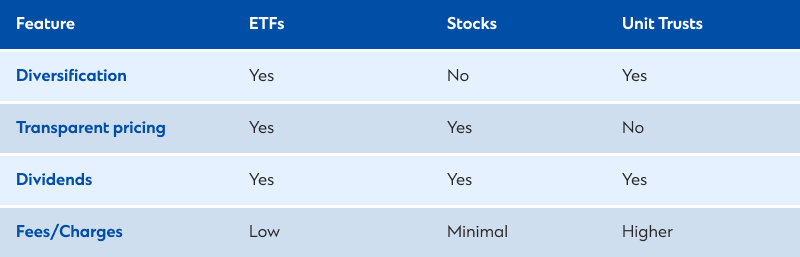
Quick comparison: ETFs vs stocks vs unit trusts
How you can start investing in ETFs
There are several common routes to access ETFs in Malaysia:
- Through Bursa-approved brokerages (via a central depository system, also known as CDS and trading account).
- Via online trading platforms that provide access to ETFs.
- Using automated platforms that build and manage diversified ETF portfolios for you based on your financial goals and risk tolerance.
To get started, kindly leave your contact information on the lead form and one of our Relationship Managers will get in touch with you. If you’re a Standard Chartered client with a Current or Savings account, log in to SC Mobile app to explore the Unit Trust and ETF-related investment funds available.
Your feedback is valuable to us. Did you find this article helpful?
This article is for general information only and it does not constitute an offer, recommendation or solicitation of an offer to enter into any transaction or adopt any hedging, trading or investment strategy, in relation to any securities or other financial instruments. This article has not been prepared for any particular person or class of persons and does not constitute and should not be construed as investment advice or an investment recommendation. It has been prepared without regard to the specific investment objectives, financial situation or particular needs of any person or class of persons. You should seek advice from a licensed or an exempt financial adviser on the suitability of a product for you, taking into account these factors before making a commitment to purchase any product or invest in an investment. In the event that you choose not to seek advice from a licensed or an exempt financial adviser, you should carefully consider whether the product or service described herein is suitable for you.
You are fully responsible for your investment decision, including whether the investment is suitable for you. The products/services involved are not principal-protected and you may lose all or part of your original investment amount. Investment products are not deposits and are not obligations of, not guaranteed by, and not protected by the Bank or any of the affiliates or subsidiaries, or by Perbadanan Insurans Deposit Malaysia (“PIDM”), any government or insurance agency.
Standard Chartered Bank Malaysia Berhad & Standard Chartered Saadiq Berhad (the “Bank”) expressly disclaim any liability and responsibility for any loss arising directly or indirectly (including special, incidental or consequential loss or damage) arising from the financial losses of the investment products due to market condition.
For Takaful / Insurance Benefits
The benefit(s) payable under eligible certificate is protected by PIDM up to certain limits. Please refer to PIDM’s Takaful and Insurance Benefits Protection System (“TIPS”) Brochure for more information.
The information stated in this article is accurate as at the date of publication.