



Table of Contents
Short on time? Here’s what to expect from the article:
- Forex (foreign exchange) is the rate at which a currency is exchanged. Exchanging currencies involves some costs.
- Forex rates are an important consideration for investors who prioritize foreign currency trading.
- Foreign investment returns are strongly tied to the stability of the currency besides the performance of the underlying assets.
What is a foreign exchange rate?
The foreign exchange rate, also called the FX rate, is the value of a nation’s currency when it is exchanged for another currency.
While there’s no centralised exchange for foreign currency, trades are conducted over computer networks connecting participants around the world. The forex market is both liquid and large. Because currency exchange is integral to international trade, investment, travel, and remittances, virtually everyone participates in forex in one way or another.
Understanding currency pairs
In forex trading, currencies are quoted in pairs, such as USD/MYR, meaning you compare the value of one against the other. In each currency pair, the first currency is called the base currency (USD in our example), and the second is the quote or counter currency (MYR). The exchange rate determines how much a US dollar is worth in Malaysian Ringgit.
For example, if the current FX rate for USD/MYR is 4.21, then 1 US dollar will provide 4.21 Ringgit in exchange.
The exchange rate is determined by the forex market. A country may choose a floating exchange rate or a fixed exchange rate.
A fixed or pegged rate is set by a nation’s government or central bank. It’s usually determined against a different major currency (such as the US dollar, Euro, or Yen). To maintain the local exchange rate, the central bank trades its own currency for the currency to which it’s pegged.
On the other hand, a floating rate is determined by market demand and supply. Market-determined currencies are considered to be “self-correcting”. When demand for a currency is high, its value increases, but when demand dips, so does the currency price.
The Malaysian Ringgit was pegged to other currencies in the past, but currently operates in a managed float.
Types of forex markets
Learn about the four different types of forex markets below.
- Spot: In a spot market, currencies are exchanged at the current rate.
- Forward: In a forward market, the buyer and seller agree to trade currencies at a predetermined rate on a specific date. The buyer and seller decide the terms of the exchange.
- Futures: Similar to a forward market, buyers and sellers agree to trade on a specific future date, but they use a centralized exchange that typically uses standardized agreements.
- Options: Options markets allow participants the opportunity to trade at a fixed price and date. However, buyers and sellers aren’t necessarily required to follow through. Traders can typically choose the prices and dates they want.
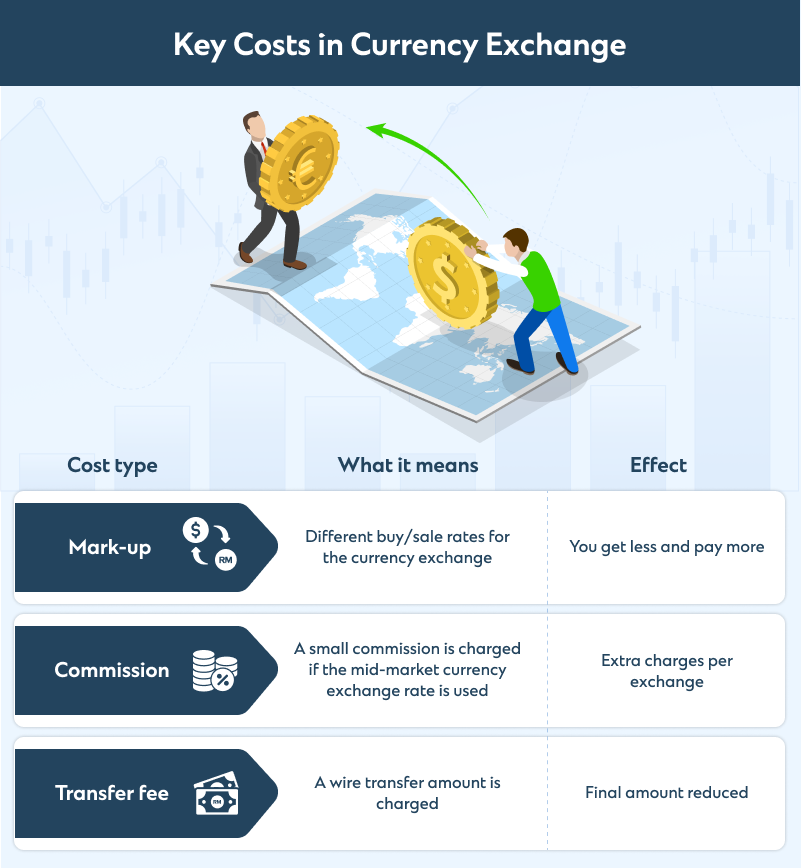
Factors affecting exchange rates
Various factors influence a currency’s exchange rate. The following factors influence and determine the exchange rate of a currency:
- Interest rates: When interest rates increase, the earning potential for lenders increases. This invites more lenders to invest, making the exchange rate of the currency stronger.
- Inflation: Low inflation encourages more spending and hence improves the purchasing power of the currency. This, in turn, increases the exchange rate for the currency.
- Public debt: When a country borrows money from domestic and international markets for public sector projects, it creates public debt. A large debt makes a country less attractive to foreign investors due to the risk of defaulting on loans. No investors will be willing to own securities denominated in a weaker currency.
- Current account deficit: This says that a country is spending more on foreign trade than it earns from it. It’s borrowing foreign capital to make up for the deficit resulting in the weakening of its own currency; this decreases the exchange rate of the currency.
- Import-export: An export brings money while imports are expenditures. If the rate of growth of exports exceeds that of imports, it shows that there is more demand for the country’s currency and this increases the exchange rate.
How currency fluctuations impact investor returns
Returns on Investment (ROI) on your investments in a foreign market depends on both the performance of the assets and the stability of the currency of that country.
Investors in Malaysia can draw valuable lessons from real-world scenarios that illustrate how exchange-rate movements influence returns:
- Equity investing in USD: Even when investments perform well abroad, exchange-rate changes can reduce domestic returns. For instance, a gain in US equities may be reduced when converted to MYR if the exchange rate increases.
For example, assume you invested MYR 2,000 in US stocks at the beginning of the year and that the equity market ends the year at the exact same level.
Here are two scenarios of how currency fluctuations can affect your returns: If the MYR climbs by 20% against the USD, your returns would be 20% more when converted back to Malaysian Ringgit; if the MYR falls by 20% against the USD, your returns would be 20% less. - Foreign bonds and Ringgit depreciation: Let’s say, a Malaysian investor buys a dollar-denominated bond that pays 4% interest. During the investment period, if the Ringgit weakens from 4.21 to 4.50 per dollar, for example, the investor will still face loss in Ringgit terms even after earning income from interest. This shows the risks Malaysian investors face when having bonds in volatile currencies.
Harnessing forex opportunities for portfolio enhancement
Utilising foreign exchange opportunities goes beyond hedging; it requires a forward-thinking approach that aligns forex strategies with broader portfolio goals.
Investors in Malaysia can capitalise on forex market inefficiencies, timing considerations, and trend analysis to enhance returns. Regular FX alerts can help with capitalisation on opportunities, especially when you are building an investment portfolio in a foreign currency. Options such as foreign currency deposits offer an additional avenue for currency exposure. Additionally, data analysis and global market insights help identify the best times to buy or sell currencies tied to a portfolio. Additionally, data analysis and global market insights help identify the best times to buy or sell currencies tied to a portfolio.
You can also use foreign currency deposit accounts to invest in products like bonds, structured investments, stocks and more. These accounts let you take advantage of a wide variety of currencies conveniently in one place.
To get started, kindly leave your contact information on the lead form and one of our Relationship Managers will get in touch with you.