

Important Note
- This is a fund of funds that will invest at least 80% of its net assets in UCITS (undertaking for collective investment in transferable securities)/UCIs (undertaking for collective investment).
- Investing in this fund may expose investors to exchange/currency risk, concentration risk, emerging markets risk, Eurozone risk as well as risks of investing in other schemes and/or ETFs. It may also involve risks relating to Standard Chartered’s CIO selection strategy, termination of the right to use Standard Chartered’s CIO selection strategy, risks associated with debt securities (including credit/counterparty risk, interest rate risk, below-investment-grade/unrated bonds risk, sovereign debt risk, volatility and liquidity risk, downgrading risk, valuation risk and credit rating risk), as well as risk of investment in collateralised and/or securitised products.
- The fund may invest in underlying schemes which may use FDI extensively for investment purposes, or of which the net derivative exposure is more than 50% of the underlying schemes’ net asset value. Investment in FDI is subject to additional risks, including counterparty and credit risk, liquidity risk, valuation risk, volatility risk and over-the-counter transaction risk. The leverage element/component of an FDI may result in significant losses.
- For distribution class, the fund may at its discretion determine to pay dividends out of income or capital or effectively out of capital of the fund. Payment of dividends out of capital and/or effectively out of capital amounts to a return or withdrawal of part of an investor’s original investment or from any capital gains attributable to that original investment. Any distributions involving payment of dividends out of the fund’s capital or payment of dividends effectively out of the fund’s capital (as the case may be) may result in an immediate reduction of the net asset value per share of the fund.
- The value of the fund can be volatile and could go down substantially. Investors may suffer substantial loss.
- Investors should not only base on this marketing material alone to make investment decisions.
In a hurry? Read this summary:
- Just as top football managers adjust tactics mid-match in response to changing circumstances, successful investors benefit from a flexible, dynamic approach to their portfolios. Rigid strategies can leave one exposed, being able to pivot keeps you in the game.
- Tactical substitutions and formation shift like those seen in Liverpool’s and Real Madrid’s matches, reflect the importance of regular review and adjustment. Similarly, periodic rebalancing and diversification in investments ensure portfolios remain resilient and capture new opportunities.
- Just as teams use a mix of defensive and offensive tactics to navigate matches, Signature CIO Funds use diversified asset allocation and periodic, disciplined adjustments to balance growth and stability. This ensures your investment portfolio can weather market cycles while remaining ready for unforeseen events.
Table of Contents
- Flexibility Wins: Asset Allocation Lessons Signature CIO Funds Derive from Football
- Why static regimes hinder long-term investments
- Football as a live example of a dynamic asset allocation strategy
- Tactical substitutions in investments: Flexible asset allocation and portfolio diversification
- Signature CIO Balanced Fund
- Signature CIO Conservative Fund
- Signature CIO Income Fund
- Signature CIO Growth Fund
- How Signature CIO Funds introduce flexibility into one’s investment portfolio
Flexibility Wins: Asset Allocation Lessons Signature CIO Funds Derive from Football
Elite football tournaments and long‑term investments often share a critical and inevitable truth: conditions are seldom static. Opposition tactics, player form, and match dynamics frequently force football managers to make real‑time tactical adjustments that can ultimately determine the outcome of a game.
Delivering consistent investment outcomes cannot be achieved through rigid adherence to a pre‑formulated plan as market conditions are consistently evolving. This is where a flexible approach, such as the Signature CIO Funds, becomes important. Designed as a globally diversified, multi‑asset fund‑of‑funds solution, they enable portfolios to respond thoughtfully to changing conditions while remaining aligned with long‑term financial objectives and guided by the expertise of Standard Chartered’s Chief Investment Office.
Why static regimes hinder long-term investments
A static investment regime assumes that market conditions and investor circumstances will remain constant over time. However, there are several variables which can cause them to fluctuate. These include interest rates, inflation, valuations, and government policy. These variables often evolve in ways difficult to anticipate, making a rigid approach with one that can leave portfolios exposed to risks arising from misalignment with both the realities of the market and an investor’s long-term financial goals.
When one looks at long-term investments, having a dynamic portfolio allows investors to better manage risk as fixed allocations may result in concentrated risks or potentially diluted returns. A flexible investment framework helps one better navigate uncertainty in the market and preserve capital across cycles.
Football as a live example of a dynamic asset allocation strategy
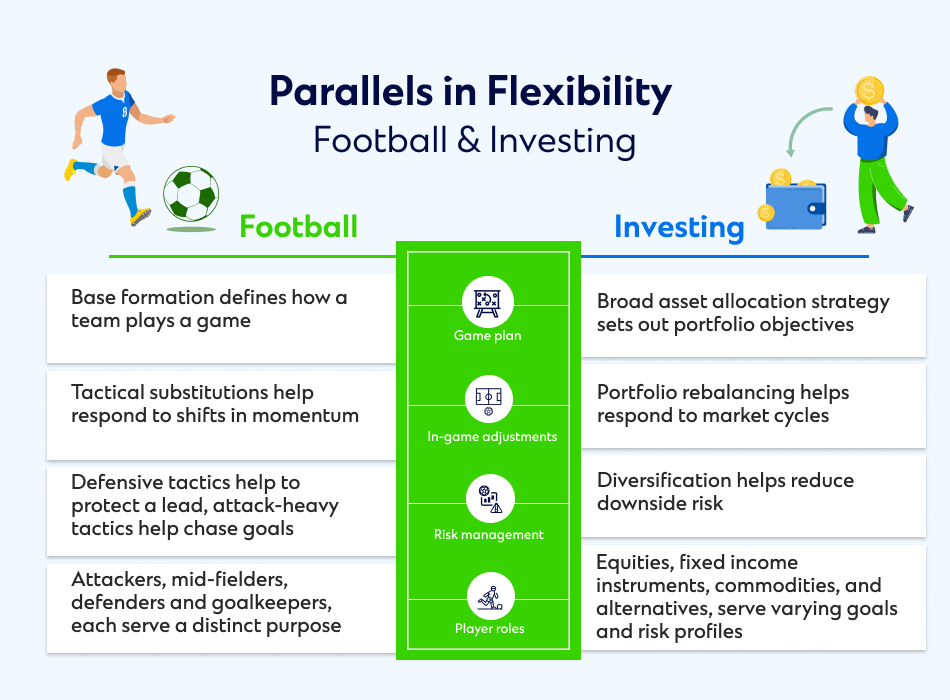
In elite football tournaments such as FIFA and the UEFA Champions League, success is rarely driven by game plans set in stone. Tactical substitutions done in real time responds to ever-changing dynamics, shifts in momentum, form, or opposition tactics are essential.
To preserve their lead in a game, a team may choose to switch to more defensive tactics and they may pivot to an attack-heavy strategy if their goal is to score in a game.
Flexibility can influence outcomes. An example of this is Liverpool’s 2-0 win in the UEFA Champions League match against Real Madrid in November 2024. Liverpool’s manager Arne Slot made an important adjustment at half-time, which resulted in the team taking control of the game. Instead of focusing on the mid-field as they did in the first half, Slot changed this structure at half-time. He got Curtis Jones to play in front of the other two players, giving the team increased space between the lines. This allowed the players to find more attacking opportunities and eventually resulted in their 2-0 win over Real Madrid.
Yet another example is Real Madrid’s 3-0 win over RB Salzburg at the FIFA Club World Cup of 2025. Xabi Alonso, Real Madrid’s manager, switched to a five-man defence for the match, instead of opting for the traditional 4-3-3 formation which had been a defining characteristic of the team under managers Carlo Ancelotti and Zinedine Zidane. This tactical adjustment showed results almost immediately, with Real Madrid being able to control the tempo of the match throughout.
Tactical substitutions in investments: Flexible asset allocation and portfolio diversification
While flexibility in investing is essential, it is rarely prudent to abandon or change one’s long-term investment intent. Much like tactical substitutions in football, changes in investment regimes must be made within a clearly defined framework—responding to evolving market conditions while remaining true to one’s objectives.
Regular portfolio review and rebalancing helps ensure one’s asset allocation strategy continues to reflect the changing priorities associated with each of one’s changing life stages and market cycles. With this approach in mind, Signature CIO Funds offers a suite of funds designed to meet varying financial goals, and investment horizons, as well as risk profiles, while allowing for measured flexibility across global capital markets.
Each fund offers diversified exposure across global equities, global bonds, commodities, liquid alternatives, and cash, with allocations varying by fund. Together, these exposures support differing objectives, ranging from capital appreciation and income generation to capital preservation and liquidity.
Signature CIO Balanced Fund
This fund attempts to provide investors with measured growth via a combination of capital appreciation and a stable income over a mid to long-term investment horizon. The fund invests similar amounts of capital into equities and fixed income instruments, with a slightly heavier tilt towards the former. For additional risk mitigation and portfolio diversification, it also invests a certain amount of capital into commodities and cash.
Signature CIO Conservative Fund
The Signature CIO Conservative Fund’s primary objective is to generate a stable income and ensure capital preservation over a long-term investment horizon. The fund allocates most of its capital to fixed income, money market, and cash, which generally have lower correlation to capital markets and are therefore more resilient during market downturns.
Signature CIO Income Fund
This fund helps investors generate a regular income by investing in a globally diversified portfolio of income-generating securities. To a smaller extent, it also focuses on capital appreciation over a long-term investment horizon by investing mainly in fixed income, equities and hybrids.
Signature CIO Growth Fund
The fund seeks to achieve accelerated growth over time, through capital appreciation. It showcases a clear tilt towards equities when it comes to asset allocation, with smaller amounts invested into fixed income instruments, commodities, and alternatives for risk mitigation via portfolio diversification. It is more suited to investors with higher levels of risk tolerance, owing to the volatility levels traditionally associated with equities.
How Signature CIO Funds introduce flexibility into one’s investment portfolio
Each of the four Signature CIO Funds is built around a clearly defined asset allocation framework tailored to different long-term outcomes. Fund managers periodically make disciplined adjustments in response to changing market conditions, while maintaining alignment with each fund’s core investment objectives.
This allows investors to mitigate impending portfolio risks, capture emerging opportunities across asset classes, sectors, and geographies, and prevent any unintended concentration of capital. Furthermore, it also allows one to balance preservation of capital with high liquidity levels, to ensure they have timely access to funds during any unforeseen contingencies such as accidents, illnesses, or even home/vehicular repairs.
Success, whether in football or capital market investments, seldom results from rigid adherence to a singular tactic. Adaptability and timely, measured adjustments; while staying true to one’s original and broader game plan, are what make the difference.
Investing in a single Signature CIO Fund or in a thoughtful combination across the board, can help investors build portfolios that remain resilient across market cycles, while balancing growth and stability in equal measures.
To know more about how Signature CIO Funds can introduce flexibility into your investment portfolio, visit our website, or reach out to a Standard Chartered Relationship Manager by using the myRM feature via online banking or the SC Mobile Banking App today.
Disclaimers
*Based on assets under management (AUM) as at 31 December 2022.
The information in this document is as at 30 June 2023 except where otherwise stated.
The role of Standard Chartered Bank (Singapore) Limited (“SCB SG”) as the fund’s Investment Advisor is solely advisory in nature while Amundi as the Investment Manager will have the final authority and decision regarding investments of the fund.
The role of SCB SG as the fund’s Investment Advisor does not imply official recommendation, it is not a recommendation or endorsement of a product, nor does it guarantee the commercial merits of a product or its performance.
This material contains information about AMUNDI ASIA FUNDS SIGNATURE CIO CONSERVATIVE FUND, AMUNDI ASIA FUNDS SIGNATURE CIO BALANCED FUND, AMUNDI ASIA FUNDS SIGNATURE CIO GROWTH FUND, AMUNDI ASIA FUNDS SIGNATURE CIO INCOME FUND (the “Funds”), sub funds of Amundi Asia Funds, an undertaking for collective investment in transferable securities existing under Part I of the Luxembourg law of 17 December 2010, organized as an open-ended mutual investment fund (“fonds commun de placement”). The management company of the Funds is Amundi Luxembourg S.A., 5, allée Scheffer, L-2520 Luxembourg and the Hong Kong Representative of the Funds is Amundi Hong Kong Limited, Suites 04-06, 32nd Floor, Two Taikoo Place, Taikoo Place, 979 King’s Road, Quarry Bay, Hong Kong (Amundi Luxembourg S.A. and/or its affiliated companies, including without limitation Amundi Hong Kong Limited, being hereinafter referred to individually or jointly as “Amundi”).
Investors should not only base on this document alone to make investment decisions. Investment involves risk. The past performance information of the market, manager and investments and any forecasts on the economy, stock market, bond market or the economic trends of the markets which are targeted by the fund(s) are not indicative of future performance. Investment returns not denominated in HKD or USD is exposed to exchange rate fluctuations. The value of an investment may go down or up. The offering document(s) should be read for further details including the risk factors. The fund(s) may use financial derivatives instruments as part of the investment strategy and invest in securities of emerging markets or smaller companies, or fix income securities. This involves significant risks and is usually more sensitive to price movements. The volatility of fund prices may be relatively increased. Issuers of fixed-income securities may default on its obligation and the fund(s) will not recover its investment. Additional risk factors are described in the offering document(s). Investors are advised to be aware of any new risks that may have emerged in the prevailing market circumstances before subscribing the fund(s).
Amundi is not responsible for the publication of this material. Certain information contained in this material has been obtained from Amundi which has not been independently verified, although Amundi and its affiliated companies believe such information to be fair and not misleading. Amundi does not accept any liability whatsoever whether direct or indirect that may arise from the publication of this material by Standard Chartered Bank (Hong Kong) Limited and use of information contained in this material. Amundi and its associates, directors, connected parties and/or employees may from time to time have interests and or underwriting commitments in the investments mentioned in this material. Amundi does not guarantee that all risks associated to the transactions mentioned herein have been identified, nor does it provide advice as to whether you should enter into any such transaction. Amundi does not make any representation as to the merits, suitability, expected success, or profitability of any such transaction mentioned herein.
Investment Fund is an investment product and some Investment Funds would involve derivatives. The investment decision is yours, but you should not invest in Investment Fund unless the intermediary who sells it to you has explained to you that the product is suitable for you having regard to your financial situation, investment experience and investment objectives.
Investment involves risks. The prices of units/ shares of unit trusts or mutual funds fluctuate, sometimes dramatically and the worst case may result in loss of your entire investment amount. It is as likely that losses will be incurred rather than profit made as a result of buying and selling unit trusts or mutual funds. Past performance of any Investment Fund is no guide to its future performance.
Investors should carefully read the relevant offering documents and in particular the Terms & Conditions contained therein, the investment policies and the risk factors and latest financial results information. It is desirable that the Investor seeks independent financial advice with respect to any investment decision.
Investors should ensure they fully understand the risks associated with unit trusts or mutual funds and should also consider their own investment objective, investment experience, financial situation and risk tolerance level before making any investment decision.