
In a hurry? Read this summary:
Mutual funds’ assets under management (AUM) in India were valued at approximately ₹752 billion as on August 31, 2025, according to the Association of Mutual Funds in India. Equity and debt mutual funds constituted about 44% and 25% of this, respectively. While preferences may seem skewed towards the former, in markets characterised by volatility and opportunity in equal measure, these funds play complementary roles in an investor’s portfolio. Read on to understand how each of them works, what they bring to the table, and how they differ.
Equity mutual funds invest a minimum of 65% of their assets into equity-linked instruments, per SEBI (Securities Exchange Board of India) rules. Investments in shares of companies across sectors, geographies, and market capitalisations help mitigate concentrated risks on one hand and offset them by providing exposure to emerging opportunities on the other.
While expense ratios are higher with these funds owing to a need for active management, they are still a popular instrument for long-term wealth creation. Bear in mind however, their performance is entirely market-linked which may impact risk levels.
Debt mutual funds invest capital in baskets of fixed-income securities such as government and corporate bonds, treasury bills, commercial papers, and certificates of deposit. Fixed interest payments on these underlying instruments at regular intervals are the primary source of returns for investors.
These funds may appeal to investors with lower risk appetites and those who prefer predictable income streams and capital preservation over capital appreciation. Diversification within the funds, moreover, helps mitigate concentrated risks in a manner similar to equity funds.
Debt funds vs Fixed Deposits: Which one should you pick?
Debt mutual funds are not the only preferred instrument for capital preservation in India. Fixed deposits have long been popular with investors seeking low risk levels and assured returns. While their USPs overlap, it is also essential to distinguish between the two, given they react differently to market dynamics and their returns and liquidity levels vary.
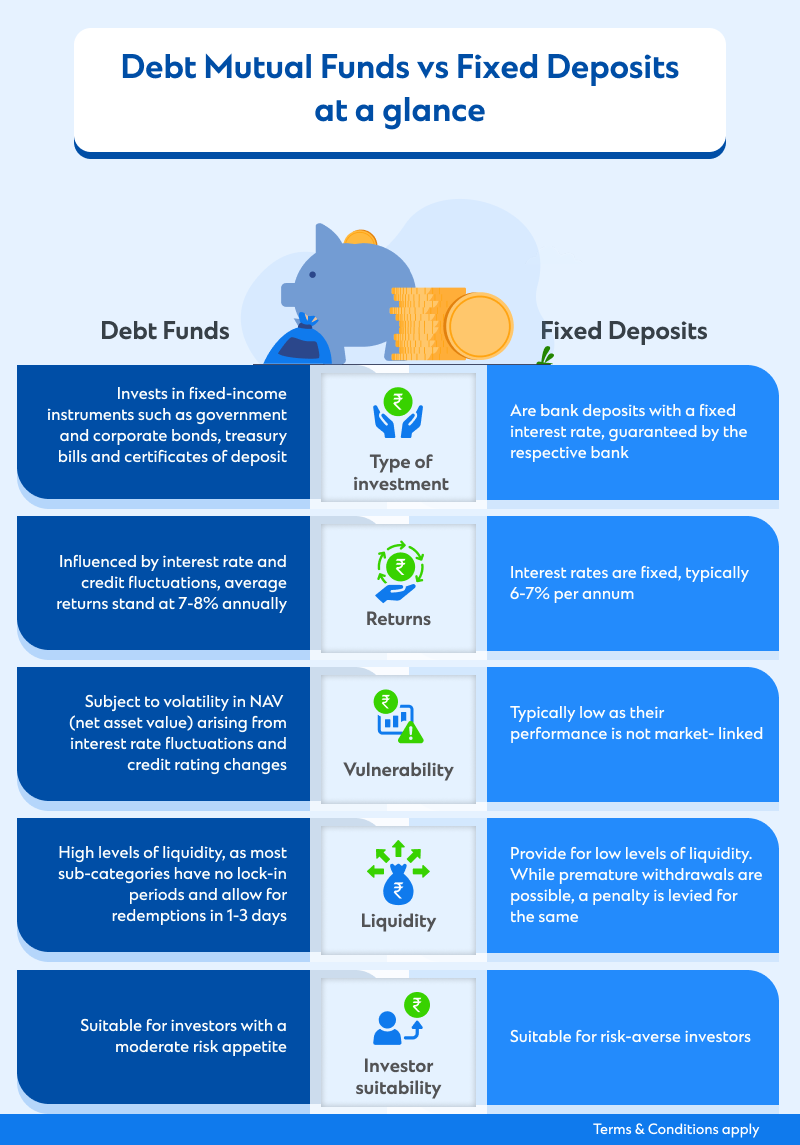
While both equity and debt mutual funds have their own USPs, there are a few important distinctions between the two.
Risk and volatility
Equity mutual funds experience higher levels of volatility as their returns are dependent on the broader market, as well as the performance of the underlying companies of which the fund has invested in. Debt funds are comparatively more stable, but not entirely risk-free either. Interest rate fluctuations and credit rating changes on underlying securities may impact these funds’ NAV (net asset value) and subsequent returns.
Liquidity
Equity funds offer easy redemptions. However, redemptions are almost always influenced by prevailing market conditions, which can affect the value of the proceeds received by investors, as well as timelines for the same. Debt mutual funds on the other hand invest in fixed-income instruments with relatively predictable price trends. Moreover, sub-categories such as liquid funds invest in securities with maturity timelines of no longer than one day, with no lock-in periods. This makes them highly liquid investment instruments.
For investors confused between equity and debt funds, hybrid mutual funds may be a suitable middle ground. They are designed to give an investor the best of both worlds by investing in a mix of equity and debt instruments. Depending on the nature of the investments (equity or debt-oriented), or if these funds actively adjust asset allocation with evolving market cycles, they may be classified as aggressive, conservative, or balanced hybrid funds.
Hybrid funds may appeal to first-time investors looking to simplify and streamline their portfolios as well as seasoned investors looking for instruments that can adapt and evolve with changing market conditions.
The choice between these three categories of mutual funds boils down to one’s financial goals, investment horizon, and risk appetite. This is where SC Invest steps in as a trusted ally, with a list of mutual fund selections via Fund Select, expert and actionable insights via Market Views on-the-go, and more.
Debt Mutual Funds: The What, How, and Why
What are Equity Mutual Funds and Why Should You Invest?
Choosing Mutual Funds for Beginners: A Guide to Smarter Investments
Standard Chartered Bank, India (‘Bank’) is an AMFI-registered distributor of mutual funds and referrer of other third-party investment products and does not provide any investment advisory services as defined under the SEBI (Investment Advisers) Regulations, 2013. Mutual fund investments are subject to market risks, please read scheme related documents carefully before investing. Past performance is not indicative of future returns. Apart from the RM-assisted journey, SC Invest is an EXECUTION-ONLY platform. The Bank does not provide any investment advice or investment recommendations in respect of any transaction effected through the SC Invest platform.
The contents on this webpage are for general information only and does not constitute an offer, recommendation or solicitation of an offer to enter into a transaction or adopt any hedging, trading or investment strategy, nor does it constitute any prediction of likely future movements in rates or prices or any representation that any such future movements will not exceed those shown in any illustration. You are fully responsible for your investment decision, including whether the product or service described here is suitable for you. Standard Chartered Bank will not accept any responsibility or liability of any kind, with respect to the accuracy or completeness of the information in this webpage. The contents herein are for general evaluation only and has not been prepared to be suitable for any particular person or class of persons. Standard Chartered Bank makes no representation or warranty of any kind, express, implied or statutory regarding the contents on this webpage or any information contained or referred to herein. This webpage is distributed on the express understanding that, whilst the information in it is believed to be reliable, it has not been independently verified by us.
This communication has been prepared on the basis of publicly available information, internally developed data and other sources believed to be reliable. Standard Chartered Bank India (“SCB/ Bank”) does not warrant its completeness and accuracy. This information is not intended as an offer or solicitation for the purchase or sale of any financial instrument / units of Mutual Fund. Recipients of this information should rely on their own investigations and take their own professional advice. Neither SCB/Bank nor any of its employees shall be liable for any direct, indirect, special, incidental, consequential, punitive or exemplary damages, including lost profits arising in any way from the information contained in this material. SCB Bank and its affiliates, officers, directors, key managerial persons and employees, including persons involved in the preparation or issuance of this material may, from time to time, have investments / positions in Mutual Funds / schemes referred in the document.
Standard Chartered Bank (“SCB/ Bank”) is a AMFI-registered Mutual Fund Distributor & a Corporate Agent for Insurance products.