


Table of Contents
In a hurry? Read this summary:
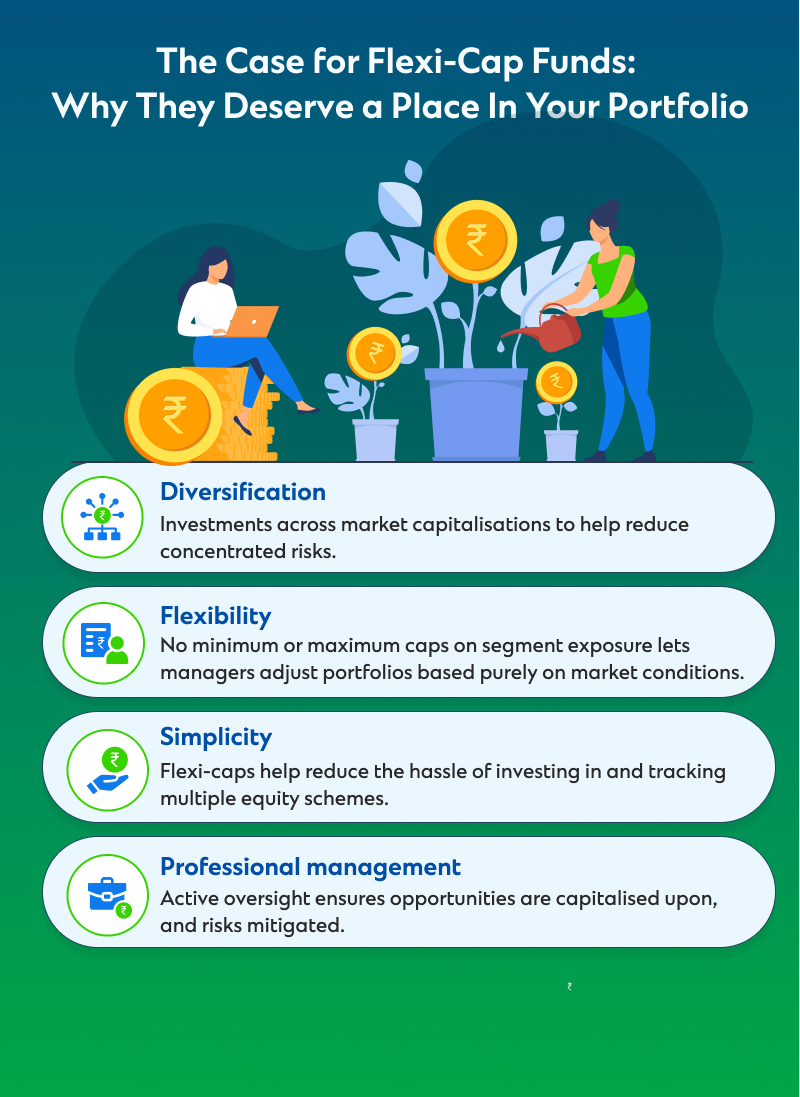
- Flexi-cap funds are open-ended mutual funds that invest a minimum of 65% of their capital in equities across market capitalisations – small, mid and large. There is no minimum cap for investments in each of these segments.
- They allow introduce simplicity to portfolios, allowing one to invest in just a single fund rather than multiple mutual funds.
- Flexi-cap funds are suited to more aggressive investors with higher risk tolerance, since varying exposure to large, mid, and small-cap stocks introduces greater volatility in the fund’s portfolio.
For investors focused on capital appreciation and portfolio diversification, flexi-cap funds can be an appealing option. Before investing in these products, it is key to understand how they are structured, their benefits, and how they differ from multi-cap funds.
Understanding what flexi-cap funds are and how they work
Flexi-cap funds are open-ended mutual funds that invest a minimum of 65% of their capital in equities and equity-linked instruments according to the rules of the Securities Exchange Board of India (SEBI), across market capitalisations – small, mid and large. There is no minimum cap for investments in each of these segments. Asset allocation is reviewed, decided upon, and rebalanced in response to market conditions.
These funds introduce simplicity to investor portfolios, giving them the option to invest in just a single fund, rather than multiple mutual funds across market capitalisations. This makes them an appealing instrument to both beginners and seasoned investors alike. This is evidenced by the fact that flexi-cap funds accounted for nearly ₹76.8 billion out of the ₹334.3 billion in equity fund inflows for August 2025, as per the Association of Mutual Funds in India’s (AMFI) August 2025 monthly note.
Who should consider investing in flexi-cap funds?
One may consider investing in flexi-cap funds if they are looking to take a more hands-on approach to wealth creation. In addition to ensuring concentrated risks are offset, they also provide investors with balanced exposure to the growth potential of small and mid-cap stocks, alongside the stability offered by large-cap stocks. This allows both capital preservation and capital appreciation.
Bear in mind, however, that flexi-cap funds are suited to more aggressive investors with higher risk tolerance. This is because continually varying exposure to large, mid, and small-cap stocks, depending on market conditions, introduces greater volatility in the fund’s portfolio. This creates potential for more pronounced short-term fluctuations alongside higher returns in the long run. One can consider investing in flexi-cap funds if they are prepared to stay invested in them through multiple market cycles.
Flexi-cap vs multi-cap funds: How do they differ?
Flexi-caps are not the only mutual fund category that offers one exposure to equity instruments across market capitalisations. Another somewhat similar option is multi-cap funds. According to SEBI regulations, these funds allocate at least 75% of their assets to equities. How they differ from the former, however, is that they are bound by a minimum investment threshold of at least 25% in each segment — large mid, and small-cap.
Multi-cap funds, in contrast to flexi-cap funds, can be chosen by those looking to take a hands-off approach to wealth creation. Risk-averse investors who prioritise stability and capital preservation in their portfolios may also consider investing in them over flexi-cap funds.
An added advantage multi-cap funds offer is that due to less frequent churn (as compared to flexi-cap funds), expense ratios on them tend to be lower as well. This helps enhance returns and makes them easier on the pocket.
Key considerations for investing in flexi-cap funds
Flexi-cap funds offer several distinct advantages. Before investing in them however, it is still important to take into consideration a few key factors, to ensure one makes informed decisions.
Performance history
Past performance isn’t necessarily an indicator of future results. It does, however, provide insight into how a fund has been managed and how it has fared across market cycles. If a fund manages to outperform its benchmark index and even its category average, this signals potential to navigate future shifts in the market effectively.
Fund strategy
Each flexi-cap fund has varying investment strategies. It is important to evaluate said strategy to make sure it aligns with one’s financial goals and risk profile. Some funds, for example, may have a more aggressive investment philosophy, focusing more on small-cap stocks with high growth potential, while others may focus on large-cap stocks to ensure portfolio stability.
Fund manager expertise
A flexi-cap fund’s performance (or any other mutual funds for that matter) is also largely dependent on a fund manager’s expertise, in addition to market conditions. Managers must therefore showcase a proven ability to navigate different market cycles, identifying and capitalising on emerging opportunities, and mitigating impending risks in time. A strong track record of the same, a long tenure with any given fund, alongside consistent performance across other schemes as well, can serve as key indicators of their competence.