
In a hurry? Read this summary:
Blending growth and stability is central to long-term wealth creation for securing one’s retirement. For the same, two options that have emerged as favourites amongst Indian investors are the National Pension System (NPS) and systematic investment plans (SIPs).
To choose between the two, however, it is essential to understand how each of them is structured and how they work to help you choose one that aligns with your financial goals.
NPS is a government-backed retirement savings scheme in which one can invest money while employed, to secure financial stability post-retirement. For the same, one requires a Permanent Retirement Account Number (PRAN).
NPS offers the option to invest in two different account types:
NPS also provides the ability to choose between two different investment approaches.
It is important to note that equity exposure is capped at 75% under NPS. This may marginally diminish returns in the long run, especially when compared to mutual funds.
Post retirement, investors can withdraw up to 60% of their corpus as a lump sum, whereas the remainder can be withdrawn as a monthly pension for life.
Subscribers can make partial withdrawals for specific purposes, including their children’s education, marriage, purchasing a home, or treatment for a medical condition. One can, however, only make three partial withdrawals pre-retirement, after a tenure of a minimum of 10 years. Moreover, these must not exceed 25% of their total contribution, and there must be a gap of at least five years between each withdrawal.
SIPs are a means to invest in mutual funds; they refer to investing pre-determined amounts into mutual fund schemes, at a set frequency. SIPs encourage patient and consistent investments which may lead to long-term wealth creation.
Through an SIP, one can choose to start, stop, or restart their investments in a given fund anytime, as well as withdraw their holdings in it, provided the fund doesn’t have a lock-in period. Additionally, most mutual funds have a minimum investment threshold of as little as ₹500 per month, which ensures investing in them doesn’t burden you financially, and helps build your post-retirement corpus at your own pace and scale.
Benefits of investing in an SIP
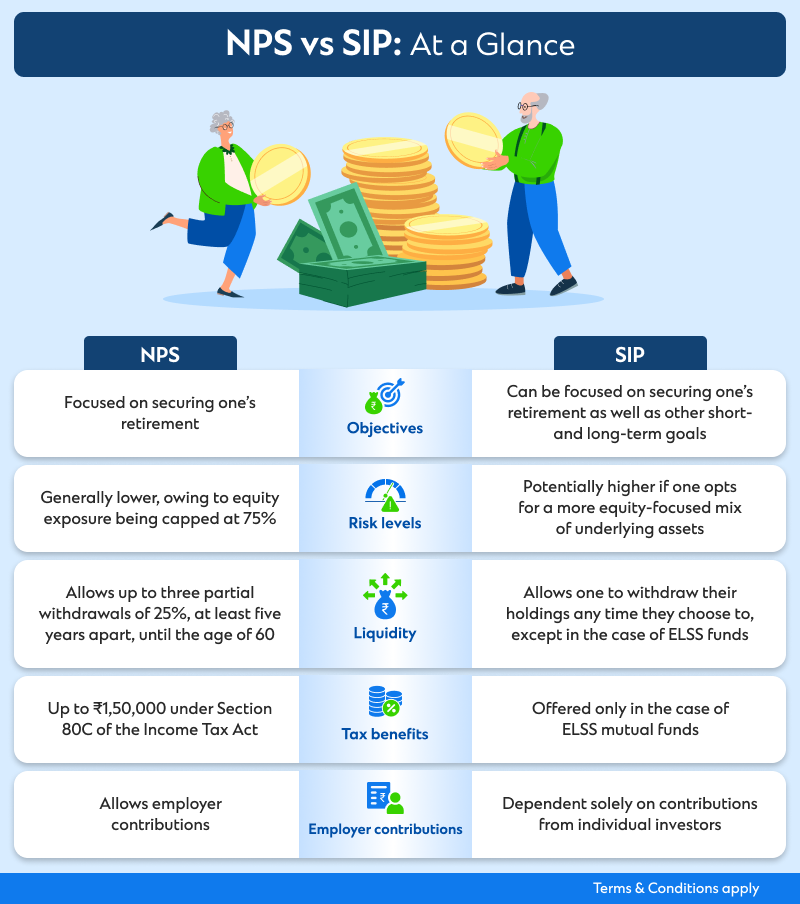
Both NPS and SIPs offer distinct advantages that help one secure their retirement. Picking between the two, however, requires an evaluation of how well each of them aligns with one’s risk appetite, liquidity preferences, and financial goals.
You should opt for NPS if you:
You should choose an SIP if you:
To get started on your investment journey, head over to SC Invest on the SC Mobile app, or walk into your nearest Standard Chartered Bank branch today.
How to Invest in SIP: The Ultimate Guide for Beginners
Standard Chartered Bank, India (‘Bank’) is an AMFI-registered distributor of mutual funds and referrer of other third-party investment products and does not provide any investment advisory services as defined under the SEBI (Investment Advisers) Regulations, 2013. Mutual fund investments are subject to market risks, please read scheme related documents carefully before investing. Past performance is not indicative of future returns. Apart from the RM-assisted journey, SC Invest is an EXECUTION-ONLY platform. The Bank does not provide any investment advice or investment recommendations in respect of any transaction effected through the SC Invest platform.
The contents on this webpage are for general information only and does not constitute an offer, recommendation or solicitation of an offer to enter into a transaction or adopt any hedging, trading or investment strategy, nor does it constitute any prediction of likely future movements in rates or prices or any representation that any such future movements will not exceed those shown in any illustration. You are fully responsible for your investment decision, including whether the product or service described here is suitable for you. Standard Chartered Bank will not accept any responsibility or liability of any kind, with respect to the accuracy or completeness of the information in this webpage. The contents herein are for general evaluation only and has not been prepared to be suitable for any particular person or class of persons. Standard Chartered Bank makes no representation or warranty of any kind, express, implied or statutory regarding the contents on this webpage or any information contained or referred to herein. This webpage is distributed on the express understanding that, whilst the information in it is believed to be reliable, it has not been independently verified by us.
This communication has been prepared on the basis of publicly available information, internally developed data and other sources believed to be reliable. Standard Chartered Bank India (“SCB/ Bank”) does not warrant its completeness and accuracy. This information is not intended as an offer or solicitation for the purchase or sale of any financial instrument / units of Mutual Fund. Recipients of this information should rely on their own investigations and take their own professional advice. Neither SCB/Bank nor any of its employees shall be liable for any direct, indirect, special, incidental, consequential, punitive or exemplary damages, including lost profits arising in any way from the information contained in this material. SCB Bank and its affiliates, officers, directors, key managerial persons and employees, including persons involved in the preparation or issuance of this material may, from time to time, have investments / positions in Mutual Funds / schemes referred in the document.
Standard Chartered Bank (“SCB/ Bank”) is a AMFI-registered Mutual Fund Distributor & a Corporate Agent for Insurance products.