Manus Costello: We’ve had a record first-half performance
Watch our Group CFO discuss the quarter’s biggest surprises, managing risk with a strong foundation, and how AI is supporting our colleagues to power growth.

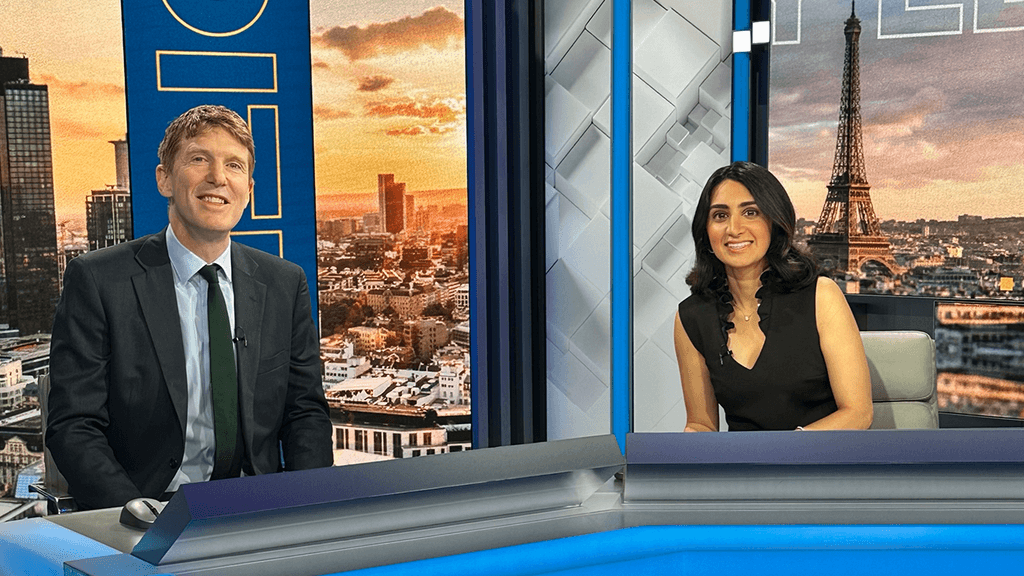
© 2026 CNBC, All rights reserved, used with permission. All figures are presented on a reported basis and comparisons are made to half-year 2025 on a constant currency basis, unless otherwise stated.
CNBC’s Ritika Gupta:
Standard Chartered half-year pre-tax profit rose better than expected, up 9 per cent to just under USD5 billion, with the company pointing to strength in its Global Banking and Wealth Solutions units. That helped offset ongoing credit charges linked to the Middle East conflict. The Bank also announced a new share buyback of USD1 billion.
I’m pleased to say that Manus Costello, the CFO of Standard Chartered, joins me now.
Manus, welcome to the show, and congratulations on a first set of results with you in this new role.
So first of all, let’s discuss the results. You beat consensus despite what has been a tough macro backdrop. Talk to me about the drivers behind this, the biggest surprises that you had in the quarter, and how that is setting you up for the rest of the year.
Manus Costello:
Thanks. Yeah, look, we’re really pleased with what was a record first-half performance for the Bank. Our income was up 6 per cent in the first half, and that was driven by our very powerful franchises in Wealth, which was up 38 per cent, and in Global Banking, as you mentioned, which was up 19 per cent for the first half of the year.
+6%
increase in operating income
+38%
Wealth Solutions increase
+19%
Global Banking increase
They’ve really put us in a very strong position on the journey toward delivering against the financial commitments that we made at our Investor Event in May a couple of months ago, where we laid out our longer-term targets. And we’re really thrilled with the start we’ve made on that journey.
Ritika Gupta:
When it comes to Wealth income, that again, as you mentioned, was a standout performer. What are you seeing in terms of inflows from your clients across the regions, particularly in Asia? Are you still seeing some caution there?
Manus Costello:
Well, look, we’ve got a very strong Wealth business. We’re the third-largest wealth manager across Asia, and we’ve got a very broad-based business, both by geography and by product.
What we’ve seen in the first half of this year, as in fact we’ve seen for some time, is really good growth across a range of products – across our range of mutual funds, across our range of structured products, across all the kinds of products that we offer – and by geography.
So, we have good growth across all of our key centres, and we’re really pleased with how we’ve delivered in the first half of this year, and we’re really confident going into that second half as well.
Ritika Gupta:
Global Banking was also a strong performer. What is that being driven by in particular?
Manus Costello:
We have a Global Banking business which has been repositioning and has been putting itself in a position to continue to take market share over the last couple of years.
What we’ve done is deepen our franchises across different areas of the business. We’ve got very powerful franchises in areas like infrastructure. We’ve got very powerful franchises in areas like DCM across our footprint.
We’ve seen good activity from customers. We’ve seen a really strong first half of the year, and we’re really pleased with that performance.
Ritika Gupta:
But you booked a sizeable impairment, and that was down to the Middle East conflict and geopolitics. How much of that is being driven by the Middle East and what you’re seeing on the ground there? Is that direct, or is that through second-order effects?
Manus Costello:
In the second quarter, we booked an extra USD44 million of impairment, or precautionary provision, I would say, for the Middle East. We booked a little more in the first quarter. That takes us up to around USD230 million of precautionary impairment that we’ve taken.
What I would say there is that the underlying asset quality that we’re seeing in that region remains robust.
We provided disclosure at the first quarter, and we’re giving a bit more today about the shape of our business in the Middle East. We’re very comfortable with how those businesses are performing, but given the macro-outlook, we thought it was prudent to take a little more in terms of that top-up.
The main charge that we took was in the first quarter. It was a smaller top-up in the second quarter.
Ritika Gupta:
You announced the USD1 billion share buyback. Did you feel that was the right time to return capital given the uncertainty around the Middle East?
Manus Costello:
Well, we reported a very strong CET1 ratio for the quarter of 14.2 per cent, so we believe we’re in a very strong position in terms of our capital, and we’re also generating a lot of capital as well.
When we spoke to investors in May, we made a commitment about how we would deploy that capital in terms of growing the business, and we’re very happy to continue to put that capital into ensuring that we’re growing the business, paying a dividend, and any surplus we will consider what to do with.
We believe we're in a very strong position in terms of our capital.Manus CostelloGroup Chief Financial Officer
We decided at this point that the right thing to do was to return USD1 billion by share buybacks.
So, we think it’s absolutely the right thing to do, given the strength of the balance sheet and the strength of the capital generation that we’re seeing.
Ritika Gupta:
China is a key market for you. How would you characterise confidence compared to six months ago, and what are you seeing in terms of corporate demand there?
Manus Costello:
Yeah, look, I was in Shanghai recently with our management team, and it was really interesting talking to the team on the ground about the shape of our business and the shape of the Chinese economy and what they’re seeing.
We’re very focused on our China business as a franchise. By that I mean we do the domestic business, but a larger piece is the international business that we do with China.
About two-thirds of our income related to the China franchise comes from outside China, from corporates who are doing business outside China.
We’re doing really well there. We’re seeing strong growth in the channels of China exporting and China going out to the world.
So, there was a real positive sense when I spoke to colleagues in Shanghai a few weeks ago.
Ritika Gupta:
Let’s focus on the UK now. We have a new Prime Minister and a new Chancellor. Have you met with the new Chancellor? Does this change in political leadership change your outlook for the UK economy or for banking more broadly? Are you concerned ahead of the autumn Budget that you could get further taxes on the banking sector?
Manus Costello:
I’ve not yet met with the new Chancellor, no, but we’ve had constructive engagement with the UK authorities, with the government, with our regulators over a long period of time, and we expect that we’ll continue.
We have a two-way dialogue with them really. We talk to them about our regulation and about our outlook in the UK, but of course, as an international bank based in the UK, we can also bring a lot of information to the authorities about what we’re seeing globally as well.
So, we have a great two-way dialogue, and I hope that will continue under the new administration.
Ritika Gupta:
The Bank has been very vocal when it comes to AI and the productivity gains it could create. What kind of tangible benefits should investors expect within the next 12 to 24 months?
Manus Costello:
I think the investment in AI and the benefits from AI will play out over a long period of time.
They’re baked into the guidance that we gave previously.
I think it will give us both the capacity to grow revenues very fast, and we’ve given a good range of revenue growth out to 2028, and we’ve upgraded our income guidance for 2026 as well.
It does help power top-line growth as we give productivity tools to people in the front line, particularly in areas like Wealth Management, to enable them to service clients better.
We also think it will enable us to get better operating leverage, so we think we can grow our revenues faster than our costs over the next few years.
AI is one element of that. There are lots of other factors that go into that, but it really will be a game that plays out over a longer period of time.
Ritika Gupta:
Capital markets have been driving a lot of gains. They’re quite resilient this year. Are you seeing a healthy pipeline when it comes to IPOs, bond issuance or M&A?
Manus Costello:
Yeah, I mean, part of what drove that strong performance – that 19 per cent growth from Global Banking in the first half – was strong DCM activity.
We don’t have an equity business, so we don’t have an equity pipeline.
But we have seen good activity in the fixed income issuance space, and we continue to see a good pipeline into the second half of this year.
That’s part of what gives us the confidence to upgrade our guidance this morning on income.
Ritika Gupta:
And then a quick one to end. What is your biggest risk that could throw off some of the guidance?
Manus Costello:
There’s always risks in the world. I am a CFO – I’m paid to think about risks.
The macro situation remains volatile, as we’ve seen overnight. There are all sorts of different things that could happen.
But for me, the important thing is that we’ve got a really solid foundation. We’ve shown good momentum in the first half of the year, and I’m really entering the second half with good confidence.
Ritika Gupta:
All right, we’ll have to leave it there. Thank you so much.
That was Manus Costello, Chief Financial Officer of Standard Chartered.