-
ASEAN Showcase
Realising sustainable growth in Southeast Asia
Leverage insights from the SEA Green Economy Report 2026 and AI x Sustainability whitepaper series

From ambition to execution: scaling Southeast Asia’s sustainable growth
Southeast Asia is at a critical point in its development. With expectations that it could boost GDP by nearly USD1 trillion by 2030, the region is well poised to capitalise on the rapid adoption of AI.
On one hand, this vast new electricity load risks straining infrastructure, undermining competitiveness and offsetting climate gains. On the other hand, the growing energy demand from data centres, EVs and green industrial clusters will also be tied to nearly USD200 billion in committed capex over the next three to four years, raising the prospect that it could offer the demand-side anchor for renewables financing and help accelerate the energy transition.
With capital and demand accelerating, realising this opportunity will depend on addressing near‑term constraints such as time to market of renewable deployment and grid capacity.
Explore our latest reports and whitepapers on the pathways shaping the region’s next phase of development.
2026 report
Southeast Asia’s Green Economy report 2026: The New Calculus
The 2026 report argues that ASEAN’s green economy is real and scaled, with expectations that it could be worth USD430 billion by 2030, but that the system is struggling to absorb the investment.
The paper, co-authored with Bain & Company, highlights that energy demand from data centres, EVs and green industrial clusters will be tied to nearly USD200 billion in committed capex, raising the prospect that it could offer the demand-side anchor for renewables projects and financing. However, the authors highlight, realising this promise hinges on the development of a robust power grid.
Without coordinated investment in manufacturing, supply chains, and supporting infrastructure, the report also highlights that ASEAN risks remaining an EV end market rather than becoming a production hub.
Chapter 1
The dual transition
This first chapter of a new whitepaper series in partnership with the Singapore Green Finance Centre and Temasek explores whether AI infrastructure investment can help catalyse the deployment of clean energy systems and accelerate the transition in SEA. It highlights key dependencies including improved time-to-market for renewable deployment and urgent grid modernisation.
Through upcoming chapters, the series will unpack essential catalysts for progress, from supply chain white spaces to technological inflection points for low carbon firm power deployment and behind the meter solutions. It will also examine how nature risks, impacts and dependencies can be managed, and what it will take to build resilience in from the start.
Explore our 2025 report and insights
Southeast Asia’s Green Economy report 2025
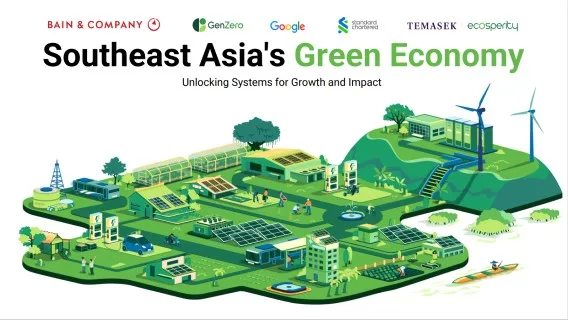
The SEA Green Economy report 2025, developed by Bain & Company, GenZero, Google, Standard Chartered, and Temasek identifies how systems-level solutions, key enabling solutions, and collaboration with APAC markets could unlock emission reductions and deliver new economic value and jobs for the region by 2030.
Download the report or tune in to our podcasts below to explore our insights.
Listen in
Tune in to our ‘SEA Green Economy’ Podcast series as we navigate key topics and opportunities with our partners Bain & Company, GenZero, Google and Temasek.



Standard Chartered has an important role to play in supporting our clients, sectors and markets to deliver net zero, but to do so in a manner that supports livelihoods and promotes sustainable economic growth. We provide financial services to clients, sectors and markets that contribute to greenhouse gas emissions however we’re committed to managing our environmental and social risks and to becoming net zero in our financed emissions by 2050.