
In a hurry? Read this summary:
When it comes to wealth creation, some investors prefer long-term security, while others prioritise liquidity and capital appreciation.
Amongst the many instruments that cater to these very different priorities, two popular options are ULIPs (or unit-linked insurance plans) and mutual funds. While ULIPs and mutual funds are market-linked investments, the two products have distinct benefits and drawbacks.
With ULIPs, capital is invested in the form of insurance premiums, and investments in equity, debt, and hybrid instruments. Regulated by the Insurance Regulatory and Development Authority of India (IRDAI), they were first introduced by the Unit Trust of India (UTI) in 1971.
Mutual funds pool capital from investors in a diversified mix of assets, including equities, debt instruments, as well as commodities, real estate, and others.
Fund managers decide on investment strategies, with an objective to generate consistent returns and/or ensure capital appreciation. They are regulated by the Securities Exchange Board of India and were first introduced by UTI in 1963.
Understanding the differences between ULIPs and mutual funds is requisite for deciding which aligns better with one’s financial goals.
Insurance coverage
In ULIPs, in the event of policyholders’ death, dependents receive a benefit, which may either be the assured sum or the fund value, whichever is higher.
Mutual funds do not have separate death benefits. However, units held in the name of investors are transferred to nominees registered at the time of investment, in case of the investor’s death.
Lock-in periods
ULIPs in India have a mandatory lock-in period of five years. One cannot withdraw their funds or surrender their policy during this period. Even if one does opt to discontinue their investments, their existing funds are locked until the end of the five-year period.
Most mutual funds have no lock-in periods, with being an exception with a three-year lock-in period. However, one can choose to sell their holdings in most mutual funds at their own discretion.
Asset allocation strategies
ULIPs allow for investments in equity, debt, and hybrid instruments, based on one’s financial goals and risk profile. They also allow switching between these instruments for a set number of times in a year, to leverage emerging opportunities in the market and mitigate impending risks in one’s portfolio. Instrument choices, however, are limited to those provided by the issuing company.
Mutual funds allow investors greater flexibility. One can invest in several funds across market capitalisations, sectors, geographies, asset classes, etc. They can also choose to start, stop, or restart their SIPs (systematic investment plans) in a fund any number of times a year, making them a suitable option for those looking to take a more hands-on approach to wealth creation.
Returns
When it comes to a comparison of returns on ULIPs and mutual funds, the former may offer lower returns. This is because one’s capital is partially diverted to insurance premium payments alongside investments. On the other hand, with mutual funds, the entirety of one’s capital is directed towards investments, resulting in potentially better long-term performance subject to market conditions.
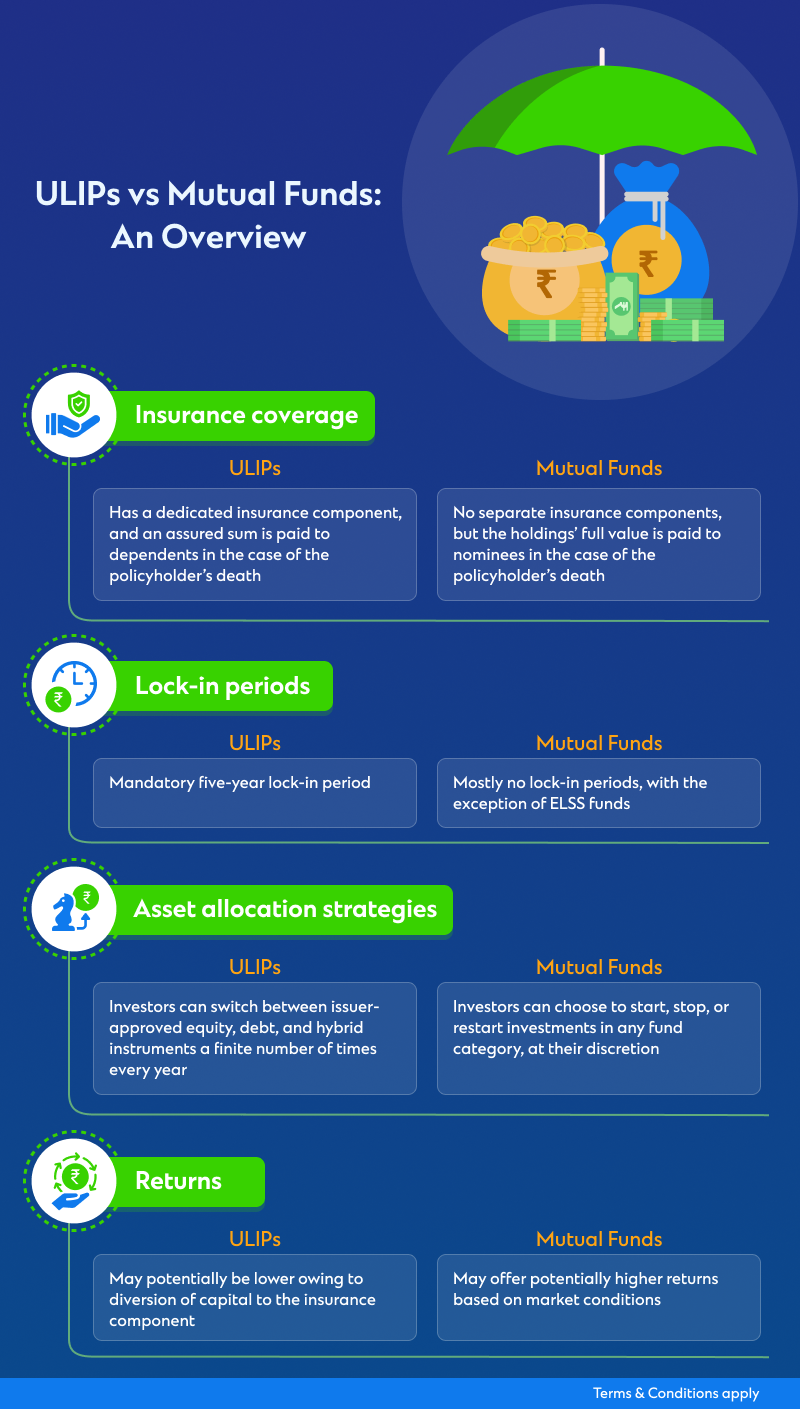
Given the differences between them, here is how to choose between ULIPs and mutual funds.
You should invest in ULIPs if you:
You should invest in mutual funds if you:
Ultimately, choosing between the two comes down to reviewing one’s evolving financial goals, investment horizon, risk profiles, and financial obligations throughout one’s life.
How to Choose Mutual Funds: Insights for Savvy Investors
Hybrid Mutual Funds: The Balanced Route to Growth and Stability
Know the many reasons why you should consider getting insurance
Standard Chartered Bank, India (‘Bank’) is an AMFI-registered distributor of mutual funds and referrer of other third-party investment products and does not provide any investment advisory services as defined under the SEBI (Investment Advisers) Regulations, 2013. Mutual fund investments are subject to market risks, please read scheme related documents carefully before investing. Past performance is not indicative of future returns. Apart from the RM-assisted journey, SC Invest is an EXECUTION-ONLY platform. The Bank does not provide any investment advice or investment recommendations in respect of any transaction effected through the SC Invest platform.
The contents on this webpage are for general information only and does not constitute an offer, recommendation or solicitation of an offer to enter into a transaction or adopt any hedging, trading or investment strategy, nor does it constitute any prediction of likely future movements in rates or prices or any representation that any such future movements will not exceed those shown in any illustration. You are fully responsible for your investment decision, including whether the product or service described here is suitable for you. Standard Chartered Bank will not accept any responsibility or liability of any kind, with respect to the accuracy or completeness of the information in this webpage. The contents herein are for general evaluation only and has not been prepared to be suitable for any particular person or class of persons. Standard Chartered Bank makes no representation or warranty of any kind, express, implied or statutory regarding the contents on this webpage or any information contained or referred to herein. This webpage is distributed on the express understanding that, whilst the information in it is believed to be reliable, it has not been independently verified by us.
This communication has been prepared on the basis of publicly available information, internally developed data and other sources believed to be reliable. Standard Chartered Bank India (“SCB/ Bank”) does not warrant its completeness and accuracy. This information is not intended as an offer or solicitation for the purchase or sale of any financial instrument / units of Mutual Fund. Recipients of this information should rely on their own investigations and take their own professional advice. Neither SCB/Bank nor any of its employees shall be liable for any direct, indirect, special, incidental, consequential, punitive or exemplary damages, including lost profits arising in any way from the information contained in this material. SCB Bank and its affiliates, officers, directors, key managerial persons and employees, including persons involved in the preparation or issuance of this material may, from time to time, have investments / positions in Mutual Funds / schemes referred in the document.
Standard Chartered Bank (“SCB/ Bank”) is a AMFI-registered Mutual Fund Distributor & a Corporate Agent for Insurance products.