

Table of Contents
In a rush? Read this summary:
- The UAE’s commitment to sustainable architecture aligns with national strategies like Net Zero 2050. Investors can have significant financial benefits such as reduced operational and maintenance costs, higher property values, and government incentives.
- The UAE promotes green development through certification programs, including globally recognised LEED and local initiatives like Estidama, which ensure buildings meet strict energy, water, and waste management standards.
- The future of sustainable architecture in the UAE involves retrofitting existing buildings and adopting a circular economy in construction to reduce waste, thereby creating new opportunities for investors and developers to enhance energy efficiency and minimise environmental impact.
As climate change has become one of the most pressing global challenges, sustainable engineering solutions have become pivotal in reducing carbon footprints, optimising energy use, and promoting long-term cost savings. It has emerged as a transformative force in the UAE, aligning with the country’s commitment to green initiatives and environmental conservation.
Sustainable building practices have also become a fundamental aspect of the UAE’s ambitious national strategies like Net Zero 2050 and UAE Vision 2030, which aim to create energy-efficient, resource-conscious, and eco-friendly infrastructure and minimise environmental impact by maximising livability and efficiency.
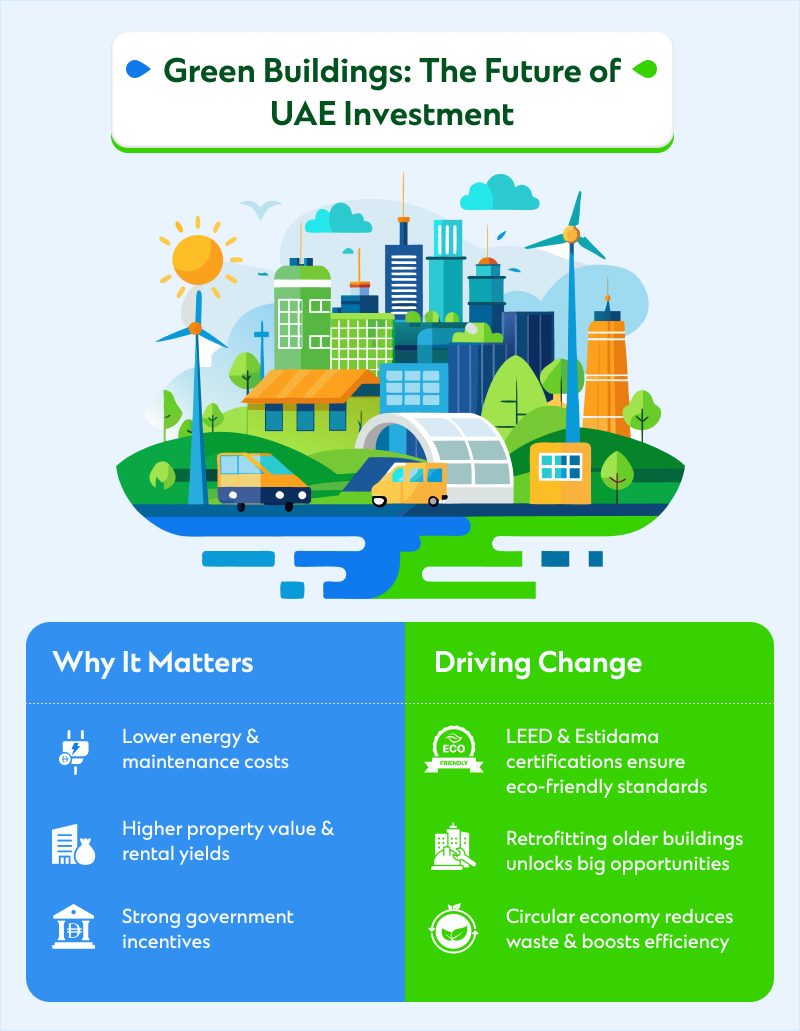
Green Buildings: The Future of UAE Investment
Why It Matters
- Lower energy & maintenance costs
- Higher property value & rental yields
- Strong government incentives
Driving Change
- LEED & Estidama certifications ensure eco-friendly standards
- Retrofitting older buildings unlocks big opportunities
- Circular economy reduces waste & boosts efficiency
Sustainability isn’t just ethical; it’s transformative, it’s the future.
Sustainable architecture and green investment benefits in the UAE
Investing in sustainable architecture is not only an ethical decision; there are economic benefits too.
- Operational cost: Energy-efficient green buildings come with features like solar panels, high-performing insulation, energy-efficient HVAC systems, and smart lighting. The Dubai Electricity and Water Authority (DEWA) confirms that investors can experience a 20 to 30% reduction in energy bills compared to other conventional buildings.
- Property value: Sustainable real estate properties have started commanding a premium in the market. Rental yields can be up to 9% higher for green-certified buildings with LEED, or Leadership in Energy and Environmental Design, certification compared to non-certified ones. The growing preference of tenants for lower utility bills, smaller carbon footprints, and a healthier living environment leads to stronger capital appreciation and a robust resale value.
- Government support: The Dubai government actively encourages various initiatives, including sustainable, green-certified, energy-efficient building development. Reduced government fees for green projects, public recognition, and an expedited permission process enhance a project’s marketability.
- Reduced maintenance cost: Sustainable architecture also includes advanced building management systems that improve operational efficiency and reduce maintenance costs. Now investors can monitor the building’s performance in real-time and identify different issues before escalating to ensure optimal functionality. A World Green Building Council report highlights that sustainable green buildings can lessen maintenance costs by up to 13%.
Green LEED certification in the UAE
The UAE encourages green development through different certification programs, including LEED and Estidama. A project with any of these certifications confirms that it meets strict energy, water, and waste management criteria.
- LEED is a globally recognised certification used to certify commercial buildings in the UAE.
- Estidama is a local initiative of the Abu Dhabi Urban Planning Council that offers a pearl rating system to assess the sustainability performance of buildings.
The future of sustainable architecture: Retrofitting existing buildings
A significant number of new constructions are green certified, but this alone is not sufficient, as around 80% of buildings that will be in use by 2050 already stand today. Many of these buildings were constructed before the efficiency standards came into existence. This is why retrofitting offers a huge opportunity for both investors and developers.
Sealing air leaks, upgrading insulation, integrating smart controls, and modernising HVAC, or heating, ventilation, and air conditioning, systems can help in a building’s energy use.
Additionally, a circular economy in construction is also crucial, as 10 to 50% of building materials are usually wasted during construction. Circular strategies include modular constructions, recycling steel and concrete, and designing for disassembly. This helps cut waste and emissions dramatically.
The Circular Economy Policy 2021-2031 in the UAE
The Circular Economy Policy 2021 to 2031 in the UAE prioritises green infrastructure, better material use, recycling targets, and emphasises renovation.
Along with the strict enforcement of recycling and waste sorting, the education of stakeholders is equally important. Different government initiatives, including recycled content mandates, investments in recycled infrastructure, and a focus on low-carbon materials, help accelerate the shift to circularity.
A sustainable vision
While green architecture is redefining the UAE landscape, the country has shown the world that sustainability and luxury can go hand in hand. Green buildings not only offer economic growth to investors, citizens, and developers but also lead to a sustainable, environmentally friendly future.
Speak to Standard Chartered’s relationship managers or contact us to learn more about the rise of sustainable architecture and investments through green buildings.