



Table of Contents
In a rush? Read this summary:
- Dollar cost averaging (DCA) is an investment plan where investors make regular, small contributions instead of a single lump sum investment.
- DCA is suitable for risk-averse investors in the UAE who prefer stress-free investment and have the discipline to invest consistently.
- While DCA is a disciplined approach, it may yield lower returns than lump-sum investing in a consistently rising market.
Dollar cost averaging (DCA) is a systematic investment plan typically used by investors to build wealth and save over the long term, thereby avoiding short-term volatility in the broader markets. Instead of investing a lump sum amount at once, investors can divide the total investment amount into smaller and regular contributions. Invest a fixed amount in a set timeline, regardless of market price movements.
DCA involves an investor splitting a lump sum into multiple, smaller investments over a set period.
Dollar cost averaging benefits
- DCA helps spread investments over time and reduces the pitfalls of ‘market timing’ (an act whereby investors try to predict the market’s movements to try and turn their trades into a profit).
- It’s an investment strategy that takes emotion out of investing, thereby helping to protect investors from potentially damaging portfolio returns.
- DCA helps reduce stress as investors eventually stop worrying about short-term market fluctuations.
- This builds wealth over time by reinforcing the practice of investing regularly.
- DCA eases the investment process by automating regular contributions, freeing investors from the stress of monitoring short-term market fluctuations.
Ideal users for DCA
- New investors: Those who are new to investing and want to enter the market gradually without committing a large sum upfront.
- Risk-averse individuals: Investors who prefer to minimise market volatility impact and are unsure about the best time to enter the market can benefit from spreading their investments over time.
- Long-term investors: Ideal for investors with a long-term investment horizon seeking steady growth over time.
- Disciplined investors: Investors who prefer a consistent systematic approach to investing by regularly contributing to their portfolio.
- Budget-conscious investors: Investors who prefer investing manageable amounts regularly rather than waiting to accumulate a large sum.
Dollar cost averaging vs lump sum
While the benefits of DCA are clear, some investors still prefer lump-sum investing because the strategy doesn’t suit every individual’s needs.
When the market is particularly strong and stock prices continue to rise, investors who regularly invest small amounts may end up earning less than an investor who invests a lump sum at once. This is because when the market is steadily rising, an investor ends up purchasing shares at a relatively higher value than before. Over time, they end up with fewer shares than an investor who made an initial lump sum investment when prices were lower.
To understand this, let’s consider a hypothetical example of two investors: one who invests AED 50,000 as a lump sum, and the other who invests AED 10,000 per month for five months.
Additionally, inflation weakens the impact of DCA by reducing the purchasing power of each installment as it is invested. Investors usually spread investments over time to mitigate the impact of market fluctuations.
While DCA helps reduce the average price one invests, poor investment choices can still lead to losses. Success depends on combining the strategy with strong investment opportunities.
How to take advantage of DCA benefits
DCA continues to serve as a suitable option for disciplined investors who desire stress-free investment, freedom from market timing pressures, and have a smaller capital to work with.
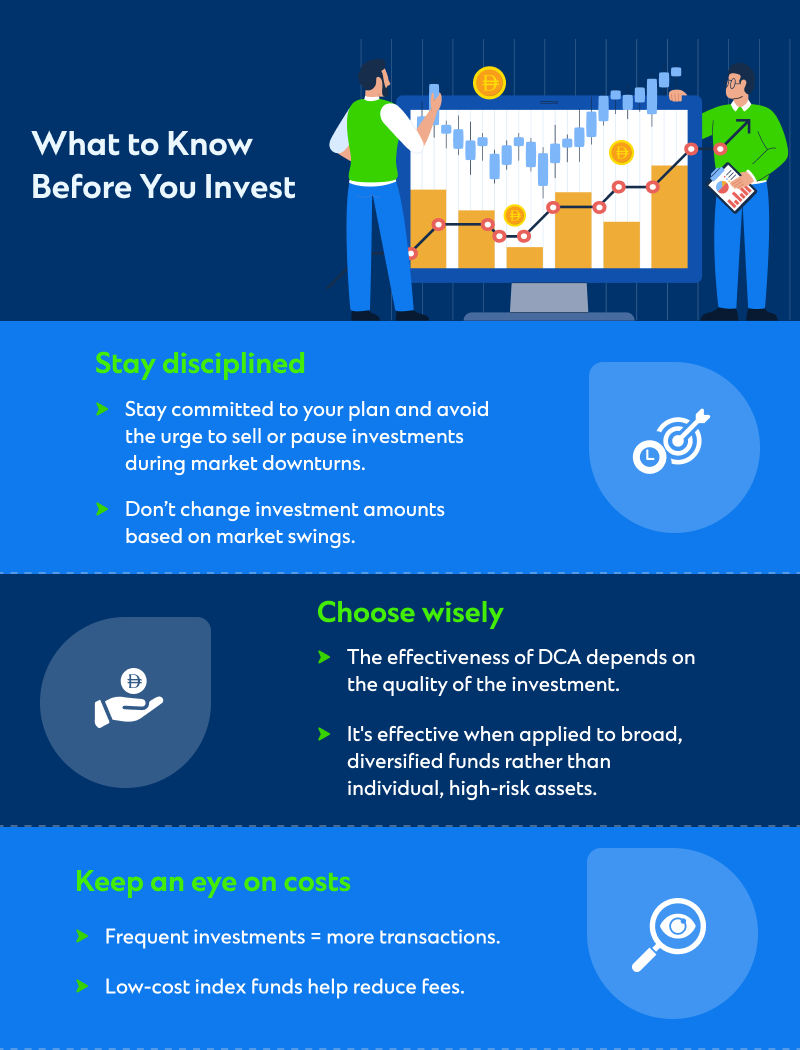
Investors who want to invest in stocks but aren’t sure when the right time is, can use the DCA approach, which helps by allowing them to invest a fixed amount on a weekly, monthly, or biweekly basis without worrying about market fluctuations or trying to predict dips. It may be tempting to pause investments during market downturns. Still, DCA usually delivers benefits such as averaging out the purchase price, removing the pitfalls of market timings, and reducing the impact of market volatility if contributions remain consistent.
How to do DCA effectively
Investors can utilise DCA to purchase Exchange-traded funds (ETFs) and individual shares. The strategy involves choosing a fixed amount and sticking to it, regardless of market performance. By committing to this approach, investors avoid making counterproductive decisions such as panic selling or buying when prices decline or rise.
Speak to your Standard Chartered relationship manager or contact us to learn more about the benefits of dollar cost averaging (DCA).