


Table of Contents
In a rush? Read the summary:
- Equity-linked notes (ELNs) combine bonds and equities. Investors can earn higher returns while preserving one’s principal.
- Returns typically depend on several things, including the participation rate, equity performance, and the issuer’s equity-linked note structure choices.
- Risks associated with equity-linked note investments may include market swings, principal loss, limited liquidity, and issuer default.
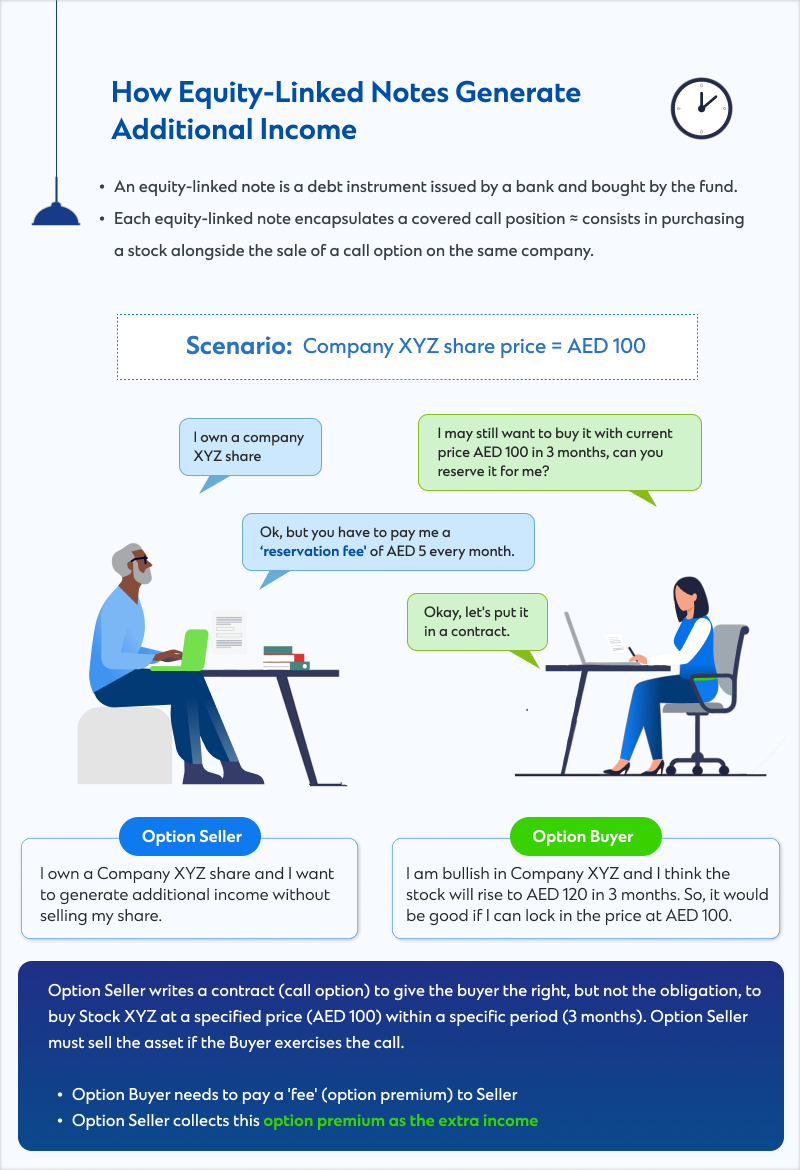
Just like bonds, an equity-linked note (ELN) is a debt instrument that pays returns based on the performance of a specific underlying asset. It’s a type of structured product popular among high-net-worth individuals (HNWIs) preferring local or global market exposure. Banks and other financial institutions issue ELNs with a set maturity date
What is an equity-linked note?
An ELN is capital-protected and usually comprises a zero-coupon bond that is paid upon maturity. It means the issuer issues a zero-coupon bond purchased at a discount that matures at its full-face value, securing the investor’s initial principal. However, it doesn’t offer a fixed interest rate during its life or at maturity. It’s a hybrid product that bridges the gap between stock market volatility and fixed income products. Once the product matures, investors receive the original principal with whatever the payoff is on the equity option.
How do equity-linked notes work?
An ELN typically consists of both bond components and equity options. The issuer can also allocate a portion of the ELN to purchase a zero-coupon bond to ensure a 100% principal return at maturity. The remaining capital is used to purchase equity derivatives (options).
Investors typically receive a portion of the profits if stocks do well. If the underlying assets underperform, only the principal is repaid. Many ELNs in the UAE market are designed to track regional benchmarks such as the Abu Dhabi Securities Exchange (ADX) and Dubai Financial Market (DFM), or international indices such as the S&P 500.
The issuer usually offers a participation rate that does not utilise a zero-coupon bond for complete capital protection. It defines the percentage of the underlying market growth that the investors are entitled to receive.
For example, if at maturity the underlying asset offers 10% returns while the participation rate is 80%, the investor receives 80% of 10%, that is 8% of the underlying equity options’ overall returns, along with the principal. However, investors may incur significant capital losses if the underlying equity declines in value at maturity.
Advantages of equity-linked notes
Risk-taking investors can benefit from equity-linked notes, especially compared to fixed-income securities
Earning better returns
Compared to traditional fixed-term deposit returns, ELNs offer higher returns with investments tied to underlying equities.
Lower risk
ELNs offer lower risk and the advantage of principal protection, as investors receive the principal in full if the issuer ensures it with a zero-coupon bond.
Structured term
Unlike fixed coupon notes (or FCNs), which are typically short-term investments (often 1–4 months), ELNs are typically medium-term investments (often 2 weeks – 1 year).
Flexibility
Investors interested in global market exposure while keeping their capital managed within the UAE can invest in ELNs.
Risk associated with equity-linked notes
- Principal risk: Instead of principal protection, some issuers offer returns based on the participation rate. Therefore, before investing, investors should consider whether the note is capital-protected under UAE marketing guidelines.
- Market risk: Market volatility often affects ELN returns, as the underlying equity determines final returns.
- Liquidity risk: Before investing, investors should keep in mind that early redemption often incurs penalties.
- Issuer default risk: Because these are unsecured debt instruments, investors can lose all or part of their invested capital if the issuing financial institution defaults, regardless of the performance of the underlying assets.
- Opportunity cost: Investors usually receive returns at maturity. Therefore, investors may miss potential gains from alternative investments during the tenure if the note redeems at principal.
Equity-linked notes are a wise choice for investors seeking higher returns than fixed-income security. At the same time, it can be a complex investment vehicle. Therefore, before investing, investors should understand the product’s features and the entire product, or they can reach out to a financial advisor for more information.
Speak to Standard Chartered’s relationship manager or contact us to learn more about equity-linked notes.