



Table of Contents
In a rush? Read this summary:
- Capital market reforms and growing demand for Shariah-compliant options are driving Exchange-Traded Fund (ETF) adoption across the Middle East and Africa.
- ETFs offer access to diverse asset classes, from global equities to commodities, while trading flexibly on UAE exchanges like Dubai Financial Market (DFM) and Abu Dhabi Securities Exchange (ADX).
- With high liquidity, daily transparency, and lower fees, ETFs are reshaping how investors engage with markets in a digital-first era.
According to a published industry report, the Middle East and Africa Exchange-Traded Funds (ETFs) market has already experienced rapid growth of USD 22.08 billion by May 2025 and is projected to reach USD 28.68 billion by 2030. This represents a steady 5.37 percent compound annual growth rate (CAGR). The growth is underpinned by the region’s rapid capital market reforms and investors’ rising appetite for Shariah-compliant investment products.
In today’s digital-first world, investors are inundated with information and investment options. With a multitude of investment vehicles available, even seasoned investors sometimes find themselves second-guessing their choices.
Remember, no single strategy fits all. However, ETFs, have emerged as a versatile solution that helps you reach your goal in a transparent and cost-effective manner.
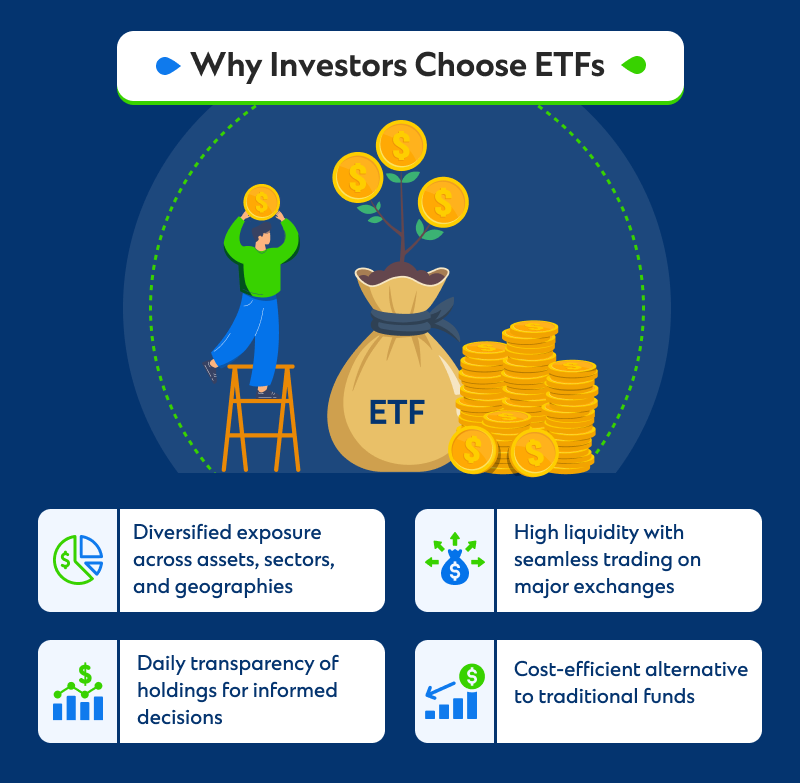
Understanding the benefits of ETF investments
An ETF holds a mix of assets, including bonds, stocks, and commodities , and is managed by the ETF manager. It’s an open-ended investment with no fixed maturity date. You can sell your shares at any time, depending on the market conditions. They are baskets of assets that track a wide range of indices, including both regional and global ones.
Investing in ETFs expands your portfolio with better diversification, transparency, and functionality. Let’s explore how.
The power of diversification in ETF investments
Investors usually diversify their portfolios across asset classes, sectors, and geographies to mitigate concentration risk and increase exposure to various good opportunities. This strategy ensures that if one asset class underperforms, another might thrive. This is how you can balance your portfolio and smooth out returns over time.
Diverse ETF investment opportunities
You can invest in ETFs in countless ways. Gain selective exposure to a subset of companies or broad exposure to an entire asset class. You can also target companies that focus on growth momentum and dividends. In short, ETFs offer you ample opportunities to construct a portfolio that aligns with your investment goals and risk tolerance.
Enhanced liquidity in ETFs
Liquidity refers to how quickly and effortlessly you can buy and sell assets without any significant price fluctuations. High liquidity means numerous buyers and sellers are available, indicating greater trading flexibility.
ETFs are considered liquid investments, as they can be traded throughout the day on major exchanges, such as the Dubai Financial Market (DFM) and the Abu Dhabi Securities Exchange (ADX). Additionally, ETFs gain a liquidity boost from the primary market, where new ETF funds are created and redeemed by authorised participants.
Flexible trading with ETFs
ETFs usually publish and update their holdings daily. Therefore, investors gain transparency by knowing what they own in real time and are equipped to make more informed investment decisions. Additionally, you can buy and sell ETF shares anytime during the trading day through your brokerage account at the prevailing market prices. On the contrary, mutual funds are traded once the market closes. You can submit a buy or sell order at any time, but it will be executed at the end of the day.
Investing in exchange-traded funds: Cost efficiency
While investment costs play a crucial role in long-term returns, ETFs usually have a lower expense ratio compared to traditional mutual funds. Most ETFs passively track an index. As a result, they involve less portfolio turnover and help minimise transaction costs.
Types of ETFs
- Global equity ETFs: Investors seeking international growth opportunities can invest in global equity ETF that offers diversified exposure to developed and emerging markets.
- Bond ETFs: These ETFs help investors to hedge against market volatility. They include corporate bonds, emerging market bonds, government bonds, or even a hybrid combination of all types.
- Commodity ETFs: They directly invest in diversified commodities, including gold, coffee, crude oil, etc., while other commodity ETFs may invest in specific commodity categories.
- Thematic ETFs: These ETFs target high-growth sectors like clean energy and artificial intelligence, allowing investors to capitalise on long-term global mega-trends.
- Shariah-compliant ETFs: These ETFs are aligned with Islamic investment principles, offering access to diversified, ethical equity baskets from global markets.
Risks to consider while investing in ETFs
It’s crucial for investors to remember that the past performance of any product is not an indicator of future results. The value of investments can fluctuate, so it’s important to be aware of the risk that you might not recover your original invested amount.
Many investors lean towards a long-term buy-and-hold strategy. For instance, if you’re aiming to add stability and recurring income to your portfolio, bond ETFs can be an efficient way to allocate a portion of your investments to fixed income.
However, the market is always shifting. While ETFs support long-term strategies, their liquidity and flexibility also enable you to make timely portfolio adjustments, potentially capitalising on short-term opportunities as they arise.
Speak to Standard Chartered’s relationship managers or contact us to find out how you can expand your investment strategy today.