


Table of Contents
In a rush? Read the summary:
- Hedge funds are privately managed alternative investment vehicles that pool capital from qualifying investors and typically aim to deliver strong returns regardless of broader market performance.
- Hedge funds can be classified depending on the strategies they use.
- Hedge funds are unregulated, and investors must meet minimum criteria to invest in them.
The United Arab Emirates (UAE) has positioned itself as a significant hub for global hedge funds, leveraging factors such as tax initiatives, regulatory reforms, and strategic talent initiatives to attract capital from traditional financial hubs such as London and New York. It’s a structural shift in the UAE, with assets under management (AUM) in the Dubai International Financial Centre surging by 58% by early 2024.
What is a hedge fund?
Hedge funds are investment vehicles that employ advanced strategies, such as derivative trading, leverage, and short selling, to outperform traditional market indices. A hedge fund pools money from qualifying investors, including institutional and accredited investors, and utilises the accumulated capital to invest across a variety of asset classes. It aims to generate higher returns by implementing various strategies, including short selling and derivative trading.
It can use a single strategy or multiple strategies to minimise risk, increase flexibility, and diversify the investor’s portfolio. Unlike exchange-traded funds (ETFs)and mutual funds, hedge funds offer more flexibility in investment choices.
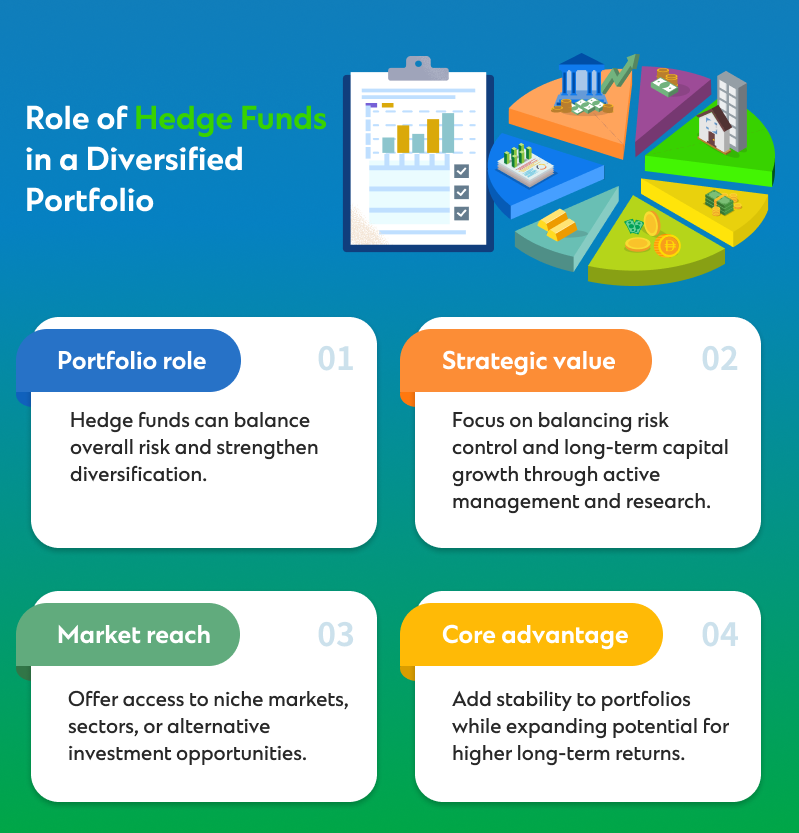
How do hedge funds work
Hedge funds usually actively seek out money-making opportunities.
- Significant events: Hedge funds take advantage of opportunities such as bankruptcies, mergers, or policy changes that can shift stock prices.
- Price gaps: It focuses on making profit by correcting minor pricing discrepancies between investments with similar term structures and cash flows.
- Long/Short equity: Hedge funds also create profits by selling overvalued stocks and simultaneously buying undervalued stocks.
- Microeconomic events: Events such as political actions and interest rate announcements also provide hedge funds with opportunities to make money.
- Market trends: Hedge funds use different strategies to benefit from both rising and falling markets.
Who can invest in hedge funds?
Due to their high-risk nature, hedge funds are restricted to qualified investors, such as institutional and accredited investors who meet specific minimum criteria.
Institutional investors are non-bank organisations that invest on behalf of clients such as pension funds. Accredited investors are high-net-worth individuals who are considered knowledgeable enough to understand the risks of hedge fund investment strategies.
Types of hedge funds in the UAE
Hedge funds in the UAE can be classified by the strategies they use.
Relative value funds
Relative value funds rely heavily on arbitrage. It’s the simultaneous purchase and sale of identical assets in different markets, while investors receive higher prices than they paid. Pure arbitrage is usually riskless and earns a profit.
Relative value arbitrage is a hedge fund strategy that always carries risk and never guarantees a profit. A hedge fund that engages in relative-value arbitrage typically seeks discrepancies in the prices of similar assets.
Directional funds
Directional and tactical investment methodologies are subject to some degree of market risk because they entail taking positions in stock markets. Hedge funds can ‘go short.’ As a result, unlike traditional portfolios designed to represent the market, directional strategies can profit from both falling and rising markets, which helps mitigate market risk.
A common mode of directional trading is referred to as fundamental growth and fundamental value funds. Here, the hedge funds determine stock value and look for stocks with high earnings relative to the overall market’s fundamental growth, or with an inappropriately low valuation relative to the market’s fundamental earnings.
Event-driven funds
These funds seek investment opportunities in corporate transactional events, such as liquidations, mergers and acquisitions, and bankruptcies. This strategy is to profit from incorrect market valuation before and after such events. Typically, hedge funds are interested in 3 general business event categories, including risk arbitrage, distressed securities, and exceptional situations.
While it is possible to buy debt instruments at a substantial discount, distressed securities hedge funds often have the expertise to support distressed companies and help prevent bank foreclosures. The debt price typically appreciates if the company regains viability.
create in the shares of the companies involved. Often, the target firm’s equity rises in value following the merger announcement, while the acquirer’s firm’s share price usually decreases.
Global macro funds
These funds can be considered a subtype of directional funds, seeking to trade with or against the overall market trend, whether from a microeconomic or global perspective.
Macro funds usually utilise the skills of microeconomists to model entire national economies and major sectors within them. Models analyse various variables, including government debt, monetary policy, currency value, employment levels, fiscal policy, and the balance of trade. The aim is to identify relevant misvaluations and predict how domestic and international events affect those variables.
Speak to Standard Chartered’s relationship manager or contact us to learn more about investing in hedge funds.