



Table of Contents
In a rush? Read this summary:
- Islamic mutual funds adhere to Shariah principles, avoiding industries deemed impermissible under Islamic law.
- These funds generate returns through capital appreciation, halal dividends, and profit-based income.
- Investors benefit from diversified portfolios across equities and Sukuk, with professional fund managers ensuring ethical, disciplined investment decisions.
A mutual fund is an investment vehicle in which money is pooled from multiple investors and invested across diversified assets, including bonds, stocks and commodities. It is recognised as a cost-effective and diversified way to invest in a range of securities. However, Islamic mutual funds are specifically designed to comply with Shariah law. These funds exclude investments in industries such as gambling, alcohol, and interest-driven banking, and focus on ethically sound companies.
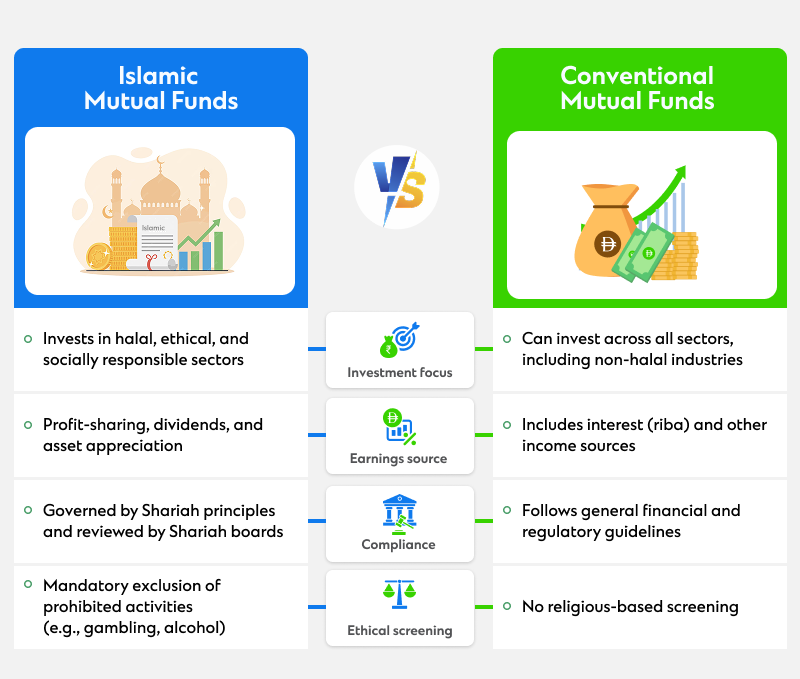
Islamic mutual funds: Key features
Investors looking for halal investment options can achieve their financial goals by investing in Shariah-compliant mutual funds. Unlike conventional mutual funds, Islamic mutual funds avoid investments in industries engaged in interest-based transactions, as Muslims are prohibited from earning interest (riba). Instead, the potential interest income is usually donated to charity.
Islamic mutual funds only invest in companies that engage in fully ethical businesses and avoid industries like alcohol, pork-related products, gambling, tobacco, etc.
Conventional mutual funds: Key advantages
- Diversification: Mutual Funds are ideal for investors who want to diversify their portfolio across various asset classes, geography, and sectors to reduce overall risk.
- Professional management: Expert fund managers evaluate markets and companies to build a well-balanced diversified portfolio, helping investors optimise performance and manage risk. Professional fund management also helps save time by eliminating the need to analyse the market and make informed investment decisions.
- Affordability: This investment tool is considered to be affordable, as one can start investing in mutual funds by setting up a Smart Savings Plan for as low as USD 200 (AED 735) per month.
- Liquidity: Investors can sell units at any time, ensuring easy access to cash. However, investors should keep in mind that liquidity often depends on the fund structure. One can choose funds based on a specific financial goal and create long-term wealth.
Shariah-compliant mutual funds: Key advantages
- Ethical investment: Islamic mutual funds, also known as halal mutual funds, prioritise ethical investments that avoid ventures that harm people or the environment. Investors who wish to ensure their investments align with principles of social responsibility often choose Shariah-compliant mutual funds.
- Diversification: these funds also diversify portfolios across different industries, enhancing potential returns and minimising market volatility risk. Since Islamic law prohibits excessive risk-taking, it also focuses on companies with low debt levels, ensuring stability.
- Sukuk investments: Sukuk, also known as Islamic bonds, are included in these funds that comply with Shariah law and offer profit-sharing based on underlying assets rather than interest-based income.
- Transparency: Regular audits ensure the fund’s operations are fully compliant with Shariah principles, offering investors transparency and confidence in their investments.
How do conventional mutual funds generate income
- Capital gains: Typically, when the market value of the assets (bonds , stocks and other underlying assets) held by a mutual fund increases, investors can benefit from capital gains.
- Asset selling: Mutual funds usually generate returns by selling assets in their portfolios at a price higher than their purchase cost.
- Dividend income: Mutual funds that hold stocks receive dividends from the companies in which it has invested. Investors often receive these dividends as income, or the mutual fund reinvests them to compound the investment’s value.
- Interest income: Mutual funds that hold traditional interest-bearing bonds generate income from interest payments, which are then distributed to investors or reinvested.
- Fixed-income securities: Bond funds usually generate income from the fixed-income securities held in their portfolios. These investment vehicles generate returns through interest income paid by corporations, the government or other entities.
- Derivative instruments: Some institutional mutual funds use derivatives, such as options and futures contracts, to enhance returns. These instruments can result in both profits and losses, introducing additional risks and complexities.
How do Shariah-compliant mutual funds generate income
- Capital appreciation: Investors seeking long-term capital appreciation can invest in compliant mutual funds that invest in companies that adhere to Shariah principles. Once the market value of the stocks increases, investors can achieve capital growth and generate returns over time.
- Profit-based income: Unlike conventional funds, Shariah-compliant mutual funds diversify their portfolios by investing in Sukuk, a financial instrument that generates returns through lease-based contracts (ijarah) or profit-sharing rather than interest payments.
- Dividend distribution: Islamic mutual Funds also invest in Shariah-compliant equities and distribute part of their profits as dividends. The capital can also be reinvested in the portfolio to increase the potential value over time. The dividend distributions are strictly derived from halal sources of business activities, ensuring full compliance with Shariah investment laws.
Signature CIO Islamic funds
Standard Chartered’s Signature CIO Islamic Fund is designed for investors seeking consistent income and long-term growth.
- The fund targets a steady payout, offering a yield of around 6% distributed monthly.
- It seeks to generate income through a diverse investment approach with flexibility across asset classes.
With a higher allocation to equities, the fund is positioned for potential capital growth over time; however, it carries a higher risk-return profile and may be more sensitive to market fluctuations.
Speak to your Standard Chartered relationship manager or contact us to learn more about investing in Shariah compliant mutual funds in the UAE.