


Table of Contents
In a rush? Read the summary:
- Life insurance provides immediate liquidity to beneficiaries, which is critical in the UAE, where bank accounts and assets are often frozen during the legal succession process.
- The proceeds ensure that families can settle mortgages, business loans, or foreign tax liabilities without being forced to sell illiquid family assets, such as real estate or businesses.
- It facilitates a fair distribution of wealth by providing cash payouts to certain heirs, allowing strategic assets (like a family company) to remain intact with a single successor without creating family disputes.
Life insurance plays a vital role in succession planning and asset transfer, providing peace of mind and creating a secure financial environment for individuals and families. It serves as a tool that eases procedural bottlenecks, provides liquidity, and supports equitable settlement of debts and inheritance outcomes. In the UAE, Wealth transfer or estate planning is based on two hybrid frameworks: civil law regimes for non-Muslims and Shariah-based inheritance principles.
Life insurance as an investment
Life insurance is a contract that offers death benefits to the beneficiaries nominated by the insured upon the insured’s death. Two types of insurance policies in the UAE are term and permanent life insurance.
Term life insurance provides a death benefit if the insured dies within a specified term, while permanent life insurance provides lifetime coverage. Certain permanent life insurance policies may accumulate a cash value over time.
Life insurance benefits in succession planning
Hedge funds usually actively seek out money-making opportunities.
- Immediate liquidation: The sudden death of the insured can freeze bank accounts. It can also cause delays in transferring properties or shares. In that case, a life insurance policy pays beneficiaries, subject to documentation requirements. It helps family members cover debts,
living expenses, funeral costs, and other expenses. - Support without delay: While estates can be tied up in court proceedings, delays in insurance proceeds mean beneficiaries receive timely financial support.
- Equalising inheritance: Estate planning usually involves individual assets, such as a piece of property or family business. Insurance helps equalise inheritance among children, avoiding disputes and preserving strategic assets rather than forcing a split or sale.
- Foreign taxes: If an individual’s assets are exposed to overseas or inheritance taxes in the UK or the US, insurance helps meet the obligations without triggering forced asset sales. Proceeds help settle business loans and mortgages while preserving net value.
- Succession planning: Insurance can help business owners involved in a buy-sell agreement: in the event of a partner’s death, the other partner can purchase the deceased partner’s share of the business and insurance funds these buy-sell agreements, ensuring liquidity for completing the buy-out process.
Selecting the right policy for wealth transfer
- Term insurance: It offers 10, 20 or 30 years coverage at lower premiums. Individuals with time-bound needs usually prefer this insurance.
- Whole life: Individuals with a goal of long-term preservation and optimisation typically prefer whole life insurance as it offers lifetime coverage with cash value.
- Universal life: This offers flexible premium benefits with an accumulation component combining growth and protection.
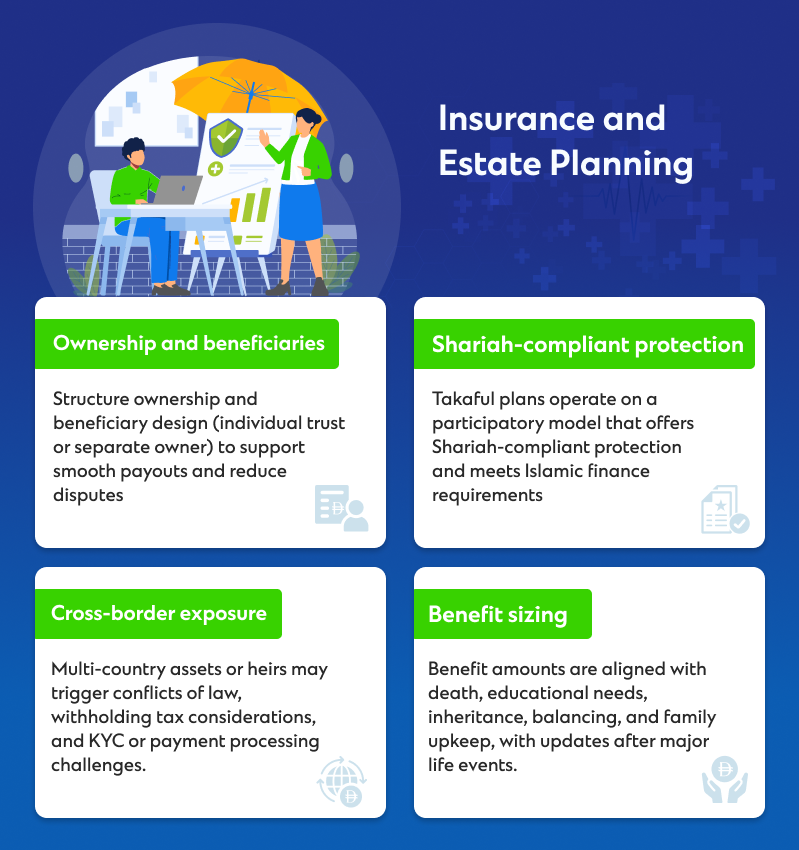
Incorporating life insurance into estate planning
- Evaluating financial goals: Individuals can determine their priorities, including wealth preservation, business continuity, and debt coverage, before choosing a life insurance plan.
- Choosing the right policy: Depending on the financial goal and long-term objectives, one can choose a life insurance policy.
- Naming beneficiaries: To ensure smooth distribution of proceeds without any discrepancies or complications, naming beneficiaries carefully is necessary.
- Reviewing the plan: If life circumstances change, individuals can revisit their estate plan periodically to make necessary adjustments.
- Professional support: UAE regulations and succession frameworks may require specialist input for effective structuring.
Speak to Standard Chartered’s relationship manager or contact us to learn more about how life insurance can help support your wealth transfer plans.