


Table of Contents
In a rush? Read this summary:
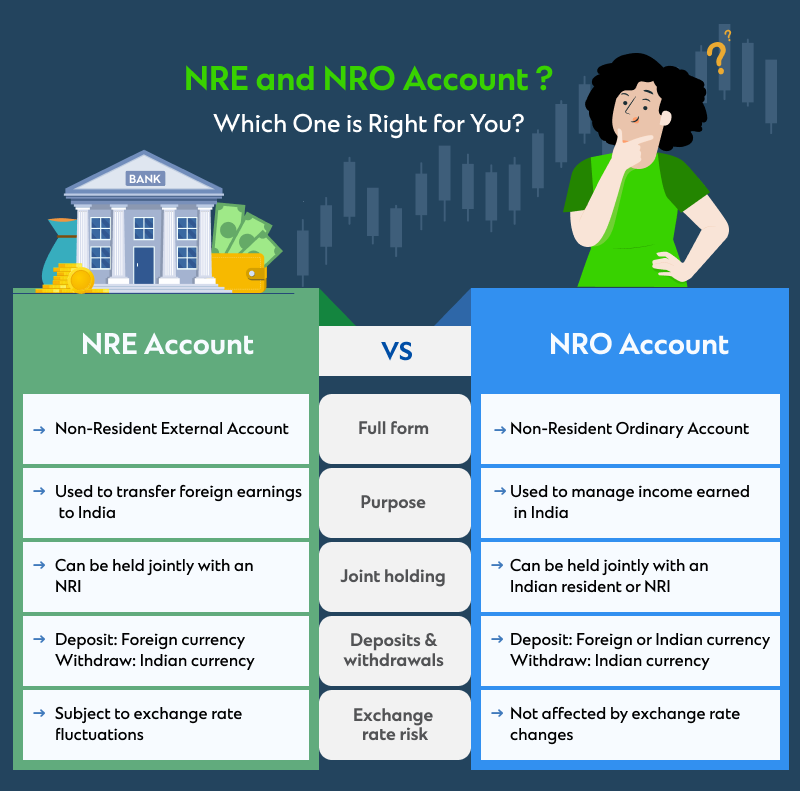
- One can use an NRE (Non-Resident External) account to deposit and manage foreign earnings remitted to India.
- The NRO (Non-Resident Ordinary) account is used to manage income earned in India.
- The NRE account is ideal for salary or foreign business income. In contrast, the NRO account is suitable for Indian-sourced income, such as rental income, and can be held jointly with a resident relative.
NRE and NRO accounts are two different types of bank accounts that can be accessed by non-resident Indians (NRIs). While an NRE account helps manage foreign earnings in India with full tax exemptions, an NRO account is for managing taxable income earned within India. By comprehending the difference between NRE and NRO accounts, investors can make informed choices regarding taxation, joint ownership, and repatriation.
What is an NRE account?
NRIs who want to remit and manage their income earned abroad while keeping their finances linked to India can use an NRE account. The foreign currency deposited in an NRE account is mandatorily converted into Indian Rupees upon deposit. There are no external currency restrictions for transferring the funds to or from an NRE account. Furthermore, the principal funds and the interest earned are fully repatriable in the foreign currency.
What is an NRO account?
NRIs can manage their income earned in India through a bank account that includes dividends, business earnings, and rental income in Indian rupees. While an NRO bank account can receive both Indian rupee deposits and foreign currency credits, the repatriation of the accumulated funds is subject to certain limits. This bank account is ideal for NRIs who want to manage income earned in India and also handle expenses there.
Similarities between NRE and NRO accounts
Both accounts are rupee-dominated, and one can open either a current or savings account, depending on their needs. NRIs must maintain the minimum average balance (or MAB) as specified by their particular bank for both these accounts. This balance amount varies widely across banks and account types.
NRIs can manage their finances in India securely with these two types of bank accounts, which provide easy access to a range of banking services, including Internet banking, fund transfers, deposits, and withdrawals within India.
NRE vs NRO account: Which one is right for you?
Depending on the source of income, one can choose between an NRE and an NRO account. NRIs should consider how they plan to use these funds.
- An NRE account is ideal for those who remit income earned abroad, such as salary or business income, to be held in India. NRIs who want to send money overseas without restrictions can utilise their tax-free income in India, as it’s free from repatriation of both interest and principal.
- An NRO account is ideal for those who want to hold an account jointly with a resident relative, making it suitable for managing family-linked finance. This bank account is ideal for users whose income is sourced in India, including dividends, pensions, rent, and other domestic sources. Remember that the interest earned is taxable, and repatriation of principal is subject to prevailing tax regulations and limited to USD 1 million per year, with documentation required.
When it comes to choosing between an NRE or NRO account, this will come in handy: an NRO account can be used to handle income for Indians and an NRE account can be used to managed foreign income. Many UAE-based NRIs use both these accounts to manage finances seamlessly across borders. Usually, an NRE account is used for salary, while an NRO account is used for rental income. By understanding the differences between these two accounts, one can ensure compliance with FEMA to manage cross-border finances effortlessly.
FEMA investment guidelines
FEMA regulations impact NRIs and their financial transactions in India and with foreign countries. Theinvestments are categorised into two different categories: permitted and prohibited.
Permitted investments
- Through the Portfolio Investment Scheme (PIS), one can do direct equity investment. Mutual fund investments, including equity and debt schemes, IPOs and rights issues, Government Securities, and corporate bonds, are also permitted.
- Residential property investments, plots for construction, and commercial property investments are also permitted.
- LLP and private limited companies, foreign direct investments in permitted sectors, and partnership firms are also permitted.
Prohibited investments
Small savings schemes, including private provident funds, Kisan Vikas Patra, National Savings Certificates, and post office deposits, are prohibited.
Acquiring agricultural land from houses and plantation properties is restricted. Although if one acquires agricultural land through inheritance, there is no restriction.
Certain business activities, like Nidhi companies, chit fund businesses, and real estate trading without development, are also prohibited.
Speak to Standard Chartered’s relationship manager or contact us to learn more about opening an NRE or NRO account.