



Table of Contents
In a rush? Read the summary:
- Bonds provide stable, predictable income through fixed interest payments, whereas structured notes offer variable returns linked to the performance of underlying assets like indices or commodities.
- Bonds are generally lower-risk instruments focused on capital preservation. Structured notes are complex hybrids that can offer higher yields and market participation.
- While bonds follow standardised terms set by the issuer, structured notes are highly customisable and can be tailored to an investor’s specific market views and risk tolerance.
In the world of finance, both traditional bonds and structured products, such as structured notes, are popular investment vehicles for asset managers looking to expand their financial strategies and increase assets under management (AUM). These two investment vehicles differ significantly in terms of risk structure and return potential.
What are traditional bonds?
Bonds are relatively low-risk investment vehicles compared to stocks, offering stability to an investor’s portfolio. Governments raise funds by issuing bonds to investors, typically offering periodic interest payments. On the other hand, investors who lend money for a fixed period receive a coupon, or stable income, for the duration of the term.
Types of bonds
In the UAE, bonds are commonly issued by governments and corporations.
- Corporate bonds : These bonds are issued by companies for the purpose of expansion.
- Government bonds: These are issued by the government to fund areas such as schools, defence, and roads.
What are structured notes
Structured notes are hybrid financial instruments that combine the features of a traditional bond with a derivative. It’s a pre-packaged investment strategy that allows investors to customise their payouts. Essentially, a financial institution issues a debt obligation. Instead of paying a fixed interest rate, investors receive returns based on the performance of underlying assets, such as a global index like the S&P 500, commodities like gold, a specific stock, or foreign currencies. It can generate higher yields than bank deposits and protect the initial capital invested against market downturns.
Types of structured notes
Structured notes are available in multiple variations with differing payoff structures. Three types of structured notes are highly popular.
- Reverse convertibles: These are high-coupon notes that usually pay a higher coupon rate than standard bonds, regardless of market performance, provided the underlying asset stays above a predefined barrier.
- Autocallables: These notes have predefined observation dates on which early redemption conditions are assessed. If conditions are met, investors may receive their capital along with a predefined coupon.
- Participation notes: Investors can participate in the upside of an underlying asset. These notes also help reduce the fear of a volatile market by offering investors a degree of capital protection.
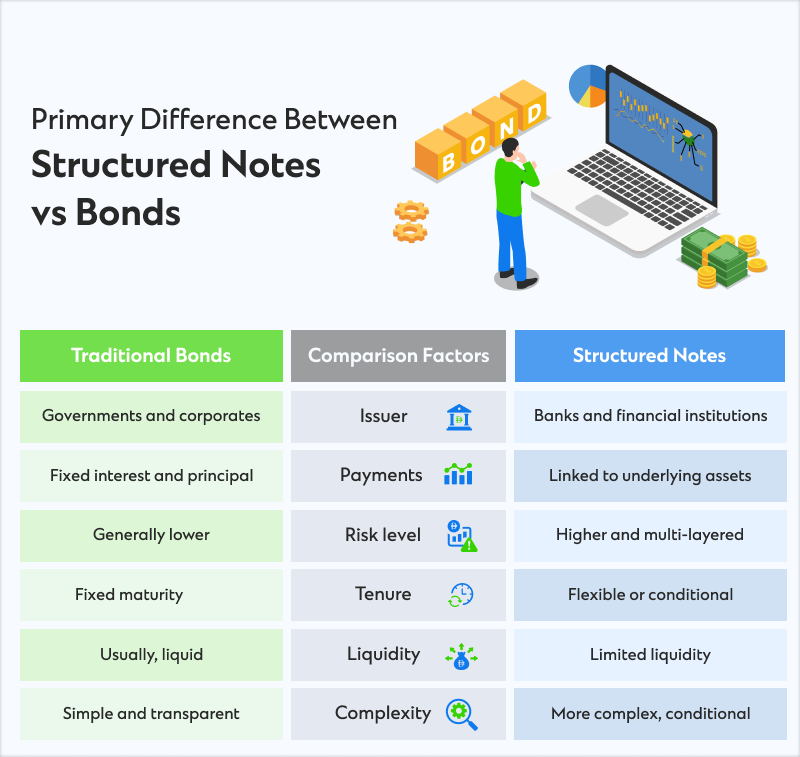
Choosing between structured notes vs bonds
Portfolio managers must understand the difference between structured notes and bonds before selecting a financial instrument. Each has its own unique characteristics and risk levels. Choosing one depends on an investor’s financial goal, investment strategy, time horizon, and risk tolerance, as each financial instrument offers different benefits.
- Nature of investment: Structured notes deliver returns linked to the performance of underlying assets. On the other hand, risk-averse investors usually prefer bonds, as these financial instruments offer both interest earnings and periodic coupon payments. The principal amount is also repaid to the investor at maturity.
- Risk and return profile: Structured notes also offer variable returns depending on the asset performance. One type of note differs from the other, and investors can receive interest payments, dividend earnings, coupons, etc. On the other hand, bonds usually offer fixed rates of return.
- Customisation: Structured notes can be customised based on an investor’s risk tolerance, payout structures, and market views, while bonds cannot be customised, as they follow standardised terms set by issuers.
- Market usage: Seasoned investors who are typically comfortable with conditional outcomes prefer structured notes, while income-focused investors usually prefer bonds.
- Risk exposure: While structured notes carry both market downside risk and issuer credit risk, bonds usually carry only issuer credit risk.
- Regulatory oversight: Depending on the jurisdiction and issue structure, notes may vary, while bonds are subject to strict regulatory frameworks.
Structured notes are usually complex financial products that combine debt with derivative components, while bonds are simple investment options that usually protect capital and offer stable, predictable returns.
Speak to Standard Chartered’s relationship manager or contact us to learn more about structured notes and bonds.