



Table of Contents
In a rush? Read this summary:
- Portfolio rebalancing is the process of realigning an investment portfolio with an individual’s risk tolerance and financial goals.
- Investors can use time-based rebalancing or threshold-based rebalancing to maintain their target allocation.
- The process encourages a systematic approach to investing that evolves with the user’s life stages and changing goals.
Portfolio rebalancing is an essential exercise for investors who want to align their portfolio with their risk appetite and investment goals amid a changing economic environment. It’s an evaluation process where investors identify the right opportunities and adjust asset allocations by selling overweight assets and reinvesting the proceeds into underweight categories based on their investment horizon, risk tolerance and financial goals.
How does portfolio rebalancing work?
Portfolio rebalancing helps investors maintain the desired level of risk and return by adjusting the asset allocation from time to time.
For example, investors in their 20s and 30s often prefer a more aggressive approach to investing and allocating a higher percentage to riskier assets. On the other hand, the financial landscape invariably shifts for investors in their 40s and 50s. These decades often come with the highest level of income and increasing financial obligations. While investors in their late 50s prefer to maintain their growth potential through an appropriate allocation to equities, their portfolio may gradually shift towards more stable, income-generating options.
Portfolio rebalancing is an act of adjusting the weights of asset classes in an investment portfolio. For example, an investor allocates 50:50 to fixed income and equity. If the equity share rises from 50% to 70%, the investor can sell some equities to buy bonds and return to the 50:50 allocation. This helps the investor keep the risk level and investment strategy on track.
When is the portfolio rebalancing required?
Investors who are unsure of the optimal time to rebalance their portfolio can consider these two simple ways to approach portfolio rebalancing.
- Time-based rebalancing: Investors can rebalance their portfolio at fixed intervals regardless of market conditions. It can be monthly, annually, or semiannually.
- Threshold-based rebalancing: Investors can review and rebalance their portfolio whenever an asset class deviates significantly from its target allocation. For example, if an asset class deviates by a predetermined proportion, such as +/- 5%, the investor can initiate portfolio rebalancing.
Rebalancing one’s portfolio once or twice a year can help prevent the portfolio value from becoming extremely volatile.
Over time, investors can adjust asset allocations based on market performance and asset values. Before making any changes, look at your financial goals. Big life decisions such as buying a house, planning a retirement at a certain age, or paying for children’s tuition often necessitate a shift in asset allocation. If the current asset class allocation does not meet the goal, investors can consider rebalancing their portfolio.
Additionally, it’s good to consider risk tolerance and the time horizon for saving and investing before making any changes.
Investment portfolio management: A systematic approach
Some investors may find portfolio rebalancing a daunting task, especially if they do not understand the rebalancing process and are inexperienced with investment tools. However, with the right knowledge and guidance, they can learn how to bring their portfolio back on track.
Establish a target allocation
Investors may expect different returns depending on their investment and financial objectives and risk tolerance. Therefore, identifying the monetary goal and aligning asset allocation accordingly should be the optimal priority.
For example, investors with higher risk appetites can have a higher allocation to the equity segment, whereas those with lower risk appetites can opt for a more conservative allocation.
Evaluate the portfolio’s current standing
Investors can classify their portfolio investments depending on the major asset classes. Converting each asset’s total value into a ratio will help evaluate its allocation against the target. Doing this will help them understand how their investment portfolio should be rebalanced.
Adjust asset allocation
Next, investors can focus on buying and selling some assets. For example, an investor with a current asset allocation of 80% stocks and 20% bonds is looking to allocate 60% to stocks, and 40% to bonds can redeem their stocks and invest more in bonds.
Track the investment portfolio
Depending on various market movements, one can track investments after completing the portfolio rebalancing. During the periodic review, one can rebalance the portfolio based on requirements. The portfolio rebalancing interval depends on an investor’s investment preferences, including monthly, quarterly, semiannual, and annual.
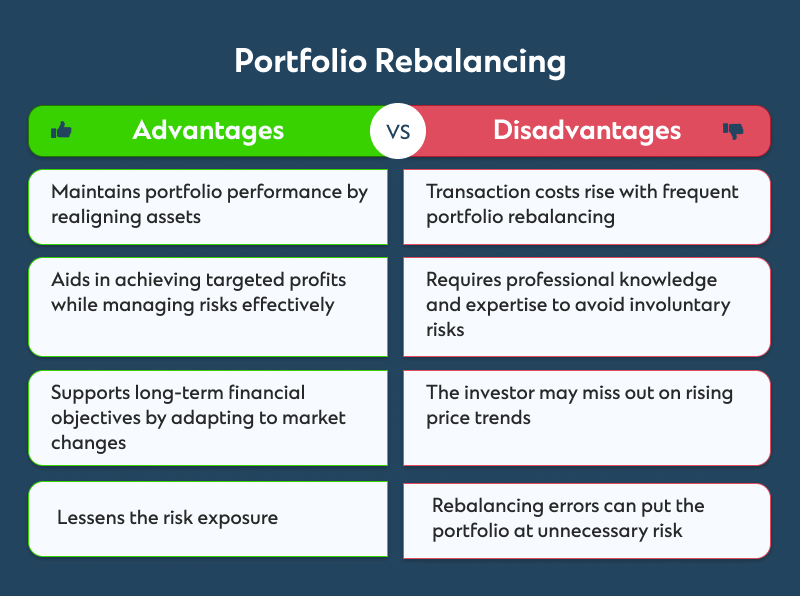
Portfolio rebalancing helps manage risk while assets offer stable performance. Ultimately, rebalancing instils a disciplined investment approach, helping to mitigate emotional decision-making during periods of market volatility.
Speak to Standard Chartered’s relationship manager or contact us to learn more about portfolio rebalancing.