In a rush? Read this summary:
– The UAE has positioned itself as an international crypto hub, with a structured regulatory framework implemented by various authorities, including VARA (Virtual Assets Regulatory Authority) & CMA (Capital Markets Authority).
– Different types of crypto trading options are available in the UAE including spot trading, derivatives and futures, and OTC (Over-the counter) trading.
– There is significant growth potential in the market; however, investors should be aware of the high volatility nature and the complexities associated with cryptocurrency investment risks.
The United Arab Emirates (UAE) witnessed over US $30 billion in crypto investments between July 2023 and June 2024, as reported by ArabianBusiness. In 2025, the UAE ranked among the top 5 countries globally for crypto friendliness.
Through strategic leadership in regulation and innovation, the UAE is actively shaping its economic trajectory. The country’s forward-thinking approach, zero personal income tax, streamlined business licensing process, and no capital gains tax on crypto profits make it one of the most attractive markets for crypto investment.
What is crypto trading?
Compared to other core financial markets, the cryptocurrency market operates differently. The market functions within a decentralised digital currency network. Each currency is generated through a peer-to-peer transaction verification system rather than relying on a central server. When users buy and sell cryptocurrencies, those transactions are added to the blockchain. This shared digital ledger records data through a process known as consensus or mining.
Due to their extremely volatile nature, investors need to stay informed about current events that may impact the cryptocurrency market, including initial coin offerings (ICOs), cryptocurrency forks, and government regulations, before engaging in crypto trading.
How to start trading crypto
Multiple options to begin trading crypto are available in the UAE and investors can choose depending on their experience.
– Spot trading: This is one of the most popular crypto trading options in the UAE that is offered by licensed exchanges, allowing investors to buy and sell cryptocurrencies directly.
– Derivatives and futures: Experienced investors usually prefer this option for crypto trading, using advanced licensed trading platforms available to retail customers regulated by VARA. It may include leverage and perpetual contracts. Leverage for eligible participants is kept within local regulatory limits to help manage risk.
– OTC trading: This is used for large-volume transactions and is preferred by high-net-worth individuals and institutional investors. Traders usually use over-the-counter (OTC) trading desks based in the UAE, where transactions are executed privately, while settlements are commonly available in AED, USD, USDC, and USDT. The conversions are straightforward and processed in the same way as international currency transfers.
Who regulates cryptocurrency trading in the UAE
The regulatory landscape includes key authorities across various jurisdictions. They are as follows:
Mainland UAE (Excluding Free Zones):
– CMA: Capital Markets Authority enforces federal supervision and harmonization throughout the UAE, and no individual may engage in virtual asset activities in the onshore UAE, according to Federal Cabinet Decision number 111 of 2022, unless they have permission and a license from the CMA or a separate local licensing body.
– CBUAE: The central bank of UAE oversees the use of virtual assets as a means of payment, specifically focusing on stablecoins, payment tokens, and their integration into the traditional financial system.
Emirate of Dubai:
– VARA: The Virtual Assets Regulatory Authority serves as the central regulatory body for Dubai’s crypto ecosystem and issues licenses to Virtual Asset Service Providers (VASPs) and monitors changing rules as circumstances evolve and market activity to avoid manipulation.
Freezones:
– DFSA: The Dubai Financial Services Authority located in DIFC (Dubai International Financial Centre), an independent framework, has its own separate legal framework built on English common law. It attracts companies that cater to international customers and individuals seeking common law-based rules.
– FSRA: The Financial Services Regulatory Authority located in ADGM (Abu Dhabi Global
Markets) is the regulator in Abu Dhabi’s freezone responsible for overseeing virtual assets, focusing particularly on institutional custody, asset management, and trading platforms.
License for Crypto Trading*
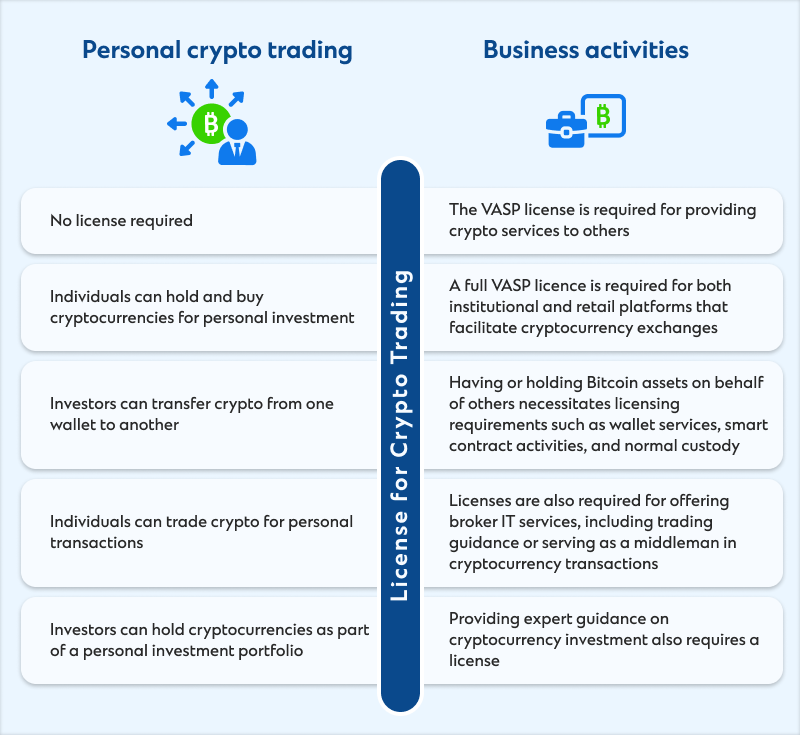
*VASP: Virtual Asset Service Provider
Risk management in crypto trading
Round-the-clock volatility
Unlike traditional stock markets, crypto markets trade 24 hours a day, 7 days a week. Consequently, price movements can occur when an investor is away from the screen. This is known to be one of the primary cryptocurrency risks, as significant market shifts can happen at any time.
Price movements
A regulatory announcement from a major economy or a simple technical issue with a broken network can shift cryptocurrency prices dramatically within minutes or hours. Understanding this risk before investing is essential.
Gains and losses
CFD (contract for difference) trading is a practice of speculating whether an asset price will rise or fall without owing to the asset. The underlying assets include commodities, shares, indices, and currencies. Traders can invest in both rising and falling markets. Once the market moves in the investors’ favour, it can magnify profits, while in the opposite situation, it can magnify losses. Even a 10% negative price movement on a leveraged position has the potential to wipe out an entire investment.
Market sentiment and cryptocurrency security
News about institutional adoption, technological developments, regulatory changes, or security breaches can have a significant influence on the cryptocurrency market, rapidly altering market sentiment, and driving substantial price movements.
Investors should plan trades before entering the market. Deciding the entry point and targeting the profit amount before entering the trade is one of the most effective risk management practices. Planning can be based on an individual’s objectives, risk tolerance, and financial goals. At the same time, before entering the market, investors should know when to exit if the market moves against them, when to take profit if it moves in their favor, and how much they are willing to risk.
It’s also important to choose the right provider to trade cryptocurrency in the UAE and invest through licensed, regulated platforms, and ensure they comply with applicable regulatory guidelines.
Start exploring cryptocurrencies easily and securely on the Standard Chartered Mobile app to explore our crypto trading capabilities or reach out to your Relationship Manager to learn how cryptocurrencies can complement your portfolio.
Disclaimer:
Standard Chartered Bank, UAE is licensed by the Virtual Assets Regulatory Authority (VARA) to facilitate the purchase and sale of virtual assets on behalf of its clients. Trading digital assets (cryptocurrencies) involves significant risk due to market volatility. The value of digital assets may fluctuate widely and you may incur losses. Rates shown above are indicative and provided for reference only. Execution at the displayed rate is not guaranteed. The final rate will be confirmed once your transaction is successfully completed. We do not provide financial, investment, or legal advice. You are responsible for your own trading decisions and should seek independent professional advice if required. Educational resources, including tutorials and FAQs are available to help you better understand digital asset trading, regardless of your level of experience. Clients are responsible for safeguarding their account credentials, including passwords and one-time authentication codes. We are not liable for losses resulting from unauthorised access due to client negligence. Our dedicated Client Care Centre is available to assist you via live chat, email, or telephone for prompt and reliable support.