Relevance in a world of tokenised and digital assets
How tokenisation is transforming financial institutions by enabling faster, more transparent, and accessible asset transactions.

The rapid emergence of tokenised assets is reshaping the global financial landscape, challenging institutions to rethink their role, their infrastructure, and their long-term strategic direction.
Tokenisation: Catalyst for opportunity, not disruption
The question often posed to financial institutions is whether tokenisation represents a threat to traditional banking. The answer depends on mindset. If institutions ignore it, the threat is real. But for those who embrace it, tokenisation becomes a compelling opportunity to modernise core services, unlock new markets, and create more efficient, resilient financial infrastructures.
Tokenisation enhances settlement speed, reduces operational friction, increases transparency, and expands investor accessibility. These benefits align closely with what banks already excel at, and they extend the value of trusted intermediation into the digital sphere.
Market projections strengthen this conviction. Standard Chartered’s Geoff Kendrick expects the market cap for tokenised real-world assets to reach USD2 trillion by the end of 2028. Industry research, including forward looking estimates from BCG and Ripple, suggests that USD18.9 trillion in assets could be tokenised by 2033, spanning everything from real world assets to money market funds and trade finance instruments. For banks, the question is not whether to participate but how quickly and effectively they can adapt.
Governance in a tokenised economy: A board-level imperative
The shift toward tokenisation extends far beyond technological innovation. It redefines corporate governance. Boards and independent directors must upgrade their understanding of digital asset risks and opportunities, recognising that fiduciary responsibility now plays out on decentralised infrastructures that operate continuously, globally, and programmatically.
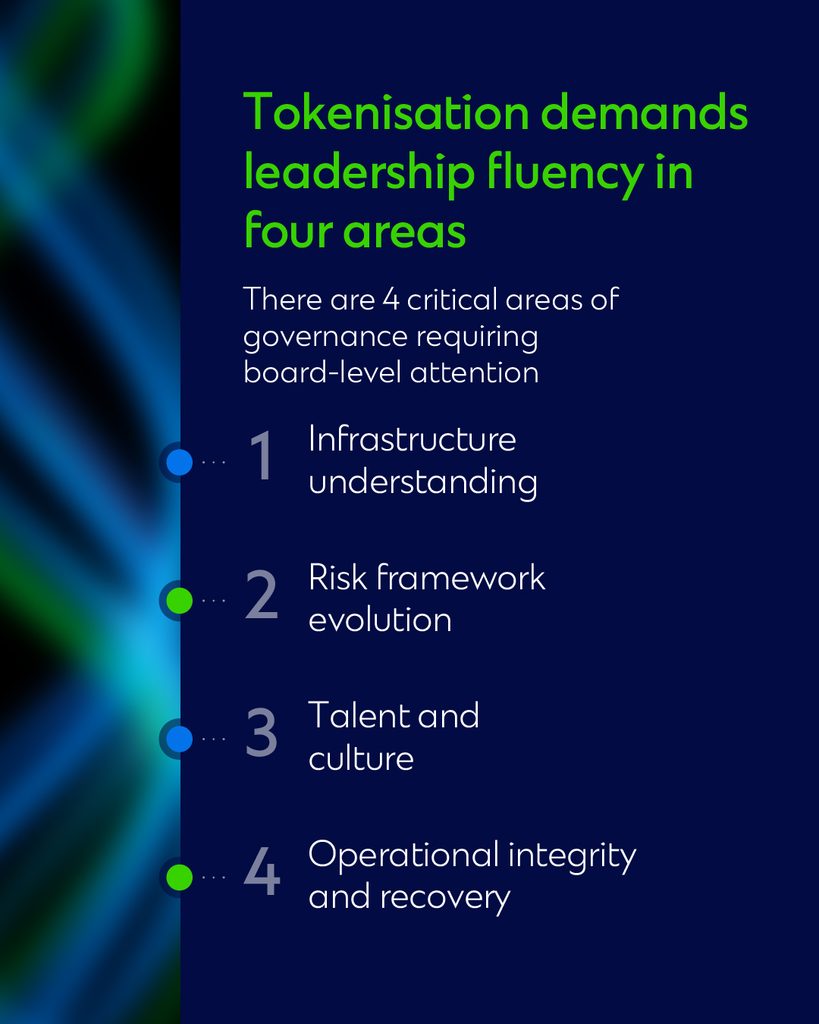
From a governance perspective, there are four critical areas requiring board‑level attention:
- Infrastructure understanding: Directors must understand the foundations of the blockchains, smart contracts, and digital custody systems on which their organisations will increasingly rely.
- Risk framework evolution: Traditional “control after the fact” models no longer suffice. Tokenised ecosystems require real-time oversight of cyber risk, operational resilience, third-party dependencies, and node level continuity.
- Talent and culture: Digital asset markets require new expertise; from cryptography to digital native compliance. Attracting and retaining talent, supported by a culture that encourages innovation, will differentiate leaders from laggards.
- Operational integrity and recovery: As internal guidance emphasises, key management, on‑chain settlement finality, and recovery frameworks are existential concerns. Institutions must maintain the same level of robust segregation, transparency, and risk management expected in traditional finance.
Boards that embrace these shifts proactively will position their institutions to lead in a tokenised future.
Success in a tokenised world: The path forward for financial institutions
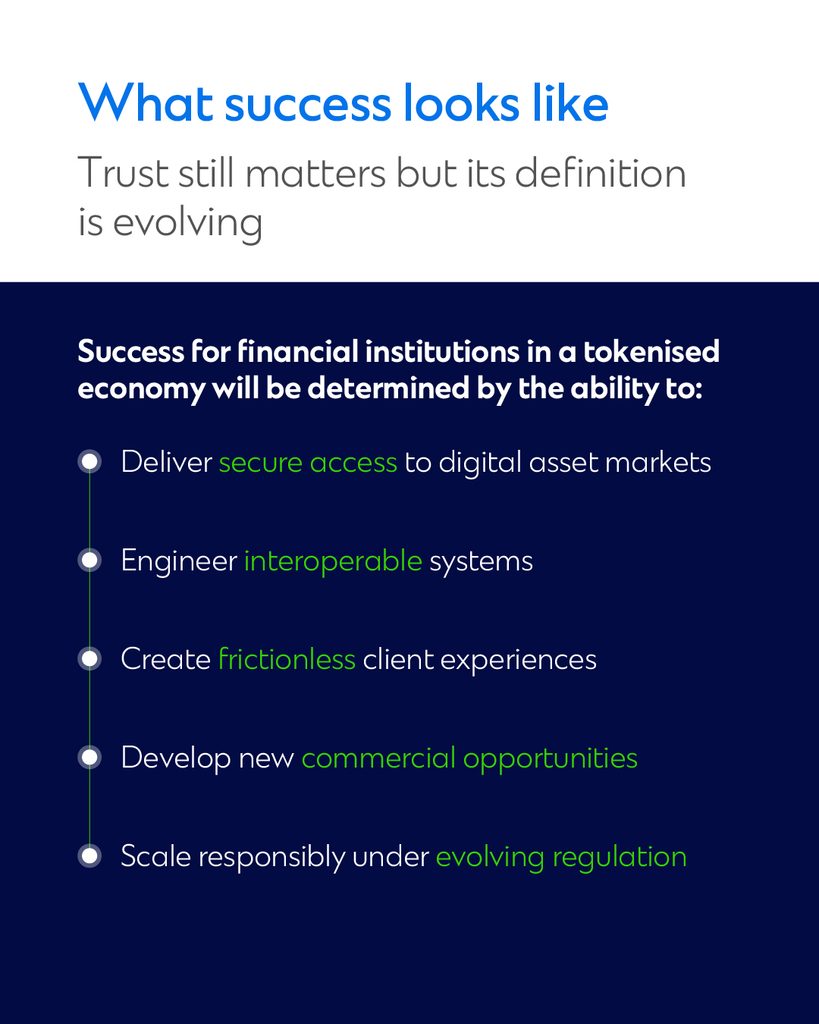
Success for banks in a tokenised economy will not be defined by technology alone. It will be measured by how effectively they maintain trust while navigating a digital paradigm. Trusted intermediaries remain essential but the definition of “trusted” is evolving to encompass the asset servicer’s capability to guide clients effectively through digital environments.
Success will be determined by the ability to:
- Deliver regulated, secure access to digital asset markets, ensuring continuity with established standards of investor protection.
- Engineer interoperable systems capable of connecting traditional and blockchain based infrastructures seamlessly.
- Create frictionless client experiences where digital and traditional asset services coexist cohesively.
- Develop new commercial opportunities, including tokenised collateral, tokenised securities, digital cash, and innovative liquidity models.
- Scale responsibly under evolving regulation, with Europe’s MiCA framework offering a strong early advantage. Other regions are stepping up efforts to move the agenda forward
Institutions that manage this transition thoughtfully will not merely survive but they will shape the next era of financial services. In this context, the Bank partnered with China Asset Management to launch a tokenized investment fund. The initiative enables on‑chain subscription, settlement, and fund administration for institutional investors, aiming to improve efficiency, transparency, and market access (notably in Hong Kong).
At Standard Chartered, this shift in the financial ecosystem is not viewed as a threat, but as a pivotal opportunity to reinforce our relevance in a digital native economy. Our conviction is clear: most financial transactions will ultimately settle onchain, and banks must position themselves across the entire digital asset value chain to remain indispensable.
This belief is far from theoretical. It is deeply embedded in the Group’s strategic approach, which recognises digital assets as an important and permanent part of the future of financial services, supported by consistent institutional client demand and by the rising focus of regulators globally.
This vision translates into a clear and mission defining role: Digital Asset Custody. As part of the Bank’s Financing and Securities Services business, this is not an experimental initiative; it is a strategic extension of our established custody offering, designed to meet rising institutional demand under a regulatory environment that is both supportive and rigorous.
A future built by the next generation
Ultimately, the future of finance will be built by the next generation of consumers, technologists, regulators, and industry leaders. Tokenisation is not an endpoint but an enabler.
If we want to be part of the future, we must participate in building it. The institutions that take this responsibility seriously by embracing innovation, strengthening governance, and committing to value creation will define their relevance for decades to come.
This article was originally published in Global Custodian.
Related insights
Stablecoins: What corporates and FIs need to know
Learn how stablecoins work, where they may support payments, treasury and liquidity, and what corporates and fin…