Agentic AI in Asset servicing: The operating model for scalable and trusted autonomy
Discover and explore how agentic AI can create new operational capacity and accelerate growth in asset servicing.

Understanding agentic AI: Foundations and emerging impact
As institutions look to unlock their next phase of growth, the question is no longer whether operations can keep up, but how they can scale intelligently.
Agentic AI represents a new operating model – moving beyond task automation and into autonomous execution with embedded governance. By enabling systems to reason, plan and act across multiple steps, agentic operating models create new operational capacity, allowing organisations to grow faster, respond more dynamically and redeploy human expertise to higher‑value decision-making.
In this model, growth is no longer constrained by the limits of legacy execution.
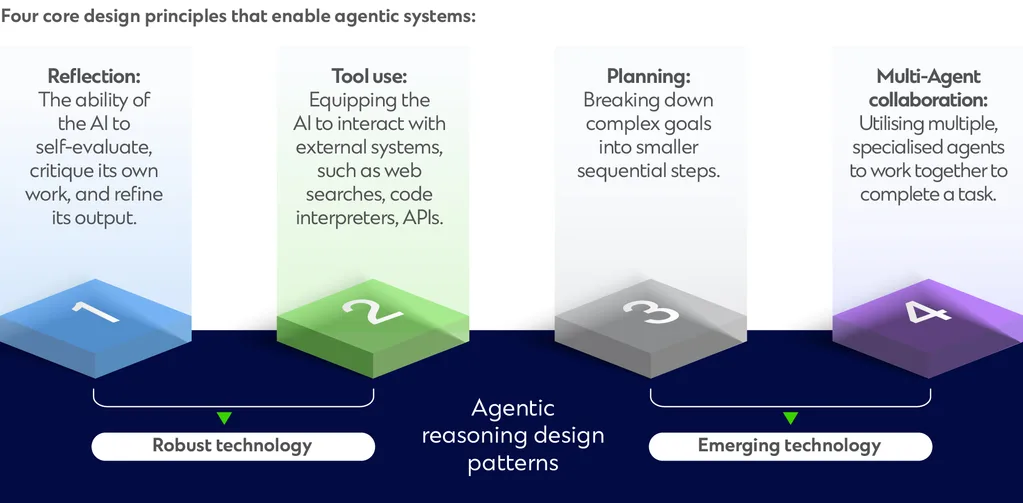
Four core design principles that enable agentic systems
Reframing automation: Integrating agentic AI into organisational structures
As we start to compare solutions to human intelligence more closely, we draw parallels between systems and processes, to human interactions and organisational structures.
For example, think about how a manager manages and directs a team of subordinates, such as operations officers. These operations officers have the autonomy to complete their tasks, but within a scope that is aligned to their skillsets and experience. Their day-to-day work is orchestrated and guided by the manager on a regular basis. The manager would step in when signoffs are required, when difficult issues arise, or when executive decisions are needed.
Agentic workflows follow the same logic. Execution is autonomous by default, supervision is embedded by design, and human intervention is deliberate rather than constant.
Crucially, this is not a replacement model. AI agents are designed to autonomously perform discrete, non‑trivial tasks, while humans continue to define objectives, set boundaries and exercise judgement where accountability matters.
Agentic AI – Future operating model impact
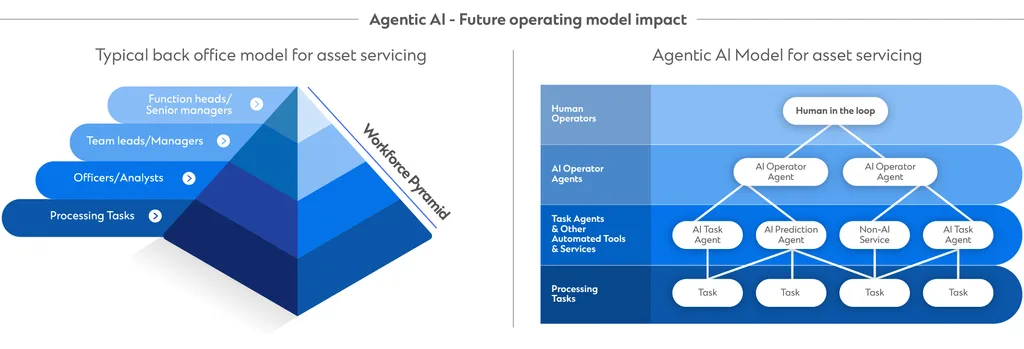
Agents, operators and humans: A layered model of autonomy
Let’s break down the AI agent model in more detail. Ideally, the lowest level AI agents are trained to perform a very specific task – not something so small that would still be handled by a traditional form of automation, but rather the smallest task that is complex enough to warrant AI usage. One level up would be an AI operator, responsible for orchestration, planning, tool selection and coordination across multiple agentic and non-agentic tasks. These operators embody the core features of agentic AI, which include making real-time decisions around how work is executed end-to-end.
The illustration below is an example of an agentic AI model for trade failure query management, where a client’s query about a failed trade is handled through coordinated AI agents with human oversight.
A client service manager (CSM) receives the query and routes it to the respective AI operator agents, which interprets the request and decomposes it into discrete tasks across specialised agents:
- Retrieving trade data and interpreting trade failure reason,
- Predicting related at‑risk trades based on the retrieved trade attributes such as currency, settlement account and settlement date and
- Drafting a client‑ready response. As the inputs of the task agents are sequential, the AI operator agents orchestrate and coordinate this flow across these task agents.
The final output from the AI operator agents would be a client-ready response containing the information and explanations required. The CSM remains the “human in the loop,” reviewing and refining the output before the final client communication. This is an example of how agentic AI augments operational efficiency while preserving accountability and client service quality in asset servicing operations.
Agentic AI workflow example for client service managers
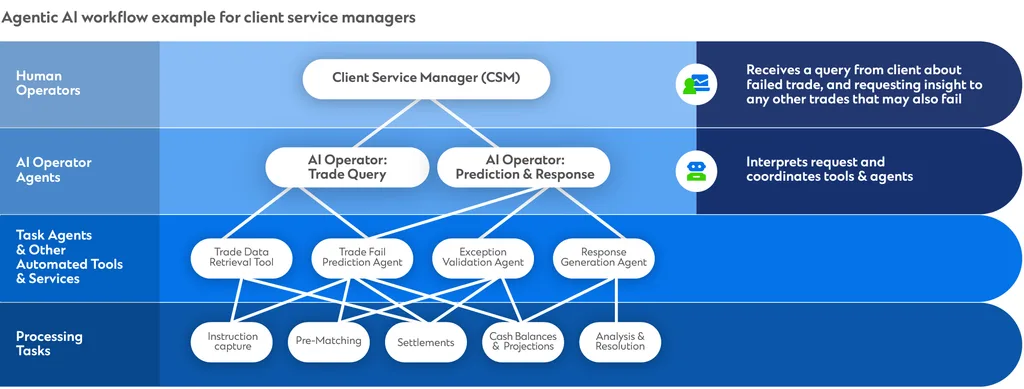
Humans remain embedded at the supervisory layer, providing oversight, escalation handling and decision‑making where judgement, accountability or sign‑off is required.
Some workflows may approach near‑full autonomy, while others retain frequent human interaction – a spectrum defined by risk, confidence and control requirements.
Transforming constraints into catalysts for innovation
The value of AI agents and operators is the ability to cut across jurisdictions or functions. In asset servicing, the two dimensions that limit scalability of technical builds are: (a) local market nuance; and (b) lack of cross-functional synergies.
Most asset servicers, especially those who are investing greatly in AI, are operating in multiple markets. While there are differences between markets in terms of processing, they are mostly driven by different data formats, varying accounting logic and distinct regulatory requirements.
This leads to a lack of fungibility across typical functions such as settlements, corporate actions, fund administration and others; yet many of the underlying processing tasks remain common, such as instruction capture, matching, reconciliations, transaction monitoring, payments, reporting and others.
AI agents can not only be trained to perform specific tasks but also perform them across market nuances and cross-functional requirements, and be orchestrated by AI operators, enabling human operators to extend their involvement across multiple locations and functions simultaneously and on a much larger scale than typical systems.
Agentic AI is not a future aspiration – it is an operating model that institutions can begin adopting today. The differentiator will not be access to models, but the ability to deploy them safely, integrate them into existing architectures and prepare the workforce to operate alongside them.
Institutions that get this right will move beyond incremental efficiency gains to create durable operational capacity – scaling growth, resilience and responsiveness in parallel. In an environment where execution is increasingly a competitive advantage, Agentic AI becomes not just a technology choice, but a strategic one.
Related insights
Stablecoins and the emergence of 24/7 capital markets
How interoperable digital money could help tokenised funds and securities move from isolated issuance projects t…