Understanding risk in restrictive markets
Learn how to measure, monitor and mitigate risk to make informed investment decisions in restrictive markets.

Restrictive markets can offer attractive opportunities, but they also require a more deliberate approach to capital allocation.
For some markets, direct investment is the right answer. Greater control, clearer economics and strategic importance may justify a larger capital commitment. In others, partnering with a local player can be more effective, providing local knowledge, regulatory familiarity, operating capability and an element of risk sharing.
The investment structure can be as important as the opportunity itself.
| Lower strategic importance | Higher strategic importance | |
| Lower country risk | Standard investment | Direct investment |
| Higher country risk | Higher return required | Structured approach: measure, monitor and mitigate |
Understanding country risk
Country risk, FX volatility, transfer restrictions, liquidity constraints and political uncertainty are often discussed qualitatively. A more robust approach is to quantify these risks and incorporate them directly into the cost of capital. Doing so provides a consistent basis for comparing opportunities across markets and assessing whether expected returns adequately compensate for the risks being taken.
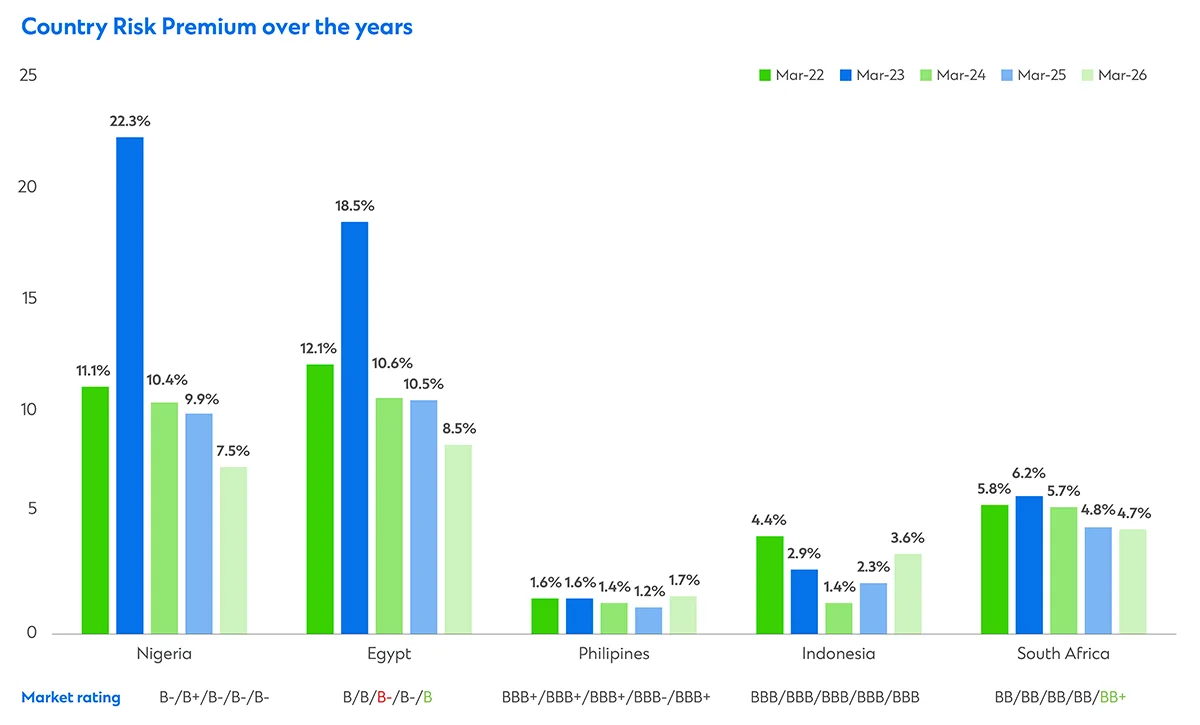
Once risks are identified, they can be monitored and, where appropriate, mitigated.
Market conditions rarely remain the same. Sovereign credit quality, exchange rates, external vulnerabilities and regulatory frameworks can change quickly. Companies entering restrictive markets should therefore treat risk management as an ongoing process rather than a one-off exercise. Early identification of changing conditions allows companies to reassess exposures before they become material.
Planning matters as much as analysis
Depending on the market, companies may need a toolkit spanning funding, liquidity, FX risk management and alternative investment structures. Higher risk does not necessarily make an investment unattractive. The question is whether the expected return adequately compensates for it.
Hedging solutions, funding diversification, local liquidity structures and alternative deployment models can all play an important role when conditions evolve.
| Measure | Monitor | Mitigate |
| Quantify country risk | Track changing conditions | Deploy funding and hedging tools |
| Incorporate into cost of capital | Monitor early warning indicators | Diversify funding |
| Assess investment structure | Reassess risk regularly | Adjust liquidity and plans |
Some of the most attractive opportunities may sit in restrictive markets. The question is whether they are properly reflected in expected returns, funding structures and ongoing monitoring.
Restrictive markets are home for Standard Chartered
For clients considering expansion into restrictive markets, Standard Chartered’s Capital Structure & Rating Advisory team can help assess market-specific risks before entry, understand their impact on cost of capital and evaluate different investment structures.
Combined with Standard Chartered’s local market presence, market-leading Global Research team, funding capabilities and risk management solutions, we can help clients understand markets before entry, transfer capital efficiently, implement mitigation frameworks and monitor changing conditions as they evolve.

Related insights
Turbulence ahead: Fuel shock deepens the returns challenge
A six-month stress test shows most airlines remain liquid, but weaker earnings and higher leverage may further s…