-
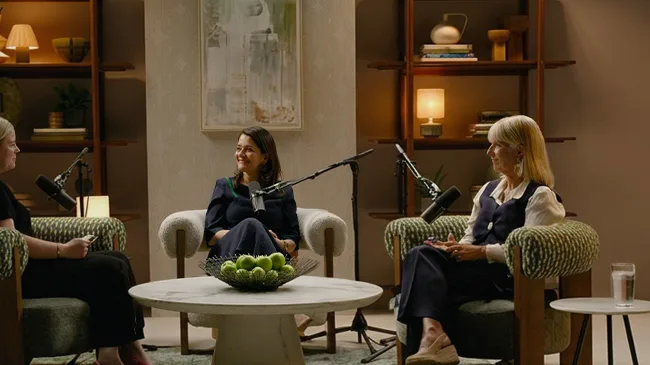
Studio Sessions
Corporate philanthropy: creating impact at scale
Discover how businesses can help address some of the world’s most complex challenges.

In the episode
- 2:38 – As aid budgets decline, businesses have an opportunity to help drive socioeconomic development.
- 5:25 – Corporates must look beyond grant giving and become conveners of internal and external partnerships to drive impact at scale.
- 16:40 – Corporate philanthropy should deliver a positive change for the communities it supports.
- 20:54 – Bringing diverse skills, expertise and perspectives onto a foundation’s board can lead to more impactful philanthropy.
Meet the guests

Tanuj Kapilashrami
Tanuj Kapilashrami is Group Chief Operating Officer of Standard Chartered and a Trustee of Standard Chartered Foundation. With more than 20 years’ experience in global financial services, she has held senior leadership roles across Asia, the Middle East and Europe. She is often featured in leading global media on a range of topics including culture, leadership, inclusion, and skills.

Clare Woodcraft
Clare Woodcraft is a Fellow at Cambridge Judge Business School and an internationally recognised expert in philanthropy. Former CEO of the Emirates Foundation and Deputy Director of Shell Foundation, she co-edited Catalytic Capital: Unleashing Philanthropy for Systems Change, exploring how to scale evidence-based social impact.
Corporate philanthropy has to make sense to your business and align to your purpose.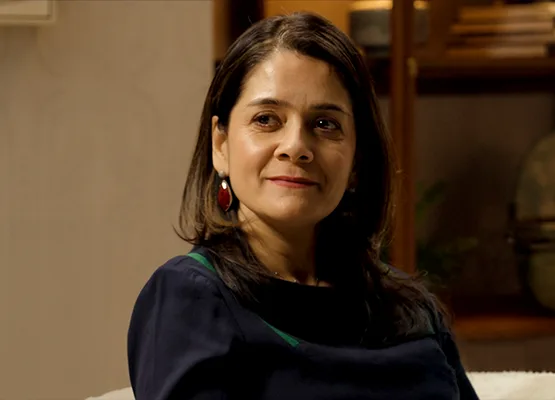 Tanuj KapilashramiGroup Chief Operating Officer and Trustee of Standard Chartered Foundation
Glossary of key terms
- ODA (Official development assistance) – Government aid provided to support the economic development and welfare of developing countries.
- OECD (Organisation for Economic Cooperation and Development) – An international organisation that works with governments to develop policies aimed at improving economic and social wellbeing.
- SDGs (Sustainable Development Goals) – The UN’s 17 global goals for achieving a more sustainable, inclusive and prosperous future.
- Catalytic capital – Capital deployed as risk capital, to de-risk investments, helping to unlock and mobilise additional funding and partners to achieve greater impact.
Trade in a fragmented world
Learn how lessons from the past inform trade today and in the future.
Extreme Weather
Discover how leaders can reduce risk and deliver long-term opportunities for growth.
Cyber Security
Find out more about the evolving cyber threats faced by organisations.
Our approach to philanthropy
Standard Chartered Foundation creates opportunity and prosperity for under-served young people across the globe.
Standard Chartered has an important role to play in supporting our clients, sectors and markets to deliver net zero, but to do so in a manner that supports livelihoods and promotes sustainable economic growth. We provide financial services to clients, sectors and markets that contribute to greenhouse gas emissions however we’re committed to managing our environmental and social risks and to becoming net zero in our financed emissions by 2050.
Learn more about our approach.
Studio Sessions: Corporate philanthropy transcript
Tanuj Kapilashrami, Group Chief Operating Officer at Standard Chartered and Trustee of Standard Chartered Foundation: …there needs to be a congruence between your business strategy and your philanthropic endeavours.
Clare Woodcraft, Fellow at Cambridge Judge Business School: …if you are investing, don’t do the same old stuff that everybody else has always been doing. And think about your capital as risk capital. So, take risks.
Emma Hughes, host of Studio Sessions and Head of Group Content & Social, Standard Chartered: Today, we’re talking about the future of corporate philanthropy.
I’m joined by Tanuj Kapilashrami, Group Chief Operating Officer at Standard Chartered and Trustee of Standard Chartered Foundation and Clare Woodcraft, Fellow at Cambridge Judge Business School, and independent philanthropy advisor.
Tanuj, Clare, welcome to Studio Sessions. Just to help us set the scene a bit, Tanuj, corporate philanthropy is something that’s obviously existed for decades, but the environment that we’re operating in has changed.
Can you talk about some of the fundamental differences that we’re now dealing with?
Tanuj: Thank you, Emma. First, it’s great to do this conversation with Clare. I’m really delighted and looking forward to the chat.
Look, a few things from my perspective. One is, we all know that the international aid environment is getting more and more difficult for a lot of people in the social sector.
But when you look at what’s happening in the world, on one side, there is a huge level of fragmentation: geopolitics and geoeconomics.
On the other side, as problems are getting more complex, the solution to those problems is becoming more interconnected.
Emma: And Clare, what about from your perspective?
Clare: So, I come at it very much from an international development perspective, but very much reflecting Tanuj’s points.
I think on the one hand, of course, this reduction in ODA [Official Development Assistance – government aid provided to support the economic development and welfare of developing countries], which has resulted in bilateral aid levels being reduced, including in the UK.
But then, if you look more broadly, you see that the needs have increased. So post-Covid, the UN came out and said the Sustainable Development Goals: it’s no longer 4 trillion per year. It’s 6 trillion per year.
So, we have this massive increase in funding required to meet the Sustainable Development Goals, obviously on the back of Covid, but also as climate change entrenches.
On the other hand, we see this intergenerational wealth transfer, which you guys see as a bank, of course, where we see capital coming to market, more and more businesses, family offices wanting to ring-fence that capital for development purposes.
We have this huge opportunity that the resources and in some respects the money is there, but we’re not matching capital to the needs. I do think that as we see aid reduced and public sector spending go down, there is this huge expectation that businesses are going to come to the table and they’re going to be able to fund socio-economic development, and in many ways that will be through corporate philanthropy.
But there’s also now an expectation that will be through commercial investment portfolios as well. That companies will be moving along this continuum of capital towards things like impact investing.
Same for family businesses. That part of your investment will be ring-fenced for impact, so you may find yourself investing in a social impact bond for healthcare in partnership with banks, in partnership with a foundation, in partnership with public sector actors.
So, I think we have understood as a global community that aid is not going to do it alone. Governments are not going to do it alone. The third sector is not going to do it alone. And given the complexity of challenges like climate change that we are now feeling and witnessing daily, people are realising that you’ve got to have these coalitions and businesses are very much part of that coalition.
Emma: And thinking about what that does to expectations from stakeholders, thinking about clients, communities and also employees. How has that changed over time? What are you starting to see there?
Tanuj: It’s fascinating for me to see that over the last decade, how the profile of trust in various institutions has changed.
And consistently, apart from very few countries in the world, the trust in businesses today is higher than it is for any other stakeholder group. Higher than governments, higher than media, higher than regulators, politicians, etc., etc.
So, for me, there is an expectation on businesses to think about the stakeholder group that they serve far more holistically and far more broadly.
Emma: What does impact really mean to you when you think about this space?
Tanuj: If you look at Standard Chartered, our purpose is driving commerce and prosperity through our unique diversity. When we say prosperity, it’s not just individual prosperity or a prosperity of companies. It’s prosperity of economies, of nation states, of communities within which we operate. That is our purpose.
Our strategy flows from our purpose, so our ambition is to be a super-connector, and if you extend then our purpose, to the way we think about our philanthropic agenda, it really flows from that.
There is a huge congruence in the mission of our foundation, which is youth unemployment, reskilling for youth in underserved communities. That is the focus where we play.
But it’s really important to see how that links to the strategy. It’s about that flow of trade, capital, ideas, talent and linked to our purpose.
As a result, when we think of impact. For us, it goes beyond grant giving. Don’t get me wrong, and Clare and I have discussed this in previous forums, grant giving is important in today’s time specifically, we do need businesses to be able to plug that gap that’s come from aid drying up for the third sector.
But we recognise that for us to deliver true impact and deliver on our super connector aspirations, we need to go beyond grant giving.
And we aspire to go beyond grant giving, to drive to systems change. And as part of the system changes, it is becoming that convener, a convener of policymakers, of clients, of colleagues to solve a really big challenge.
Clare: Philanthropy is private capital for public good, but philanthropy is also risk capital. It is capital where you can do innovative solution creation, which you might not be able to do within the business sector or even within the third sector with a smaller, less well-resourced entity.
So, I always say when I was working at Shell Foundation, I felt that we were like the scientists in this lab coming up with new solutions that when we were successful, we could take back to the mothership, to the corporation and say: “Will you help us go to scale in partnership with governments and other like-minded entities?”
And I would also argue, therefore, that now we have this huge opportunity to bring more business acumen to the third sector. We know that in the philanthropic sector, there is some USD1.5 trillion sitting in endowments.
So, this is not money that’s being spent annually in grants, this is money sitting in investment portfolios. Sometimes investing in the very things that we are trying to address through our corporate philanthropy.
So, what we are trying to say through this book [Catalytic Capital: Unleashing Philanthropy for Systems Change] is that the more we recognise the catalytic opportunity of philanthropy, the more we can deal with some of these large-scale systemic challenges and have real impact.
So, the opportunity now for corporate philanthropy is to really bring in some of that expertise of yes, grants are absolutely critical, most third sector organisations need grants to be able to build their resilience, to work in a programmatic way with their communities.
But if you can move beyond grants and build a portfolio that has different financial instruments, then in many cases you can unleash the full potential of your endowment, if you have an endowment.
Even foundations that don’t have endowments, you can have things like repayable grants. You can start to build more sustainable models. The challenge we have in our sector is that most foundations don’t have deep expertise, deep financial expertise, deep business acumen, so they will struggle.
So, you might have an investment committee with a foundation that has its own ideas about how to deploy the endowment for maximum financial return, and then a programmatic committee that is dealing with climate change in the community.
Now, if we can link those two, if we can start to link the investment aspirations of a philanthropic entity with the programmatic ones, that’s really where the magic can happen. And that’s where corporate foundations can really play a role, going above and beyond investing simply in programmatic work, but actually investing in building institutional capacity.
Which takes us back to the risk aspect of philanthropy. So, philanthropy can work in collaboration with others to do things like, so if we talk about social impact bonds, a new phenomenon, a new way of funding impact and socio-economic outcomes, philanthropy can come in and buy down the risk.
It can fund the randomised controlled trials. It can fund the research, the data to make sure that whatever programmatic intervention is built is based on evidence and is going to have a real impact in the area of the programmatic work.
Now that expertise has to be built and funded by philanthropic capital, and when it’s corporate philanthropy, you already have that expertise.
Tanuj: Can I just bring it closer to home a little bit in the context of the work that we are doing, agree with everything that Clare’s just said, as a bank, we’ve got the ability to be able to bring really innovative financing solutions, such as blended finance and other innovative financing models. We’re looking at some really interesting social bonds with some of our partners in places like Africa, the work that we are doing with Generation Unlimited etc., creating so many employment opportunities for women across Africa. So, we’ve got the whole range of financing tools.
But then what really excites me is if I look at the data coming out of our employee volunteering efforts and what our employees are doing is a huge amount of skills-based volunteering, because there are loads of smaller institutions who need the skills that being a banker, you’re able to offer to them.
So to me, if you then start looking at the whole system, which has got the employee volunteering hours that we do at one end of the spectrum to grant giving at the other end, and all of the range of financing institutions that we deploy.
A huge part of it is also bringing up private wealth: our private wealth clients and their capital in service of the philanthropy agenda.
It is about bringing the power of the ecosystem to deliver impact at scale, and if you are able to then take that expertise to advocacy, you’re able to change the system and deliver the catalytic change that Clare talks about in her book and in her research.
Emma: And Standard Chartered Foundation has obviously gone through its own journey over the last few years. Can you talk a bit about the factors that underpin why that change has happened?
Tanuj: So, once you have secured the foundation, it is then about having a very clear vision of what you’re going after. We’ve got some very clear financial numbers or targets that we have set for ourselves.
We’ve set 250,000 new jobs, quality jobs created by 2030. We’ve already created 100,000 jobs, impacting millions of lives already. There is a really clear North Star.
But to me, as we have matured and we’ve been able to get more and more partners with us on our journey, our ability to then go beyond delivering on the numbers to start thinking of second, third, fourth-order impact, is becoming more sophisticated.
So, it’s not just for us important how many people get into quality jobs. It’s also important how many of them stay in quality jobs. Why is it that people, when they get their job, especially women in many of our markets, drop out of active employment? Does it require thinking about solutions very differently?
We know AI is changing the nature of work and reducing demand for some entry-level roles. So, we need to do work to actually increase the number of entry level jobs. What does that look like?
So, our work in the blue economy in ASEAN, we are looking at the intersectionality between the work that we do on climate to job creation.
How do we create new jobs, and how do we work with our partners to expand employment opportunities in the oceans and the blue economy, and then reskill, upskill people to be able to take on those jobs?
So, I think for me, what happens, the journey is: you secure the foundation, very clear mission, what is the space that we want to play? But then you go beyond just the obvious data and metrics to get into the impact much more from the long-term and try to change the sort of dynamic in the society.
Emma: How much are foundations talking to each other and knowledge-sharing?
Clare: So that’s another space that has massively improved over the last 10 or 15 years and we’ve been calling for this with more investment in infrastructure. Infrastructure means, for me, first and foremost professional networks. So, I have built and run networks, professional networks within the philanthropic sector.
And too often philanthropists don’t want to fund that part. It’s kind of the behind-the-scenes, the back office infrastructure. It’s not the funky stuff that we want to put out there on our website. But it is critical, because once you start to build those networks, you create institutional learning.
My own experience at the Emirates Foundation when we were working alone on youth development, the way I discovered that multiple other foundations in the Arab world were also working on the same thing, was because we became chair of a network. Suddenly that opened up this huge opportunity for us to work with others, to learn, to stop reinventing the wheel. But it’s still a challenge. We have some great networks now. We have the Asia Venture Philanthropy Network, we have the Africa Venture Philanthropy Alliance, Impact Europe here in Europe, Arab Foundations Forum, where I was chair, but these networks are constantly looking for support.
They can be very powerful because they bring together notably South-South communities. So, there’s a lot of shared commonality there around the challenges faced.
But they’re often struggling because they’re not perceived as a kind of programmatic intervention that requires philanthropy. But I think that’s a huge opportunity for the future, because from there, from those networks, you’re also going to get more blended approaches.
Tanuj: We talk about partnerships with customers, ultra-high net worth individuals, policymakers, government institutions, etc.
I do want to dial up partnerships with our own colleagues. So, if I see our own experience, especially when it comes to our private banking and affluent banking businesses, the partnerships we have with relationship managers are incredibly important.
No more is it about, you want to talk about philanthropy? We’ll get somebody in the foundation to come and speak to you. It’s actually our front-line bankers becoming strong ambassadors of this agenda.
And the reason for that is because they’ve understood that those are the kind of conversations the clients are really interested in having.
They have also understood that that makes it a source of competitive differentiation for the brand. You’re able to go beyond transactional conversations to true relationship-based conversations.
And most importantly, I think one of the big reasons our employees choose to join Standard Chartered and continue to work for Standard Chartered is because they are purpose-led individuals who want to work for a purpose–led institution.
So, partnerships are not just external. Sometimes, in large globally matrixed businesses, partnerships are also internal to ensure that you have your frontline colleagues becoming ambassadors of the brand and taking this agenda forward.
Emma: And on the measurement side, you’ve obviously talked, Tanuj, about some of the challenges there as we transition more into the systems change piece versus the more traditional giving a grant, which as we’ve said, is still important.
But, Clare, I wondered if you could just expand a bit on those challenges. How do you know that you’re genuinely making a difference?
Clare: So, I think in the last five or 10 years, we’ve become obsessed about measuring outcomes, measuring outputs versus inputs, and being able to translate that into outcomes. And somewhere along the way, I think we’ve got confused about what it means to deliver social change.
And I always say we need social impact at scale. And people say, what do you mean by scale. And I mean a positive, permanent impact on that community.
So, if you walk away in fiveor 10 years and you come back later, you find that that intervention that you offered up, has changed the lives of those people in a way that is ongoing.
You can see that you did good. Now, that doesn’t mean to say we shouldn’t be gathering data and building institutional learning to be able to understand when something doesn’t work, why doesn’t it work? And I think too often we abandon programs where we don’t see an immediate impact. Rather than deconstruct them, get the data, learn why it failed. In 2010, we published our report at Shell Foundation, on our Failure report, if you like.
We talked about how our model had failed to deliver impact until we changed our strategy. And people were astonished that we were willing to go public with that. But what we were saying is that this is institutional learning. If we can’t share this, then others are going to replicate the mistakes that we made, and we’d like to avoid that. But for me, impact is really it’s a mindset.
Do you have the transparency inside your organisation and the trust to be able to say: “We tried this, it didn’t work, now let’s try differently, use the resources we deployed differently.”
And one of the challenges we have is foundations don’t like sharing data. I was part of building the network at the OECD for monitoring foundations globally. Until today, we have around 200 that share their data proactively.
But there are hundreds of thousands of foundations globally. And it’s really challenging to get them to share data. And this is really what we need to work more on to really understand how much capital is out there, who is investing in which SDG, who is partnering with another? Because otherwise we’re flying blind and that’s really still a gap in our market.
Tanuj: I think there is a need. And definitely that’s been one of our own insights in the foundation to move away from measurement and reporting for just compliance reasons, but to move beyond to say: “What is the data telling us, and where does that feedback loop that is going to help us drive the change which addresses the blockers?” To my mind, it’s about more sophisticated measurement but much more joining the dots than I think we have done, historically in the past.
So that’s I think for me, a really important point. The other thing I will say is data is incredibly important. Of course it is. I’m a banker, so you would expect me to say that. But what’s more important are the underlying stories.
And I think, how do we get the balance between reporting the data both in terms of outputs but data at various steps, where the blockers are, what can we do to address the block, but actually shifting the stories that we tell, which move away from just individual impact to how the system and communities are being affected.
So I think there is a nuance in the qualitative reporting as there is in the quantitative reporting. But I think once you do it and once you tell that story of how it impacts the system, I think it’s more empowering, it’s more energising, and I think it’s easier to convene partners in some of those conversations.
Clare: Well, it’s about having those open, frank, internal conversations, like you guys did at your strategy review. And often we haven’t done that historically. What we are doing better now and need to do more is just having open, frank conversations.
We’re talking about one of the world’s most significant challenges, climate change. If we can’t openly discuss this, what could and couldn’t be done as the third sector, which ostensibly is the voice of civil society, then who can?
So, I think it’s great that foundations are becoming more transparent and open and willing to have those conversations. Now we need to match that with the capacity to not just capture the data because capturing data is one thing, and then actually using it and applying it is another.
Emma: Looking ahead, what do you think the corporate philanthropy space in the future is going to look like?
Tanuj: I think we need to make these conversations more inclusive. And one of the first things we did as part of our refresh strategy is really spend a lot of time thinking of our trustees and our foundation, and what are the skill sets our trustees bring to this debate.
So in some ways, the more diverse the set of voices are, and more diverse the set of experiences are, it’s my fundamental belief that the quality of response we’ll come up with is much better.
So we’ve got people who’ve got expertise in the third sector who sit on the foundation, but we’ve got seasoned bankers we’ve got people who understand next gen wealth and intergenerational wealth transfer, so given all of the constraints that we have discussed I don’t think this is optional anymore.
This is not an indulgence. We got to, we are not going to have, you know, you see where we are, on our UN SDGs and, the gap against meeting those objectives is growing even more. I think the world realised that if we don’t collaborate and we don’t get a diverse set of experiences, voices to solve some of these challenges, we are not going to be able to deliver at pace.
And I think that’s been to me a big change. And I hope and I feel actually very confident that change, which has started in the last few years, is only going to accelerate in the times to come.
Emma: And Clare, what about from you?
Clare: As Tanuj said, we don’t have any other option now. There is an inevitability to this. I cite the OECD again because I do like the work they do on building this data, but at one of their conferences earlier this year, which was indicative in and of itself, they highlighted the significant work being done to mobilise private capital for development.
So this is a big call out to the international business community to say: “You guys are not off the hook.” If you think that international development is something that governments and the UN and the World Bank is going to do alone, forget it.
So, there’s a huge drive. And I cite one of your colleagues who was an insurance guy, but apparently this is often said in the financial sector, if we pass three degrees of global warming, the world becomes un-bankable and uninsurable.
Now, clearly, we’re not there yet. But I think I found that terrifying. And I actually went up to these speakers afterwards to explain this. What do you mean?
And they were like, well, literally if that level of climate change is creating that much day-to-day crisis and international disaster in terms of climate, whether it’s about crops, whether it’s about heat waves, whatever the subject might be, they said that’s it, we wouldn’t be able to insure or to finance it.
And I just thought, wow, that’s such a telling indication in that it explains that climate change, socio-economic challenges, the UN Sustainable Development Goals, are a business issue as much as they are a philanthropic issue.
Business brings innovation. It brings a solutions approach to thinking that is equally needed in this time of extreme challenges.
Emma: Really powerful messages from both of you. But if you could distill it down into just one thing that you want our viewers to take away from today’s conversation, what would that be?
Tanuj: I think the one thing for me, is the fact that there needs to be a congruence between your business strategy and your philanthropic endeavours. It has to make sense to your business, aligned to your purpose and the power of businesses to be able to convene, distinct voices to solve that challenge. There is no space for ego in this, and for us to deliver impact at scale, it has to be less about your personal ego, but it’s about bringing your skill sets and expertise to be able to solve some of these big problems.
And I think that is our focus at Standard Chartered; this is about the role of the convening power of the brand to be able to go after youth unemployment, youth reskilling, which is one of the biggest problems facing the markets that we call home.
Emma: And what about you, Clare?
Clare: Well, I would say this, wouldn’t I? But I would say be more catalytic. So, if you are investing philanthropically, don’t do the same old stuff that everybody else has always been doing and don’t reinvent the wheel. See who else is out there doing good work and help them to scale rather than reinventing something anew.
And think about your capital as risk capital. So, take risks. Do the crazy stuff that other people don’t dare to do, to find solutions to some of these extremely complex challenges that we face.
Because in essence, that’s the purpose of philanthropy. That’s where you can be super innovative and collaborative and work with who you would normally consider your competitors.
So really, that’s it for me. Be more catalytic and embrace the nature of philanthropy.
Emma: Thank you both so much for joining us today.
Tanuj and Clare: Thanks, Emma. Thank you.