What treasurers & CFOs need to know about ESG ratings today
Specific ESG topics, from governance credibility to transition readiness and operational resilience, shape credit, investor and operational narratives.

In a world of competing priorities, does Environmental, Social, and Governance (ESG) still matter? For treasurers and CFOs, the picture has become rather nuanced. Specific topics such as governance credibility, transition readiness and operational resilience are embedded in credit assessment, investor positioning and operational risk management.
Credit narrative
ESG rarely determines credit outcomes on its own. Where it is named, governance dominates. Leverage, ownership structures and transparency together account for 77 to 93 per cent of ESG-labelled cases. However, a second pattern deserves attention. Environmental or social factors often accumulate quietly alongside traditional risk, compounding outcomes in either direction without being separately identified or individually meaningful.
Investors
Preferences in practice often diverge from those stated publicly. In primary markets, disclosures and disclosure-driven ESG ratings are not a universal pricing lever. Their effect strengthens as one moves from deeper, better-covered markets towards those in which the marginal investor has higher diligence needs.
Our analysis finds 0.9bps of additional bookbuild compression in US investment grade, 3.1bps in Europe and 8.0bps in emerging market hard currency, driven by higher ESG disclosure.
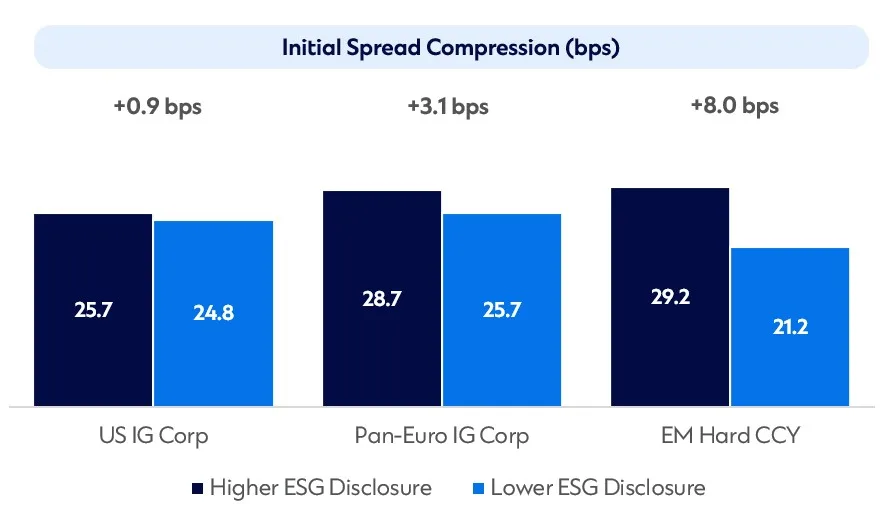
Note: Initial compression measures the tightening from Initial Price Talk (IPT) to Final Guidance for Issuance
Within secondary markets, labelled and screened funds that reference ESG ratings and disclosures remain limited though still a meaningful source of demand.
Operations
Capital allocation is where intent becomes visible. ESG mentions on earnings calls have been falling since 2022, yet our recent client outlook survey indicates that one-third of surveyed corporates expect to increase green and energy transition capex, often linked to cost savings, increased efficiency or risk reduction from incidents such as cyberbreaches or regulatory fines. Such initiatives remain central to transition and impact company valuation over the long-term.
How should treasurers and CFOs treat ESG considerations in their planning?
ESG ratings and disclosures remain relevant and now sit within broader credit, investor and operational risk assessments. The work for corporates is to understand where each channel matters in practice and to weigh any standalone ratings alongside broader capital priorities. Doing this well can provide meaningful advantages in investor engagement and market execution.
To explore these themes further, learn more about our Capital Structure & Rating Advisory capabilities or get in touch with us.
Related insights
Turbulence ahead: Fuel shock deepens the returns challenge
A six-month stress test shows most airlines remain liquid, but weaker earnings and higher leverage may further s…