



Table of Contents
In a rush? Read this summary:
- The SEP (Systematic Equity Plan) is a disciplined, long-term strategy that enables investors to buy certain stocks directly at regular, defined intervals.
- Risks include Market Volatility (price fluctuations), Performance Risk (company failure), Liquidity Risk (difficulty selling shares quickly), and Credit Risk (creditors are paid before equity investors).
- Risks can be mitigated by diversifying, adopting a long investment time frame, and having a good understanding of the marketplace.
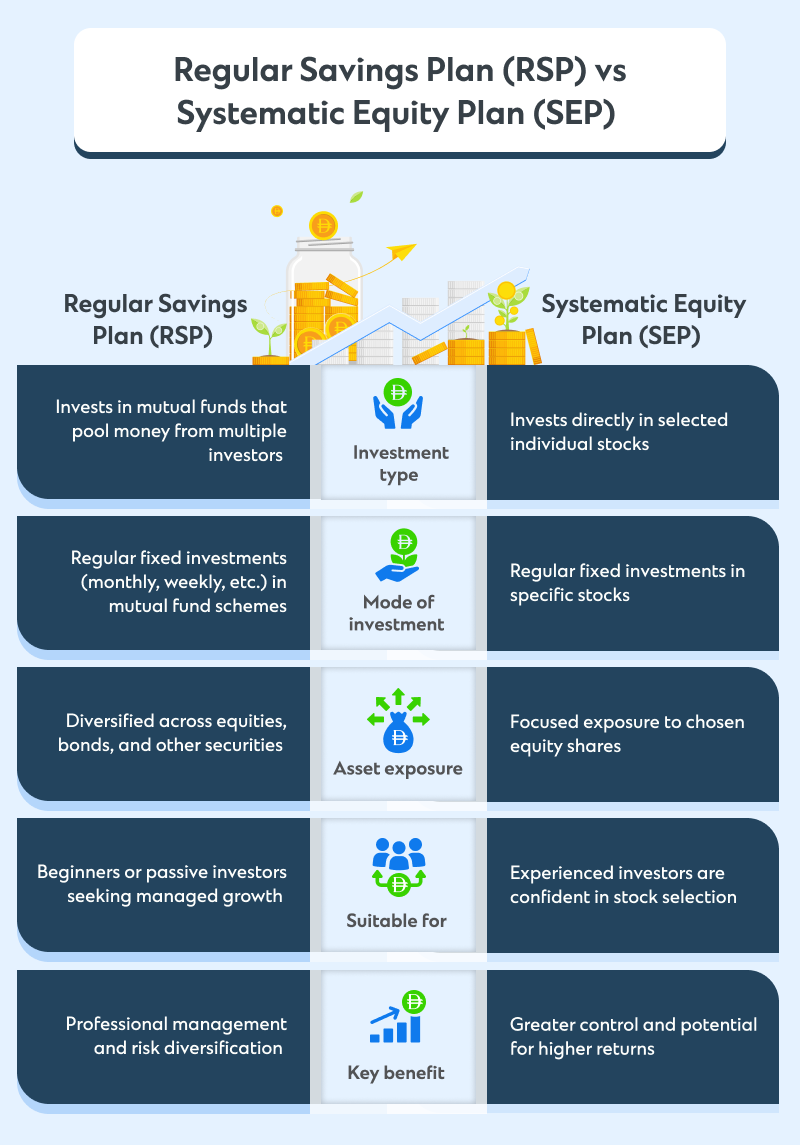
While a regular savings plan (RSP) helps investors to invest in mutual funds that pool money from different investors and invest in diverse securities, including bonds, stocks, etc., a systematic equity plan (SEP) helps investors to invest directly in a particular stock or set of stocks periodically, including weekly, monthly, or fortnightly, in a fixed proportion.
Investors who prefer direct equity trading with a long-term, disciplined approach can invest in a SEP that helps them achieve financial freedom.
Risks associated with a systematic equity plan (SEP)
Equity investments are considered subject to market risk. However, investors can minimise risk by investing the same amount at regular intervals. It also enhances investment returns by lowering the average unit purchase cost in both high- and low-market environments.
- Market volatility: Before investing in equities at regular intervals, investors should keep in mind that stock prices can fluctuate sharply over short periods, potentially shifting investor sentiment.
- Performance risk: A company’s financial performance determines a company’s stock value and dividend payouts. Operational failures, declining profitability, and poor management factors can impact share prices.
- Liquidity risk: Some shares can be difficult to sell quickly, especially in smaller or less-traded markets. Additionally, certain shares can have a significant difference between their buy and sell prices, making it difficult to dispose of them. Investors who want to sell illiquid shares quickly may receive significantly less than the original investment price.
- Regulatory risks: The value of specific stocks is also affected by altered market conditions, which are usually driven by changes in financial regulations, government policies, and laws.
- Credit risk: One should keep in mind that, in the event of bankruptcy or failure for any reason, the company pays its creditors first before equity investors.
Systematic equity plan (SEP): How to manage investment risks
- Diversification strategy: Investors can diversify across various industries to reduce concentration risk.
- Long-term investment: Equity investments has the potential to become profitable and stable over time, and the total value of the investment increases when the market grows. On the other hand, when the market is down, investors can buy more shares or units.
- Stay informed: Investors who want to make informed decisions can follow market news and trends and avoid impulsive buying and selling driven by market volatility.
Benefits of SEP in the UAE
The UAE has robust governance frameworks that mitigate risks of conflicts of interest, fraud, and mismanagement. Corporate governance standards are enforced by regulatory bodies, including the Securities and Commodities Authority (SCA) and the Dubai Financial Services Authority (DFSA), thereby enhancing accountability and transparency.
- Wealth creation: Investors seeking to build significant wealth over the long term can invest through a SEP. Despite short-term market volatility, when the stock market starts growing, investors can see potential returns.
- Beat inflation: Investors who want to outpace inflation by growing the purchasing power of money can invest in equities that usually offer satisfactory returns.
- Steady income: Some companies listed on the Dubai Financial Market (DFM) and Abu Dhabi Securities Exchange (ADX) pay regular dividends on their shares. Therefore, investors seeking both capital appreciation and a supplementary income stream often choose to invest in these dividend-paying equities.
Speak to your Standard Chartered relationship manager or contact us to learn more about investing in SEP in the UAE.