

Table of Contents
In a rush? Read this summary:
- Exchange-Traded Funds (ETFs) can be traded throughout the day, while index funds are transacted at day’s end.
- Both offer low-cost, diversified exposure to markets locally and globally.
- Key differences lie in trading flexibility, structure, and cost efficiency.
In today’s investment landscape, diversification has become more than a protective measure; it’s a reliable financial strategy that has gained incredible popularity due to its versatility and risk management benefits.
For investors, Exchange-Traded Funds (ETFs) and index funds have emerged as powerful investment vehicles for building diversified portfolios that can offer long-term growth and withstand market volatility. These financial tools have become increasingly relevant to the sophisticated financial landscape because of their cost efficiency, global exposure, and accessibility.
This article explores how ETFs and index funds differ in structure, cost, and trading flexibility, and how each can play a strategic role in building a diversified investment portfolio.
ETFs vs index funds: Understanding the key differences
An ETF is an investment fund that holds a diversified portfolio of assets, including commodities, bonds, and stocks listed and is traded on a stock exchange. Index funds are mutual funds that offer a stable investment designed to replicate a specific index’s performance, such as the Standard & Poor’s 500 (S&P 500) or a local UAE Index.
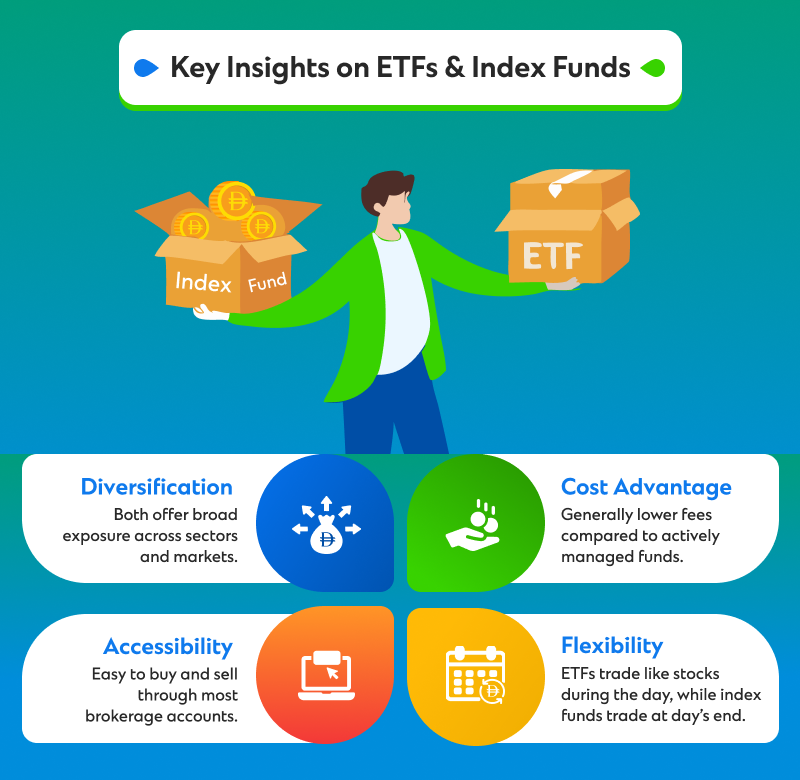
ETFs can be traded on an exchange throughout the day, much like individual stocks. In contrast, index funds are typically traded directly through asset management companies at the end of the trading day. Both offer valuable opportunities for portfolio diversification. However, they have significant differences in trading opportunities and costs.
How ETFs and index funds strengthen portfolio diversification
- Broad market exposure: ETFs and index funds help investors gain significant exposure to hundreds or even thousands of securities in a single investment. For instance, investors can choose from locally available ETFs that track the performance of indices like Abu Dhabi Securities Exchange (ADX) or Dubai Financial Market (DFM), as well as globally focused ETFs that provide access to developed and emerging markets without the complexity of managing individual international securities.
- Cost efficiency: Investors benefit from relatively low management fees compared to actively managed funds. Oftentimes, it can significantly impact overall returns for long-term investors interested in accessing global funds.
- Liquidity and transparency: These investment vehicles offer the advantage of liquidity, allowing investors to sell and buy them throughout the trading day, similar to stocks. Furthermore, most ETFs disclose their holdings daily, providing a high level of transparency that supports informed decision-making. Similarly, index funds also offer diversification exposure while minimising concentration risks by providing investment options in a wide range of stocks across various sectors.
- Risk mitigation: While geopolitical factors, trade flows, and global energy markets can influence economic cycles, the level of risk mitigation offered by these investment tools can provide significant relief to investors.
- Ease of access: While many mutual funds require a minimum investment, investors can get started with a small amount of capital, investing in ETFs or index funds. The democratisation of access allows a broader segment of investors to incorporate these instruments into their portfolios regardless of size or experience.
Index funds help manage risk by providing diversification across a broad market. Instead of being exposed to the performance of a single company, an investor’s risk is spread out across all the companies within the index. By investing in an index mutual fund, investors can save time on analysing individual stocks, which helps to simplify the fund research process.
Similarly, many ETFs provide a diversified exposure to a specific sector, geography, or theme, assisting investors to manage concentration risks and broaden their portfolios beyond individual stocks.
ETFs vs index funds: Customising allocation based on investment goals
While ETFs have gained considerable popularity amongst investors because of their cost effectiveness and versatility, index funds have become a popular investment option because of their low costs, diversification benefits and simplicity. Globally, ETFs focused on Environmental, Social, and Governance (ESG) principles are gaining momentum, offering a way for investors to align with sustainable investing themes.
Investors choose between ETFs and index funds depending on their investment preferences, trading style and investment goals. Both of these passive investment options are designed to track market indices. Although both offer cost-effective diversification, they significantly differ in terms of applicability, trading, and structure. are designed to track market indices. Although both offer cost-effective diversification, they significantly differ in terms of applicability, trading, and structure.
Investors looking for flexibility can consider investing in ETFs. The lower expense ratio of ETFs compared to index funds makes them a cost-effective choice for investors with significant investment volumes. Investors usually are concerned about brokerage fees when it comes to investing in ETFs.
Index funds, on the other hand, are more suitable for investors having a long-term approach. They can be redeemed at the net asset value (NAV) determined at the end of a trading day. Investors do not have to track the price fluctuations the entire day. Additionally, without incurring frequent trading costs, index funds support systematic investment plans (SIPs).
Speak to Standard Chartered’s relationship managers or contact us to learn more about ETFs and index funds investments.