



Table of Contents
In a rush? Read this summary:
- Exchange-traded funds (ETFs) often offer lower fees and real-time trading, while mutual funds provide professional management with end-of-day pricing.
- Both options spread risk, but ETFs typically track indexes, while mutual funds follow a manager’s strategy.
- The right pick depends on an investor’s goals, risk appetite, time horizon, and how actively they manage investments.
Many investors grapple with the choice between exchange-traded funds (ETFs) and mutual funds , two prominent investment avenues. Both have seen substantial growth in assets under management (AUM) over the years, reflecting their popularity among investors.
While mutual funds and ETFs share similarities as pooled investment vehicles, it is important to understand their distinct characteristics.
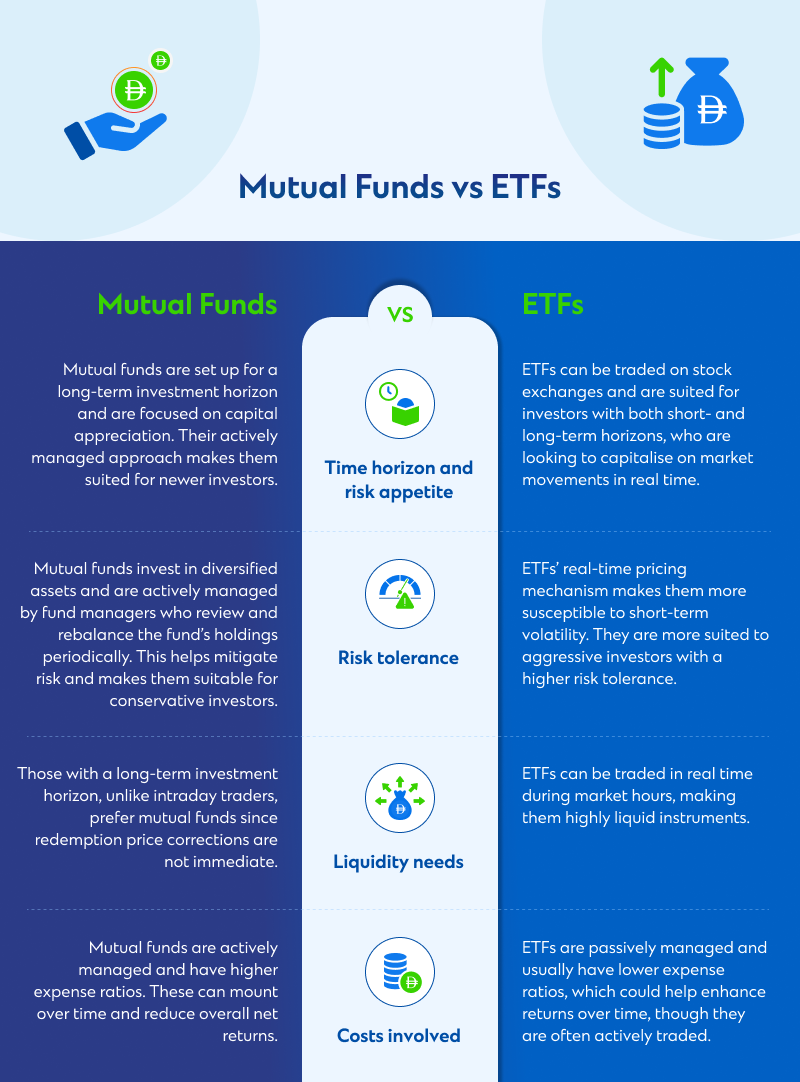
ETFs vs mutual funds: Key differences
While both ETFs and mutual funds offer diversified exposure, it’s important to understand their key differences.
Cost comparison between ETFs and mutual funds
Compared to the costs associated with actively managed investments, indexed mutual funds and indexed ETFs charge lower management fees and other expenses.
Furthermore, it’s essential to consider the total cost of ownership, which encompasses the expense ratio, as well as trading and holding costs.
Actively managed mutual funds usually carry higher expense ratios, as professional managers actively analyse markets and adjust portfolios to outperform market benchmarks. In contrast, ETFs generally follow a passive strategy, tracking indices such as the Standard & Poor’s 500 (S&P 500), which results in lower management costs.
Liquidity and trading
Both ETFs and mutual funds are considered liquid assets, meaning they can be bought and sold effortlessly. While investors can trade ETFs throughout the day, mutual funds are priced once per day.
A defining feature of ETFs is their dual-market structure, the secondary market, where investors trade on the exchange, and the primary market, where the underlying securities of the ETF are traded. This underlying market liquidity can often exceed ETF’s secondary market liquidity.
Diversification
Both mutual funds and ETFs offer diversification, but their approaches can differ. Mutual funds pool capital to invest in a range of assets, such as stocks and bonds, with the fund manager’s strategy defining the portfolio. A core principle of many ETFs is their direct relationship with the index they track.
Conversely, ETFs are designed to track a specific index, sector, or commodity, offering a targeted diversification strategy, for example, mirroring a global market index or a particular sector of the economy.
ETFs vs mutual funds: Factors for consideration
- Investment goals: Your investment goals are a key factor in the choice. A hands-off approach focused on long-term growth may find mutual funds a suitable option. Conversely, investors seeking to track specific indexes or sectors at potentially lower costs often find ETFs align their objectives.
- Trading tactics: With mutual funds, all transactions on a given day are executed at the same price, which is calculated after the market closes. ETFs, however, offer real-time pricing throughout the trading day, providing investors with more control over their entry and exit points. This makes ETFs a compelling choice for investors who prefer frequent trading.
- Risk appetite: ETFs, due to their real-time online trading, can be more sensitive to intraday market fluctuations. Investors who prioritise the stability of a professionally managed portfolio may find mutual funds more aligned with their risk tolerance. In contrast, those comfortable with market volatility might favour ETFs for their potential returns and flexibility.
- Time horizon: An investor’s time horizon is another factor to consider. Mutual funds provide a professionally managed strategy to navigate market cycles, while ETFs offer the flexibility of quick entry and exit from positions.
ETFs vs mutual funds: Making an informed investment choice
Between mutual funds and ETFs, the decision often comes down to an individual’s preferences, goals, and financial situation: investors who are cost-conscious and seek flexibility may prefer ETFs, while mutual funds can appeal to those who value professional fund management and are prepared to pay higher management fees.
- Do your research: Before investing in mutual funds or ETFs, it is prudent for investors to review fees and performance history to make an informed investment strategy.
- Start with the minimum: Beginning with a modest investment and gradually increasing it can be a practical approach for new investors, potentially with professional guidance.
- Diversify your investments: Whether an investor chooses mutual funds or ETFs, diversifying the investment portfolio across different sectors is a widely accepted approach to help mitigate risk.
Ultimately, the ideal investment vehicle depends on an investor’s personal preferences, risk tolerance, and financial objectives. Both mutual funds and ETFs are effective tools for building wealth over time when integrated into a well-defined investment strategy.
Speak to Standard Chartered’s relationship managers or contact us to learn more about investing in ETFs and mutual funds in the UAE.