

Table of Contents
In a rush? Read this summary:
- Private keys grant users access to digital assets. Stolen keys may mean users’ assets are gone forever.
- For maximum safety, users can use cold storage (offline hardware) for long-term holdings and hot wallets (online) only for daily trading.
- The UAE provides a robust legal shield through Federal Decree Law No. 34, making it a secure but regulated hub for digital finance.
Across the global financial landscape, the United Arab Emirates (UAE) is recognized as a hub for cryptocurrency transactions. The burgeoning digital economy comes with rapid growth, providing users with greater control over their financial transactions. However, it also comes with significant challenges, including cyber threats such as illicit transactions, hacking, and fraud.
Understanding crypto security
Digital assets built on blockchain technology have become increasingly popular, where businesses and individuals alike have embraced them. This widespread adoption, however, has made digital assets vulnerable to various threats, which consequently require security measures.
Unlike traditional banking, crypto security is grounded in decentralization and cryptography. While blockchain technology enables secure, decentralized transactions—giving users greater control over their assets while emphasizing the need for risk management, a crypto private key (i.e. a secret alphanumeric code) authorizes access to digital assets on a blockchain and helps users safeguard their funds. These codes play a vital role in cryptocurrency transactions and have become prime targets for hackers.
Navigating the Crypto Security Regulatory Framework
As of January 1, 2026, the capital markets regulator, the Securities and Commodities Authority (SCA), was renamed to the Capital Markets Authority (CMA). It is a major upgrade to the UAE’s financial laws to handle complex digital financial markets better and align with international standards.
Simultaneously, Dubai’s Virtual Assets Regulatory Authority (VARA) continues to focus on strict cybersecurity and consumer protection standards for Virtual Asset Service Providers (VASPs). These protections are maintained through security audits, real-time monitoring of suspicious transactions, strict custody control, and mandatory licensing for specific activities.
Crypto risk management: Law on combating cyber crimes
Cyber safety and digital security are serious issues, and the Government of the UAE protects residents and citizens to strengthen trust in the digital space. Federal Decree Law No. 34 of 2021 was established to combat cybercrimes and rumors, taking effect on 2nd January 2022. It’s a comprehensive legal framework to address different concerns related to abuse and misuse of online technologies.
Types of cryptocurrency risks
Let’s take a closer look at the risks associated with cryptocurrency investments.
- Information theft: Hackers usually target private keys to access digital wallets. If these keys are compromised, attackers will gain complete control over the user’s digital assets, resulting in significant financial losses.
- Unauthorized Mining: Mining is the process of using computer resources to secure and validate transactions and the blockchain network. Fraudsters can deploy mining malware that uses a user’s computer power to mine cryptocurrency for the attacker. It simultaneously slows down the device and increases its electricity costs.
- Phishing attacks: These common types of cryptocurrency scams trick users into revealing the details of their private keys and other sensitive information by impersonating legitimate entities. Users find fake emails and websites that appear genuine and fall for them.
- Insider threats: Individuals within an organization access users’ sensitive information and exploit their positions to steal digital currency. Organizations can prevent this by monitoring systems and implementing strict access control.
- Investment scams: These scams range from Ponzi schemes to fake Initial Coin Offerings (ICOs) that lure users with promises of high returns. Once victims invest their money, their funds are gone.
Effective cryptosecurity practices
Explore a few common best practices to safeguard your cryptocurrency below:
- Crypto wallets: Users can send, receive, and store cryptocurrencies and manage multiple assets under one roof, often through a single interface or app. Crypto wallets rely on decentralized networks. These cryptographic systems protect identities and secure transactions. Unlike traditional online banking, crypto wallets use public key infrastructure (PKI) to safeguard data and authenticate users.
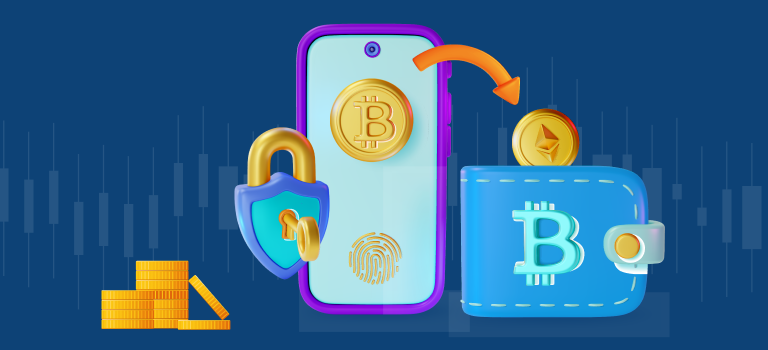
- Hardware wallets: These physical devices, also known as cold storage, store private keys offline. Considered to be one of the most secure storage options, hardware wallets minimize exposure of private keys to online threats.
- Software wallets: A software wallet, also called a hot wallet, is an application installed on a device. It does not provide users with direct access to the account’s private key. Instead, the central entity or the exchange that issues the wallet retains the account’s private key. Users can access their funds by entering their username and password into the centralized entity’s interface.
Safeguard digital assets from phishing attacks
These are some recommended tips to maximize security and protect your investment.
- Be cautious of unsolicited links, attachments, and emails by verifying the source before clicking.
- Use official applications and choose licensed and regulated platforms for information and transactions.
- Back up your wallets and store recovery phrases in secure, offline locations; storing sensitive keys in unencrypted cloud storage is discouraged.
- Exchange security is equally important. Choosing exchanges that offer strong security measures and robust authentication protocols can be helpful.
- Keep a small portion for cryptocurrency trading on exchanges; the rest can be transferred to a secure wallet.
- Setting up alerts for transactions and login attempts lets you know instantly in case of any unauthorized activities.
Start exploring cryptocurrencies easily and securely on Standard Chartered’s mobile app to explore our crypto trading capabilities or reach out to your Relationship Manager to learn how cryptocurrencies can complement your portfolio.