


Table of Contents
In a rush? Read the summary:
- When companies distribute a portion of their profits to shareholders, it is called a dividend. On the other hand, companies classified as growth stocks reinvest their profits to fuel further growth opportunities.
- Investors looking for stability typically prefer dividend stocks, while those seeking a swift increase in share prices usually prefer growth stocks.
- Growth and dividend stocks differ in objectives and risk profiles, with metrics like P/E ratio and P/B ratio used to access a company’s book value and past performance.
Investors can become part-owners of a company by purchasing its shares, also known as stocks. In the UAE financial landscape, one can invest in stocks through two options: growth stocks and dividend stocks. Each comes with its own benefits and suits investors with different investment goals.
What are dividend stocks?
Companies that distribute a part of their profits to shareholders, typically on an annual or quarterly basis, are referred to as dividend stocks. These are shares of companies that are often stable, well-established, and large in size; their payouts represent a tangible return on investment for shareholders.
Key features of dividend stocks
- Consistent revenue: Dividend stocks can be a dependable passive income generator. Investors can receive income that can be reinvested later. Dividend stocks, in contrast to other investments, enable investors to hold shares and preserve capital while receiving regular payouts. They can make money without selling assets.
- Stable companies: These are often found in stable industries like banking, consumer goods, or utilities. Investors can benefit from regular income. A key metric here is the payout ratio, which shows the percentage of earnings a company distributes to its shareholders. Additionally, investing in these companies can lead to long-term wealth accumulation.
- Lower risk: Stable companies are usually less risky than new or small companies. Hence, these stocks are stable as companies that pay dividends are financially sound businesses with a great track record. Therefore, it has potential for capital appreciation. Companies may pay and increase dividends over time. This stability often results in consistent, long-term capital appreciation.
- Slower growth: Investors can receive steady returns through dividends as stock prices do not fluctuate quickly. Compared to growth stocks, which are subject to more dramatic price changes, dividend stocks are less volatile and carry lower risk, making them a safer choice for conservative investors.
What are growth stocks?
Just like dividend stocks, growth stocks are also shares of companies. Growth stocks, unlike dividend stocks, do not distribute dividends to investors; instead, they reinvest their profits to fuel further growth. These businesses usually aim for rapid growth in high-growth industries such as technology, e-commerce, or renewable energy. Instead of consistent income, investors typically look for capital growth and the possibility of future profits.
Key features of growth stocks
- Earning potential: Growth stocks focus on companies that offer potential for future growth. These companies usually deliver rising profits and revenues even if current valuations remain high. Investors usually expect rapid expansion from these companies over time, which justifies their higher stock prices.
- Investment horizon: Unlike dividend stocks, investors usually maintain a long-term outlook with growth stocks as these stocks offer potential for a swift increase in share prices. Despite higher volatility, they attract investors seeking significant capital gains rather than immediate income.
- Risk and volatility: Risk tolerance is a crucial factor that distinguishes dividend stocks from growth stocks. While investors with lower risk tolerance focus on stable cash flow, growth stock investors are usually risk-tolerant and ready for significant stock price fluctuations, as these stocks carry higher risks due to their speculative nature. These companies prioritise capital allocation toward research and development and market expansion to increase their overall valuation over time.
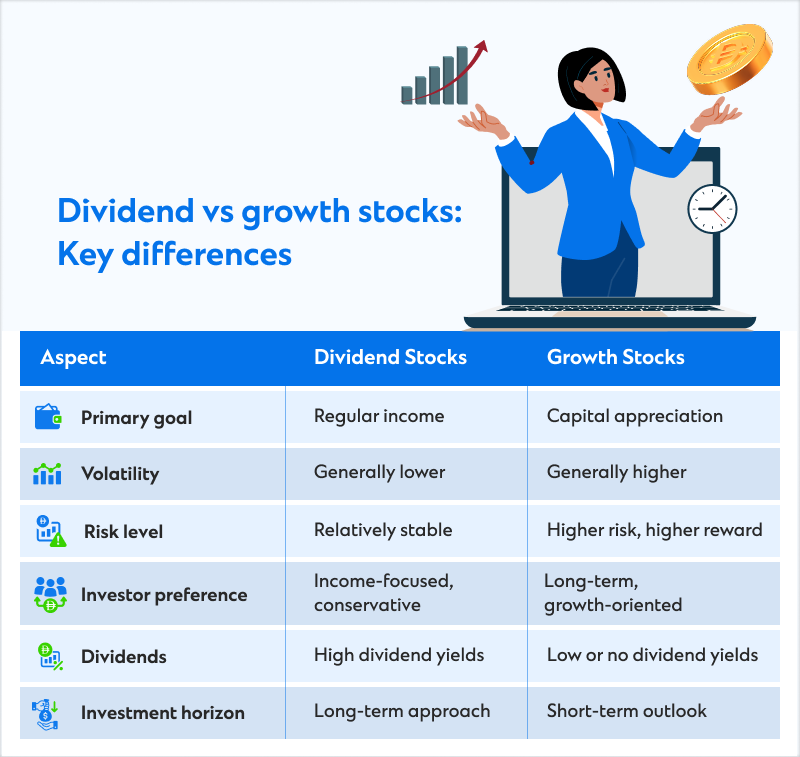
Dividends vs growth stocks: How to identify
Identifying dividend and growth stocks requires understanding their key characteristics. While dividend stocks usually offer lower price-to-earnings ratios, growth stocks tend to offer an above-average P/E ratio, focusing on expanding earnings.
- Price-to-earnings (P/E) ratio: Investors can track a company’s record to decide whether its stock price reflects its earnings.
- Price-to-book (P/B) ratio: Investors usually calculate a company’s book value and then compare it to the stock price.
- Free cash flow: Positive free cash flow indicates that a company has the capital to grow, pay down debt, and reinvest profits while paying dividends.
Before investing, other metrics like total equity, overall sales, revenue growth trends, and debt should be calculated.
Speak to Standard Chartered’s relationship manager or contact us to learn more about growth stocks and dividend stocks.