


Table of Contents
In a rush? Read this summary:
- The net asset value (NAV) is the total value of a fund’s assets minus its liabilities, calculated once daily for mutual funds to determine the per-unit trading price.
- The NAV per Unit formula is: (Total Assets – Total Liabilities) / Number of Outstanding Units.
- The NAV serves as the primary tool for tracking a fund’s performance; an upward trajectory in NAV indicates that the fund’s underlying investments are increasing in value.
A mutual fund is a type of investment instrument that pools money from investors and invests in diverse securities, including stocks, bonds, etc., to achieve the fund’s goal, which may be to track an index or to provide diversified access to a given asset class. Mutual funds trade only once a day based on the fund’s Net Asset Value (NAV), while individual stocks or ETFs trade during market hours on an exchange.
The net asset value (NAV) refers to the total value of a mutual fund’s assets minus its liabilities. This essentially reflects the value of a single unit of the mutual fund. The NAV per unit is calculated by dividing the fund’s NAV by the number of units issued. It is the price investors pay when buying or selling a unit of the mutual fund.
When looking at a mutual fund, the first thing every investor observes is its NAV, as a fund’s performance is determined by changes in its NAV. A mutual fund that performs well will have an upward trajectory in its NAV per unit.
Let’s look at how NAV is calculated and how it affects the performance of mutual fund returns.
How to calculate Net Asset Value?
The procedure of NAV calculation is simple:
NAV = (Total Assets – Total Liabilities)
NAV Per Unit = (Total Assets – Total Liabilities)/Number of Outstanding Units (or Shares)
What are assets?
Assets are the market value of the fund’s holdings, such as corporate bonds and stocks, receivables such as dividends, and cash equivalents such as money market funds
What comprises liabilities?
Liabilities are debts and outstanding payments, as well as operating costs incurred, including administrative and management charges.
What is the per-share NAV?
Per share NAV, or NAV per share/unit, is the Net Asset Value (NAV) divided by the total number of outstanding shares. This is an important calculation for capital sales, fund distributions, or situations where new investors are added to the fund mid-cycle.
Formula for calculating NAV Per Share: NAV per Share = (Total NAV) / (Number of Outstanding Shares).
How does NAV work?
NAV acts as a valuation tool that reflects the current value of the fund’s portfolio. For mutual funds, the NAV per share determines the price at which investors can purchase or redeem their units at the end of each trading day.
For private equity, the NAV is an essential indicator of the fund’s value, since shares do not trade on public exchanges and are thus even more critical. The NAV is updated quarterly or periodically in accordance with established valuation methodologies.
The NAV varies with changes in the market value of the underlying assets. If the value of the portfolio increases, the NAV will increase. Conversely, the value will go down if the assets’ value declines. The relationship is direct; therefore, the NAV is an accurate determinant of how the investment is performing on a per-share basis.
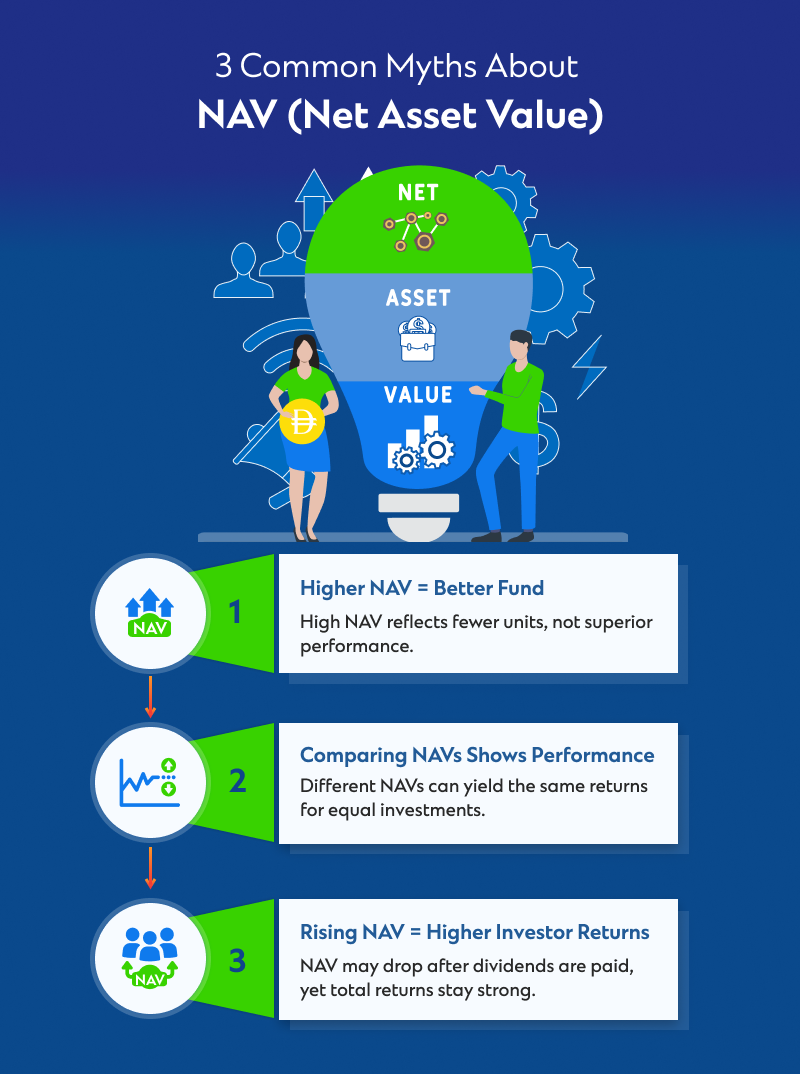
However, NAV is not the only determinant of future performance; investors should also evaluate the fund’s strategy, risks, and market conditions.
Example: Let’s assume a hypothetical private equity fund:
- Fair value of portfolio investments: AED 50 million
- Cash and other assets: AED 5 million
- Liabilities (fees, accruals, expenses): AED 3 million
- Outstanding units: 100,000
NAV = (AED 50M + AED 5M) – AED 3M = AED 52M
NAV per unit = AED 52M / 100,000 = AED 520
At this time, each investor’s share is valued at AED 520, bringing the total NAV to AED 52 million.
Role of NAV in fund performance evaluation
Investors can use NAV as a fundamental benchmark to evaluate a fund’s performance. An increasing NAV over time usually suggests the growing value of the fund’s investments; a declining NAV may suggest underperformance of the fund or adverse market conditions.
Investors can evaluate the performance of a fund manager’s underlying assets and monitor the effectiveness of the fund manager’s strategy through NAV. One can also decide whether to purchase or sell a fund unit based on the NAV. NAV also serves as a key metric for understanding the value creation within the portfolio and for negotiating secondary sales in private equity.
One can monitor investment performance by observing NAV. However, this cannot be the only consideration, as other important variables such as current market trends, fund objectives, and fees should also be considered.
The NAV is an important metric that both fund managers and investors may use in a very straightforward, quantitative manner to assess a fund’s performance and value.
Therefore, investors should know how to calculate NAV and interpret its meaning to make informed decisions.
Speak to your Standard Chartered relationship manager or contact us to learn more about investing in mutual funds in the UAE.