



Table of Contents
In a rush? Read this summary:
- Real Estate Investment Trusts (REITs) offer investors access to income-generating real estate assets with added liquidity and diversification across sectors like residential, logistics, healthcare, and hospitality.
- UAE-listed REITs have gained traction due to strong property market fundamentals, rising demand for Shariah-compliant options, and shifts in asset allocation.
- With evolving market dynamics and high occupancy trends, the REIT landscape in the UAE continues to expand across asset types and investment structures.
Real estate investment trusts (REITs) have emerged as a strategic option for portfolio diversification because of their unique characteristics in a dynamic real estate market like the UAE. Through REITs, investors gain exposure to income-generating property assets without carrying the operational burden of direct ownership.
While the correlation of returns varies from low to high, UAE REITs have shown resilience, offering stability and attractive yields. This explains for the increased interest in REIT investments observed among UAE residents of late, particularly those in Dubai, driven by the region’s economic stability, competitive returns, and improved regulatory frameworks.
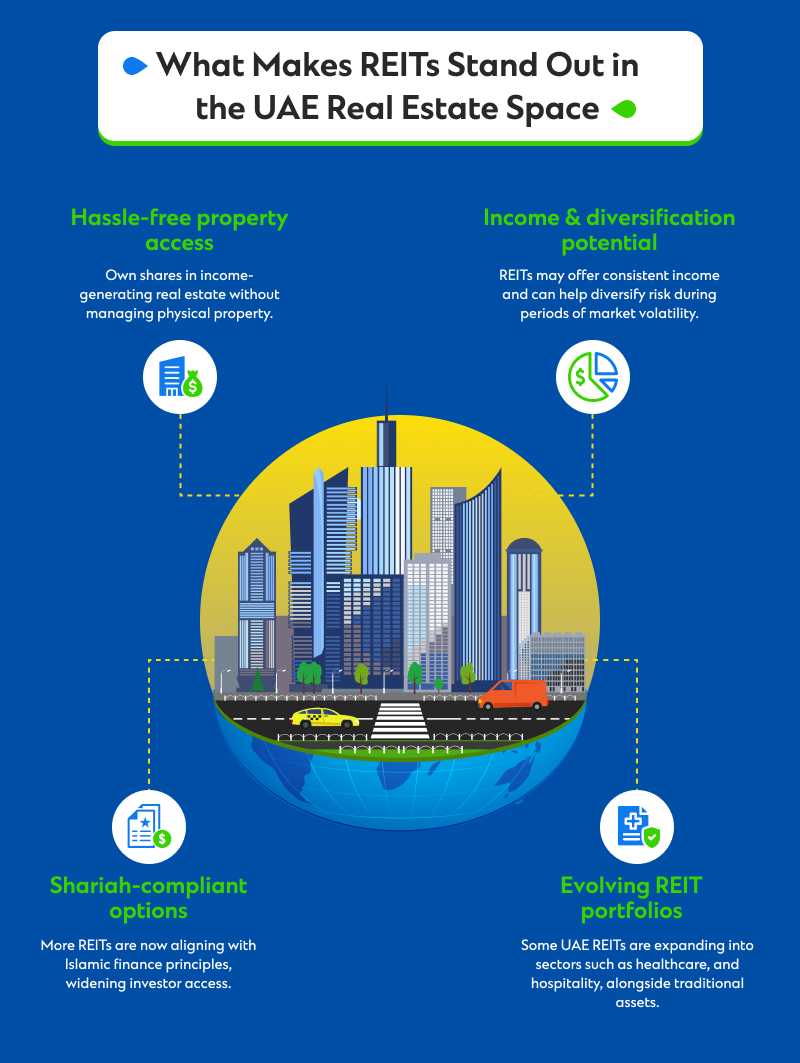
In this article, we’ll explore how REIT investing works, the role of equity REITs in diversifying portfolios and how you can access them to tap into a broader and more flexible real estate investment opportunity.
A hassle-free approach to property investment with REITs
REITs are companies that trade on major stock exchanges and offer greater liquidity than physical property investments. While owning and managing income-producing property assets, they distribute most of their income among shareholders as dividends.
It serves as an accessible entry point into the flourishing real estate market without the hassle of property management.
Dubai real estate investors are accustomed to illiquidity in physical properties. On the other hand, listed REITs are liquid assets traded on major stock exchanges, allowing you to buy and sell shares effortlessly. If you’re looking for a refreshing change, consider REITs to build a diversified portfolio with the cost of a single share.
Exploring REIT options
Investors can access a growing range of REITs locally and internationally. Each focus on different segments of the real estate market.
- Equity REITs: These are one of the most common types of REITs that invest in and own properties. Income is generated through rent. The property types may include office buildings, residential apartments, industrial facilities, and retail centres.
- Mortgage REITs: Also known as mREITS, these offer financing for income-producing real estate. They invest in mortgage-backed securities or mortgages and earn interest on their investments
- Hybrid REITs: This type of REIT combines both mortgage and equity REITs investment strategies; it offers a blended approach by investing in mortgages and owning properties.
Diversification benefits of REITs
Are REITs better than real estate investments ? As an investor, including REITs in your investment portfolio can enhance diversification, as real estate returns are generally not influenced by the same factors that affect stocks and bonds. For example, property market dynamics and rental income trends usually affect real estate returns.
Moreover, the correlation of REITs is low to moderate with other asset classes. Therefore, it can help even out portfolio returns over time. Additionally, it provides stability during periods of stock market volatility. The tangible value of underlying properties, along with their income-producing nature, contributes to this stability.
REITs in the UAE market: Trends & opportunities
In 2024, Dubai’s commercial investment market has already witnessed a surge in transactional activity, with a high office occupancy rate and continued rising rental values. While rents for logistic spaces jumped 8% in Abu Dhabi and 16% in Dubai by Q4 2024, commercial office occupancy topped 90%. Prime logistics properties remain in high demand, with leases signaling strong investor interest. A shift in REIT asset allocation is also evident.
Funds like Emirates REIT and ENBD REIT have already expanded beyond residential holdings and traditional office spaces into healthcare, education, logistics, and hospitality infrastructure. On the other hand, Dubai’s inaugural residential REIT initial public offering (IPO) further underscores this momentum.
Shariah-compliant REITs are also gaining traction. These are structured to avoid non-permissible activities and align with local investor preferences.
A comprehensive guide to strategic investing in REITs
Investors can consult licensed financial advisors in the UAE or a certified Islamic finance specialist to invest in Shariah-compliant REITs.
To make an informed decision as an investor, consider the following steps.
- First, thoroughly review the official prospectus and refer to informational materials, if available. Through these documents, you will easily come to know the structures, finances, governance, and risk factors, as well as their assets.
- Seek clarity from a qualified financial advisor who can help interpret the offering documents of REITs, advise how your investment can help you achieve your long-term financial goals, and explain tax implications.
- Additionally, it’s important to stay up to date on broader market developments. Remember, the real estate landscape of Dubai, especially the REIT sector, is dynamic. Being aware of different regulatory changes, economic trends, and sector performance will help you make more informed decisions over time. more informed decisions over time.
Speak to your Standard Chartered relationship manager or contact us to learn more about investing in REITs in the UAE.