



Table of Contents
In a rush? Read this summary:
- Small-cap companies (market cap $300M–$2B) offer higher growth potential compared to mid-and large-caps, but also carry higher risk.
- Small-cap Mutual Funds (MFs) provide diversification by investing across multiple industries, reducing concentration risk while offering exposure to innovative and agile companies.
- Adding small-cap funds to a portfolio can enhance long-term growth. Investors can balance volatility by including stable assets like large-cap funds or debt funds.
The first step in smart investing is understanding that it usually involves some degree of risk. Building a diversified portfolio allows investors to better manage risk and take advantage of growth possibilities across multiple sectors.
Including small-cap mutual funds in a portfolio can provide exposure to smaller-sized companies. These companies may offer higher growth potential than their mid-cap and large-cap counterparts, though they also come up with a higher degree of risk. Small-cap funds typically cover a variety of industries and sectors and may help investors seek significant capital appreciation over the long term.
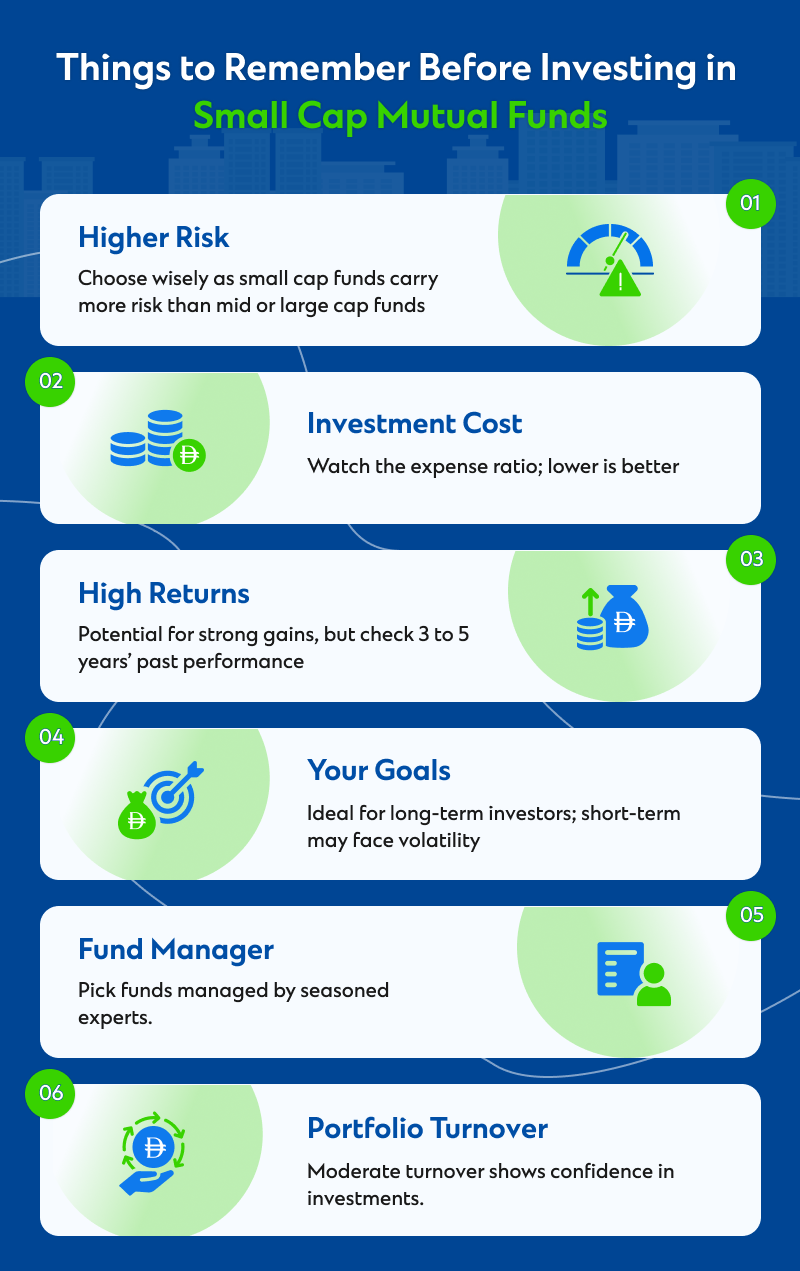
What are small caps mutual funds?
Small-cap mutual funds are investment funds that primarily invests in stocks of small-cap companies. Several characteristics differentiate these funds from those that invest in large and mid-cap stocks. Along with diversification benefits, small-cap stocks are more likely to give higher returns compared to large and mid-cap stocks. They come with higher risks as well. In the global financial market, a small-cap company is generally defined as having a market capitalisation between $300 million and $2 billion. These companies often represent a wide range of industries and can be more agile, innovative, and adaptable to market changes.
Advantages of small-cap mutual funds
- Potential for higher growth: Small-cap funds often invest in developing companies in their early stages of growth, which may have significant future potential. While investing in small-cap funds involves risk, they may offer an opportunity for higher growth.
- Portfolio diversification: For investors seeking to enhance their portfolio mix, small-cap mutual funds may be a suitable option, particularly for those whose existing investments are low-risk. These mutual funds invest in multiple companies across various industries.
- Institutional investor behavior: Small-cap funds often get overlooked by institutional investors compared to large-cap funds. Individual investors can identify those undervalued stocks and benefit from their growth.
- Active fund management: Fund managers often actively manage small-cap mutual funds, making strategic investment decisions to maximise returns. This will help investors navigate volatility and potentially achieve higher returns over the long term.
Disadvantages of small-cap mutual funds
One of the most notable downsides of investing in small-cap funds is high risk and market volatility. Small-cap mutual funds investment is concentrated on growing companies with a small market cap. As a result, the risk is quite high. To manage risk, investors may consider seeking the assistance of experienced professionals when selecting small-cap mutual funds.
How to invest in small cap mutual fund
- Step 1: Choose a trustworthy financial service provider that offers mutual fund services, such as Standard Chartered.
- Step 2: Open an investment account by visiting the official website of the financial service provider and fill in the required details to open an account.
- Step 3: New clients have to complete a one-time Foreign Account Tax Compliance Act (FATCA) and Central Securities Depository Regulation (CSDR) declaration.
- Step 4: Once the account is officially registered, investors can go through the investment options. Platforms also offer online mutual fund services through which investors can buy, sell, or track mutual fund investments.
Building a diversified portfolio with small-cap mutual funds
Investing in small-cap mutual funds may help investors optimise their potential returns and leverage long-term wealth creation. However, before investing, it is important to be clear about one’s financial objectives and risk tolerance. It is also crucial to acknowledge the high risk of small-cap fund investments. Portfolio diversification can also be achieved by including relatively stable asset classes such as large-cap funds, actively managed hybrid funds, or debt funds.
Speak to Standard Chartered’s relationship managers or contact us to learn more about small-cap investments in the UAE.