



Table of Contents
In a rush? Read the summary:
- Cryptocurrencies are decentralized digital assets that utilize blockchain technology and cryptography to make peer-to-peer transactions without the need for central authorities like banks.
- The cryptocurrency marketplace includes Bitcoin and thousands of alternative currencies, known as “altcoins”, such as Ethereum and Litecoin, each with its own unique function.
- Trading and issuing cryptocurrencies are legal in the UAE, governed by a dual-layered framework: the CMA oversees federal regulations, and VARA manages licensing specifically within Dubai.
Trading without comprehensive understanding of an asset is merely blind speculation; professional crypto investing begins with a foundation of knowledge. Cryptocurrency, also known as crypto, is a virtual or digital currency that utilizes cryptography for security. Cryptography is a computational and mathematical practice that encodes and decodes data. Cryptocurrencies are usually decentralised and based on blockchain technology. It means that, unlike conventional government-issued currencies, they enable peer-to-peer transactions without relying on a central authority such as a government or a bank.
Individual computers that maintain the blockchain network are referred to as nodes. Each cryptocurrency transaction is validated and recorded by these networks on a public ledger called a blockchain. Since cryptocurrencies are decentralized in nature, they are resistant to censorship and fraud.
Crypto investment: Bitcoin and Altcoins explained
Bitcoin was the first cryptocurrency that came into existence in 2009 . The market has since expanded to include an extensive array of other cryptocurrencies, including altcoins. Users can utilize different cryptocurrencies based on their specific utility.
For example, some act as payment vehicles while others are designed to support decentralized applications. Individuals can choose one, depending on their goals, understanding of how cryptocurrency works, and risk tolerance. This section provides a foundational understanding of cryptocurrency for beginners. Before engaging in cryptocurrency trading , it is essential to conduct thorough research and assess additional risks.
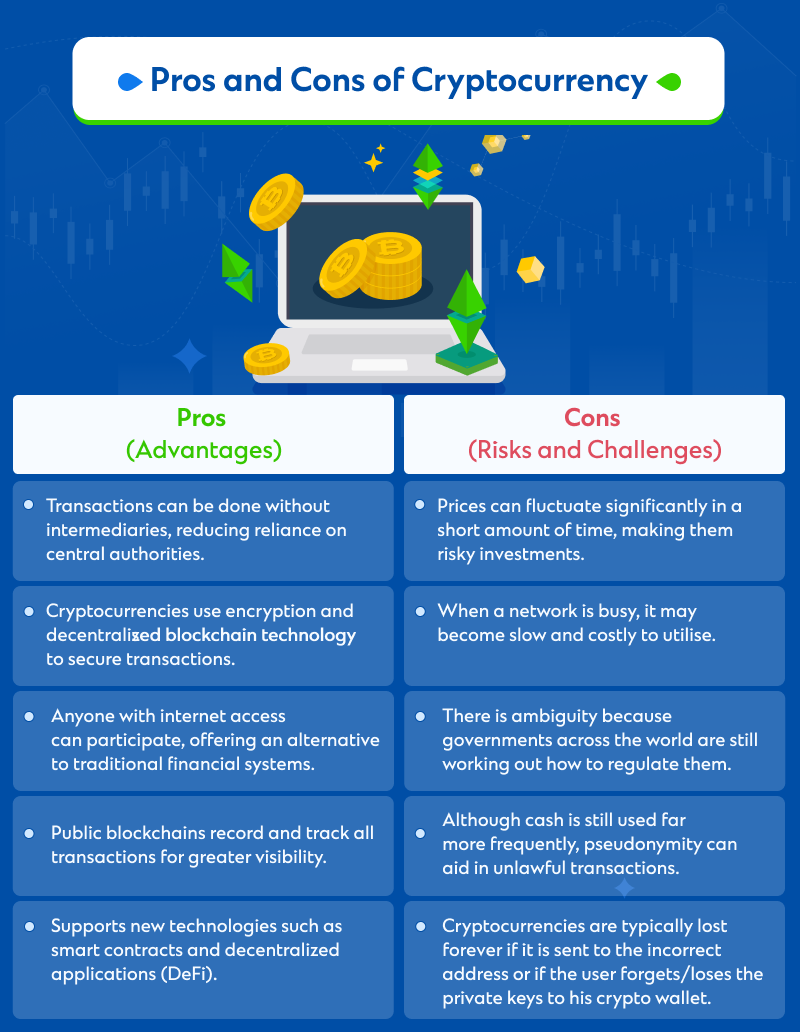
How do cryptocurrencies work?
To better understand how cryptocurrencies function, investors must grasp the core technological pillars that support their security and independence.
- Blockchain technology: A distributed public ledger that cryptocurrencies operate on. It’s a record that holds all transactions and is updated by network participants (miners or validators) who verify new transactions.
- Crypto mining: The process of creating units of cryptocurrencies. It utilizes the power of a computer to solve complex mathematical problems that verifies transactions and generates new coins. Various brokers also provide users with the option to purchase cryptocurrencies, to store and spend them using encrypted wallets.
- Network consensus: A blockchain is hosted across multiple computers (also called nodes) on a network. Everyone within the network can view the blocks of transactions that have been verified, which makes it transparent but very difficult to alter.
- Cryptography: It is a mechanism that uses complex math and algorithms to secure and verify transactions within a block, that links all the blocks together. Each block references its predecessor.
Altering stored information and changing the entire chain can be rejected by the majority of the network. Therefore, this combination of decentralized consensus and cryptographic security offers immutability and transaction transparency while making manipulation extremely difficult.
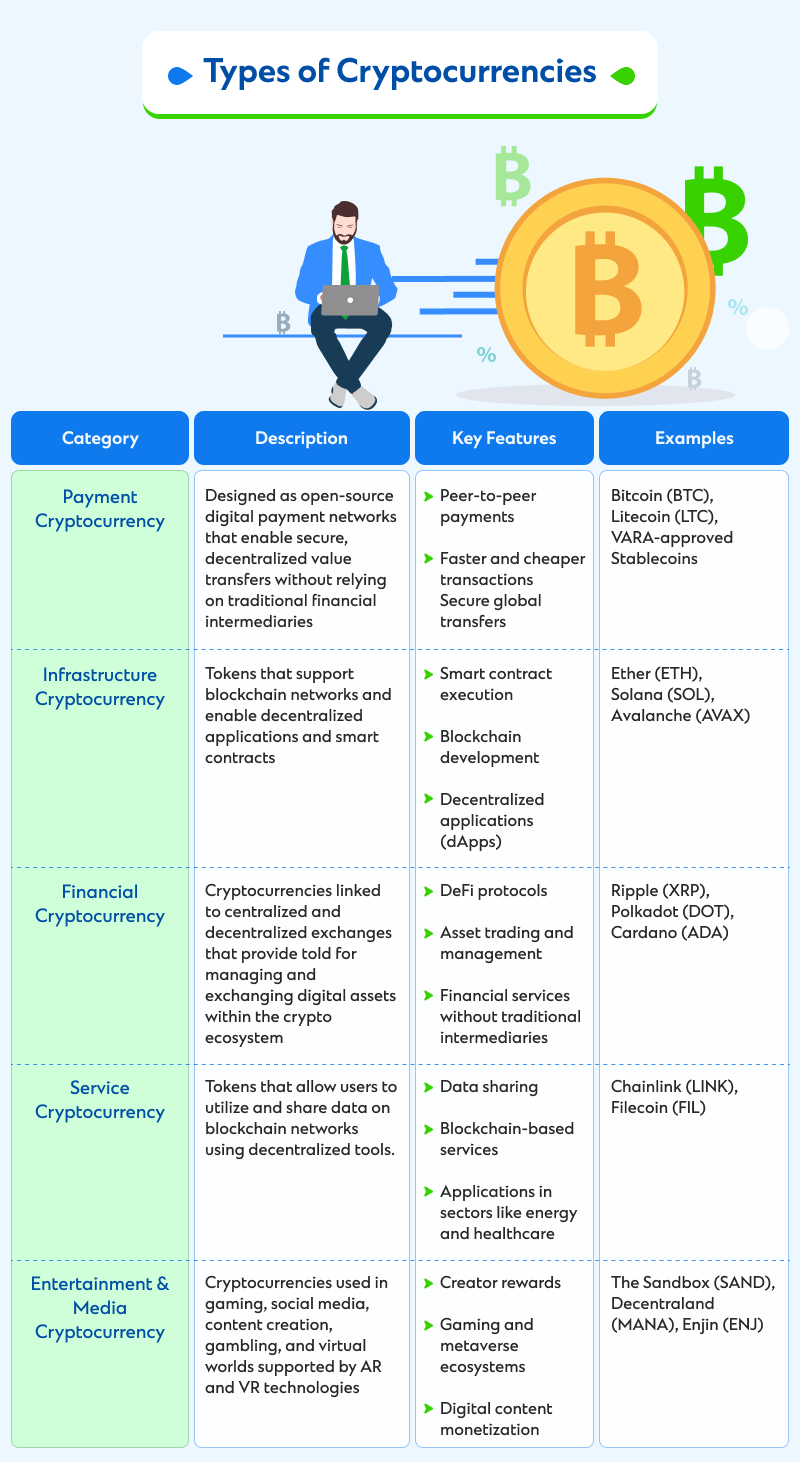
Types of cryptocurrencies
There are several types of cryptocurrencies in the market today, with Bitcoin being the most popularly traded currency.
- Payment cryptocurrencies: Users can store and transact value on a decentralized network without the need for centralized intermediaries such as the government and banks. For example, payment cryptocurrencies like Litecoin (LTC) and Bitcoin (BTC) aim to provide cheaper, faster, and more secure transactions. Individuals can securely conduct financial transactions worldwide with this infrastructure.
- Infrastructure cryptocurrency: These are tokens that support the underlying technology and networks that enable decentralized applications and smart contracts. For example, infrastructure cryptocurrencies like Ether (ETH), Solana (SOL), and Avalanche (AVAX) are primarily connected to blockchain networks that provide smart contract functionality, allowing developers to design self-executing contracts for a range of applications.
- Financial cryptocurrencies: These are connected to centralized and decentralized exchanges and offer tools for managing and exchanging assets within the crypto ecosystem. They provide features similar to traditional finance in a more open and accessible manner and are frequently connected to DeFi protocols.
- Service cryptocurrencies: Users can utilize and share data on blockchain networks using the tools offered by service cryptocurrencies. They use the transparency and security of distributed ledgers to improve various sectors such as energy and healthcare.
- Entertainment and media cryptocurrencies: Users can receive rewards for creating content, gambling, social media, and games. These cryptocurrencies support digital worlds accessible through augmented and virtual reality technologies.
Users can differentiate other cryptocurrencies from Bitcoin by referring to them collectively as ‘altcoins’
How to choose the right crypto
- Financial goal: Investors should have a clear strategy that focuses on financial goals rather than market sentiment. Depending on their goals, they may be interested in long-term trends or short-term price movements, and accordingly, they can choose the right cryptocurrency to invest or utilize.
- Project fundamentals: Investors should evaluate whether a project has a practical use case beyond its theoretical foundations. The coin should also have a competent team with an active community. It involves verifying whether the project has undergone external audits and has support through partnerships or venture capital backing.
- Security concerns: Cryptocurrencies are vulnerable to bugs, rug pulls and hacks. Therefore, users must check the security controls and consensus mechanisms such as Proof of Stake (PoS), Proof of Work (PoW), etc. Also, they have to check regulatory trends, as not all coins are accessible across every jurisdiction.
- Diversification: Traders typically diversify their trading portfolio across multiple cryptocurrencies. It reduces the likelihood that all positions will move in the same direction.
Is cryptocurrency legal in the UAE?
The UAE has a well-defined legal framework for cryptocurrency-related activities. The Virtual Assets Regulatory Authority (VARA), the cornerstone of the region’s legal framework for the digital asset industry, was established under Law No. (4) of 2022 for the emirate of Dubai . This all-encompassing framework positions the UAE as a secure, well-regulated environment for crypto activities.
The issuance, trading, and listing of cryptocurrencies are legal in the UAE. Under the current 2026 framework, the Capital Markets Authority (CMA) regulates virtual asset activities at the federal level, and the Virtual Assets Regulatory Authority (VARA) regulates them within Dubai. Users are able to buy and sell cryptocurrency in the UAE provided they comply with applicable regulatory guidelines and invest through licensed, regulated platforms such as Standard Chartered UAE.
Start exploring cryptocurriences easily and securely on Standard Chartered app or reach out to your Relationship Manager tolearn how cryptocurriences can complement your portfolio .