ASEAN’s energy transition: What corporates say
ASEAN needs USD400 billion a year to reach net zero. See why corporates see upside in the transition, and how to finance it.

Key takeaways
- Every corporate surveyed sees climate risk as material, and flood risk is the threat they name most often.
- Almost three-quarters believe that moving to a low-carbon economy will strengthen their business.
- The main barriers to faster progress are affordability and infrastructure, not consumer willingness.
- ASEAN needs an estimated USD400 billion a year to reach net zero, yet it accounts for just 3 per cent of the world’s outstanding sustainable debt.
- Every corporate surveyed has already raised sustainable finance and expects to do so again, pointing to cheaper funding and a broader investor base.
The transition has become an economic strategy, not just a climate one
ASEAN is home to nearly 700 million people and some of the world’s fastest-growing economies, with the population set to grow by around 80 million over the next 25 years. As incomes rise and industry expands, and AI adoption rates increase, electricity demand will climb sharply, which makes building out the power system one of the region’s most pressing priorities. Recent geopolitical shocks, trade disruption and supply chain uncertainty have only strengthened the case for energy systems that are more domestically anchored and less exposed to imported fuel.
The scale of that demand is striking. ASEAN’s electricity consumption reached 1,352 TWh in 2024, and if consumption per head rose to the level of today’s high-income countries, total demand could increase around 4.5 times, to nearly 6,200 TWh. Yet, solar and wind still make up just 4 per cent of the region’s electricity generation, against roughly 30 per cent in mature markets such as the EU and Australia.
That gap between potential and reality is where the opportunity lies. Renewable power, storage, grids and the technologies around them help ASEAN economies expand supply, build resilience and stay competitive, and they do far more than meet climate goals. Our ASEAN Transition Survey report captures how corporates in the region’s most transition-critical sectors are responding, and their answers tell us three things: how they see the risks, where they are putting their capital, and what is holding them back.
Survey in numbers
- 100 per cent of the corporates surveyed see climate risk as material to their business, and more than 90 per cent flag flood risk specifically.
- 74 per cent believe a shift to a low-carbon economy will benefit their company’s outlook.
- Almost 9 in 10 already engage with solar power, the solution they also expect to outperform.
- 100 per cent have already raised sustainable finance, and all expect to do so again.
- 67 per cent expect to use green or sustainability-linked bonds or loans; 53 per cent expect to use blended finance.
- More than 70 per cent expect their local transport to electrify, and more than 90 per cent want to use batteries.
Climate risk is perceived as material, but few are funding adaptation
Every company surveyed perceives climate risk as material: 64 per cent already treat it as a current threat to their business, and the rest expect it to become one over the medium to long term. Flood risk is the most named concern, cited by more than 90 per cent of respondents, including every energy and utility company, with droughts and storms close behind. There is realism alongside the concern. Around 70 per cent think their countries will ‘somewhat likely’ meet long-term emission targets, but only 13 per cent call success ‘extremely likely’, a signal that effort will need to intensify.
Building renewables alone will not solve these risks. Adaptation spending is not keeping pace with the money going into cutting emissions, and water is fast becoming a defining issue. Adaptation is the process of adjusting practices, systems and structures to moderate potential damage and cope with the consequences of natural and climate-related hazards. This includes adjusting socio-economic and environmental practices to limit damage. Only 7 per cent of corporates see no water-related risk at all, while 40 per cent describe scarcity as a significant and growing challenge for their economy, a pressure that data-centre development will only add to. Faced with these risks, corporates are already acting, though not evenly.
The easy wins are underway, but deeper decarbonisation is lagging
Every corporate surveyed has an emission-reduction strategy in place, expects to invest more in the transition over the next five years, and wants to make its supply chain more sustainable. However, that activity gathers around a familiar set of scalable, near-term solutions: solar, energy efficiency and the circular economy. Solar leads by a clear margin, with almost 9 in 10 corporates already engaged, and it is also the solution they most expect to beat expectations.
“Which solutions does your company engage with?”, per cent of respondents
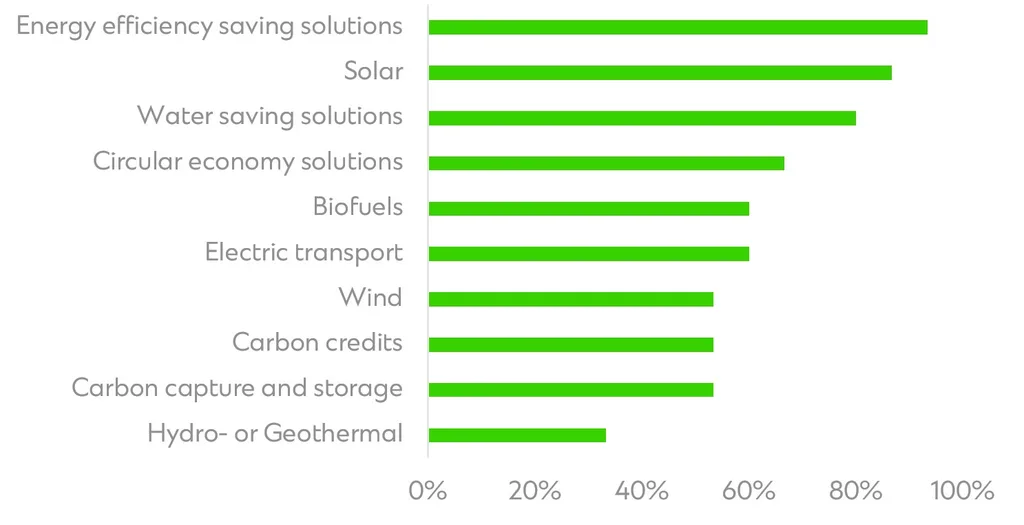
Engagement concentrates on solar, energy efficiency and circularity, with solar reaching almost 9 in 10 corporates.
On the other hand, engagement with deeper decarbonisation solutions like carbon capture and storage, as well as hydrogen remain limited, and engagement is noticeably lighter among industrials and commercial real estate. 74 per cent of corporates say they are convinced a low-carbon economy will strengthen their business, suggesting they increasingly see the transition as profitable, even if it is not yet fully bankable. This unevenness has less to do with intent and comes down more to cost and infrastructure.
Cost and infrastructure, not willingness, set the pace
Affordability is the single biggest barrier to accelerated progress. Corporates point to high upfront costs and a lack of economies of scale as the main reasons transition spending slips, which means engagement is also likely to rise as these solutions get cheaper.
Infrastructure is the other hard limit. Grid capacity, energy storage and electric vehicle (EV) charging are all lagging demand. More than 70 per cent of corporates expect their local transport to electrify, yet they see a shortage of charging infrastructure as the key obstacle, and appetite for batteries, which more than 90 per cent want to use, is held back by supply and cost. Corporates welcome data centres and AI, but they know both will call for a great deal more renewable capacity, and more grid to carry it. As a result, they expect a transition that is gradual and hybrid, with coal use falling while gas bridges the gap until renewables and storage can scale.
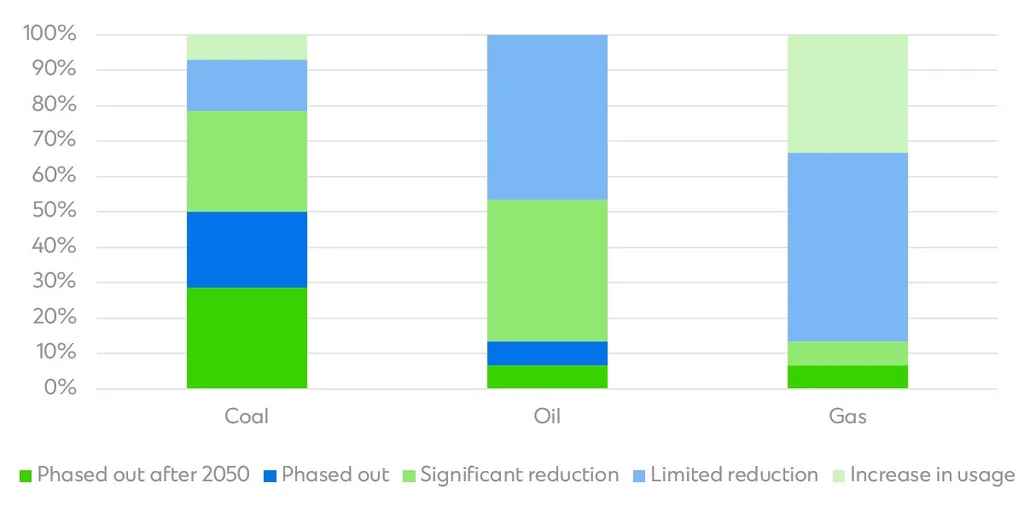
That hybrid view comes through clearly in how corporates see traditional fuels changing by 2050 – where they expect coal and oil use to fall by 2050, while gas declines more slowly as a bridging fuel.
How will your country’s use of the following fuels change by 2050?
| Fuel | How corporates expect use to change by 2050 |
|---|---|
| Coal | Around half expect it to be phased out by or after 2050, though about 20 per cent foresee only a limited reduction or even higher use |
| Oil | Just over half expect a significant decline or phase-out, closely tied to the electrification of transport |
| Gas | Expected to fall more slowly than coal or oil, and widely seen as a lower-emission bridge until renewables and storage scale |
If cost and infrastructure set the pace, financing is what changes it.
ASEAN is under-financed for the transition but the right tools exist to help close the gap
Low carbon energy investment in ASEAN reached about USD32 billion in 2023, short of the USD400 billion a year the region needs to reach net zero, a figure that adds up to more than USD10 trillion between 2025 and 2050. The region also holds just 3 per cent of the world’s outstanding sustainable debt and has issued far less than peers of similar credit quality.
Private capital makes up 55 per cent of climate finance flows across South and East Asia and the Pacific, against 65 per cent in Europe and as much as 93 per cent in the US and Canada. Together, these figures highlight ASEAN’s transition financing gap – and the opportunity to mobilise more private and sustainable capital.
Cumulative investment requirements
(USD trillion until 2050)
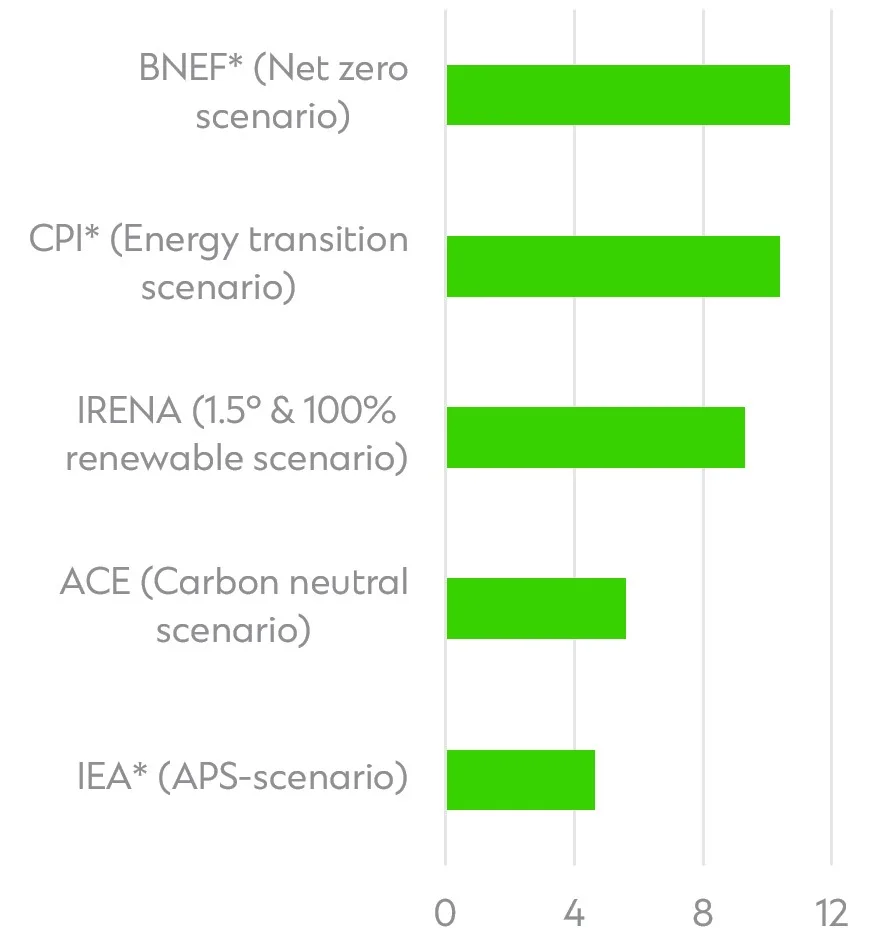
*Southeast Asia, others ASEAN
ASEAN transition investment needs
(annual USD billion, 2024-2025)
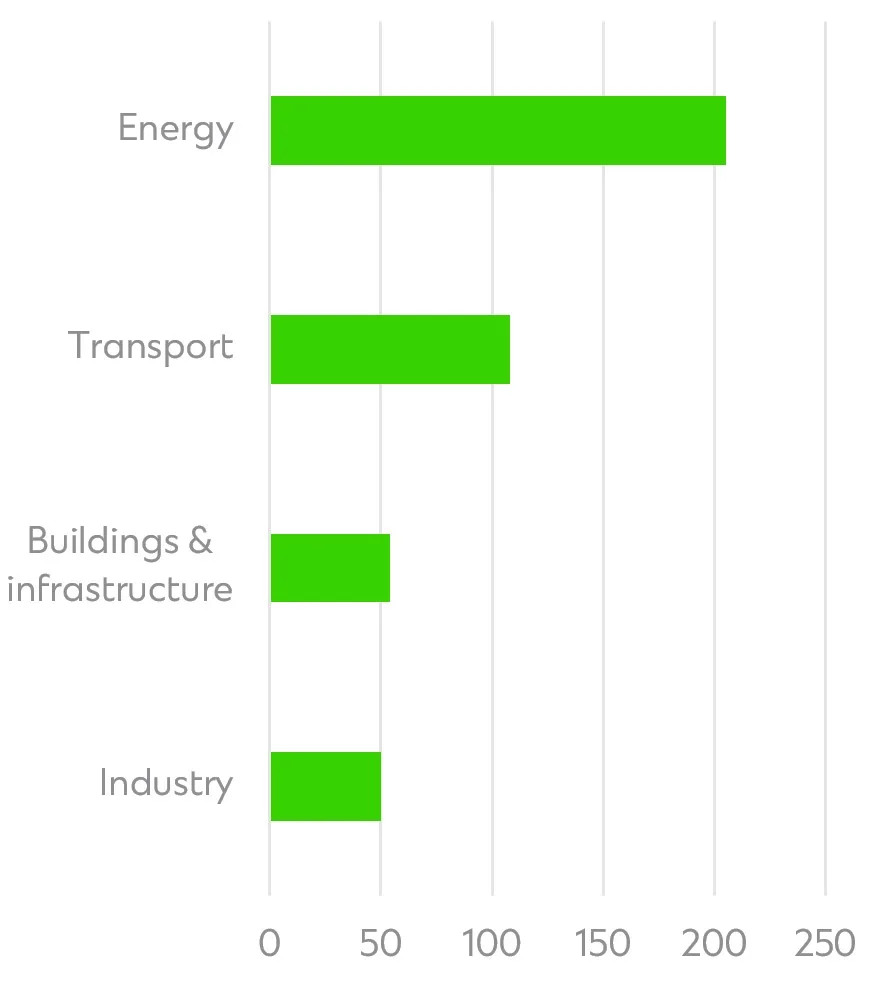
ASEAN may need more than USD 10 trillion by 2050, with energy and transport the largest calls on capital.
Outstanding sustainable debt (USD billion 2024, population in brackets)
| S&P credit rating | B | BB | BBB | A | AA | AAA |
|---|---|---|---|---|---|---|
| ASEAN countries | ||||||
| Vietnam(102 mn) | 5 | |||||
| Indonesia (287 mn) | 27 | |||||
| Phillipines (118 mn) | 14 | |||||
| Thailand (72 mn) | 30 | |||||
| Malaysia (36 mn) | 21 | |||||
| Singapore (6 mn) | 109 | |||||
| Other countries | ||||||
| Turkey (88 mn) | 43 | |||||
| Brazil (213 mn) | 51 | |||||
| India (1476 mn) | 70 | |||||
| Mexico (133 mn) | 66 | |||||
| Chile (20 mn) | 70 | |||||
| China (1413 mn) | 394 | |||||
| Saudi Arabia (35 mn) | 39 | |||||
| UAE (12 mn) | 53 |
ASEAN holds just 3 per cent of global sustainable debt, and has issued less than similarly rated peers.
The signal from corporates is encouraging – every company surveyed has already raised sustainable finance, and all of them expect to again, with most reporting real benefits: cheaper funding, a wider investor base and new banking relationships, the last of these cited by 40 per cent. The tools they expect to use most are green and sustainability-linked bonds or loans, at 67 per cent, and blended finance at 53 per cent.
Interest in carbon markets is growing too with more than 40 per cent not active yet, but every corporate that knows its carbon strategy expects to buy or sell credits in future. That shift is happening across the region, and India’s compliance carbon market, expected from 2026, is an early catalyst they say is worth watching.
“Which of the following statements do you agree with?”, per cent of respondents
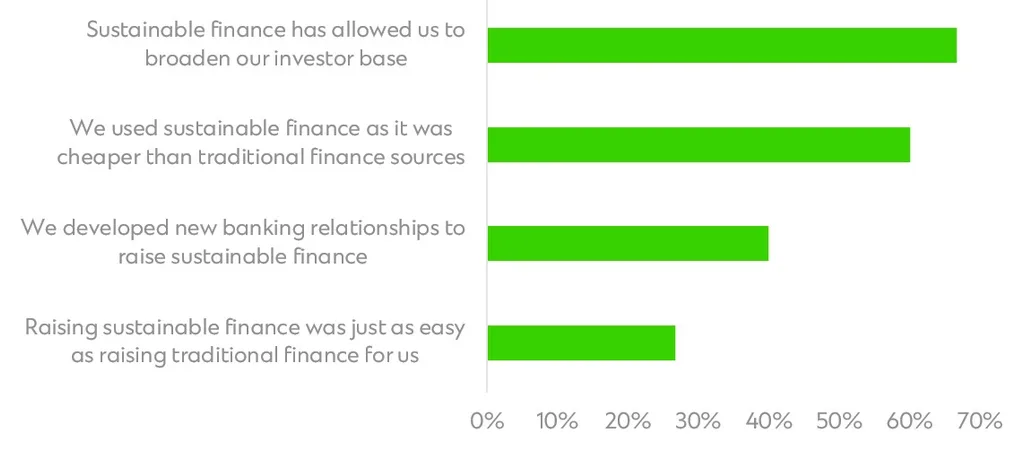
Corporates report that sustainable finance broadened their investor base and proved cheaper than traditional funding.
As Ben highlights, what stands out from this research is that the business case for transition is increasingly clear to corporates across ASEAN. The constraint is no longer conviction, it’s capital. The Bank’s role is to make the transition bankable: structuring financing that turns credible plans into investment on the ground, and connecting clients to a deeper, more diverse pool of capital than they could reach alone.
The region has the demand, the resources and the ambition. Closing the financing gap is what turns that potential into delivery. Ben DalyGlobal Head, Transition Finance and Advisory
The sectors and instruments we support
At Standard Chartered, we work with clients across the full transition suite of solutions, and the right instruments differing by sector:
| Sector | Transition position | Investment focus | Key challenges | Financing possibilities |
| Utilities | Central to electrification, renewable generation and grid distribution | Grid infrastructure, battery storage, renewable capacity | High upfront capital intensity, permitting and project delays, lighter use of sustainable finance | Sustainable bonds for mature renewables, blended finance for grid and storage, transition finance and SLLs for transitioning utilities |
| Energy | Core to low-emission supply, with coal and gas exposure and gas as a possible bridge | Renewable capacity, efficiency and storage, with CCS and hydrogen longer term | Challenging economics, need for regulatory and pricing support | Green loans and bonds for renewables, transition bonds and loans for mixed portfolios, blended and concessional capital for CCS and hydrogen |
| Materials | Circularity and resource productivity, exposed to water and nature risk | Energy efficiency, process innovation, water and waste circularity | Project bankability, exposure to volatile commodity cycles | SLLs, SLBs and asset-backed finance for efficiency, green loans or bonds for circularity projects |
| Industrials | Energy-intensive manufacturing, construction and equipment | Equipment and fleet electrification, on-site efficiency, fuel switching | Credible transition plans needed to strengthen the funding case, stronger policy support | Early stage: SLLs, transition working-capital and supply-chain finance. Mature stage: green loans and bonds. |
Utilities are a particular opportunity. They engage strongly with the transition but make comparatively little use of sustainable finance, and that mismatch points to real headroom as the region electrifies.
The corporates that pair credible transition plans with the right financing will move fastest, and they will capture the resilience and cost advantages first.
ASEAN and India: one trajectory, two starting points
ASEAN’s transition, though, is not happening in isolation.
ASEAN is one chapter in a larger regional shift. In neighbouring India, corporate appetite for the transition is just as strong, though fewer than 40 per cent of companies have tapped sustainable finance so far. That is a clear contrast with ASEAN, where corporates are already active in the market. Two markets, one trajectory, different starting points. Together, they account for close to USD700 billion a year in transition investment need, and a shared move toward carbon markets as the next wave of activity.
We look at Corporate India’s perspective in our companion report, India and the Energy Transition, part of our ongoing series on the transition globally.
Frequently asked questions
Related insights
Unlocking capital for clean cooking and emissions reductions
Find out how we helped the World Bank unlock affordable capital for clean energy projects in Ghana.
Standard Chartered has an important role to play in supporting our clients, sectors and markets to deliver net zero, but to do so in a manner that supports livelihoods and promotes sustainable economic growth. We provide financial services to clients, sectors and markets that contribute to greenhouse gas emissions however we’re committed to managing our environmental and social risks and to becoming net zero in our financed emissions by 2050.