



Table of Contents
In a rush? Read this summary:
- Equity allocation refers to the strategic distribution of a portfolio across stocks and other assets. It depends on an individual’s long-term financial objectives and risk tolerance.
- Individuals with a National Investor Number (NIN) can invest in equities. They can open a trading account through a security broker approved by the Securities and Commodities Authority (SCA).
- Equities generate income through dividends and capital gains. UAE residents are not subject to any personal income tax on either of these incomes.
The United Arab Emirates has emerged as one of the world’s most attractive investment destinations, offering residents, expats and international investors dynamic economic growth, tax-efficient investment opportunities, and investor-friendly regulations, especially in the equity market. As equity allocation gains increasing relevance in the country’s evolving financial markets, understanding its strategic importance has become essential for every investor.
Equity rebalancing basics: The fundamentals of equity ownership
An investor who invests in equities gains direct ownership of a portion of a publicly listed company, which is traded as shares. Companies issue these shares to raise capital as an alternative to taking debt, such as bonds or loans. A company’s value is reflected in the price of these shares. Share prices fluctuate based on demand and supply, which in turn are influenced by market sentiment around the company’s performance and prevailing economic conditions.
Equity allocation is the breakdown of stocks versus other assets of an investor’s total portfolio and is dependent on an investor’s risk tolerance. For example, high-risk investors, such as young professionals, usually have a long investment horizon. They typically allocate a larger share of their portfolios to equities. Conversely, investors with low risk tolerance, such as someone nearing retirement, may prefer allocating a smaller share of their portfolios to equities to protect capital. On the other hand, investors who wish to diversify exposure in their portfolio may allocate across different types of equities.
Equity allocation across different asset classes
To invest in UAE equities, new investors must obtain a National Investor Number (NIN) and open a trading account through an authorised securities broker licensed by the Securities and Commodities Authority (SCA).
While the Dubai Financial Market (DFM) offers a range of securities, the Abu Dhabi Securities Exchange (ADX) is known for its strong government-backed listings. On the other hand, NASDAQ Dubai offers dual listings and regional and global financial instruments.
- Direct investments: Investors can access exchanges like ADX and DFM for direct equity investments.
- Indirect investments: Indirect investments can be done through exchange-traded funds (ETFs) and mutual funds, which hold a group of stocks.
Earnings from equities
Equity earnings can be generated through capital gains and dividends. When shares are sold at a price higher than the purchase cost, it is known as capital gains. On the other hand, when a company distributes a portion of its profits to shareholders, it is known as dividends.
In the UAE, zero personal income tax on both capital gains and dividends makes equity investments highly tax-efficient compared to many global markets.
Importance of equity allocation
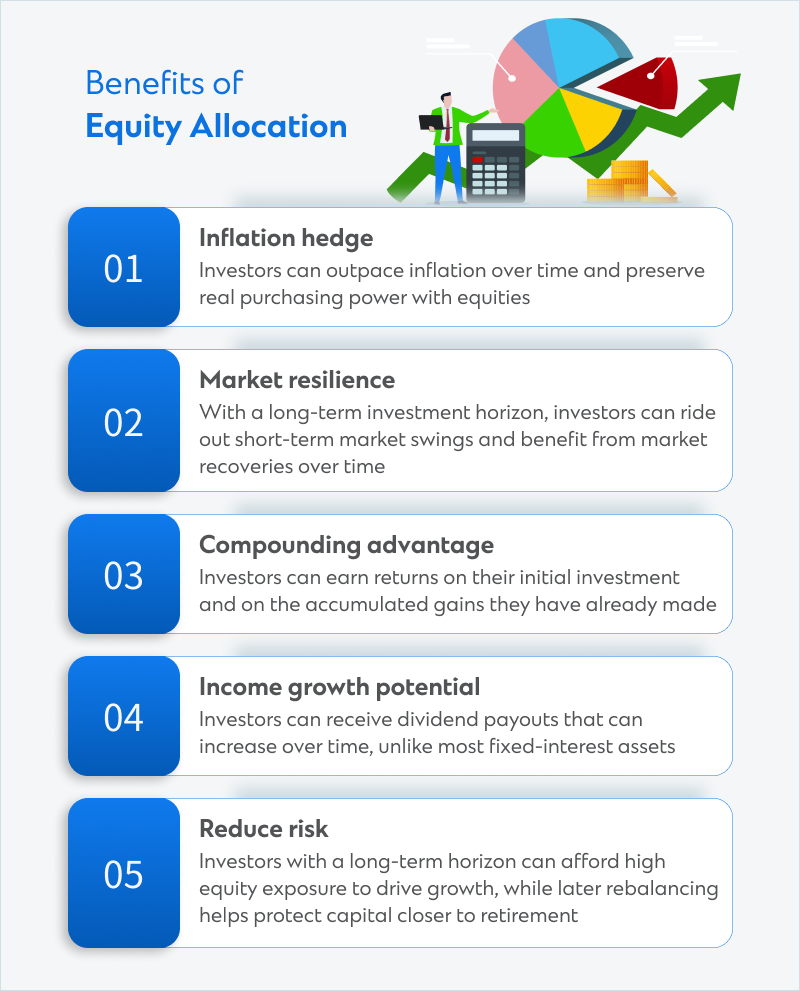
- Higher return potential: Equities can outperform other asset classes, including cash or bonds, over time, making them a powerful investment vehicle for wealth accumulation. Long-term investors may have higher returns with equity portfolios.
- Compounding returns: Investors can receive compounding returns, where earnings are reinvested to generate more earnings over time. It typically increases wealth with long-term investments.
- Diversification: Investors can reduce market risk by diversifying an equity portfolio across industries, geographies, and sectors. This diversification can offer a balance between risk and returns.
- Market uptrends: With equity portfolio appreciation, investors can achieve substantial gains and fully capitalise on positive market trends without the dilution from lower-yielding debt securities.
- Inflation hedging: Equities can outpace inflation by preserving the investment’s purchasing power. Investors can invest in growth-oriented equities that help protect their wealth from eroding due to inflation.
- Liquidity: Compared to tangible assets like real estate, stocks often offer substantially better liquidity, enabling investors to convert holdings into cash more efficiently to meet changing financial needs.
Equity allocation is not just a technical term but a strategic decision that helps investors participate in economic growth and manage financial risk. With expanding capital markets, investment diversification, investor-friendly regulations, and tax benefits, individuals can strategically allocate the right portion of equities to capture growth in local industries while diversifying their portfolios to meet long-term financial objectives.
Speak to Standard Chartered’s relationship manager or contact us to learn more about the importance of equity allocation.