



Table of Contents
Key takeaways:
- NRIs (Non-resident Indians) can hold fixed deposits in foreign currencies which helps protect their savings from INR depreciation and exchange rate fluctuations.
- Interest earned on FCNR accounts is tax-free in India, and both principal and interest can be transferred abroad without restrictions.
- FCNR deposits offer predictable returns, while options such as GIFT City funds allow NRIs to diversify globally and manage currency volatility.
According to RBI, the Indian rupee (INR) has depreciated by an average of 4.5% annually since 1991. Therefore, preserving the value of overseas earnings has become a key concern for Global Indians, including Non-resident Indians (NRIs), Persons of Indian Origin (PIOs), and Overseas Citizens of India (OCIs), making foreign currency investments in India an increasingly strategic choice.
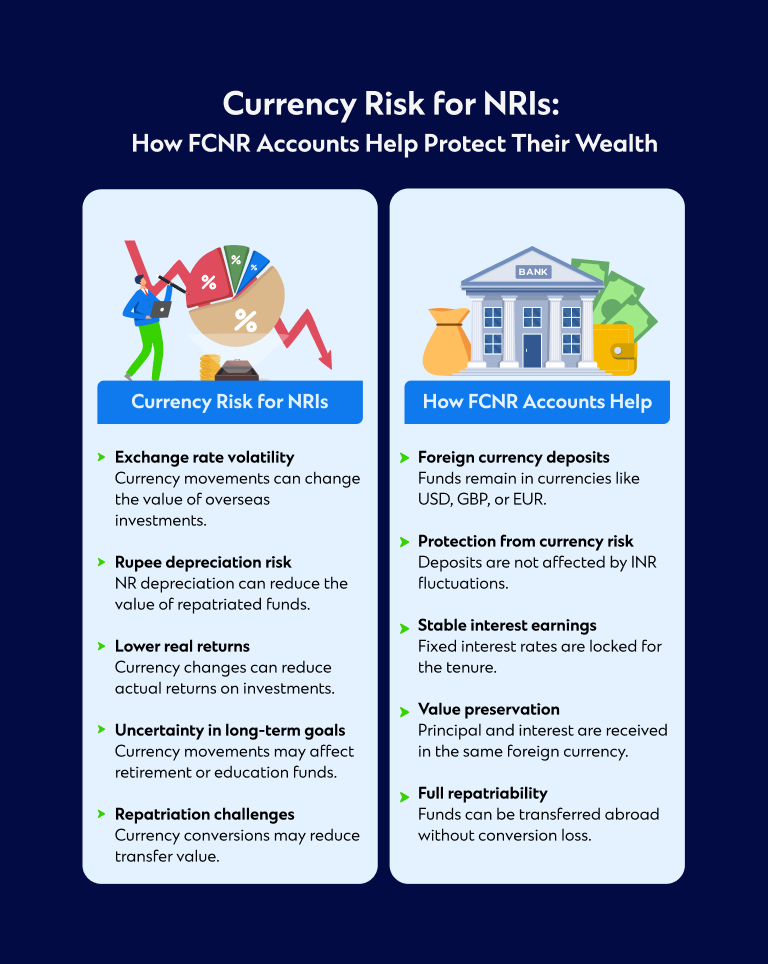
Global Indians can safeguard and invest overseas earnings in a foreign currency through a fixed deposit account in India while hedging currency risk and receiving secure, predictable returns. One of the effective ways to achieve this is through a Foreign Currency Non-Resident Bank (FCNR (B)) account, which helps maintain a fixed deposit in India while securing funds against exchange rate fluctuations by offering the ability to hold deposits in major currencies like USD for tenures ranging from 1 to 5 years.
For operational flexibility, funds can be transferred seamlessly to or from a Non-Resident External (NRE) account, a rupee-denominated account for parking overseas earnings in India, and a non-resident ordinary (NRO) account, a current/savings bank account to receive earnings in India, such as rent or pension or vice versa. While transfers from NRO accounts to FCNR(B) are subject to a $1 million annual limit under FEMA regulations and require tax clearance (Form 15CA/15CB), both accounts are subject to currency conversion at prevailing rates at the time of transfer. Additionally, the interest on FCNR (B) account is tax-free in India.
Foreign currency deposit
Banks can accept FCNR (B) deposits in any freely convertible currency in accordance with the Foreign Exchange Management Act regulations. Any amount of money can be deposited, and the principal amount and interest earned are fully repatriable. NRIs can transfer the funds to an overseas account without any upper limits.
FCNR accounts are often viewed as a strong investment choice for NRIs. These foreign currency term deposit accounts have a locking period, meaning the investment amount can be held in the FCNR account for 1 to 5 years.
Investors should keep in mind that before the completion of 1 year, no interest is paid. After 1 year, interest is calculated on the period during which the deposit was held. One may have to pay a penalty for a premature withdrawal, as per RBI guidelines.
FCNR account benefits
- Transfer money freely: NRIs can transfer money from the FCNR account to the overseas bank account and vice versa since it is held in foreign currency.
- Overdraft facility: A person can apply for an overdraft facility up to 2X the deposit amount against their FCNR deposits and access funds during an emergency.
- Avoid currency fluctuation risk: Investors can protect their funds from currency fluctuation risk as the deposits are maintained in foreign currency.
- Joint account holder: Two or more NRIs and PIOs can hold an account jointly as a resident relative on a former or survivor basis.
- Receive loans: FCNR accounts are used as collateral for loans. However, banks usually do not allow repatriation of the funds from this loan.
Documentation requirements for FCNR account
NRIs, PIOs who wish to open an FCNR account must submit a few documents.
- Valid passport
- Valid driving license, Aadhar card or voter ID card as address proof
- Valid admission letter, work permit, employment visa etc
- A valid foreign address proof
- Permanent account number (PAN) card. If the PAN card is unavailable, Form 60 is applicable.
- For seafarer account, copy of the contract letter, passport, and Visa declaration letter, etc.
- PIOs must submit the field in a duly signed form for the declaration of status
GIFT City (Gujarat International Finance Tec-City) fund
Along with FCNR accounts, NRIs can also explore investment opportunities at GIFT City, the first International Financial Services Centre (IFSC) in India that offers modern infrastructure, tax advantages, and flexible rules for global investors. It has already achieved a turnover of $102.35 billion in May 2025 and supports over 200 fund management entities. These are mutual funds offered by fund houses through different banking units located within the IFSC at GIFT City and regulated by the International Financial Services Centre Authority (IFSCA).
Why do NRIs invest in the GIFT City funds?
NRIs consider GIFT City funds for various reasons.
- Global currency investment: NRIs can directly invest in foreign currency without converting it into Indian rupees, as GIFT City funds are available in USD, AED, SGD, and GBP. Hence, just like an FCNR account, it helps reduce currency fluctuation risk.
- Fewer currency conversions: NRIs can protect the value of their investment from exchange rate changes by avoiding frequent currency conversions, since investments are made in global currencies.
- Diversification benefits: Investments in the Gift City fund provide investors with exposure to global equities, bonds, and other assets, helping reduce the impact of currency movements on overall returns.
- Tax efficiency: Investments in GIFT City funds are structured to be tax-efficient, often benefiting from zero TDS on distributions to non-residents.
Interested to learn how to protect your wealth against currency fluctuations? Visit Standard Chartered’s International Banking page, contact us, or speak to your Standard Chartered Relationship Manager for more information on FCNR(B) Deposits.
FAQs about Foreign Currency Non-Resident Bank FCNR(B) accounts
1. Who is eligible to open an FCNR(B) account?
Any NRI, OCI, or PIO with an active bank account can open one, provided that the funds are remitted in foreign currency.
2. What are the accepted currencies for an FCNR(B) deposit?
FCNR(B) deposits can be made in any freely convertible currency, subject to FEMA regulations. There is no cap on the amount that can be deposited.
3. What is the lock-in period for an FCNR(B) deposit?
The lock-in period for an FCNR deposit range from a minimum of 1 year with up to 5 years. No interest will be paid for any withdrawals prior, and penalties may also be incurred following RBI guidelines.
4. Are FCNR(B) deposits repatriable?
FCNR deposits are freely repatriable, enabling the transfer of both principal and interest to India without any currency conversion loss.