What will accelerate SAF scale-up?
Sustainable aviation fuel (SAF) is key to decarbonising aviation but faces economic and policy hurdles. Explore solutions to scale SAF.

Sustainable aviation fuel (SAF) is widely recognised as the most viable pathway to decarbonise aviation. Unlike many other hard-to-abate sectors, aviation has limited alternatives: efficiency gains and fleet renewal help at the margin, but meaningful emissions reduction will depend on replacing conventional jet fuel with lower-carbon alternatives.
Yet despite growing momentum, SAF scale-up remains constrained by economics, sustainable feedstocks, policy incentives and availability of risk capital to finance such infrastructures. The challenge today is no longer ambition – it is execution.
A market is forming, but price remains the binding constraint
Regulation has begun to create clearer demand signals for SAF, particularly through blending mandates and compliance frameworks. Voluntary demand from airlines and corporates is also growing, driven by net-zero commitments and customer expectations.
However, price remains the key constraint. SAF continues to trade at a significant premium to conventional jet fuel, and tolerance for sustained cost increases across the value chain remains limited. Survey evidence suggests that acceptable ticket price increases for long-haul flights are modest, reinforcing the reality that voluntary premiums alone will not close the cost gap.
Without durable policy support – whether through strong mandates, production incentives or carbon pricing – SAF will struggle to compete on purely commercial terms in the near to medium term.
Production pathways are advancing, but unevenly
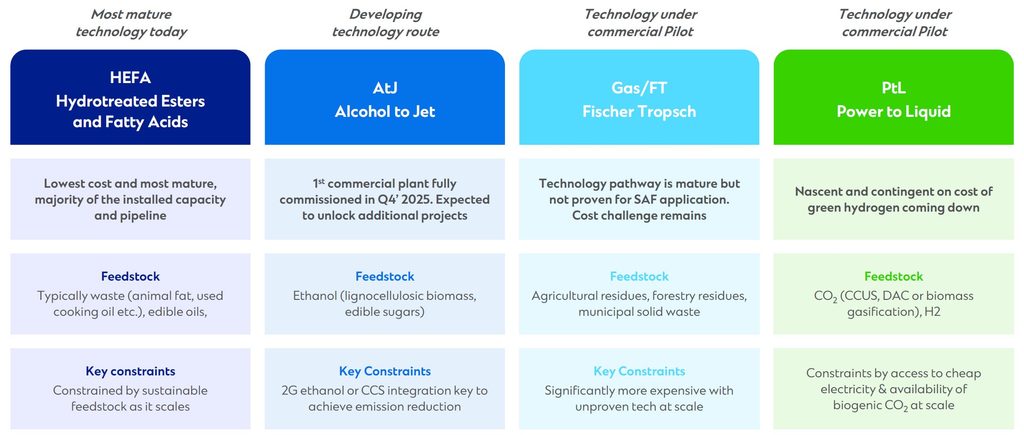
On the supply side, multiple SAF production pathways are emerging, each with different cost, maturity and scalability profiles.
HEFA-based (Hydrotreated Esters and Fatty Acides) SAF remains the most mature and lowest-cost technology today, accounting for the majority of installed capacity and near-term pipeline. Operational learning over the past decade has helped stabilise costs, and margins have begun to recover from the lows seen in mid-2025 as regulatory demand strengthened and market concerns around oversupply eased.
However, HEFA faces structural limits. Sustainable waste-based feedstocks are finite, and competition for these inputs is intensifying across renewable diesel and SAF markets.
Alternative pathways – including Alcohol-to-Jet (AtJ), Fischer-Tropsch (FT) and Power-to-Liquid (PtL) – offer greater long-term scalability but remain at earlier stages of commercialisation. While AtJ projects are beginning to reach initial commercial operations, other routes continue to face higher costs, technology risk and dependence on low-cost clean electricity or green hydrogen.
As a result, capacity can grow – but not quickly or uniformly without targeted support.
Sustainable feedstocks, technology diversification and delivery risks remain material
Beyond production capacity, several structural risks continue to shape investor behaviour.
Feedstock security is a primary concern. Access to sustainable, eligible inputs remains one of the largest risks for new projects, particularly as eligibility rules tighten and competition increases. Technology risk also varies significantly by pathway, with less mature routes facing higher uncertainty at scale but remain a key solver for feedstock constraints.
Capital delivery risk cannot be ignored. SAF projects are large, complex industrial developments, exposed to construction, commissioning and operational risks similar to those seen in refining and chemicals. These risks directly influence both cost of capital and financing availability.
Capital is available, but selectively deployed for adequately structured deals
Despite these challenges, capital appetite for SAF exists. Dedicated transition-focused funds have grown rapidly, and strategic investors continue to evaluate opportunities across the value chain.
However, financing is increasingly selective. Investors and lenders are prioritising projects with credible demand visibility, supportive policy frameworks, defensible feedstock strategies and realistic cost trajectories. Debt financing is available, but typically requires de-risked structures – including contracted offtake, policy support, blended finance or balance-sheet backing.
In this environment, scaling SAF is less about finding capital, and more about structuring projects in a way that aligns risk, return and transition objectives.
What will accelerate SAF scale-up?
Three factors are critical to accelerating SAF deployment:
- Durable policy frameworks that reduce long term demand uncertainty and narrows the cost gap over time.
- Clear technology and feedstock strategies that balance near-term deployment with long-term scalability.
- Financing structures suited to transition realities, rather than treating SAF as a fully mature market and an infrastructure asset from day one.
Progress is being made across all three, but alignment remains uneven.
From insight to execution: financing SAF at scale
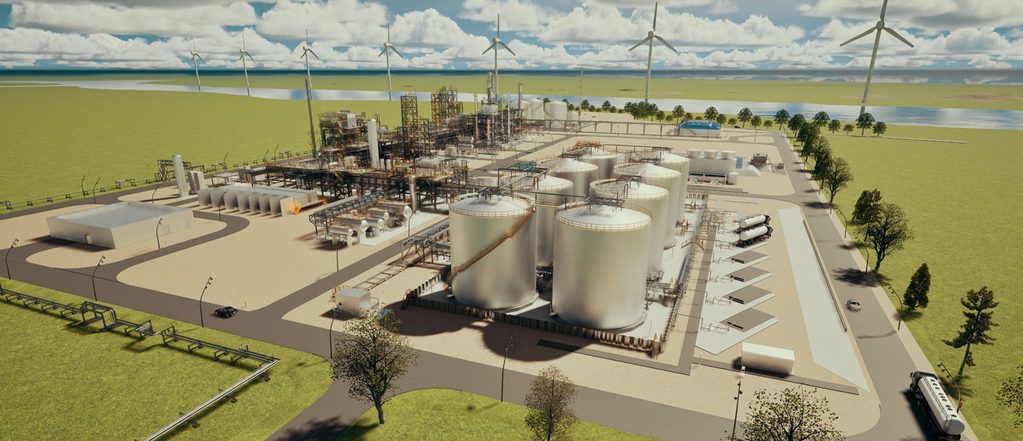
Turning SAF ambition into operational capacity requires financing structures that recognise both the transition imperative and the risks inherent in an emerging sector. This is where transition finance moves from theory to execution.
Standard Chartered recently supported the development of a sustainable aviation fuel production facility in Delfzijl, the Netherlands for DSL-01 B.V., a wholly owned subsidiary of SkyNRG. The Bank acted as Mandated Lead Arranger, Original Lender and Original Hedge Counterparty, deploying its balance sheet to support a complex greenfield asset.
Structuring predictability and risk allocation were critical here. The project is underpinned by an Offtake Agreement with KLM Royal Dutch Airlines to take 75 per cent of the production as the primary off-taker, providing long-term revenue visibility and strengthening the bankability of the facility. The SAF plant is expected to produce 100,000 tonnes of sustainable aviation fuel per year when operations begin in the second half of 2028.
“From a project finance perspective, this transaction brings together the key elements required to finance SAF at scale. Long-term predictable revenue through an offtake agreement with a major airline, experienced infrastructure sponsors, and alignment with European regulatory frameworks combine to create a robust and efficient structure. It shows how thoughtful risk allocation can turn an emerging technology into a bankable asset class,” says James Richards, Executive Director, Infrastructure & Development Finance, Europe at Standard Chartered.
The transaction also reflects the broader role that transition finance can play in convening stakeholders across the value chain.
Ben Daly, Global Head of Transition Finance at Standard Chartered notes, “SAF is a key near-term solution for aviation decarbonisation, and transactions like this demonstrate how finance can bring together producers and airlines to create investable solutions that meet both climate objectives and commercial requirements.”
Together, the deal illustrates how SAF projects can attract capital when policy frameworks, technology pathways and financing structures are aligned – offering a repeatable model for scaling production as the market matures.
"This transaction marks Standard Chartered’s first financing of a sustainable aviation fuel production facility and reflects our commitment to supporting the transition of hard-to-abate sectors."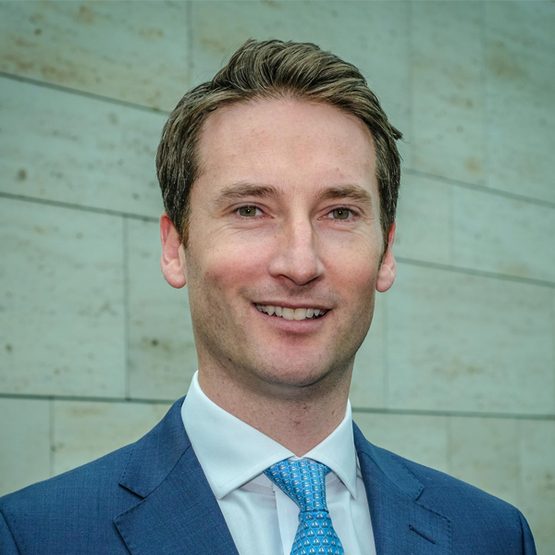 Ben DalyGlobal Head of Transition Finance, Standard Chartered
Enabling scale through transition finance
Scaling SAF sits squarely within the broader transition finance challenge: financing assets that are essential to decarbonisation, but not yet fully competitive on a standalone basis.
This requires more than capital. It requires advisory capabilities that help project sponsors, airlines and investors navigate policy frameworks, assess technology and delivery risks, structure offtake arrangements and design financing solutions that can evolve as the sector matures.
At Standard Chartered, transition finance focuses on supporting clients across hard-to-abate sectors to move from ambition to execution – through pragmatic, financeable transition pathways. In SAF, that means helping align policy, technology and capital to enable scale at the pace required to deliver meaningful emissions reduction.
Explore more insights
India’s energy transition: what corporates say
What Indian corporates say about net zero, capital constraints and the role of sustainable finance — and what it…
Standard Chartered has an important role to play in supporting our clients, sectors and markets to deliver net zero, but to do so in a manner that supports livelihoods and promotes sustainable economic growth. We currently provide financial services to clients, sectors and markets that contribute to greenhouse gas emissions however we’re committed to net zero in our own operations by 2025 and in our financed emissions by 2050.