-

Corporate & Investment Banking
Getting you ready for ISO 20022
Let us help prepare your data, systems and processes for the transition.

Adopting ISO 20022
ISO 20022 is a global, open messaging standard that brings richer data to payments. Swift and major payment infrastructures are adopting it for cross-border and domestic payments, with timelines and requirements varying by market, infrastructure, message type and client channel.
There are implications to corporates and financial institutions, which will need to assess the impact on their data, systems and payment processes to prepare for upcoming requirements. We’re here to help you navigate the transition.
Impact to you and your organisation
The impact of ISO 20022 will vary depending on your role, systems, and payment flows, but there are common considerations for both corporate and financial institutions.
How Standard Chartered can help
ISO 20022 is an industry-wide change, but successful implementation depends on practical preparation. Standard Chartered combines ISO 20022 expertise with deep market experience across Asia, Africa, and the Middle East to help you to prepare with confidence.
Guidance
Access practical guidance on ISO 20022 requirements and key milestones.
Testing
Validate payment and reporting formats ahead of industry deadlines to identify issues early and support a smoother transition.
Connectivity
Connect through Straight2Bank, APIs and host-to-host channels to support ISO 20022 payment and reporting workflows.
Expertise
Access support from teams across Asia, Africa and the Middle East with experience helping clients navigate local requirements and market developments.
Hear from us
In our ISO 20022 Made Simple podcast series, we invite industry experts to dive deep into how this game-changing messaging standard is revolutionising payments, risk management and more. Subscribe wherever you get your podcasts to keep up with our latest episodes.
Episode 8
Siemens getting focused and intelligent with data
Is real-time data making treasury more intelligent, or simply more hectic?
Treasury Management International’s Eleanor Hill is joined by Gherri D’Innocenzo from Siemens Treasury and Aysara Yusupova, Europe Head for Digital Channel Solutions, to explore how treasurers can harness real-time data to support better decision-making, rather than generating more distraction than insight.
Drawing on Siemens’ experience of implementing ISO 20022 across 80 countries, the discussion examines how richer, more structured data can help address long-standing challenges such as inconsistent bank reporting, while improving reconciliation, cash application, liquidity management and overall cash visibility.
Episode 7
Unlocking the Full Value of ISO 20022 at Inchcape
How corporates can turn the transition to ISO 20022 into a strategic advantage.
In this episode, Treasury Management International’s Eleanor Hill sits down with Hannisel Obedicen and Suki Teh from Inchcape, and Jessica Fon, Executive Director for Payments and Treasury Solutions, to explore how corporates can turn the transition to ISO 20022 into a strategic advantage.
They discuss why ISO 20022 is far more than a payments messaging upgrade, how it is enabling organisations to unlock richer data, streamline reconciliation, strengthen automation, and gain greater visibility over cash flows.
Listen on Spotify and Apple for practical insights from the front line and how forward-looking treasurers are using the migration to enhance efficiency, improve reporting, and create lasting value across the finance function.
Episode 6
What does ISO 20022 mean for Banks and Corporates?
Impact of the ISO 20022 transition on corporate and bank clients.
In this episode, Danielle Johnson, Head of International Payments and Market Management at Westpac, joins Vibhor Narang, Executive Director for Structured Solutions in Cash Management and Danielle Sharpe, Head of Global Clearing Product, both at Standard Chartered, to discuss the impact of the ISO 20022 transition on corporate and bank clients.
They explore how multinational corporations and financial institutions are utilising ISO 20022 to revolutionise their operations, highlighting both the opportunities and challenges involved.
Tune in to the video podcast here or listen on Spotify and Apple.
Episode 5
What ISO 20022 means for people, not just systems
How will ISO 20022 affect teams, roles and skills across financial institutions?
As the financial industry shifts toward ISO 20022, the transformation isn’t just technical — it’s human. This episode examines how banks and financial institutions are preparing their people to thrive in a new messaging paradigm. From product managers to compliance officers, from technology teams to operations leads, ISO 20022 is shaping the next generation of roles, skills, and team structures.
We explore how organisations are upskilling staff, rethinking cross-functional collaboration, and building the human foundation required to unlock the full potential of structured data and enriched payment flows. This episode is a timely and necessary look at the people behind the pipes — the professionals who will translate ISO strategy into real-world impact.
Tune in to the video podcast here or listen on Spotify and Apple.
Episode 4
Global standard, regional realities
Why does ISO 20022 adoption vary across markets and regions?
Join us in this insightful episode as we delve into the global implementation and adaptation of ISO 20022, the international standard for electronic data interchange between financial institutions. Our expert guests, Joanne Fraser and Camilla Bullock, provide a comprehensive analysis of how different regions are embracing this transformative standard.
Tune in to the video podcast here or listen on Spotify and Apple.
Episode 3
Navigating the ISO 20022 Migration
What does an ISO 20022 migration involve, and how should organisations prepare?
ISO 20022 isn’t just a messaging standard. It’s a catalyst for unlocking value across the payments ecosystem. In this episode, we zoom in on the practical realities of migration. We explore what exactly is migrating and when, break down key timelines and resource considerations, and discuss the common challenges banks face-from technical integration to operational disruptions. We will also look at the surprises that have emerged along the way, share insights on how banks are adapting, and highlight tools and strategies that can help institutions navigate the journey more smoothly.
Tune in to the video podcast here, or listen on Spotify and Apple.
Episode 2
Artificial Intelligence X ISO 20022 = A Perfect Match?
How Artificial Intelligence (AI) can enhance the efficiency and accuracy of ISO 20022 message processing.
Can AI unlock the full potential of ISO 20022? This episode focuses on how Artificial Intelligence (AI) can enhance the efficiency and accuracy of ISO 20022 message processing. Our speakers will deep dive on specific AI applications and discuss the potential ethical concerns and regulatory implications. We will also look at the emerging AI-driven technologies and innovations.
Tune in to the video podcast here, or listen on Spotify and Apple.
Episode 1
Enhanced Data = Enhanced Risk Management
How can richer ISO 20022 data support compliance, sanctions screening and financial crime prevention?
The future of financial crime prevention starts with better data. This episode delves into how ISO 20022’s richer data formats and standardised messages can improve compliance, risk management in correspondent banking flows. We cover the benefits which makes the process more effective, as well as sanctions screening, fraud detection and AML checks.
Read the accompanying article here or tune in to the video podcast here.
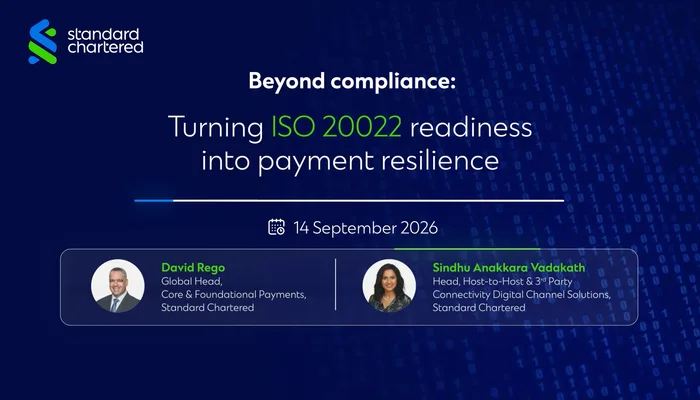
Webinar
Beyond compliance: Turning ISO 20022 readiness into payment resilience
In this webinar, our experts explain what ISO 20022 structured address requirements mean for corporates and financial institutions. Delve into the practical implications across payment data, beneficiary information, operational processes and key payment initiation channels, including Straight2Bank Web, Host-to-Host connectivity and API Banking.
Featured guide

Unlock the value of ISO 20022
ISO 20022 is more than a messaging upgrade; it’s a new language for financial communication that is built on enriched, structured data that drives innovation, enhances compliance, and increases transparency in the payments ecosystem.
This guide will help you navigate the complexities of this transformation to unlock its full value.
FAQs
Useful resources
Whether you’re after technical spec documents or implementation guides, we’ve got you covered.

Whitepaper
Frictionless reconciliation and allocation of cash
Can the adoption of ISO 20022 XML turn this dream into reality?
Read our whitepaper to find out.
Our latest thinking
Our perspectives on global trends, in-market nuances and more
RMB internationalisation 2.0: Where business flows, ecosyste…
As business flows become more global, the renminbi is evolving into a currency that companies can use, hold, hed…
The corridors of global capital: How flows are reshaping glo…
Capital is moving in greater volumes than ever, but technological and geopolitical shifts reshape how it travels…
Shaping a faster, smarter and more resilient treasury
How are ASEAN treasury leaders harnessing AI, digital assets and connected systems to improve decisions, reduce …
Mobilising capital for the EU-India economic corridor
The EU-India FTA could accelerate cross-border growth, but success will depend on how effectively capital is mob…
From digital assets experimentation to execution
Across Greater China and North Asia, regulation, tokenisation and digital money are moving digital assets toward…
Rethinking controls for institutional stablecoin adoption
Standard Chartered's Minli Ng on building stablecoin controls around use cases, risk context and governance.
Treasury’s future: mobility and liquidity
As digital money evolves, the priority is enabling liquidity to move seamlessly across borders, networks and mar…