

Table of Contents
The investment landscape of 2026 so far has been defined by a tug-of-war between structural technological innovation and persistent geopolitical friction, including the escalating tensions in the Middle East. With the Volatility Index (VIX) briefly spiking to nearly 30 in March, the need for diversified investments has never been more critical.
To navigate such complexities, Standard Chartered’s Chief Investment Office has consistently advocated for a ‘barbell strategy’ – a deliberate balance that pairs resilient, defensive equity exposure with high-conviction growth engines to optimise opportunistic returns.
While risk-off sentiment is expected to remain elevated in the near term, our base case anticipates that volatility will mean-revert over time.
Our back-testing shows that, historically, a VIX reading crossing the 30 threshold has proven to be a favourable entry point for long-term investors, with the S&P500 Index delivering an average 12-month return of 15.5% following such spikes.
Consequently, we believe the current environment offers a unique window to take advantage of the heightened volatility, including through put-writing strategies.
Sussing out defensive anchors
In the defensive half of our barbell, we prioritise sectors that offer stable cash flows and capital resilience.
A standout theme is global ex-US buybacks. Share repurchase programmes outside the US are gaining traction as companies prioritise capital returns amid growing uncertainty.
This theme specifically targets companies with a net reduction in shares outstanding of 5% or more over the past year.
These buybacks not only signal management confidence but also help cushion portfolios against volatility by reducing share supply.
The theme is currently skewed towards the financials and energy sectors, which together comprise over 50% of the Invesco International BuyBack Achievers Index.
Complementing the above is a core allocation to US utilities. Underpinned by stable cash flows and essential services across economic cycles, the sector is currently benefiting from the structural tailwind of rising power demand, driven by both AI data centre expansion and the broader electrification trend. The US utilities sector provides a predictable dividend stream and resilience against market swings.
For investors seeking a pragmatic stabiliser, European banks offer a compelling blend of defensiveness and modest growth. Money markets are pricing in at least 50bps of rate hikes from the ECB and BoE by year-end 2026, which will further support European banks’ net interest margins and profitability.
Rounding out our defensive posture is a focus on China non-financial, high-dividend state-owned enterprises (SOEs). These entities offer steady income streams and are backed by government policy support, aligning with policymakers’ push for improved shareholder returns. In a market often characterised by volatility, dividend-rich non-financial Chinese SOEs offer resilience and predictability, especially given their lower exposure to the country’s prolonged property market downturn.
Tapping growth engines to capture the structural upside
The other side of the barbell focuses on capturing the structural trends defining the next decade.
Global semiconductors remain our preferred sub-sector within the broader technology complex. The sector is supported by robust AI-related capex and lower vulnerability to near-term AI disruption risks. With valuations having adjusted sharply since early 2026, the risk-reward for adding exposure has improved significantly.
The US aerospace and defence sector has also emerged as a compelling growth engine. Geopolitical headwinds have driven a renewed upswing in defence spending, exemplified by US President Trump proposing a record USD 1.5trn defence budget for FY2027. The sector offers a dual exposure – military contracts provide a hedge against geopolitical risks, while the commercial aerospace side continues to benefit from post-pandemic travel recovery and fleet modernisation.
Finally, we see long-term opportunity in Hang Seng Technology, which offers exposure to innovative companies poised for recovery and long-term expansion, supported by China’s 15th Five-year Plan. As AI and technology developments continue to evolve alongside potential policy stimulus, we anticipate a further valuation re-rating for major Hong Kong-listed technology leaders.
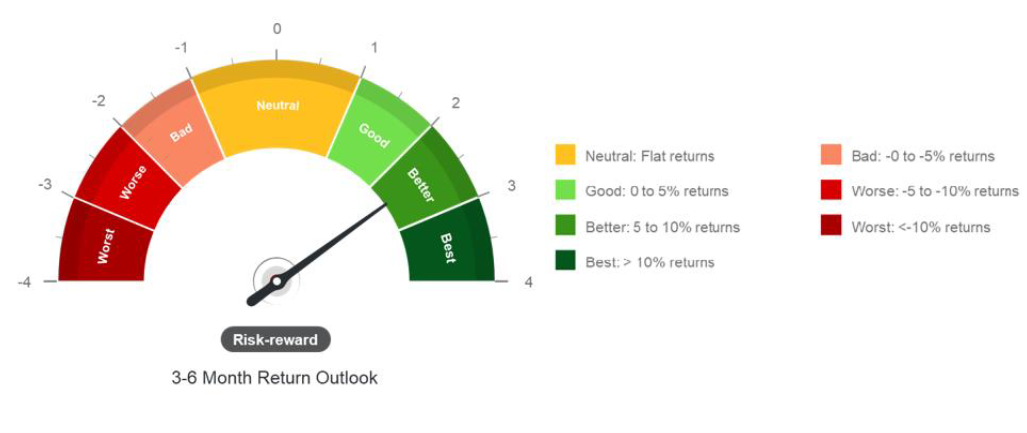
For April 2026, our ‘AI Bubble Meter’ remains unchanged, with the confidence index holding at 2.5, indicating a ‘better’ risk-reward profile for the AI theme over the medium-to-longer term. This implies a potential 3-6-month return outlook of 5-10%, with no evidence of an AI bubble.
Forging a balanced path to capture returns
In times of turbulence, it is tempting to retreat into safety or chase growth at all costs. The path ahead will likely remain choppy, but volatility should be viewed as an opportunity rather than a deterrent.
By employing a barbell strategy – balancing defensive anchors against promising growth engines – investors can participate in structural upside while maintaining a necessary cushion against uncertainty.
This disciplined approach remains our most effective tool for capturing opportunistic returns amid volatility.


Your feedback is valuable to us. Did you find this article helpful?
This article is for general information only and it does not constitute an offer, recommendation or solicitation of an offer to enter into any transaction or adopt any hedging, trading or investment strategy, in relation to any securities or other financial instruments. This article has not been prepared for any particular person or class of persons and does not constitute and should not be construed as investment advice or an investment recommendation. It has been prepared without regard to the specific investment objectives, financial situation or particular needs of any person or class of persons. You should seek advice from a licensed or an exempt financial adviser on the suitability of a product for you, taking into account these factors before making a commitment to purchase any product or invest in an investment. In the event that you choose not to seek advice from a licensed or an exempt financial adviser, you should carefully consider whether the product or service described herein is suitable for you.
You are fully responsible for your investment decision, including whether the investment is suitable for you. The products/services involved are not principal-protected and you may lose all or part of your original investment amount.
Standard Chartered Bank (Singapore) Limited will not accept any responsibility or liability of any kind, with respect to the accuracy or completeness of information in this article.
Deposit Insurance Scheme
Singapore dollar deposits of non-bank depositors are insured by the Singapore Deposit Insurance Corporation, for up to S$100,000 in aggregate per depositor per Scheme member by law. For clarity, these investment products are not deposits and do not qualify as an insured deposit under the Singapore Deposit Insurance and Policy Owners’ Protection Schemes Act 2011. Foreign currency deposits, dual currency investments, structured deposits and other investment products are not insured.
The information stated in this article is accurate as at the date of publication.