This is to inform that by clicking on the hyperlink, you will be
leaving
sc.com/sg
and entering a website operated by other parties.
Such links are only provided on our website for the convenience of
the Client and Standard Chartered Bank does not control or endorse
such websites, and is not responsible for their contents.
The use of such website is also subject to the terms of use and
other terms and guidelines, if any, contained within each such
website. In the event that any of the terms contained herein
conflict with the terms of use or other terms and guidelines
contained within any such website, then the terms of use and other
terms and guidelines for such website shall prevail.
The Role of Blue-Chip and Mid-Cap Stocks in Wealth Creation in Singapore
In a hurry? Read this summary:
Blue-chip stocks anchor portfolios with capital preservation and a stable income through regular dividend payments. These stocks are less susceptible to market fluctuations.
Mid-cap stocks tend to be more volatile than blue-chips, but stable when compared to small-cap stocks. These stocks offer a combination of increased growth potential as well as lower risk levels.
To pick the right stocks for their portfolio, one must factor in their investment objectives, horizon, liquidity preferences, as well as risk profile.
Equity markets offer investors the opportunity for capital appreciation. However, navigating a market—especially in times of volatility—emphasises the importance of striking a balance between stability and growth. Investors can achieve the same via portfolio diversification, by investing in a mix of equities across market segments: blue-chip stocks, mid-cap stocks, and small-cap stocks.
Blue-chip stocks and their enduring relevance
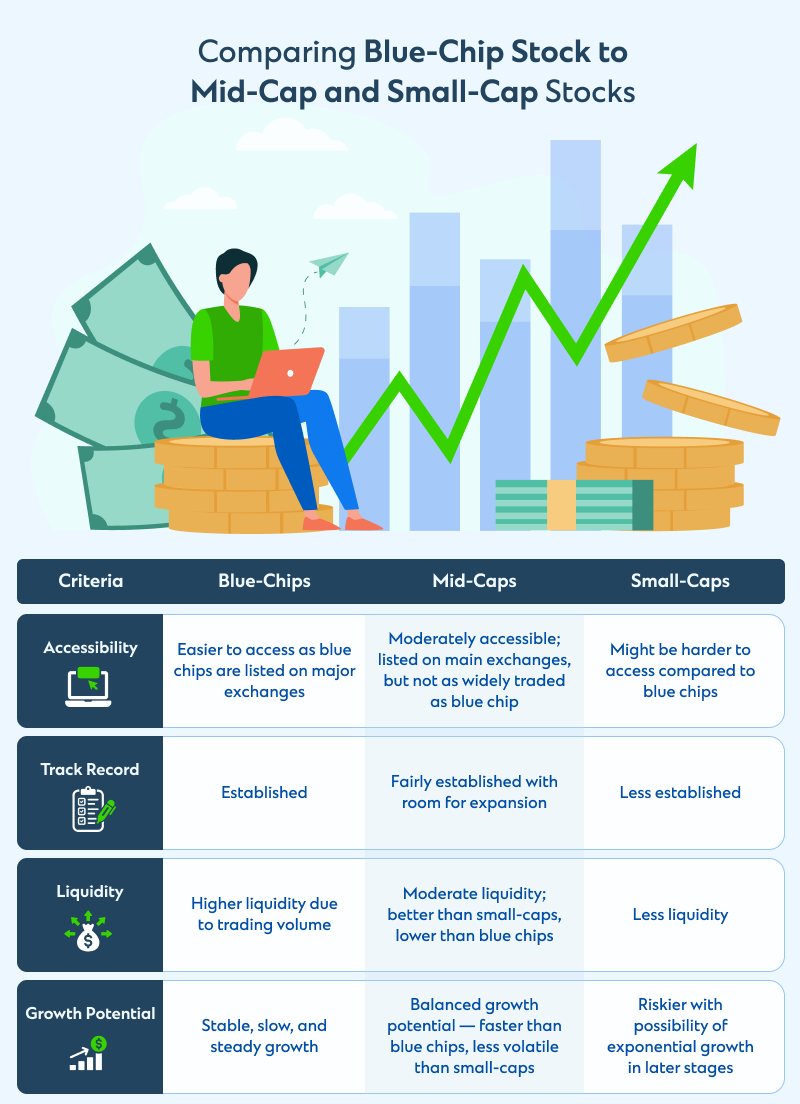
Blue-chip equities (typically large-cap companies with a market capitalisation of SGD 13.01 billion or more) are known for being well-established and stable/reputable because they enjoy a dominant position in their respective industries. These companies typically have a history of delivering consistent and solid returns, as well as an ability to bounce back from market downturns.
Blue-chip stocks, therefore, are suitable for risk-averse investors seeking predictable returns on their investments. Investors with higher levels of risk tolerance benefit from blue-chip stocks in their portfolio, too, as they have the potential to offset volatility and subsequent underperformance from mid- and small-cap stocks in their portfolio. It is important to note, however, there is no guarantee that blue chips can withstand all market downturns. Moreover, while they may provide capital preservation and a stable income, blue-chip stocks may not necessarily be geared towards capital appreciation, unlike small-cap stocks.
In Singapore, blue-chip stocks are listed and tracked on the Straits Times Index (STI). Examples of these include DBS Group Holdings, Singapore Airlines, Singapore Telecommunications, and Mapletree Industrial Trust.
Mid-cap stocks: The middle ground
Mid-cap stocks refer to companies with a market cap of between SGD 2.61 billion and SGD 13.01 billion. Performance with these stocks tends to be more volatile than that of blue-chip stocks, but stable when compared to small-caps. Often referred to as growth stocks, they may not necessarily be industry leaders, but have the potential to transform into them over time. This is because they have more headroom for growth in terms of their share prices, providing for capital appreciation. They can also improve their annual earnings faster than those of large-cap companies, giving shareholders a greater opportunity to receive a stable income via periodic dividends.
Mid-cap stocks’ relatively increased volatility (while it does make them suited to more aggressive investors) also gives one the ability to make long-term investments in them at discounted prices on occasion. This also allows one mid-cap to potentially grow into large-cap equities in the long run.
Small-cap stocks refer to companies with a market capitalisation ranging from SGD 390 million to SGD 2.61 billion; though this criterion may differ across countries and stock exchanges.
Typically, small-cap companies are in early stages of development, and their share prices may potentially grow exponentially in the long run. Investments in them, however, are also usually deemed riskier due to their heightened volatility.
How to choose the right stocks for your portfolio
If you are wondering which stock fits better with your investment objectives, liquidity requirements, risk profile, and investment horizon, consider the following:
Capital appreciation vs preservation
Those who prioritise capital preservation and a stable income through dividends may consider investing in blue-chip stocks, while those who seek growth in the form of capital appreciation in the long run, with relatively lower volatility levels, can invest in mid-cap stocks.
Investor risk profiles
Risk-averse investors such as those nearing retirement usually prefer investing in blue-chip stocks owing to their resilience, and ability to quickly bounce back from market downturns. Mid-cap stocks cater more to investors with a moderate risk profile — individuals willing to accept a certain degree of volatility in exchange for better returns, when compared to blue-chip stocks.
More aggressive investors, such as those just starting out in their careers, can consider investing in small-cap stocks given their longer investment horizon and higher levels of disposable income.
Investment horizon
Blue-chip stocks tend to be favoured by investors looking to grow their money over a long-term period, with consistent returns. However, owing to higher liquidity levels, they are a good fit for short-term investors as well. Mid-cap stocks require a medium-to-long-term investment horizon. This is because performance may fluctuate in the short run. Patient investors can expect growth and stability as these companies mature.
Infographic recommendation:
If you are interested in adding Blue Chip and Mid-Cap stocks into your portfolio, start your account with us at Standard Chartered’s Smart Online Trading Platform.
Your feedback is valuable to us. Did you find this article helpful?
Disclaimer
This article is for general information only and it does not constitute an offer, recommendation or solicitation of an offer to enter into any transaction or adopt any hedging, trading or investment strategy, in relation to any securities or other financial instruments. This article has not been prepared for any particular person or class of persons and does not constitute and should not be construed as investment advice or an investment recommendation. It has been prepared without regard to the specific investment objectives, financial situation or particular needs of any person or class of persons. You should seek advice from a licensed or an exempt financial adviser on the suitability of a product for you, taking into account these factors before making a commitment to purchase any product or invest in an investment. In the event that you choose not to seek advice from a licensed or an exempt financial adviser, you should carefully consider whether the product or service described herein is suitable for you.
You are fully responsible for your investment decision, including whether the investment is suitable for you. The products/services involved are not principal-protected and you may lose all or part of your original investment amount.
Standard Chartered Bank (Singapore) Limited will not accept any responsibility or liability of any kind, with respect to the accuracy or completeness of information in this article.
Deposit Insurance Scheme
Singapore dollar deposits of non-bank depositors are insured by the Singapore Deposit Insurance Corporation, for up to S$100,000 in aggregate per depositor per Scheme member by law. For clarity, these investment products are not deposits and do not qualify as an insured deposit under the Singapore Deposit Insurance and Policy Owners’ Protection Schemes Act 2011. Foreign currency deposits, dual currency investments, structured deposits and other investment products are not insured.
The information stated in this article is accurate as at the date of publication.
Global Market Outlook H2 2025: Positioning for a weak dollar
We are Overweight global equities. Policy easing worldwide, strong chances of a US soft landing and a weaker USD are supportive of risky assets. We favour diversified global equity exposure, within which we upgrade Asia ex-Japan equities to Overweight.